This comprehensive analysis compares UNI and GRT, two leading DeFi governance tokens, examining their investment characteristics across multiple dimensions. UNI, the Uniswap protocol's governance token, currently trades at $5.49 with a market cap ranking 37th, while GRT operates The Graph's data indexing infrastructure at $0.0425. The article evaluates historical price trends since 2021, tokenomics structures, institutional adoption patterns, and technical ecosystems. It provides price forecasts through 2031, ranging from $2.92-$6.33 for UNI and $0.033-$0.045 for GRT in 2026. Investment strategies, risk assessments, and comparative value propositions help readers understand which token suits their objectives. Whether seeking DEX infrastructure exposure or blockchain data services exposure, investors gain data-driven context for evaluating both assets on Gate.
Introduction: Investment Analysis of UNI - Value, Price Prediction and Risk Assessment
In the cryptocurrency market, Uniswap (UNI) has emerged as a significant protocol since its launch in 2020. As the first automatic market-making transaction protocol built on the Ethereum blockchain, UNI has garnered attention for its role in decentralized exchange infrastructure.
UNI Token: Launched in September 2020, UNI serves as the governance token for the Uniswap protocol, representing a decentralized approach to liquidity provision and trading.
As of January 2026, UNI ranks 37th by market capitalization with a current price of $5.485. The token has experienced notable price fluctuations, with a circulating supply of approximately 634.68 million tokens out of a maximum supply of 1 billion tokens.
This article will examine UNI's investment characteristics through multiple dimensions including historical price trends, supply mechanism, market performance, and technical ecosystem. Key areas of analysis include:
Price volatility patterns and market cycles
Token distribution and circulation dynamics
Protocol adoption and trading volume metrics
Technical infrastructure and ecosystem development
The analysis aims to provide objective data and context for understanding UNI's position in the decentralized finance landscape, without making specific investment recommendations.
I. Historical Price Comparison and Current Market Status
UNI and GRT Historical Price Trends
-
2021: UNI experienced significant price movement during the DeFi boom, with its price reaching a peak of $44.92 in May 2021. This represented a period of strong growth for decentralized exchange protocols.
-
2021: GRT saw substantial appreciation during the same period, reaching its all-time high of $2.84 in February 2021, driven by increased demand for blockchain data indexing services.
-
Comparative Analysis: During the 2021-2026 market cycle, UNI declined from its high of $44.92 to approximately $5.49, representing a significant correction. Meanwhile, GRT experienced a more pronounced decline, falling from $2.84 to around $0.04, reflecting different market dynamics and adoption patterns for data indexing protocols versus decentralized exchanges.
Current Market Situation (2026-01-13)
- UNI Current Price: $5.485
- GRT Current Price: $0.04251
- 24-Hour Trading Volume: UNI recorded $1,483,095.08 compared to GRT's $132,535.10
- Market Sentiment Index (Fear & Greed Index): 26 (Fear)
View real-time prices:
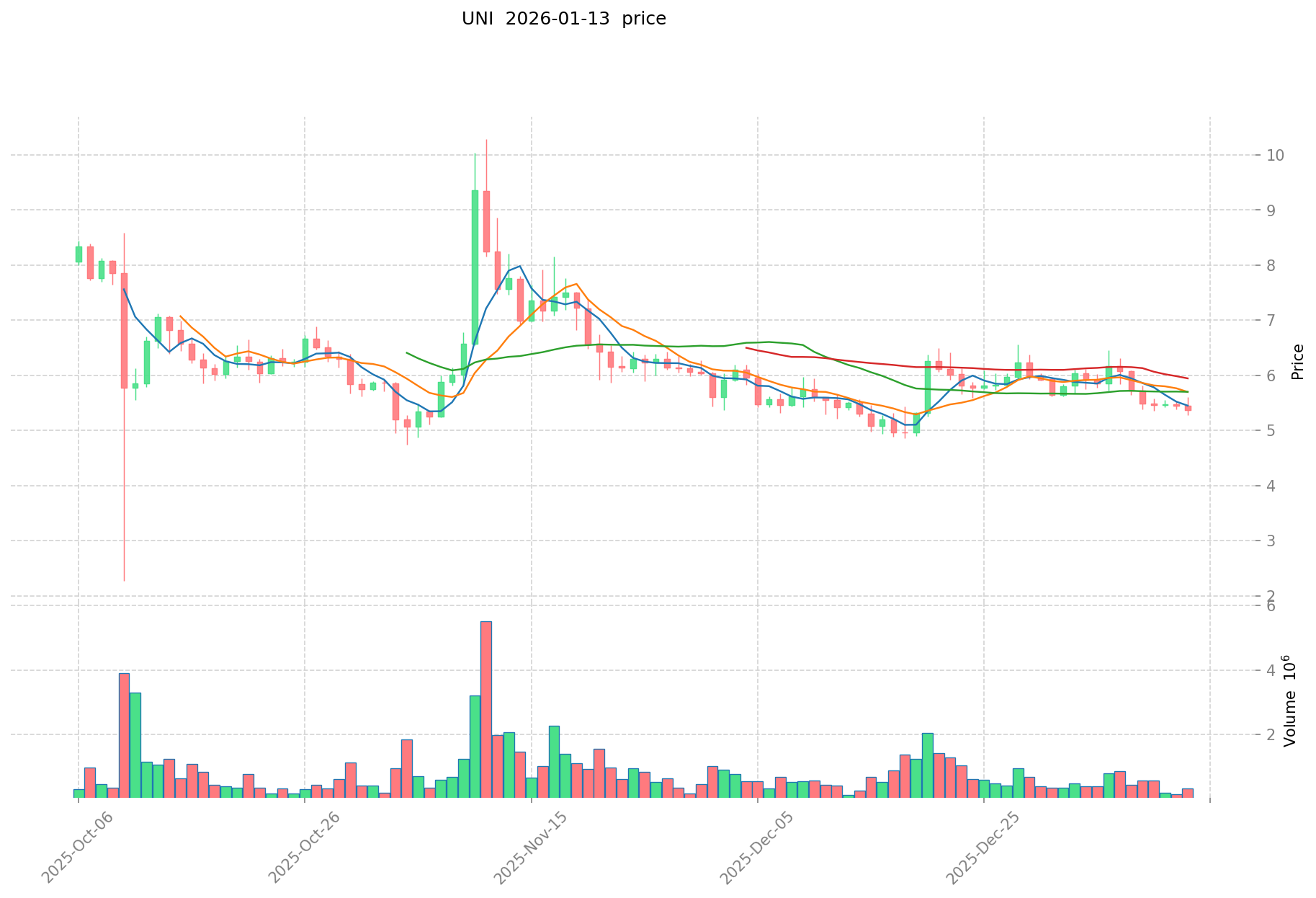
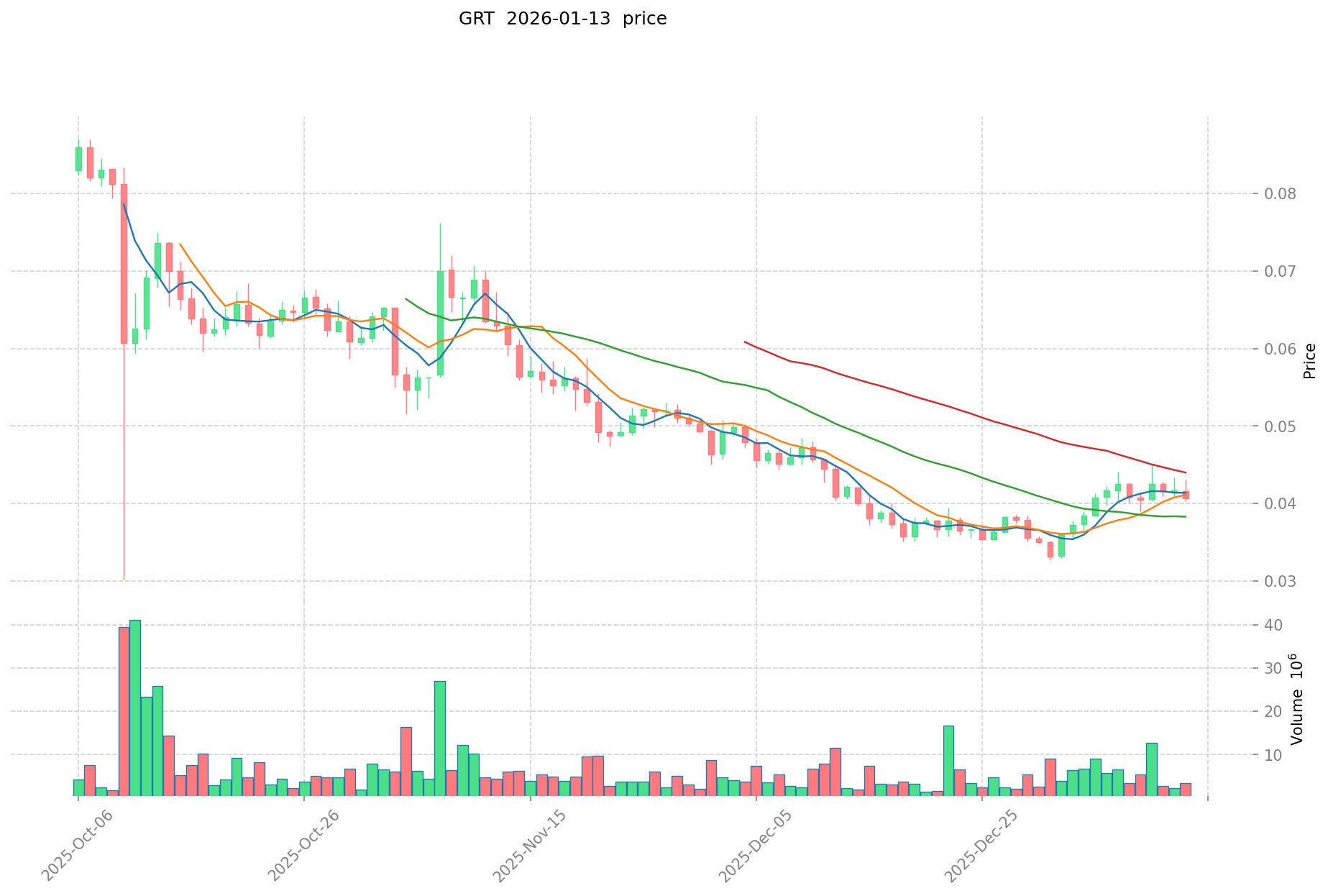
II. Core Factors Influencing Investment Value: UNI vs GRT
Tokenomics and Supply Mechanism Comparison
-
UNI: The governance token features a fixed total supply model. According to reference materials, UNI's design reflects certain structural characteristics where token holders primarily realize returns through price appreciation rather than direct income generation from governance functions. The initial token distribution allocates stakes to relevant parties who can monetize their holdings primarily through price increases.
-
GRT: The token's value prospect is influenced by its supply mechanism and market acceptance level. Research indicates that supply dynamics play a significant role in shaping GRT's investment characteristics, though specific mechanisms require evaluation based on historical price patterns and adoption metrics.
-
📌 Historical Pattern: Supply mechanisms have demonstrated influence on price cycle dynamics, with different tokenomic structures potentially leading to varying value capture patterns over market cycles.
Institutional Adoption and Market Application
-
Institutional Holdings: Evaluation of institutional preference requires analysis of historical adoption patterns. Research suggests that institutional adoption represents a key assessment factor when comparing these assets.
-
Enterprise Adoption: The practical application scenarios differ between UNI and GRT. UNI's governance-focused model contrasts with other tokens that may feature more direct economic utility mechanisms such as fee distribution or revenue sharing.
-
Regulatory Landscape: Policy considerations represent an important evaluation dimension, though specific national positions vary and continue to evolve across different jurisdictions.
Technical Development and Ecosystem Building
-
UNI Technical Framework: The platform operates with a governance mechanism where token holders participate in decision-making processes. Reference materials note that UNI's governance function does not directly generate income for holders, representing a key technical characteristic of its design.
-
GRT Technical Evolution: The Graph's technical development focuses on its core indexing and querying infrastructure. The project's evolution depends on continued market acceptance and technical implementation success.
-
Ecosystem Comparison: Value capture mechanisms vary significantly between projects. Materials indicate that tokens with actual economic functions (such as dividend distribution or fee sharing) demonstrate different characteristics compared to governance-only tokens like UNI. For governance tokens, value realization often depends on DAO control over cash flows or system parameters.
Macroeconomic Factors and Market Cycles
-
Inflation Environment Performance: The comparative performance of digital assets under different inflation scenarios depends on multiple factors including market liquidity conditions and broader monetary policy environments.
-
Macroeconomic Monetary Policy: Interest rate movements and currency index fluctuations represent external factors that may influence digital asset valuations, though specific impacts vary based on market conditions and investor sentiment.
-
Geopolitical Considerations: Cross-border transaction demand and international developments may affect adoption patterns, though the specific impact on individual tokens depends on their use cases and market positioning.
III. 2026-2031 Price Forecast: UNI vs GRT
Short-term Forecast (2026)
- UNI: Conservative $2.92-$5.51 | Optimistic $5.51-$6.33
- GRT: Conservative $0.033-$0.043 | Optimistic $0.043-$0.045
Mid-term Forecast (2028-2029)
- UNI may enter a consolidation phase with projected price range of $5.40-$8.67 in 2028, potentially reaching $5.76-$8.44 by 2029
- GRT may experience gradual growth with estimated price range of $0.044-$0.064 in 2028, advancing to $0.056-$0.066 in 2029
- Key drivers: institutional capital inflows, ETF developments, ecosystem expansion
Long-term Forecast (2030-2031)
- UNI: Baseline scenario $6.77-$8.16 (2030) | Optimistic scenario $9.88-$13.92 (2031)
- GRT: Baseline scenario $0.034-$0.062 (2030) | Optimistic scenario $0.048-$0.100 (2031)
View detailed price predictions for UNI and GRT
Disclaimer
UNI:
| Year |
Predicted High Price |
Predicted Average Price |
Predicted Low Price |
Price Change |
| 2026 |
6.33305 |
5.507 |
2.91871 |
0 |
| 2027 |
8.288035 |
5.920025 |
3.13761325 |
7 |
| 2028 |
8.6669166 |
7.10403 |
5.3990628 |
29 |
| 2029 |
8.437456431 |
7.8854733 |
5.756395509 |
43 |
| 2030 |
11.58928010901 |
8.1614648655 |
6.774015838365 |
48 |
| 2031 |
13.92427520702955 |
9.875372487255 |
5.925223492353 |
80 |
GRT:
| Year |
Predicted High Price |
Predicted Average Price |
Predicted Low Price |
Price Change |
| 2026 |
0.0451984 |
0.04264 |
0.0328328 |
0 |
| 2027 |
0.060169304 |
0.0439192 |
0.040405664 |
3 |
| 2028 |
0.06401442996 |
0.052044252 |
0.0442376142 |
22 |
| 2029 |
0.0661534487172 |
0.05802934098 |
0.0562884607506 |
36 |
| 2030 |
0.08692795278804 |
0.0620913948486 |
0.033529353218244 |
46 |
| 2031 |
0.099842962916548 |
0.07450967381832 |
0.048431287981908 |
75 |
IV. Investment Strategy Comparison: UNI vs GRT
Long-term vs Short-term Investment Strategies
-
UNI: May appeal to investors focused on decentralized exchange infrastructure and governance participation. The token's value proposition centers on the Uniswap protocol's role in the DeFi ecosystem, with potential value capture through governance influence over protocol parameters and development direction.
-
GRT: May suit investors interested in blockchain data infrastructure and indexing services. The token's investment case relates to the demand for data querying services across blockchain networks, with value dynamics tied to network adoption and query volume growth.
-
Time Horizon Considerations: Historical data suggests both tokens have experienced significant price volatility. Short-term strategies require attention to market sentiment indicators and trading volume patterns, while longer-term approaches depend on ecosystem development trajectories and adoption metrics.
Risk Management and Asset Allocation
-
Conservative Allocation Approach: A risk-averse strategy might consider limited exposure to both assets, with potential allocation weighting based on market capitalization, liquidity depth, and historical volatility patterns. UNI's relatively higher market capitalization and trading volume may represent different risk-return characteristics compared to GRT.
-
Growth-Oriented Allocation: Investors with higher risk tolerance might adjust position sizing based on conviction in specific use cases. UNI's established position in decentralized exchange infrastructure contrasts with GRT's specialized focus on data indexing services.
-
Hedging Instruments: Risk management approaches may incorporate stablecoin reserves for capital preservation, derivative instruments where available, and diversification across multiple protocol tokens with different value drivers.
V. Potential Risk Comparison
Market Risk
-
UNI: The token faces market risks associated with decentralized exchange adoption patterns, competition from alternative DEX protocols, and overall DeFi sector sentiment. Historical price data shows significant drawdowns during market correction phases, with the token declining from peak levels during the 2021-2026 period.
-
GRT: Market risks include adoption rates of data indexing services, competition from alternative infrastructure providers, and dependency on broader blockchain ecosystem growth. Price history indicates substantial volatility, with notable declines from previous cycle peaks.
-
Correlation Factors: Both tokens demonstrate exposure to general cryptocurrency market conditions, with price movements influenced by broader digital asset sentiment, liquidity conditions, and macroeconomic factors.
Technical Risk
-
UNI: Technical considerations include the Ethereum network's scalability characteristics, smart contract security of the Uniswap protocol, and the governance mechanism's effectiveness in implementing protocol upgrades. The platform's reliance on Ethereum infrastructure means it shares certain technical dependencies with the underlying blockchain.
-
GRT: Technical risks relate to the indexing protocol's ability to scale with increasing data demands, network reliability for query services, and the technical complexity of maintaining data infrastructure across multiple blockchain networks.
Regulatory Risk
-
Jurisdictional Variations: Regulatory approaches toward decentralized exchange protocols and data infrastructure services vary across different regions. Both tokens face uncertainty regarding how authorities may classify and regulate their respective functions within the blockchain ecosystem.
-
Compliance Evolution: The regulatory landscape continues to develop, with potential implications for how decentralized protocols operate and how governance tokens function within regulatory frameworks. Different jurisdictions may adopt varying stances on token classification and protocol oversight.
VI. Conclusion: Which Is the Better Buy?
📌 Investment Value Summary:
-
UNI Characteristics: The token represents exposure to decentralized exchange infrastructure with an established market position. Key characteristics include governance participation rights, correlation with DeFi sector performance, and dependence on trading volume through the Uniswap protocol. The governance-focused model means value capture occurs primarily through potential appreciation rather than direct income generation.
-
GRT Characteristics: The token provides exposure to blockchain data indexing infrastructure with a specialized use case. Notable aspects include its role in data querying services, dependency on multi-chain ecosystem growth, and market positioning in the infrastructure layer of blockchain technology.
✅ Investment Considerations:
-
Entry-Level Participants: Those new to digital assets might prioritize understanding the fundamental differences between governance tokens and utility tokens, evaluating liquidity characteristics, and starting with limited position sizes while building familiarity with market dynamics.
-
Experienced Participants: Investors with market experience may conduct deeper analysis of protocol metrics including trading volumes, governance participation rates, total value locked, and comparative performance across market cycles. Assessment of risk-adjusted returns and portfolio correlation effects represents important analytical dimensions.
-
Institutional Participants: Professional investors might evaluate factors including market depth for position building, custody solutions, regulatory classification considerations, and how these assets fit within broader digital asset allocation frameworks. Due diligence on protocol security, governance structures, and competitive positioning represents standard assessment practice.
⚠️ Risk Disclosure: The cryptocurrency market exhibits high volatility. This content provides informational analysis and does not constitute investment advice. Market participants should conduct independent research and consider their individual circumstances before making allocation decisions.
VII. FAQ
Q1: What is the fundamental difference between UNI and GRT tokens?
UNI is a governance token for the Uniswap decentralized exchange protocol, while GRT is a utility token for The Graph's blockchain data indexing services. UNI provides holders with voting rights on protocol parameters and development decisions, with value realization primarily through price appreciation rather than direct income generation. In contrast, GRT serves as the economic mechanism within The Graph network, facilitating payment for data querying and indexing services across multiple blockchain networks.
Q2: How have UNI and GRT performed since their market peaks?
Both tokens have experienced significant corrections from their all-time highs. UNI declined from $44.92 in May 2021 to approximately $5.49 as of January 2026, representing a substantial drawdown. GRT experienced a more pronounced decline, falling from $2.84 in February 2021 to around $0.04251, reflecting different market dynamics between decentralized exchange protocols and data infrastructure services. These price movements illustrate the high volatility characteristic of the cryptocurrency market.
Q3: What are the projected price ranges for UNI and GRT through 2031?
Short-term forecasts for 2026 project UNI in the range of $2.92-$6.33, while GRT is estimated between $0.033-$0.045. By 2031, optimistic scenarios suggest UNI could reach $9.88-$13.92, with GRT potentially ranging from $0.048-$0.100. These projections depend on multiple factors including institutional adoption, ecosystem expansion, and overall market conditions. It's important to note that cryptocurrency price predictions carry significant uncertainty and should not be relied upon as guarantees of future performance.
Q4: What are the primary risks associated with investing in UNI versus GRT?
UNI faces market risks related to DEX adoption patterns, competition from alternative protocols, and dependency on the Ethereum network's scalability. Technical risks include smart contract security and governance mechanism effectiveness. GRT's risks center on adoption rates of data indexing services, competition from alternative infrastructure providers, and the technical complexity of maintaining multi-chain data infrastructure. Both tokens share exposure to regulatory uncertainty, with jurisdictional variations in how authorities classify and regulate decentralized protocols. Additionally, both demonstrate high correlation with broader cryptocurrency market sentiment and macroeconomic conditions.
Q5: How should investors approach position sizing between UNI and GRT?
Position sizing should align with individual risk tolerance, investment objectives, and time horizons. Conservative approaches might favor limited exposure with weighting based on market capitalization and liquidity depth—UNI's higher market cap and trading volume may present different risk-return characteristics. Growth-oriented investors might adjust allocations based on conviction in specific use cases: UNI for decentralized exchange infrastructure versus GRT for blockchain data services. Risk management should incorporate diversification across multiple protocol tokens, potential hedging instruments, and maintaining stablecoin reserves for capital preservation. Independent research and consideration of personal circumstances remain essential before making allocation decisions.
Q6: What role does tokenomics play in the investment case for UNI and GRT?
Tokenomics significantly influences value capture mechanisms for both assets. UNI features a fixed total supply of 1 billion tokens with approximately 634.68 million in circulation, designed primarily as a governance token where value realization occurs through price appreciation rather than direct income generation. The token's structure differs from protocols offering dividend distribution or fee sharing mechanisms. GRT's tokenomics relate to its supply mechanism and role within The Graph's economic model for data indexing services. Understanding these structural differences is crucial for evaluating long-term value propositions, as tokens with actual economic utility functions may demonstrate different value capture patterns compared to governance-only tokens during market cycles.
* The information is not intended to be and does not constitute financial advice or any other recommendation of any sort offered or endorsed by Gate.