This article provides a comprehensive investment comparison between USDC, a dollar-pegged stablecoin launched in 2018, and IMX, a utility token powering Immutable X Layer 2 protocol. The analysis covers historical price trends showing USDC maintaining $1.00 stability versus IMX's volatility from $9.52 peak to $0.2637 current price. It examines tokenomics, institutional adoption, technological ecosystems, and macroeconomic factors influencing both assets. The content addresses investor pain points through detailed risk assessment, portfolio allocation strategies ranging from conservative (80-90% USDC) to aggressive (70-80% IMX), and 2026-2031 price projections. Readers gain clarity on which asset suits their investment profile—USDC for capital preservation and DeFi participation, IMX for NFT infrastructure growth exposure. Featuring real-time Gate price data and comprehensive FAQ addressing fundamental differences, regulatory risks, and macroeconomic impacts.
Introduction: Investment Comparison Between USDC and IMX
In the cryptocurrency market, the comparison between USDC vs IMX remains a topic that investors cannot avoid. The two assets demonstrate significant differences not only in market cap ranking, application scenarios, and price performance but also represent distinct positioning within the crypto ecosystem.
USDC (USD Coin): Launched in September 2018, this fully collateralized stablecoin has gained market recognition through its operational transparency and regulatory compliance framework. As a dollar-pegged digital asset, USDC serves as a critical medium for transactions and liquidity provision across multiple blockchain networks.
IMX (Immutable): Since its launch, IMX has positioned itself as a utility token powering the Immutable X protocol, a Layer 2 scaling solution for NFTs on Ethereum. The token facilitates network activities including trading, liquidity provision, and application development within the NFT ecosystem.
This article will comprehensively analyze the investment value comparison between USDC vs IMX, covering historical price trends, supply mechanisms, institutional adoption, technological ecosystems, and future projections. We aim to address the question most pertinent to investors:
"Which is the better buy right now?"
I. Historical Price Comparison and Current Market Status
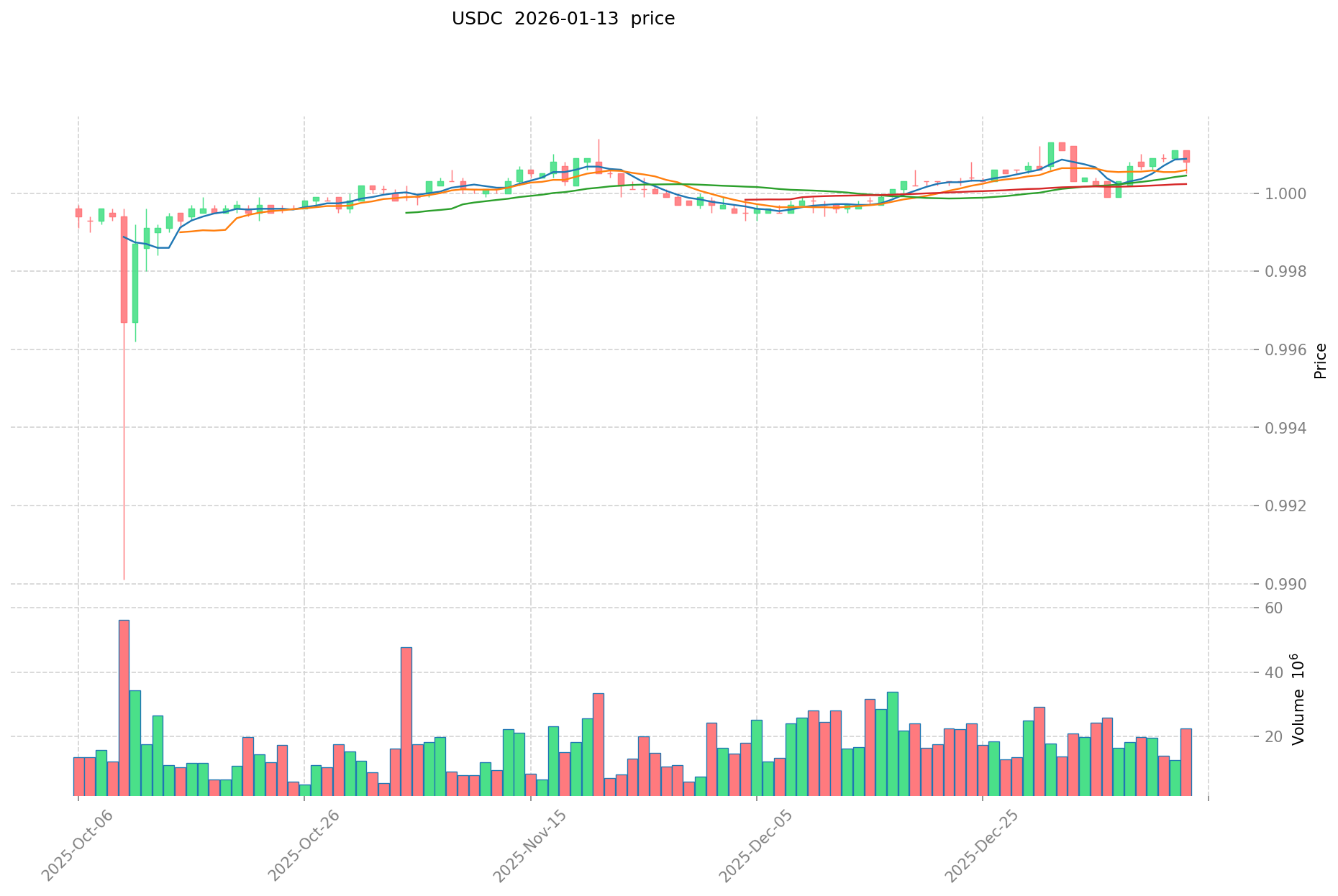
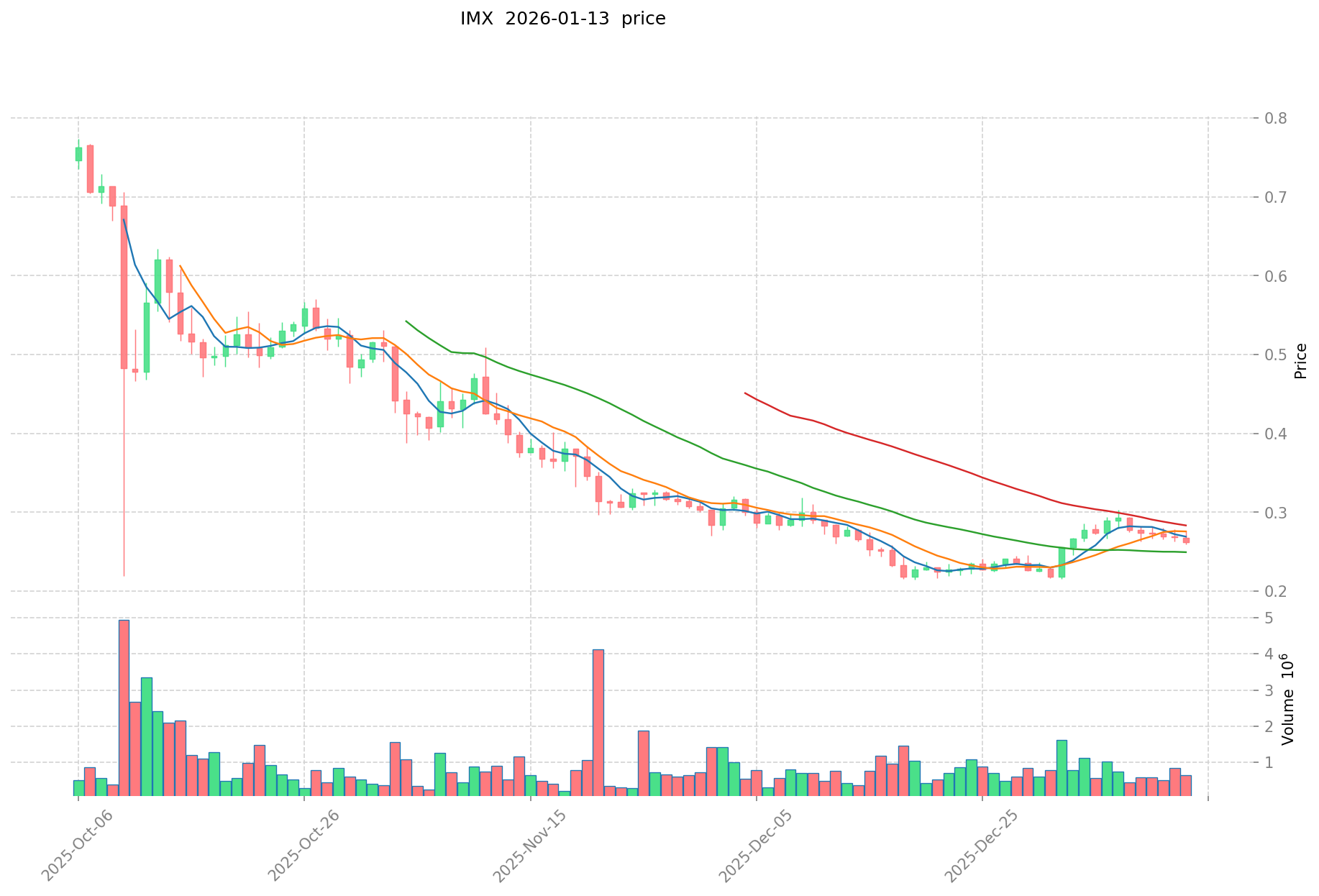
USDC (Coin A) and IMX (Coin B) Historical Price Trends
- 2019: USDC reached a historical high of $1.17 on May 8, 2019, driven by early adoption and market demand for stablecoins.
- 2021: IMX reached an all-time high of $9.52 on November 26, 2021, influenced by growing interest in NFT infrastructure and Layer 2 solutions.
- Comparative Analysis: During market cycles, USDC has maintained relative stability as a stablecoin pegged 1:1 to the US dollar, with minor fluctuations between $0.88 (historical low on March 11, 2023) and $1.17. In contrast, IMX experienced significant volatility, declining from its peak of $9.52 to a historical low of $0.215226 on December 19, 2025, representing a substantial correction from its all-time high.
Current Market Status (January 13, 2026)
- USDC Current Price: $1.00
- IMX Current Price: $0.2637
- 24-Hour Trading Volume: USDC $23,891,205.88 vs IMX $163,463.30
- Fear & Greed Index: 26 (Fear)
View Real-Time Prices:
II. Core Factors Influencing USDC vs IMX Investment Value
Supply Mechanism Comparison (Tokenomics)
-
USDC: As a stablecoin pegged to the US dollar, USDC maintains a 1:1 reserve backing mechanism. Each USDC token is supported by equivalent US dollar reserves or approved assets, with supply adjusting dynamically based on market demand through minting and redemption processes.
-
IMX: The token supply mechanism for IMX follows a predetermined distribution model designed to support the Immutable X ecosystem. The tokenomics structure aims to incentivize network participants while maintaining scarcity through controlled release schedules.
-
📌 Historical patterns indicate that supply mechanisms can influence price cycles through market liquidity dynamics and holder behavior patterns.
Institutional Adoption and Market Application
-
Institutional Holdings: USDC has gained traction among institutional investors seeking stable value storage and settlement mechanisms within digital asset operations. IMX has attracted attention from entities focused on NFT infrastructure and blockchain gaming sectors.
-
Enterprise Adoption: USDC serves primarily in cross-border payments, trading settlements, and as collateral in DeFi protocols. IMX finds applications within NFT marketplaces and blockchain-based gaming platforms, addressing scalability challenges.
-
Regulatory Landscape: Different jurisdictions have varying approaches to stablecoin regulation and layer-2 scaling solutions. Regulatory frameworks continue to evolve, potentially impacting both assets differently based on their classification and use cases.
Technology Development and Ecosystem Building
-
USDC Technical Infrastructure: The stablecoin operates across multiple blockchain networks, with ongoing efforts to expand interoperability and settlement efficiency. Technical developments focus on transparency in reserve attestations and cross-chain functionality.
-
IMX Technology Evolution: According to available information, Immutable X addresses Ethereum's limitations including scalability constraints and user experience challenges. The platform emphasizes instant transactions and enhanced scalability features.
-
Ecosystem Comparison: USDC integrates extensively within DeFi protocols, centralized exchanges, and payment systems. IMX concentrates on NFT marketplace infrastructure and gaming applications, with development focused on reducing transaction costs and improving throughput.
Macroeconomic Factors and Market Cycles
-
Performance in Inflationary Environments: USDC maintains dollar parity by design, offering stability rather than inflation protection. IMX, as a utility token, may experience volatility influenced by broader market sentiment and adoption metrics.
-
Monetary Policy Impact: Interest rate changes and US dollar index fluctuations directly affect USDC's competitive positioning against yield-bearing alternatives. IMX valuations may respond to liquidity conditions and risk appetite in digital asset markets.
-
Geopolitical Considerations: Cross-border transaction demand and international regulatory developments can influence both assets. USDC benefits from increased demand for dollar-denominated settlements, while IMX adoption depends on global expansion of NFT and gaming ecosystems.
III. 2026-2031 Price Prediction: USDC vs IMX
Short-term Prediction (2026)
- USDC: Conservative $1.00 | Optimistic $1.00
- IMX: Conservative $0.2276 - $0.2646 | Optimistic $0.2646 - $0.2752
Mid-term Prediction (2028-2029)
- USDC may maintain stable market positioning, with projected price range around $1.00
- IMX may enter growth phase, with projected price range between $0.2125 - $0.4757
- Key drivers: institutional capital inflows, ETF developments, ecosystem expansion
Long-term Prediction (2030-2031)
- USDC: Baseline scenario $1.00 | Optimistic scenario $1.00
- IMX: Baseline scenario $0.3333 - $0.4445 | Optimistic scenario $0.4773 - $0.5155
View detailed price predictions for USDC and IMX
Disclaimer
USDC:
| Year |
Predicted High Price |
Predicted Average Price |
Predicted Low Price |
Price Change |
| 2026 |
1 |
1 |
1 |
0 |
| 2027 |
1 |
1 |
1 |
0 |
| 2028 |
1 |
1 |
1 |
0 |
| 2029 |
1 |
1 |
1 |
0 |
| 2030 |
1 |
1 |
1 |
0 |
| 2031 |
1 |
1 |
1 |
0 |
IMX:
| Year |
Predicted High Price |
Predicted Average Price |
Predicted Low Price |
Price Change |
| 2026 |
0.275184 |
0.2646 |
0.227556 |
0 |
| 2027 |
0.3643542 |
0.269892 |
0.19432224 |
2 |
| 2028 |
0.377376489 |
0.3171231 |
0.212472477 |
20 |
| 2029 |
0.475732218465 |
0.3472497945 |
0.33335980272 |
31 |
| 2030 |
0.4773295675197 |
0.4114910064825 |
0.333307715250825 |
56 |
| 2031 |
0.515515932921276 |
0.4444102870011 |
0.391081052560968 |
68 |
IV. Investment Strategy Comparison: USDC vs IMX
Long-term vs Short-term Investment Strategies
-
USDC: Suitable for investors prioritizing capital preservation, requiring stable value storage for trading operations, or seeking a reliable medium for DeFi protocol participation. The asset functions primarily as a transaction facilitator rather than a speculative investment vehicle.
-
IMX: Suitable for investors focused on NFT infrastructure growth potential, blockchain gaming ecosystem expansion, and willing to accept higher volatility in exchange for possible appreciation tied to Layer 2 adoption trends.
Risk Management and Asset Allocation
-
Conservative Investors: USDC 80-90% vs IMX 10-20%
- Emphasis on capital stability with limited exposure to volatile assets
- USDC provides liquidity and stability while IMX offers measured growth potential
-
Aggressive Investors: USDC 20-30% vs IMX 70-80%
- Higher allocation toward utility tokens with ecosystem development prospects
- USDC maintains emergency liquidity and rebalancing flexibility
-
Hedging Instruments: Stablecoin allocation for volatility buffering, options strategies for downside protection, cross-asset portfolio diversification across different blockchain ecosystems
V. Potential Risk Comparison
Market Risk
-
USDC: Exposure to reserve composition changes, competitive pressure from alternative stablecoins, and liquidity demand fluctuations during market stress periods. Historical de-pegging events, such as the March 2023 incident, demonstrate vulnerability to banking sector developments.
-
IMX: Subject to broader NFT market sentiment shifts, competition from alternative Layer 2 solutions, and dependency on gaming sector adoption rates. Price volatility remains considerable, with historical drawdowns exceeding 95% from peak levels.
Technology Risk
-
USDC: Multi-chain deployment introduces smart contract vulnerabilities across different blockchain environments. Operational dependencies on reserve custodians and attestation processes create systemic risk factors.
-
IMX: Layer 2 scaling solutions face technical challenges including network stability during high-demand periods, potential security vulnerabilities in bridging mechanisms, and dependencies on Ethereum base layer performance.
Regulatory Risk
- Global regulatory frameworks continue evolving with different implications for stablecoins versus utility tokens. USDC faces increasing scrutiny regarding reserve transparency, banking relationships, and potential classification under securities regulations in various jurisdictions. IMX encounters regulatory uncertainty surrounding NFT marketplace operations, gaming token classifications, and cross-border transaction compliance requirements. Jurisdiction-specific approaches create fragmented regulatory landscapes affecting both assets differently based on their functional characteristics.
VI. Conclusion: Which Is the Better Buy?
📌 Investment Value Summary:
-
USDC Advantages: Maintains dollar parity design, offers high liquidity across multiple platforms, serves critical infrastructure role in digital asset operations, benefits from transparent reserve attestations, and provides stability during volatile market conditions.
-
IMX Advantages: Addresses scalability challenges in NFT ecosystems, positioned within growing blockchain gaming sector, offers utility within Immutable X protocol operations, and provides exposure to Layer 2 infrastructure development trends.
✅ Investment Recommendations:
-
Novice Investors: Consider prioritizing USDC for stability and familiarity with dollar-denominated value, while maintaining minimal IMX exposure only after understanding volatility characteristics and ecosystem fundamentals.
-
Experienced Investors: Evaluate portfolio allocation based on risk tolerance and market outlook. USDC serves liquidity management and rebalancing functions, while IMX allocation depends on conviction regarding NFT infrastructure growth and tolerance for drawdown periods.
-
Institutional Investors: Assess USDC for treasury management, settlement operations, and collateral requirements. IMX allocation requires due diligence on ecosystem development metrics, competitive positioning analysis, and regulatory compliance frameworks across operational jurisdictions.
⚠️ Risk Warning: Cryptocurrency markets exhibit considerable volatility. This content does not constitute investment advice. Conduct independent research and consider personal financial circumstances before making investment decisions.
VII. FAQ
Q1: What is the fundamental difference between USDC and IMX as investment assets?
USDC is a stablecoin designed to maintain a 1:1 peg with the US dollar, functioning primarily as a transaction medium and value storage tool rather than a speculative investment. IMX is a utility token powering the Immutable X Layer 2 protocol, offering exposure to NFT infrastructure growth but with significantly higher volatility. USDC provides capital preservation through dollar-backed reserves and transparent attestations, while IMX derives value from ecosystem adoption, trading activity on NFT marketplaces, and blockchain gaming sector expansion.
Q2: How do the supply mechanisms of USDC and IMX differ?
USDC operates through a dynamic supply mechanism that adjusts based on market demand via minting and redemption processes, with each token backed by equivalent US dollar reserves or approved assets. IMX follows a predetermined distribution model with controlled release schedules designed to incentivize network participants while maintaining scarcity. USDC's supply directly responds to real-time market needs through regulated issuance, whereas IMX's tokenomics structure aims to balance ecosystem incentives with long-term value stability through planned allocation milestones.
Q3: Which asset is more suitable for portfolio risk management?
USDC serves better for conservative risk management strategies, providing stability, high liquidity, and capital preservation during volatile market conditions. It functions effectively as a hedging instrument, emergency liquidity reserve, and portfolio rebalancing tool. IMX suits investors seeking growth exposure within NFT infrastructure and willing to accept substantial volatility—historical data shows drawdowns exceeding 95% from peak levels. Conservative portfolios typically allocate 80-90% to USDC with 10-20% IMX exposure, while aggressive strategies reverse this ratio to 20-30% USDC and 70-80% IMX.
Q4: What regulatory risks differentiate USDC from IMX?
USDC faces increasing regulatory scrutiny regarding reserve transparency, banking relationships, and potential securities classification across various jurisdictions, particularly concerning stablecoin frameworks. The March 2023 de-pegging event highlighted vulnerabilities to banking sector developments and regulatory oversight. IMX encounters regulatory uncertainty surrounding NFT marketplace operations, gaming token classifications, and cross-border compliance requirements. Jurisdiction-specific approaches create fragmented regulatory landscapes, with stablecoins typically subject to financial institution regulations while utility tokens navigate evolving digital asset frameworks.
Q5: How do macroeconomic conditions affect USDC and IMX differently?
USDC maintains dollar parity by design, offering stability rather than inflation protection, with performance directly tied to US dollar strength and monetary policy decisions. Interest rate changes impact USDC's competitive positioning against yield-bearing alternatives. IMX experiences volatility influenced by broader market sentiment, liquidity conditions, and risk appetite in digital asset markets. During inflationary environments, USDC preserves nominal value while potentially losing purchasing power, whereas IMX may experience price fluctuations based on adoption metrics and ecosystem growth independent of traditional inflation dynamics.
Q6: What technological advantages does each asset offer?
USDC provides multi-chain interoperability across numerous blockchain networks, enabling seamless cross-border settlements, DeFi protocol integration, and payment system functionality. Technical infrastructure emphasizes transparency through regular reserve attestations and efficient value transfer mechanisms. IMX addresses Ethereum's scalability constraints through Layer 2 technology, offering instant transactions, reduced gas fees, and enhanced throughput specifically for NFT trading and blockchain gaming applications. While USDC prioritizes universal accessibility and stability, IMX focuses on specialized infrastructure solving specific use-case limitations within digital collectibles ecosystems.
Q7: How should investors approach price prediction differences between USDC and IMX?
USDC price predictions consistently project $1.00 across all timeframes (2026-2031) reflecting its stablecoin design and dollar-pegging mechanism. Investment decisions should focus on liquidity needs, regulatory compliance, and opportunity costs versus yield-bearing alternatives. IMX projections show potential price ranges from $0.2276-$0.2752 (2026) to $0.3333-$0.5155 (2031), indicating growth scenarios tied to NFT infrastructure adoption and ecosystem expansion. Investors should evaluate IMX based on development milestones, competitive positioning, and tolerance for volatility rather than treating price predictions as guaranteed outcomes.
Q8: What institutional adoption patterns distinguish USDC from IMX?
USDC has achieved broad institutional adoption for treasury management, settlement operations, and collateral requirements across centralized exchanges, DeFi protocols, and payment processors. Enterprise use cases span cross-border remittances, trading settlements, and stable value storage within digital asset operations. IMX attracts institutional interest primarily from entities focused on NFT marketplace infrastructure, blockchain gaming platforms, and Layer 2 scaling solutions. Institutional IMX involvement centers on ecosystem development partnerships rather than treasury holdings, reflecting its utility token characteristics versus USDC's role as operational infrastructure for diverse financial activities.
* The information is not intended to be and does not constitute financial advice or any other recommendation of any sort offered or endorsed by Gate.