This comprehensive guide compares USDE and NEAR, two distinct crypto assets serving different investment purposes. USDE, a synthetic stablecoin launched in 2023, maintains price stability through Delta Neutral hedging of staked Ethereum, generating yields suitable for capital preservation. NEAR, a Layer-1 blockchain protocol launched in 2020, focuses on mobile decentralized applications with higher volatility and appreciation potential. The article analyzes historical price performance, tokenomics, institutional adoption across major exchanges and DeFi protocols, technical ecosystems, and five-year price forecasts through 2031. Investment recommendations differentiate by risk tolerance: conservative investors should allocate 70% USDE and 30% NEAR for stability, while aggressive investors may reverse allocation for growth exposure. Comprehensive risk analysis covers market volatility, technical vulnerabilities, and regulatory uncertainties, concluding that USDE suits capital preservation while NEAR offers grow
Introduction: Investment Comparison Between USDE and NEAR
In the cryptocurrency market, the comparison between USDE vs NEAR has consistently been a topic that investors cannot overlook. Both demonstrate notable differences in market cap rankings, application scenarios, and price performance, representing distinct positioning within the crypto asset landscape.
USDe (USDE): Launched in 2023, it has gained market recognition through its positioning as a censorship-resistant, scalable, and stable crypto-native synthetic dollar solution, achieved by delta-hedging staked Ethereum collateral.
NEAR (NEAR): Since its inception in 2020, it has been positioned as a highly scalable blockchain protocol designed to support decentralized applications on mobile devices, providing developers with critical infrastructure for building mobile blockchain DApps.
This article will comprehensively analyze the investment value comparison between USDE vs NEAR, focusing on historical price trends, supply mechanisms, institutional adoption, technical ecosystems, and future predictions, attempting to answer the question investors care about most:
"Which is the better buy right now?"
I. Historical Price Comparison and Current Market Status
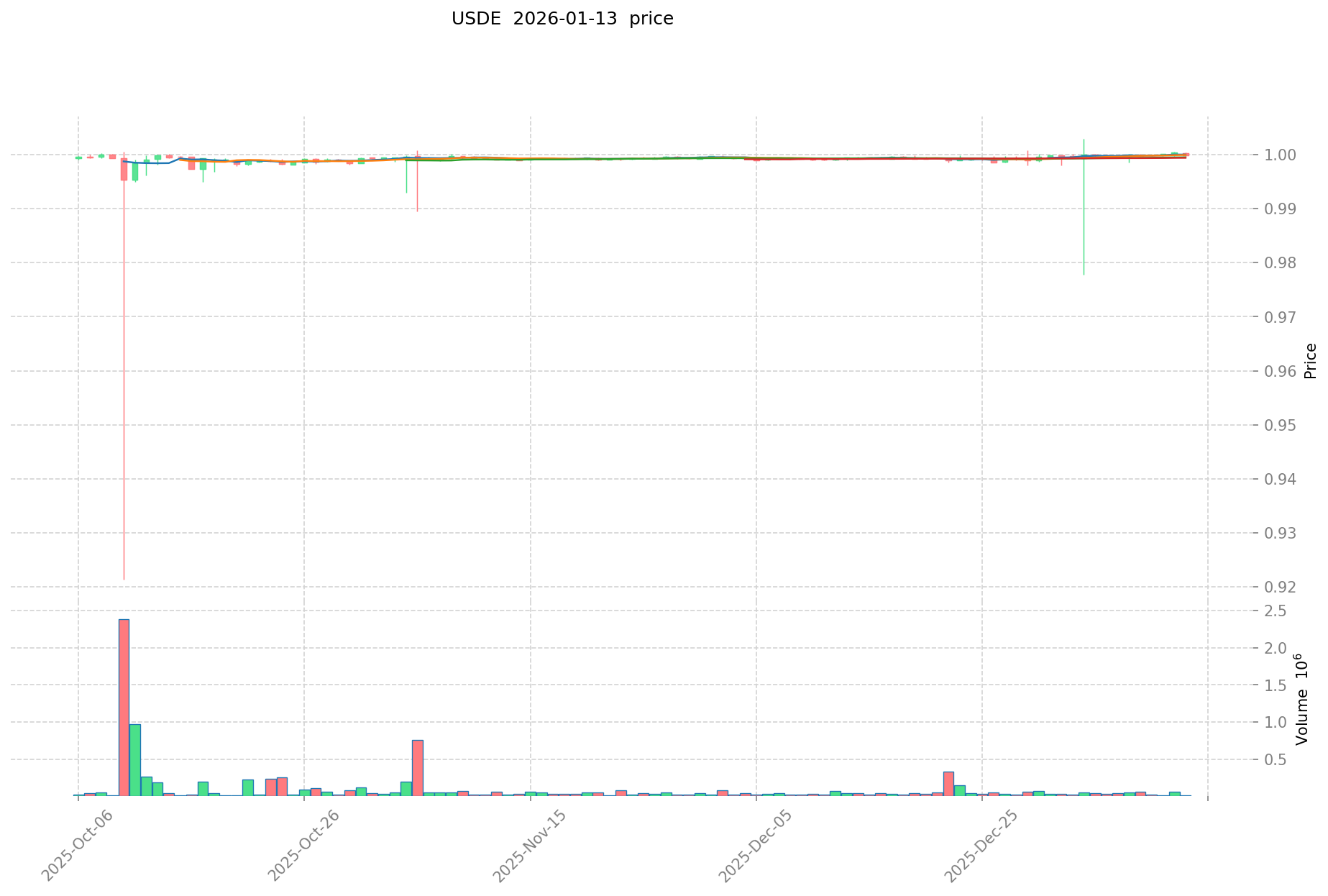
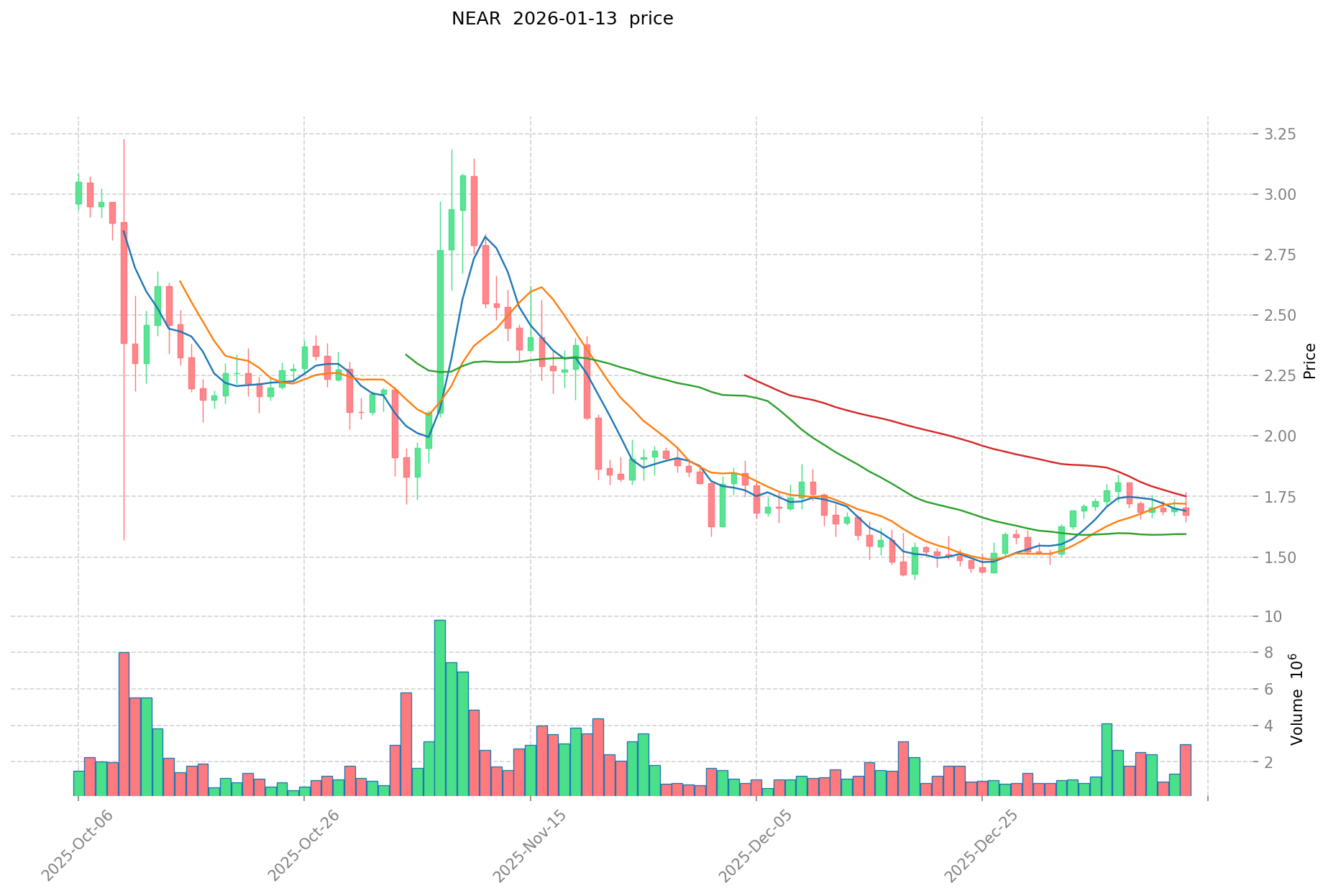
USDE (Ethena USDe) and NEAR (Near Protocol) Historical Price Trends
- 2024: USDE reached its all-time high of $1.5 in November 2024, reflecting strong market demand during a period of stablecoin adoption growth.
- 2022: NEAR Protocol achieved its all-time high of $20.44 in January 2022, driven by significant ecosystem expansion and developer activity on the platform.
- 2025: USDE experienced its all-time low of $0.9213 in October 2025, while NEAR faced downward pressure reaching $0.526762 in November 2020 during early-stage market discovery.
- Comparative Analysis: During the 2024-2025 market cycle, USDE maintained relative stability with limited volatility between $0.9213 and $1.5, consistent with its synthetic dollar design. In contrast, NEAR demonstrated higher volatility, declining from its peak of $20.44 to current levels near $1.76, reflecting broader market corrections and competitive pressures in the Layer-1 blockchain space.
Current Market Status (January 13, 2026)
- USDE Current Price: $0.9999
- NEAR Current Price: $1.7618
- 24-Hour Trading Volume: USDE recorded $15.04 million compared to NEAR's $5.16 billion in trading activity
- Market Capitalization: USDE stands at $6.38 billion (ranking #24) while NEAR maintains $2.26 billion (ranking #47)
- Market Sentiment Index (Fear & Greed Index): 26 (Fear)
View real-time prices:
II. Core Factors Influencing USDE vs NEAR Investment Value
Supply Mechanism Comparison (Tokenomics)
-
USDE: USDe employs a collateral-backed mechanism where users deposit crypto assets (such as stETH) at a 1:1 ratio to mint USDe stablecoins. The protocol utilizes a Delta Neutral strategy, combining Ethereum staking yields with perpetual contract funding rates to generate returns. This model does not rely on traditional fiat reserves, maintaining stability through market-neutral hedging strategies.
-
NEAR: Information regarding NEAR's specific supply mechanism was not found in the reference materials.
-
📌 Historical Pattern: USDe's supply mechanism is designed to maintain price stability through hedging strategies rather than driving price cycles. Its yield generation depends on market leverage demand and staking returns, which may fluctuate with market conditions but does not inherently create supply-driven price volatility.
Institutional Adoption & Market Application
-
Institutional Holdings: Reference materials indicate that major exchanges like Bybit have integrated USDe, allowing it to serve as collateral for perpetual futures trading and participate in spot trading pairs. USDe can also be used in earning programs and new token mining activities, demonstrating growing institutional adoption.
-
Enterprise Adoption: USDe has been integrated into various DeFi protocols for lending (Morpho, Aave), liquidity mining (Curve), and yield tokenization (Pendle). The stablecoin serves multiple functions including trading collateral and yield generation within decentralized finance ecosystems.
-
Regulatory Landscape: The reference materials did not provide specific information comparing regulatory attitudes toward USDE and NEAR across different jurisdictions.
Technical Development & Ecosystem Construction
-
USDE Technical Framework: USDe operates on Ethereum and utilizes smart contracts for collateral management and yield distribution. The protocol employs off-exchange settlement (OES) custody solutions with third-party custodians providing regular audit reports. The technical infrastructure includes integration with centralized exchanges for funding rate arbitrage and on-chain staking mechanisms.
-
NEAR Technical Development: Specific information about NEAR's technical development was not available in the provided materials.
-
Ecosystem Comparison: USDe demonstrates integration across DeFi lending platforms, DEX liquidity pools, and yield optimization protocols. The stablecoin participates in multiple ecosystem applications including Curve's stablecoin pools, Aave lending markets, and Pendle's yield tokenization system. USDe holders can stake their tokens to receive sUSDe, which generates yields from both staking rewards and funding rates.
Macroeconomic Environment & Market Cycles
-
Performance in Inflationary Conditions: USDe maintains a 1:1 peg to the US dollar through Delta Neutral strategies rather than serving as an inflation hedge. Its value proposition centers on yield generation rather than inflation protection.
-
Monetary Policy Impact: USDe's yield generation mechanism is sensitive to market conditions affecting funding rates and staking returns. During bullish market periods, increased leverage demand typically drives higher funding rates, potentially increasing USDe yields. Conversely, bearish conditions or negative funding rate scenarios may reduce returns or require reserve fund utilization.
-
Geopolitical Factors: The reference materials did not provide specific analysis of how geopolitical factors or cross-border transaction demands distinctly impact USDE versus NEAR.
III. 2026-2031 Price Forecast: USDE vs NEAR
Short-term Forecast (2026)
- USDE: Conservative $0.91-$1.00 | Optimistic $1.00-$1.14
- NEAR: Conservative $1.45-$1.76 | Optimistic $1.76-$1.97
Mid-term Forecast (2028-2029)
- USDE may enter a gradual expansion phase, with estimated price range of $1.07-$2.18
- NEAR may enter a moderate growth phase, with estimated price range of $1.75-$2.81
- Key drivers: institutional capital inflows, ETF developments, ecosystem expansion
Long-term Forecast (2030-2031)
- USDE: Baseline scenario $1.10-$1.87 | Optimistic scenario $1.81-$2.62
- NEAR: Baseline scenario $1.45-$2.60 | Optimistic scenario $1.49-$3.03
View detailed price predictions for USDE and NEAR
Disclaimer
USDE:
| Year |
Predicted High Price |
Predicted Average Price |
Predicted Low Price |
Price Change |
| 2026 |
1.139886 |
0.9999 |
0.909909 |
0 |
| 2027 |
1.56204378 |
1.069893 |
0.86661333 |
7 |
| 2028 |
1.8028766943 |
1.31596839 |
1.0659343959 |
31 |
| 2029 |
2.18319155901 |
1.55942254215 |
0.8888708490255 |
55 |
| 2030 |
2.2829946017076 |
1.87130705058 |
1.1040711598422 |
87 |
| 2031 |
2.617210040941188 |
2.0771508261438 |
1.807121218745106 |
107 |
NEAR:
| Year |
Predicted High Price |
Predicted Average Price |
Predicted Low Price |
Price Change |
| 2026 |
1.974 |
1.7625 |
1.44525 |
0 |
| 2027 |
2.204535 |
1.86825 |
1.083585 |
6 |
| 2028 |
2.72876595 |
2.0363925 |
1.75129755 |
15 |
| 2029 |
2.8114434855 |
2.382579225 |
2.21579867925 |
35 |
| 2030 |
2.90865271788 |
2.59701135525 |
1.45432635894 |
47 |
| 2031 |
3.0281152402215 |
2.752832036565 |
1.4865292997451 |
56 |
IV. Investment Strategy Comparison: USDE vs NEAR
Long-term vs Short-term Investment Strategies
-
USDE: Suitable for investors seeking stable yield generation and capital preservation. The stablecoin's Delta Neutral hedging mechanism and yield generation from staking rewards make it appropriate for conservative investors prioritizing consistent returns over capital appreciation. Short-term holders can benefit from funding rate arbitrage opportunities, while long-term holders may accumulate yields through sUSDe staking programs integrated across DeFi platforms.
-
NEAR: Suitable for investors with higher risk tolerance seeking capital appreciation through blockchain infrastructure growth. The protocol's focus on mobile decentralized applications and developer ecosystem expansion presents opportunities for investors willing to accept volatility in exchange for potential upside. Short-term traders may capitalize on price fluctuations driven by ecosystem developments, while long-term investors may benefit from network adoption and utility expansion.
Risk Management and Asset Allocation
-
Conservative Investors: USDE 70% vs NEAR 30% - This allocation prioritizes capital preservation through stablecoin exposure while maintaining limited growth potential through blockchain protocol exposure.
-
Aggressive Investors: USDE 30% vs NEAR 70% - This allocation emphasizes growth potential through higher NEAR exposure while maintaining liquidity and stability through USDE holdings for tactical rebalancing opportunities.
-
Hedging Tools: Stablecoin allocation through USDE provides natural hedging against crypto market volatility. Portfolio diversification across different asset categories (synthetic stablecoins vs Layer-1 protocols) offers risk mitigation. Integration with DeFi lending platforms enables collateralized borrowing for additional hedging strategies.
V. Potential Risk Comparison
Market Risks
-
USDE: Primary market risks include funding rate volatility affecting yield generation, liquidity risks during extreme market conditions, and depegging scenarios if Delta Neutral strategies fail to maintain price stability. Market leverage reduction during bearish periods may compress yields and reduce stablecoin attractiveness. Competitive pressure from traditional stablecoins and alternative synthetic dollar solutions may impact adoption and market positioning.
-
NEAR: Market risks encompass significant price volatility characteristic of Layer-1 blockchain protocols, with historical evidence showing substantial drawdowns from peak valuations. Competition from established blockchain platforms and emerging Layer-1 solutions presents ongoing market share challenges. Trading volume fluctuations and liquidity variations may impact price discovery and execution quality for larger positions.
Technical Risks
-
USDE: Technical risks involve smart contract vulnerabilities in collateral management systems, dependency on third-party custody solutions for off-exchange settlement, and execution risks in maintaining Delta Neutral positions across multiple venues. Oracle dependencies for price feeds and yield calculations present potential failure points. Integration complexities with multiple DeFi protocols may introduce systemic risks during market stress events.
-
NEAR: Specific technical risk information for NEAR Protocol was not available in the provided materials, preventing detailed analysis of scalability challenges, network stability considerations, or potential security vulnerabilities inherent to the protocol architecture.
Regulatory Risks
-
Regulatory uncertainty surrounding synthetic stablecoins may impact USDE's operational framework, particularly regarding classification as securities or regulated financial instruments in various jurisdictions. Evolving stablecoin regulations globally could impose reserve requirements or operational restrictions affecting the Delta Neutral hedging model.
-
Blockchain protocol regulations may affect NEAR's development trajectory and adoption patterns, particularly in jurisdictions implementing strict crypto asset frameworks. Cross-border transaction regulations and data privacy requirements for decentralized applications may influence ecosystem growth.
-
Divergent regulatory approaches across major markets create compliance complexity for both assets, with potential impacts on institutional adoption, exchange listings, and integration capabilities within traditional financial infrastructure.
VI. Conclusion: Which Is the Better Buy?
📌 Investment Value Summary:
-
USDE Advantages: Provides capital stability through synthetic dollar design with yield generation capabilities from staking and funding rates. Demonstrates growing institutional adoption across major exchanges and DeFi protocols. Offers utility as trading collateral and participation in multiple earning strategies. Maintains relatively low volatility suitable for risk-averse positioning within crypto portfolios.
-
NEAR Advantages: Represents exposure to blockchain infrastructure development with focus on mobile decentralized applications. Historical performance indicates potential for significant capital appreciation during favorable market cycles. Provides diversification benefits as Layer-1 protocol distinct from Ethereum-based assets.
✅ Investment Recommendations:
-
Beginner Investors: Consider USDE allocation for initial crypto exposure, offering stability and yield generation while learning market dynamics. Limited NEAR exposure may provide growth potential without excessive risk concentration.
-
Experienced Investors: Evaluate portfolio allocation based on risk tolerance and market outlook. USDE serves strategic purposes for liquidity management and yield optimization, while NEAR may complement growth-oriented positions contingent on ecosystem development assessment.
-
Institutional Investors: USDE integration across DeFi infrastructure and exchange adoption presents opportunities for treasury management and collateral optimization. NEAR evaluation requires thorough due diligence regarding protocol fundamentals and competitive positioning within the Layer-1 landscape.
⚠️ Risk Disclosure: Cryptocurrency markets exhibit high volatility and substantial risk of capital loss. This content does not constitute investment advice, financial guidance, or recommendations for specific investment actions. Investors should conduct independent research and consult qualified financial advisors before making investment decisions.
VII. FAQ
Q1: What is the fundamental difference between USDE and NEAR as crypto assets?
USDE is a synthetic stablecoin designed to maintain a 1:1 peg with the US dollar, while NEAR is a Layer-1 blockchain protocol token with significant price volatility. USDE operates as a censorship-resistant, scalable synthetic dollar solution that generates yields through delta-hedging staked Ethereum collateral and perpetual contract funding rates. Its primary purpose is capital preservation with yield generation, maintaining relative price stability between $0.92-$1.50. In contrast, NEAR functions as the native token of a blockchain platform focused on supporting mobile decentralized applications, with its value directly tied to network adoption, developer activity, and ecosystem growth. NEAR has demonstrated substantial volatility, ranging from an all-time high of $20.44 in January 2022 to current levels around $1.76, reflecting typical Layer-1 protocol price dynamics driven by market sentiment and competitive positioning.
Q2: How do the yield generation mechanisms differ between USDE and NEAR?
USDE generates yields through its Delta Neutral hedging strategy combining Ethereum staking rewards with perpetual contract funding rates, while NEAR's return potential primarily derives from token price appreciation. USDE holders can stake their tokens to receive sUSDe, which accumulates yields from both on-chain staking mechanisms and funding rate arbitrage across centralized exchanges. This yield generation is relatively predictable during normal market conditions, though it may fluctuate based on leverage demand and staking returns. The stablecoin's design prioritizes consistent yield generation over capital appreciation. NEAR token holders, however, do not receive automatic yields from holding the asset; instead, returns depend entirely on market-driven price movements influenced by ecosystem developments, network adoption, and broader crypto market cycles, presenting higher risk-reward characteristics.
Q3: Which asset is more suitable for conservative investors seeking capital preservation?
USDE is significantly more appropriate for conservative investors prioritizing capital preservation and stable returns. With its synthetic dollar design maintaining prices near $1.00 through Delta Neutral hedging strategies, USDE provides minimal principal volatility compared to traditional crypto assets. The stablecoin offers yield generation opportunities through staking programs integrated across multiple DeFi platforms, including Morpho, Aave, and Curve, enabling conservative investors to earn returns while maintaining capital stability. Its integration as collateral on major exchanges like Bybit further enhances utility for risk-averse positioning. In contrast, NEAR's historical volatility—declining from $20.44 to current levels near $1.76—demonstrates substantial drawdown risk inappropriate for conservative portfolios. The recommended allocation for conservative investors would be 70% USDE and 30% NEAR, emphasizing capital preservation through stablecoin exposure while maintaining limited growth potential.
Q4: What are the primary risks specific to USDE's operational model?
USDE faces distinct risks related to its Delta Neutral hedging mechanism and dependency on third-party infrastructure. Primary operational risks include funding rate volatility that directly impacts yield generation, particularly during bearish market conditions when negative funding rates may reduce returns or require reserve fund utilization. The stablecoin relies on off-exchange settlement custody solutions with third-party custodians, introducing counterparty risks despite regular audit reports. Smart contract vulnerabilities in collateral management systems present technical risks, while oracle dependencies for price feeds and yield calculations create potential failure points. Depegging scenarios could occur if Delta Neutral strategies fail to maintain price stability during extreme market stress events. Additionally, liquidity risks may emerge during periods of mass redemptions or market dislocations, and evolving regulatory frameworks surrounding synthetic stablecoins could impose operational restrictions affecting the current business model.
Q5: How does institutional adoption compare between USDE and NEAR?
USDE demonstrates stronger documented institutional adoption with concrete integration across major exchanges and DeFi protocols. The stablecoin has been integrated into Bybit as collateral for perpetual futures trading and participates in spot trading pairs, earning programs, and new token mining activities. Within decentralized finance, USDE operates across lending platforms including Morpho and Aave, liquidity mining programs on Curve, and yield tokenization systems through Pendle. This multi-protocol integration indicates growing institutional recognition of USDE's utility for treasury management and collateral optimization. The available reference materials did not provide specific information regarding NEAR's institutional adoption patterns, preventing direct comparison of enterprise integration, custody solutions, or institutional holdings. However, NEAR's focus on mobile decentralized applications and developer infrastructure suggests a different adoption trajectory centered on ecosystem growth rather than institutional treasury applications.
Q6: What market conditions would favor NEAR over USDE for investment returns?
NEAR would likely outperform USDE during bullish crypto market cycles characterized by increased developer activity, ecosystem expansion, and broad Layer-1 protocol adoption. Favorable conditions include positive market sentiment driving capital into blockchain infrastructure projects, successful deployment of mobile decentralized applications on NEAR's platform, and technological developments enhancing the protocol's competitive positioning against established Layer-1 solutions. During such periods, NEAR's potential for capital appreciation would significantly exceed USDE's stable yield generation, as evidenced by historical performance when NEAR reached $20.44 during strong market conditions in January 2022. However, this higher return potential comes with substantially greater downside risk during market corrections. Investors with higher risk tolerance seeking growth exposure and willing to accept volatility would favor NEAR allocation, while those prioritizing capital preservation and consistent yields would maintain USDE positioning regardless of market conditions.
Q7: How do the 2026-2031 price forecasts reflect each asset's risk-return profile?
The price forecasts clearly demonstrate USDE's capital preservation focus versus NEAR's growth potential with associated volatility. USDE forecasts range from conservative estimates of $0.91-$1.00 in 2026 to optimistic long-term projections of $1.81-$2.62 by 2031, representing a maximum potential appreciation of approximately 162% over five years while maintaining downside protection near current levels. This modest growth trajectory aligns with the stablecoin's design emphasizing stability and yield generation rather than capital appreciation. In contrast, NEAR forecasts range from $1.45-$1.76 in 2026 to optimistic projections of $1.49-$3.03 by 2031, reflecting both higher upside potential (approximately 72% maximum growth) and significant downside risk given the wide range between conservative and optimistic scenarios. The forecasts confirm USDE as appropriate for capital preservation strategies, while NEAR suits investors accepting higher volatility for potential appreciation tied to ecosystem development and Layer-1 protocol adoption trends.
Q8: What portfolio allocation strategy optimally balances USDE and NEAR for diversification?
Optimal portfolio allocation between USDE and NEAR depends on individual risk tolerance, investment timeframe, and portfolio objectives. Conservative investors should maintain 70% USDE and 30% NEAR allocation, prioritizing capital preservation through stablecoin exposure while capturing limited growth potential through blockchain protocol exposure. This allocation provides stability during market downturns while participating in potential NEAR appreciation during favorable conditions. Aggressive investors may reverse this allocation to 30% USDE and 70% NEAR, emphasizing growth potential through higher protocol exposure while maintaining liquidity and stability through USDE holdings for tactical rebalancing opportunities. A balanced approach would employ a 50-50 allocation, offering equal exposure to stability and growth characteristics. Regardless of initial allocation, investors should implement regular rebalancing to maintain target weights, particularly after significant price movements in NEAR, and utilize USDE's integration with DeFi lending platforms to generate additional yields while providing collateral for hedging strategies during market volatility.
* The information is not intended to be and does not constitute financial advice or any other recommendation of any sort offered or endorsed by Gate.