This comprehensive guide compares USDP, a dollar-pegged stablecoin backed by Paxos and regulated by New York State, with RUNE, the native token of THORChain's cross-chain protocol. USDP maintains price stability around $1.00 through 1:1 reserve backing, making it ideal for capital preservation and transaction settlement. RUNE exhibits significant volatility, currently trading at $0.6361 after declining from its $20.87 peak. The article analyzes historical price trends, tokenomics, institutional adoption, technical ecosystems, and regulatory frameworks. For risk-averse investors, USDP offers stability; growth-focused investors may consider RUNE's DeFi exposure. Both assets serve complementary portfolio roles: USDP provides liquidity and downside protection on Gate, while RUNE offers speculative growth potential within diversified cryptocurrency strategies.
Introduction: Investment Comparison Between USDP and RUNE
In the cryptocurrency market, the comparison between USDP vs RUNE has become a topic that investors cannot avoid. The two differ significantly in market cap ranking, application scenarios, and price performance, representing distinct crypto asset positioning.
USDP (USDP): Launched in 2018, it has gained market recognition by providing digital alternatives to cash as the world's first compliant stablecoin, issued by Paxos and regulated by the New York State Department of Financial Services.
RUNE (RUNE): Since its launch in 2019, it has been positioned as the native token of the THORChain ecosystem, a highly optimized multi-chain protocol that facilitates cross-chain transactions and liquidity provision.
This article will comprehensively analyze the investment value comparison of USDP vs RUNE around historical price trends, supply mechanisms, institutional adoption, technical ecosystems, and future predictions, and attempt to answer the question investors care about most:
"Which is the better buy right now?"
I. Historical Price Comparison and Current Market Status
USDP (Coin A) and RUNE (Coin B) Historical Price Trends
- 2024: USDP reached its all-time high of $1.502 on April 16, 2024, showing a moderate upward deviation from its $1.00 peg during that period.
- 2024: USDP recorded its all-time low of $0.9824 on January 3, 2024, reflecting tight price stability within a narrow range.
- 2021: RUNE experienced significant growth, reaching its all-time high of $20.87 on May 19, 2021, driven by increased interest in cross-chain liquidity protocols.
- 2019: RUNE recorded its all-time low of $0.00851264 on September 28, 2019, during its early market phase.
- Comparative Analysis: During recent market cycles, USDP has maintained relative stability around its $1.00 peg with minimal deviation, while RUNE has shown substantial volatility, declining from its peak of $20.87 to current levels near $0.64, reflecting broader market corrections and sector-specific challenges.
Current Market Status (January 19, 2026)
- USDP current price: $1.00
- RUNE current price: $0.6361
- 24-hour trading volume: USDP $1,486,682.63 vs RUNE $574,781.54
- Market capitalization: USDP $47.57M vs RUNE $223.28M
- Market sentiment index (Fear & Greed Index): 44 (Fear)
View real-time prices:
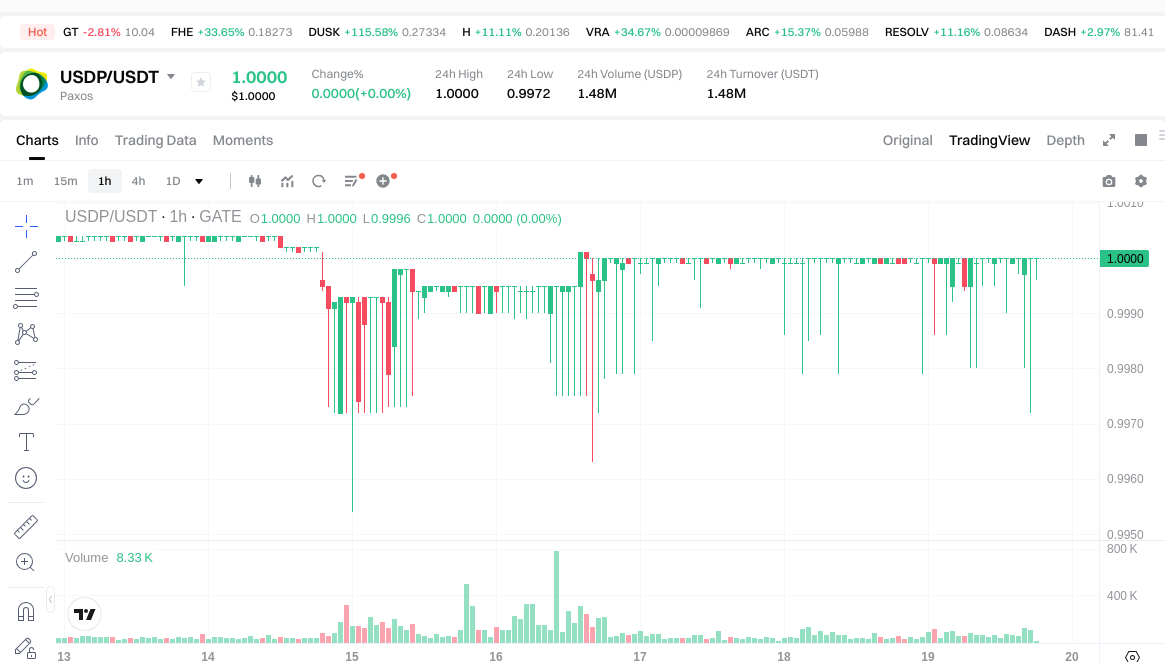
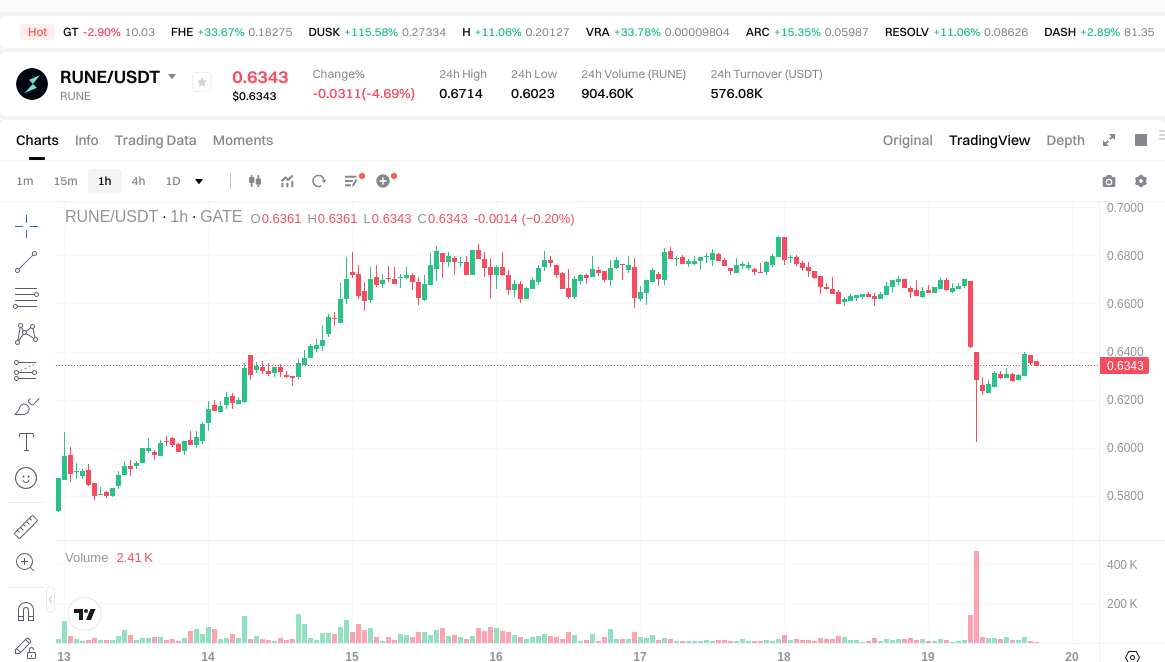
II. Core Factors Influencing USDP vs RUNE Investment Value
Supply Mechanism Comparison (Tokenomics)
- USDP: Operates on a 1:1 reserve mechanism where users can mint equivalent USDP tokens by depositing US dollars or cryptocurrencies on the Paxos platform, maintaining dollar parity through direct reserve backing.
- RUNE: Information regarding specific supply mechanism details is limited in the provided materials, though it is associated with decentralized finance systems and MakerDAO's development framework.
- 📌 Historical Pattern: Supply mechanisms play a role in shaping price stability and value propositions, with reserve-backed models typically prioritizing stability over speculative growth cycles.
Institutional Adoption and Market Application
- Institutional Holdings: USDP's collateral mechanism and smart contract functionality on Ethereum blockchain positions it as a tool for automated, trustless transactions in institutional settings.
- Enterprise Adoption: USDP serves functions including value measurement, storage medium, and circulation instrument within crypto ecosystems, though specific cross-border payment and settlement adoption data requires further analysis.
- National Policy: Stablecoins face varying regulatory attitudes across jurisdictions, with stability mechanisms and reserve transparency being key considerations for regulatory acceptance.
Technical Development and Ecosystem Building
- USDP Technical Framework: Leverages Ethereum blockchain's smart contract capabilities to enable automated operations, with collateral mechanisms supporting reliability through reserve requirements.
- RUNE Development Context: Connected to MakerDAO ecosystem developments, including the Endgame Plan proposed in June 2022, which focuses on enhancing complete decentralization, improving DAI liquidity and rate stability, and increasing protocol sustainability.
- Ecosystem Comparison: USDP functions primarily within stablecoin applications for value storage and transaction settlement, while RUNE's association with DeFi infrastructure suggests broader ecosystem integration potential, though specific DeFi, NFT, and smart contract deployment details require additional examination.
Macroeconomic and Market Cycles
- Inflation Environment Performance: Stablecoins like USDP are designed to maintain dollar parity rather than serve as inflation hedges, functioning as price anchors within volatile crypto markets.
- Macroeconomic Monetary Policy: Interest rates and dollar index movements directly impact dollar-pegged assets like USDP through their underlying reserve values, while broader DeFi protocols may experience different sensitivity patterns.
- Geopolitical Factors: Cross-border transaction demands and international regulatory developments influence stablecoin adoption patterns, with reserve transparency and banking relationships becoming critical considerations during market stress periods.
III. 2026-2031 Price Forecast: USDP vs RUNE
Short-term Forecast (2026)
- USDP: Conservative scenario maintains at $1.00 | Optimistic scenario maintains at $1.00
- RUNE: Conservative scenario ranges from $0.54 to $0.63 | Optimistic scenario reaches up to $0.72
Medium-term Forecast (2028-2029)
- USDP is expected to maintain price stability around $1.00 throughout the medium term
- RUNE may enter a gradual growth phase, with projected price range of $0.58 to $0.99
- Key drivers: institutional capital inflows, ETF developments, and ecosystem expansion
Long-term Forecast (2030-2031)
- USDP: Baseline scenario maintains at $1.00 | Optimistic scenario maintains at $1.00
- RUNE: Baseline scenario ranges from $0.72 to $1.08 | Optimistic scenario reaches up to $1.58
View detailed price predictions for USDP and RUNE
Disclaimer: Price forecasts are based on historical data analysis and market trends. Cryptocurrency markets are highly volatile and subject to various risk factors. These predictions should not be considered as investment advice. Users should conduct their own research and risk assessment before making any investment decisions.
USDP:
| Year |
Predicted High Price |
Predicted Average Price |
Predicted Low Price |
Price Change |
| 2026 |
1 |
1 |
1 |
0 |
| 2027 |
1 |
1 |
1 |
0 |
| 2028 |
1 |
1 |
1 |
0 |
| 2029 |
1 |
1 |
1 |
0 |
| 2030 |
1 |
1 |
1 |
0 |
| 2031 |
1 |
1 |
1 |
0 |
RUNE:
| Year |
Predicted High Price |
Predicted Average Price |
Predicted Low Price |
Price Change |
| 2026 |
0.723216 |
0.6344 |
0.53924 |
0 |
| 2027 |
0.82135768 |
0.678808 |
0.4072848 |
6 |
| 2028 |
0.8400927808 |
0.75008284 |
0.5775637868 |
17 |
| 2029 |
0.985908884896 |
0.7950878104 |
0.739431663672 |
24 |
| 2030 |
1.27341263713664 |
0.890498347648 |
0.8459734302656 |
39 |
| 2031 |
1.579655018892787 |
1.08195549239232 |
0.724910179902854 |
70 |
IV. Investment Strategy Comparison: USDP vs RUNE
Long-term vs Short-term Investment Strategies
- USDP: Suitable for investors seeking price stability, capital preservation, and transaction settlement functions within cryptocurrency portfolios. The asset's dollar-peg mechanism makes it appropriate for risk-averse participants prioritizing liquidity and minimal volatility exposure.
- RUNE: Suitable for investors interested in cross-chain liquidity protocols and decentralized finance ecosystem growth potential. The asset may appeal to participants with higher risk tolerance seeking exposure to DeFi infrastructure development.
Risk Management and Asset Allocation
- Conservative Investors: USDP 70-80% vs RUNE 20-30%
- Aggressive Investors: USDP 20-30% vs RUNE 70-80%
- Hedging Tools: Stablecoin allocation, options contracts, cross-asset diversification strategies
V. Potential Risk Comparison
Market Risks
- USDP: Exposure to reserve management risks, regulatory changes affecting stablecoin operations, banking relationship dependencies, and potential de-pegging events during market stress periods.
- RUNE: Subject to broader cryptocurrency market volatility, liquidity fluctuations in cross-chain protocols, competitive pressures from alternative DeFi solutions, and correlation with overall crypto market sentiment cycles.
Technical Risks
- USDP: Smart contract vulnerabilities on Ethereum blockchain, operational risks in reserve management systems, potential issues with minting and redemption mechanisms.
- RUNE: Network scalability challenges, cross-chain bridge security considerations, protocol upgrade implementation risks, potential smart contract vulnerabilities affecting liquidity pools.
Regulatory Risks
- Global regulatory frameworks show varying approaches toward stablecoins and DeFi protocols. USDP faces regulatory scrutiny related to reserve transparency, banking compliance, and stablecoin-specific legislation. RUNE encounters regulatory uncertainty surrounding decentralized protocols, cross-chain operations, and potential classification questions across different jurisdictions.
VI. Conclusion: Which Is the Better Buy?
📌 Investment Value Summary:
- USDP Advantages: Price stability around $1.00 peg, regulatory compliance through Paxos issuance, reserve backing mechanism, lower volatility profile suitable for capital preservation and transaction settlement applications.
- RUNE Advantages: Exposure to cross-chain liquidity protocol development, potential growth opportunity from current price levels compared to historical ranges, participation in DeFi ecosystem evolution.
✅ Investment Recommendations:
- Beginner Investors: Consider larger allocation to USDP for stability and capital preservation while gaining cryptocurrency market exposure. Limited RUNE allocation could provide growth potential within risk tolerance parameters.
- Experienced Investors: Evaluate portfolio objectives and risk appetite to determine appropriate balance. USDP serves liquidity and stability functions, while RUNE offers exposure to specific DeFi protocol developments.
- Institutional Investors: Assess regulatory compliance requirements, liquidity needs, and strategic positioning. USDP provides stablecoin functionality for operational purposes, while RUNE allocation depends on DeFi exposure mandates and risk frameworks.
⚠️ Risk Disclaimer: Cryptocurrency markets exhibit significant volatility. This analysis does not constitute investment advice. Conduct independent research and risk assessment before making investment decisions.
VII. FAQ
Q1: What is the fundamental difference between USDP and RUNE?
USDP is a dollar-pegged stablecoin designed for price stability, while RUNE is a volatile DeFi protocol token. USDP operates on a 1:1 reserve mechanism where each token is backed by equivalent US dollar deposits, maintaining a consistent price around $1.00. It functions primarily as a medium of exchange and store of value within crypto markets. In contrast, RUNE serves as the native token of the THORChain ecosystem, facilitating cross-chain liquidity provision and transactions. RUNE's price fluctuates significantly based on market conditions, having ranged from an all-time high of $20.87 in May 2021 to a current price of $0.64.
Q2: Which asset is more suitable for risk-averse investors?
USDP is more appropriate for risk-averse investors seeking capital preservation. The stablecoin's dollar-peg mechanism minimizes volatility exposure, with historical price deviations remaining within a narrow range between $0.98 and $1.50. This stability makes USDP suitable for investors prioritizing liquidity, transaction settlement functions, and protection against cryptocurrency market fluctuations. Conservative portfolio allocations might include 70-80% USDP to maintain stability while limiting exposure to volatile assets like RUNE to 20-30% for potential growth opportunities.
Q3: What are the primary regulatory risks for USDP versus RUNE?
USDP faces regulatory scrutiny related to reserve transparency, banking compliance, and evolving stablecoin-specific legislation. As a Paxos-issued token regulated by the New York State Department of Financial Services, USDP must maintain strict reserve backing and operational standards. RUNE encounters different regulatory challenges surrounding decentralized protocols, cross-chain operations, and potential classification uncertainties across various jurisdictions. Global regulatory frameworks show varying approaches toward both stablecoins and DeFi protocols, creating compliance considerations that differ significantly between these two asset classes.
Q4: How do price forecasts compare for USDP and RUNE through 2031?
USDP price forecasts maintain the $1.00 peg consistently through 2031 across all scenarios. RUNE projections show potential growth from current levels of $0.64, with conservative estimates ranging from $0.54 to $1.08 by 2030, and optimistic scenarios reaching up to $1.58 by 2031. However, these forecasts carry significant uncertainty given RUNE's historical volatility and current price positioning 96% below its all-time high. USDP's predictability contrasts sharply with RUNE's speculative growth potential, reflecting their fundamentally different value propositions as stable versus growth-oriented assets.
Q5: What technical risks should investors consider for each asset?
USDP's technical risks include smart contract vulnerabilities on the Ethereum blockchain, operational risks in reserve management systems, and potential issues with minting and redemption mechanisms that could affect the dollar peg during stress periods. RUNE faces network scalability challenges, cross-chain bridge security considerations, protocol upgrade implementation risks, and potential smart contract vulnerabilities affecting liquidity pools. While both assets operate on blockchain infrastructure, USDP's risks center on maintaining reserve backing and operational stability, whereas RUNE's risks relate to complex cross-chain protocol functionality and DeFi ecosystem dependencies.
Q6: How does institutional adoption differ between USDP and RUNE?
USDP has gained institutional recognition through its compliant structure and Paxos issuance, positioning it for automated, trustless transactions in enterprise settings. The stablecoin serves functions including value measurement, storage medium, and circulation instrument within institutional crypto operations. RUNE's institutional adoption relates to its role in DeFi infrastructure and cross-chain liquidity protocols, though specific enterprise use cases are less developed compared to stablecoin applications. Institutional investors typically allocate to USDP for operational liquidity and regulatory compliance purposes, while RUNE allocation depends on specific DeFi exposure mandates within institutional risk frameworks.
Q7: What market conditions favor USDP versus RUNE performance?
USDP maintains consistent performance across varying market conditions due to its dollar-peg mechanism, functioning as a safe haven during cryptocurrency market volatility. The stablecoin serves as a price anchor when investors seek capital preservation during downturns. RUNE performance correlates more strongly with broader DeFi sector growth, cross-chain adoption trends, and risk-on market sentiment. Bull market conditions with increased interest in decentralized protocols and cross-chain liquidity provision typically favor RUNE, while bear markets or periods of regulatory uncertainty benefit USDP's stability-focused value proposition.
Q8: Can USDP and RUNE serve complementary roles in a portfolio?
Yes, USDP and RUNE can serve complementary functions within a diversified cryptocurrency portfolio. USDP provides stability, liquidity, and capital preservation, functioning as a base layer for portfolio construction and rebalancing activities. RUNE offers exposure to DeFi protocol development and potential growth opportunities from cross-chain liquidity provision. A balanced approach might allocate USDP for transaction settlement, portfolio stability, and risk management, while maintaining smaller RUNE positions for growth potential aligned with individual risk tolerance. The combination allows investors to maintain cryptocurrency market exposure while managing volatility through stablecoin allocation.
* The information is not intended to be and does not constitute financial advice or any other recommendation of any sort offered or endorsed by Gate.