This comprehensive analysis compares VARA and IMX, two distinct blockchain infrastructure assets serving different market segments. VARA positions itself as regulatory compliance infrastructure for virtual asset service providers, while IMX functions as an established Layer-2 scaling solution for NFT transactions on Ethereum. The article examines historical price performance, where VARA declined 99.59% from its 2024 peak to $0.0011699, while IMX fell 97.74% from 2021 highs to $0.2311, with IMX demonstrating superior liquidity at $246,386.30 daily volume versus VARA's $24,241.69. Key comparison factors include tokenomics, institutional adoption patterns, ecosystem integration, and risk profiles across market cycles. Investment strategy recommendations differentiate between novice investors favoring IMX's established ecosystem, experienced investors exploring portfolio diversification, and institutional investors assessing technical architecture and regulatory frameworks. The analysis covers market risks, liqui
Introduction: Investment Comparison Between VARA and IMX
In the cryptocurrency market, the comparison of VARA vs IMX has consistently been a topic that investors cannot avoid. The two not only demonstrate significant differences in market cap ranking, application scenarios, and price performance, but also represent distinct crypto asset positioning.
VARA (VaraNetwork): Since its launch in 2023, VARA has gained market recognition by positioning itself as a platform for building next-generation decentralized applications (dApps), integrating the Actor Model and Persistent Memory architecture to enhance network efficiency and security in the Web3 ecosystem.
IMX (Immutable): Since its emergence, IMX has been recognized as a Layer-2 scaling solution for NFTs on Ethereum, featuring instant transactions, massive scalability, and zero gas fees for minting and trading, making it one of the prominent players in the NFT infrastructure space.
This article will comprehensively analyze the investment value comparison of VARA vs IMX through historical price trends, supply mechanisms, institutional adoption, technological ecosystems, and future predictions, attempting to answer the question that concerns investors most:
"Which is the better buy right now?"
I. Historical Price Comparison and Current Market Status
VARA and IMX Historical Price Trends
-
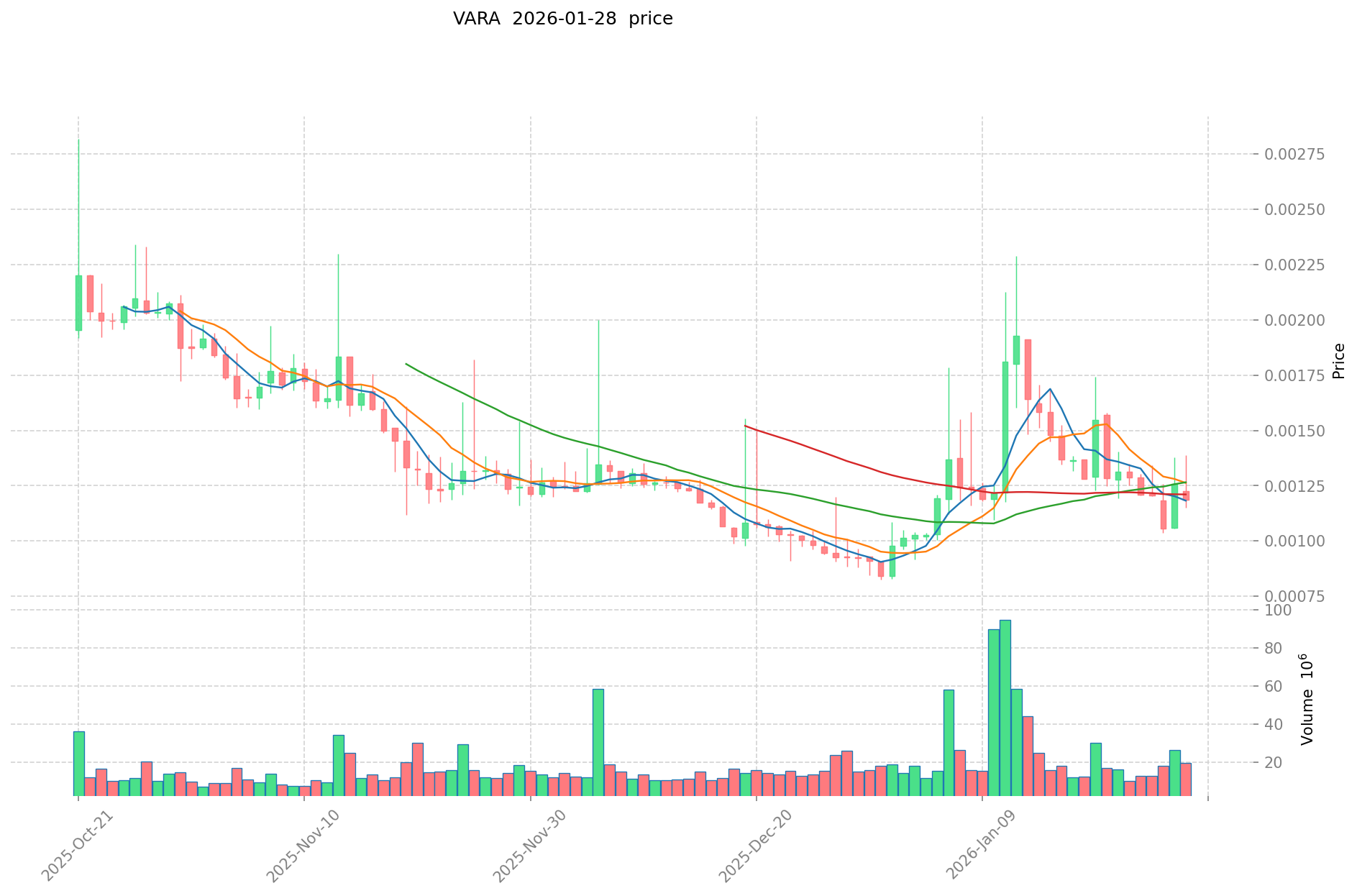
2024: VARA reached its all-time high of $0.20 on January 17, 2024, driven by initial market enthusiasm. Subsequently, the price experienced significant downward pressure throughout the year.
-
2025: VARA recorded its all-time low of $0.0008251 on December 31, 2025, reflecting prolonged bearish sentiment and limited market activity.
-
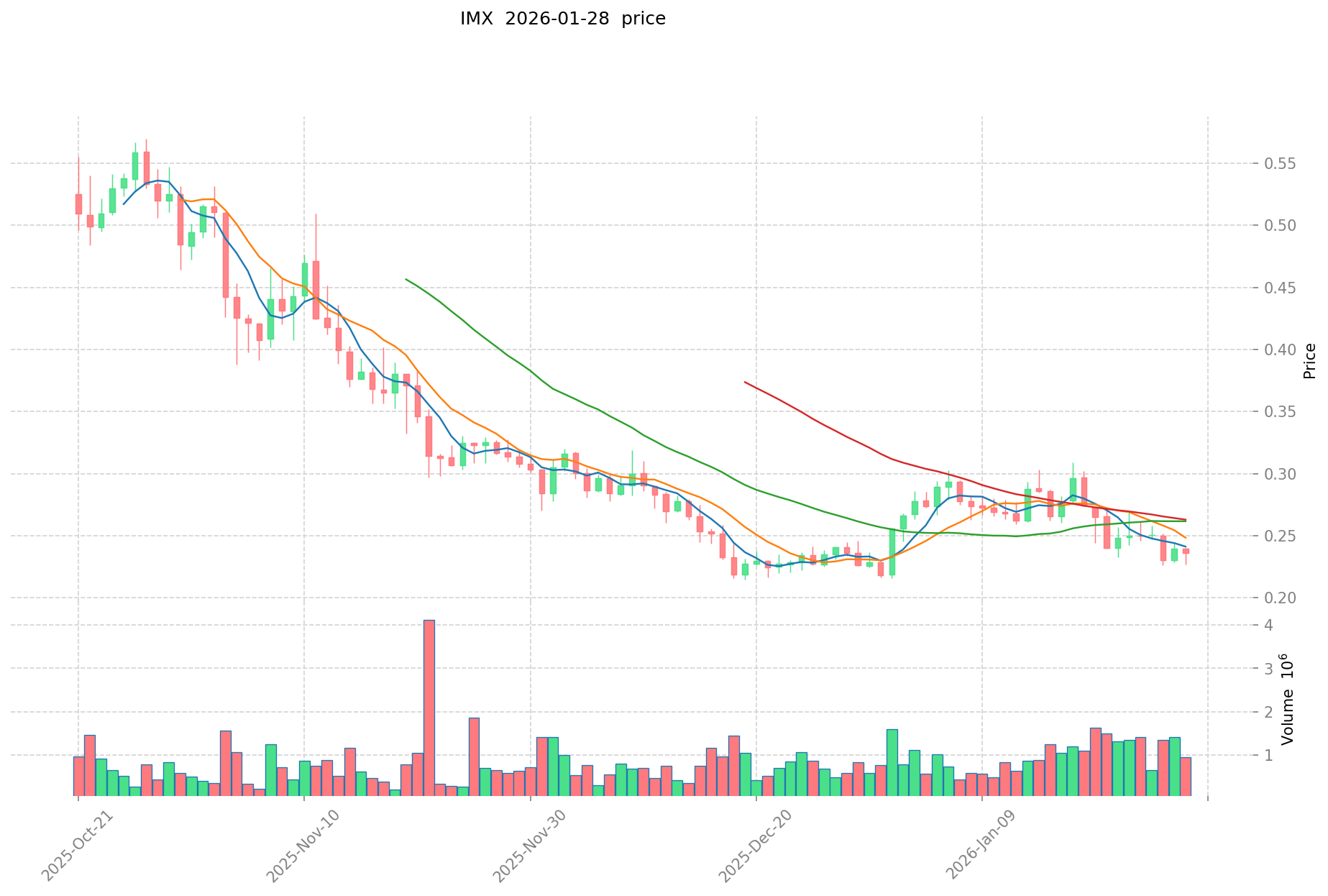
2021: IMX achieved its all-time high of $9.52 on November 26, 2021, coinciding with the broader NFT market boom and strong investor interest in Layer 2 scaling solutions.
-
2025: IMX recorded its all-time low of $0.215226 on December 19, 2025, affected by extended market correction and reduced trading volumes.
-
Comparative Analysis: During the 2024-2025 market cycle, VARA declined from its peak of $0.20 to $0.0008251, representing a decrease of approximately 99.59%. In contrast, IMX fell from its historical high of $9.52 to $0.215226, marking a decline of about 97.74%. Both assets experienced substantial drawdowns, though VARA showed relatively higher volatility within a shorter timeframe since its launch.
Current Market Status (2026-01-29)
- VARA Current Price: $0.0011699
- IMX Current Price: $0.2311
- 24-Hour Trading Volume: VARA recorded $24,241.69, while IMX recorded $246,386.30
- Market Sentiment Index (Fear & Greed Index): 29 (Fear)
View real-time prices:
II. Core Factors Influencing VARA vs IMX Investment Value
Supply Mechanism Comparison (Tokenomics)
- VARA: The reference materials indicate VARA's value is associated with its Virtual Asset Service Provider (VASP) license framework, though specific tokenomics details regarding supply mechanism were not provided in the available sources.
- IMX: The IMX token serves multiple functions within the Immutable X ecosystem, including governance, staking, and fee payments. These utility mechanisms are designed to incentivize network-beneficial activities such as trading and ecosystem participation.
- 📌 Historical Pattern: Token utility and ecosystem integration have historically influenced adoption cycles and value appreciation in blockchain projects.
Institutional Adoption and Market Application
- Institutional Holdings: The reference materials mention institutional movements, with FalconX transferring approximately $12.14 million worth of IMX from Binance over a one-week period, suggesting institutional interest in IMX.
- Enterprise Adoption: IMX demonstrates application within the Immutable X ecosystem, particularly in gaming and NFT sectors. VARA's application centers on regulatory compliance and virtual asset service provision.
- National Policy: VARA operates within a regulatory framework that involves VASP licensing, indicating a structured approach to compliance in virtual asset services.
Technology Development and Ecosystem Building
- VARA Technology Focus: The project emphasizes innovation in virtual asset service provision and regulatory compliance infrastructure.
- IMX Technology Development: IMX functions as the native token of Immutable X, a Layer 2 scaling solution. The token's utility extends across governance mechanisms, staking rewards, and transaction fee payments.
- Ecosystem Comparison: IMX shows integration within DeFi protocols, NFT marketplaces, and gaming applications. The reference materials highlight IMX's role in facilitating network activities and ecosystem participation through its multi-functional token design.
Macroeconomic and Market Cycle
- Inflation Environment Performance: The available materials do not provide sufficient data to determine the inflation-resistant characteristics of either asset.
- Macroeconomic Monetary Policy: The reference materials do not contain specific information regarding the correlation between interest rates, dollar index movements, and the performance of VARA or IMX.
- Geopolitical Factors: The materials note the importance of regulatory frameworks in virtual asset services, particularly regarding VARA's VASP licensing structure, though specific geopolitical impacts were not detailed.
III. 2026-2031 Price Forecast: VARA vs IMX
Short-term Forecast (2026)
- VARA: Conservative $0.001111 - $0.001170 | Optimistic $0.001170 - $0.001685
- IMX: Conservative $0.138 - $0.231 | Optimistic $0.231 - $0.288
Mid-term Forecast (2028-2029)
- VARA may enter a gradual growth phase, with projected prices ranging from $0.001385 to $0.002524
- IMX may enter a consolidation and expansion phase, with projected prices ranging from $0.145 to $0.386
- Key drivers: institutional capital inflows, ETF developments, ecosystem expansion
Long-term Forecast (2030-2031)
- VARA: Baseline scenario $0.001459 - $0.002680 | Optimistic scenario $0.002680 - $0.003751
- IMX: Baseline scenario $0.192 - $0.432 | Optimistic scenario $0.432 - $0.501
View detailed price predictions for VARA and IMX
Disclaimer
VARA:
| Year |
Predicted High Price |
Predicted Average Price |
Predicted Low Price |
Price Change |
| 2026 |
0.001684656 |
0.0011699 |
0.001111405 |
0 |
| 2027 |
0.00186973418 |
0.001427278 |
0.00112754962 |
22 |
| 2028 |
0.0024233039523 |
0.00164850609 |
0.0013847451156 |
40 |
| 2029 |
0.002524522226226 |
0.00203590502115 |
0.0017712373684 |
74 |
| 2030 |
0.003078288391978 |
0.002280213623688 |
0.00145933671916 |
94 |
| 2031 |
0.003750951410966 |
0.002679251007833 |
0.002063023276031 |
129 |
IMX:
| Year |
Predicted High Price |
Predicted Average Price |
Predicted Low Price |
Price Change |
| 2026 |
0.288375 |
0.2307 |
0.13842 |
0 |
| 2027 |
0.386710875 |
0.2595375 |
0.145341 |
12 |
| 2028 |
0.365130331875 |
0.3231241875 |
0.306967978125 |
39 |
| 2029 |
0.381981258253125 |
0.3441272596875 |
0.22712399139375 |
48 |
| 2030 |
0.501014877379031 |
0.363054258970312 |
0.192418757254265 |
57 |
| 2031 |
0.466597333628645 |
0.432034568174671 |
0.397471802720698 |
86 |
IV. Investment Strategy Comparison: VARA vs IMX
Long-term vs Short-term Investment Strategies
-
VARA: May appeal to investors focused on emerging regulatory infrastructure and virtual asset service frameworks. The token's association with VASP licensing structures positions it within the compliance-oriented segment of the cryptocurrency market. Given its significant volatility and nascent development stage, VARA may be suitable for investors with higher risk tolerance who are interested in early-stage projects within the regulatory technology space.
-
IMX: May suit investors seeking exposure to established Layer 2 scaling solutions and NFT infrastructure. The token's multi-functional utility across governance, staking, and transaction fees within the Immutable X ecosystem provides multiple value accrual mechanisms. IMX may appeal to investors interested in gaming and NFT sectors with a focus on scalability solutions.
Risk Management and Asset Allocation
-
Conservative Investors: A potential allocation could consider 20% VARA vs 80% IMX, reflecting IMX's more established market position and broader ecosystem integration. This allocation prioritizes the relatively more mature project while maintaining limited exposure to emerging regulatory infrastructure.
-
Aggressive Investors: A potential allocation might explore 40% VARA vs 60% IMX, increasing exposure to VARA's higher volatility and potential growth trajectory while maintaining substantial position in IMX's Layer 2 ecosystem.
-
Hedging Tools: Portfolio protection strategies may include stablecoin allocation for liquidity management, options contracts for downside protection, and cross-asset diversification across different blockchain infrastructure segments.
V. Potential Risk Comparison
Market Risks
-
VARA: The token has demonstrated substantial volatility, with an approximate 99.59% decline from its peak. Limited trading volume of $24,241.69 suggests lower liquidity, which may result in increased price sensitivity to market movements. The nascent stage of development and limited market history present uncertainty regarding sustained adoption.
-
IMX: Despite experiencing an approximate 97.74% decline from historical highs, IMX maintains higher trading volumes at $246,386.30, suggesting relatively better liquidity conditions. The token remains exposed to broader NFT market cycles and gaming sector performance, which have historically shown significant volatility.
Technical Risks
-
VARA: The reference materials do not provide detailed technical specifications regarding network scalability or operational stability. As an emerging infrastructure project, potential challenges related to system performance and security implementation may exist during development phases.
-
IMX: As a Layer 2 scaling solution, IMX faces technical considerations related to network capacity, transaction processing efficiency, and security architecture. The reliance on Ethereum's base layer introduces dependencies on underlying network performance and potential vulnerabilities in cross-layer interactions.
Regulatory Risks
- Global regulatory developments may impact both assets differently. VARA's focus on VASP licensing and compliance infrastructure may be influenced by evolving virtual asset service provider regulations across jurisdictions. IMX, as a Layer 2 solution facilitating NFT transactions, may face regulatory scrutiny regarding digital asset trading frameworks and securities classifications in various markets. The divergent regulatory approaches across regions regarding blockchain infrastructure and digital collectibles may create varying compliance requirements and operational considerations for both projects.
VI. Conclusion: Which Is the Better Buy?
📌 Investment Value Summary:
-
VARA Advantages: The project operates within the regulatory compliance segment, focusing on virtual asset service provider infrastructure. For investors interested in emerging regulatory technology frameworks, VARA represents exposure to this specialized sector. However, the token has shown substantial volatility and limited trading volume.
-
IMX Advantages: IMX demonstrates established market presence as a Layer 2 scaling solution with functional utility across governance, staking, and transaction fees. The token benefits from integration within gaming and NFT ecosystems, supported by institutional interest as evidenced by significant capital movements. Higher trading volumes suggest relatively better liquidity conditions compared to VARA.
✅ Investment Recommendations:
-
Novice Investors: Consider prioritizing assets with established track records and broader ecosystem integration. IMX may offer more accessible entry points due to higher liquidity and clearer use cases within the Layer 2 and NFT infrastructure space. Thorough research regarding market fundamentals and risk tolerance assessment remains essential.
-
Experienced Investors: May evaluate portfolio diversification across different blockchain infrastructure segments. IMX provides exposure to Layer 2 scaling and NFT markets, while VARA offers positioning within regulatory compliance infrastructure. Asset allocation should reflect individual risk profiles and market outlook across various cryptocurrency sectors.
-
Institutional Investors: Could assess both assets within broader blockchain infrastructure portfolios, considering IMX's demonstrated institutional interest and VARA's regulatory-focused positioning. Due diligence regarding technical architecture, ecosystem development, and regulatory frameworks remains critical for institutional allocation decisions.
⚠️ Risk Warning: The cryptocurrency market exhibits substantial volatility. This analysis does not constitute investment advice. Investors should conduct independent research and consider their financial circumstances before making investment decisions.
VII. FAQ
Q1: What are the main differences between VARA and IMX in terms of their core functions?
VARA focuses on regulatory compliance infrastructure for virtual asset service providers (VASPs), while IMX operates as a Layer 2 scaling solution for NFT transactions on Ethereum. VARA positions itself within the regulatory technology segment, emphasizing VASP licensing frameworks and compliance infrastructure for the virtual asset services industry. In contrast, IMX provides technical infrastructure for NFT ecosystems, offering instant transactions, massive scalability, and zero gas fees for minting and trading. The fundamental distinction lies in their market positioning: VARA addresses regulatory compliance needs, whereas IMX solves technical scalability challenges in the NFT and gaming sectors.
Q2: Which asset demonstrates better liquidity based on current market data?
IMX shows significantly better liquidity with a 24-hour trading volume of $246,386.30 compared to VARA's $24,241.69. This substantial difference reflects IMX's more established market presence and broader investor participation. Higher liquidity typically results in reduced price slippage during transactions, more efficient order execution, and lower volatility sensitivity to individual trades. For investors prioritizing ease of entry and exit positions, IMX's trading volume suggests more favorable liquidity conditions. However, both assets have experienced considerable declines from their historical peaks, with VARA dropping approximately 99.59% and IMX falling about 97.74%.
Q3: What evidence exists regarding institutional interest in these assets?
Institutional interest appears more pronounced for IMX based on available data. Reference materials indicate that FalconX transferred approximately $12.14 million worth of IMX from Binance over a one-week period, demonstrating significant institutional capital movement. This activity suggests institutional participants are actively positioning in IMX, potentially reflecting confidence in the Layer 2 scaling narrative and NFT infrastructure sector. In contrast, the reference materials do not provide specific evidence of institutional accumulation or strategic positioning in VARA. The presence of institutional activity often signals market maturity and may influence long-term price stability, though it does not guarantee future performance.
Q4: How do the tokenomics and utility mechanisms differ between VARA and IMX?
IMX features comprehensive tokenomics with multiple utility functions including governance participation, staking rewards, and transaction fee payments within the Immutable X ecosystem. These mechanisms create various value accrual pathways and incentivize network-beneficial activities such as trading and ecosystem engagement. The multi-functional design aims to align token holder interests with network growth. Conversely, the reference materials provide limited specific details regarding VARA's tokenomics structure beyond its association with VASP licensing frameworks. The token's value proposition appears tied to regulatory compliance infrastructure, though concrete supply mechanisms and utility functions were not extensively documented in available sources.
Q5: What are the primary risk factors investors should consider for each asset?
VARA's primary risks include substantial volatility (99.59% decline from peak), limited liquidity evidenced by low trading volumes, nascent development stage, and uncertainty regarding sustained market adoption. The project's focus on regulatory infrastructure represents a specialized sector with less established market dynamics. IMX faces risks related to NFT market cyclicality, gaming sector performance volatility, Layer 2 technical dependencies on Ethereum's base layer, and regulatory uncertainty regarding digital asset trading frameworks. Both assets operate in a market environment characterized by a Fear & Greed Index of 29 (Fear), suggesting cautious market sentiment. Additionally, both projects face evolving regulatory landscapes that may impact operational frameworks across different jurisdictions.
Q6: Based on price predictions, which asset shows higher potential growth by 2031?
According to the forecast models, IMX demonstrates higher absolute price appreciation potential by 2031. IMX's optimistic scenario projects a price of $0.501 by 2031, representing approximately 117% growth from its current price of $0.2311. In contrast, VARA's optimistic scenario forecasts $0.003751 by 2031, which represents approximately 220% growth from its current price of $0.0011699. While VARA shows higher percentage growth potential, IMX maintains significantly higher absolute price levels throughout the forecast period. However, these predictions involve substantial uncertainty, and actual outcomes depend on numerous factors including market conditions, technological developments, regulatory changes, and ecosystem adoption rates that cannot be precisely determined.
Q7: Which asset is more suitable for portfolio diversification purposes?
The assets serve different diversification functions within cryptocurrency portfolios. IMX provides exposure to established Layer 2 scaling infrastructure and NFT markets, positioning portfolios within the gaming and digital collectibles sectors. This alignment with specific use cases offers diversification across blockchain application layers and market segments experiencing development activity. VARA offers exposure to regulatory compliance infrastructure, representing a distinct sector focused on VASP frameworks and virtual asset service provision. For investors seeking diversification across different blockchain infrastructure segments, allocating to both assets addresses separate market narratives—technical scalability versus regulatory compliance. However, effective diversification requires consideration of correlation patterns with broader cryptocurrency markets and assessment of individual risk tolerance levels.
Q8: What market conditions would favor VARA versus IMX performance?
IMX performance may benefit from increased NFT market activity, gaming sector expansion, growing demand for Layer 2 scaling solutions, and institutional adoption of blockchain infrastructure. Favorable conditions include mainstream gaming integration, NFT utility expansion beyond collectibles, and Ethereum ecosystem growth. VARA performance may be supported by increasing regulatory clarity around virtual asset service providers, growing demand for compliance infrastructure, jurisdictional adoption of VASP licensing frameworks, and enterprise focus on regulatory technology solutions. Market environments emphasizing regulatory compliance and institutional-grade infrastructure may favor VARA's positioning. Conversely, periods of technological innovation focus and consumer-facing application growth may favor IMX's Layer 2 and NFT infrastructure narrative.
* The information is not intended to be and does not constitute financial advice or any other recommendation of any sort offered or endorsed by Gate.