This comprehensive analysis compares VELO and TRX, two distinct blockchain platforms with different market positioning and investment profiles. VELO, launched in 2020, operates as a DeFi liquidity protocol on Optimism network targeting cross-border payments and Asian PayFi applications, with a market cap of $108.16 million. TRX, established since 2017, functions as large-cap blockchain infrastructure with $29.35 billion market capitalization and significantly higher trading liquidity. The article examines historical price trends, tokenomics mechanisms, technical ecosystems, and institutional adoption patterns to help investors understand key differences. Detailed price projections through 2031 and risk assessments across market, technical, and regulatory dimensions inform investment strategy recommendations. Whether you're a novice or experienced investor, this comparison on Gate provides essential insights for evaluating which platform better aligns with your portfolio objectives and risk tolerance.
Introduction: Investment Comparison Between VELO and TRX
In the cryptocurrency market, the comparison between VELO vs TRX has consistently been a topic of interest for investors. The two not only differ significantly in market cap ranking, application scenarios, and price performance, but also represent distinct positioning within the crypto asset landscape.
VELO (VELO): Launched in 2020, it has gained market recognition through its positioning as a blockchain-based financial protocol that provides an open credit network for enterprises by implementing credit stabilization and stablecoin issuance on distributed ledgers.
TRON (TRX): Since its inception in 2017, it has been recognized as a large-scale public blockchain infrastructure, becoming one of the cryptocurrencies with substantial global trading volume and market capitalization, particularly after entering the decentralized stablecoin era in 2022.
This article will provide a comprehensive analysis of the investment value comparison between VELO vs TRX, focusing on historical price trends, supply mechanisms, institutional adoption, technical ecosystem, and future projections, while attempting to address the question investors care about most:
"Which is the better buy right now?"
I. Historical Price Comparison and Current Market Status
Historical Price Trends of VELO (Coin A) and TRX (Coin B)
- 2021: VELO reached its all-time high of $2.29 on March 8, 2021, during the broader cryptocurrency market rally. The price subsequently declined from this peak.
- 2022: VELO hit its historical low of $0.00103046 on December 20, 2022, reflecting the bearish market conditions that affected most crypto assets during that period.
- 2024: TRX achieved its all-time high of $0.431288 on December 4, 2024, marking a significant milestone in its price history.
- 2017: TRX recorded its historical low of $0.00180434 on November 12, 2017, shortly after its initial launch.
- Comparative Analysis: During various market cycles, VELO experienced substantial volatility, declining from its peak of $2.29 to a low of $0.00103046. In contrast, TRX demonstrated more gradual growth, rising from its 2017 low to reach new highs in 2024.
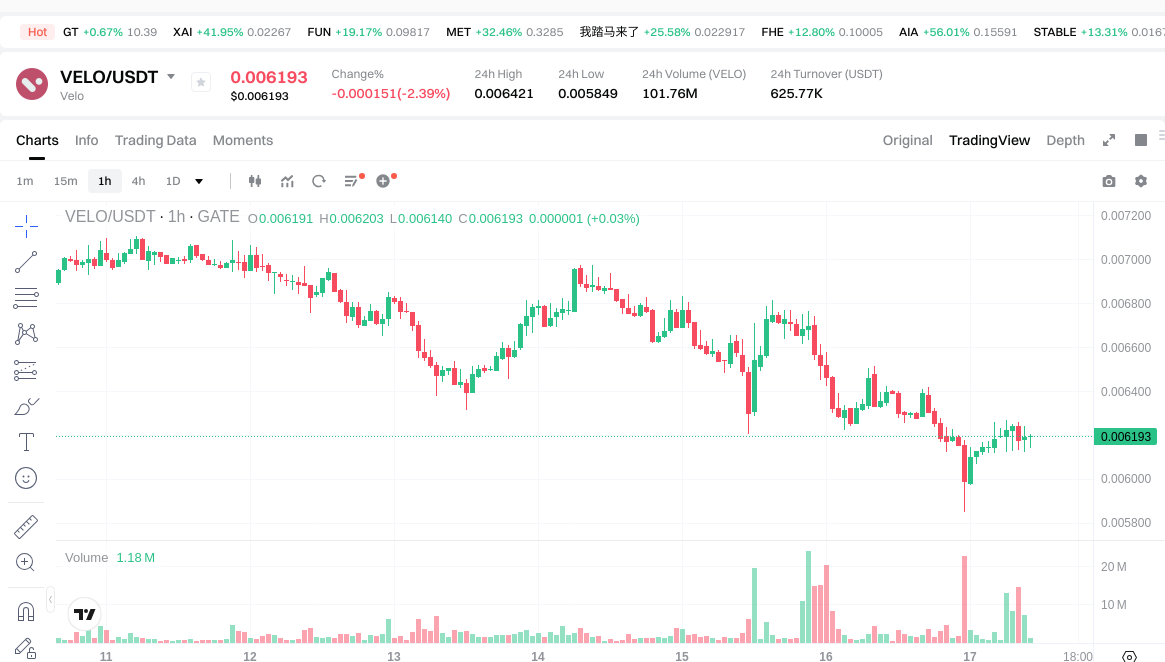
Current Market Status (January 17, 2026)
- VELO current price: $0.006158
- TRX current price: $0.30989
- 24-hour trading volume: VELO recorded $621,481.63 while TRX showed significantly higher activity at $3,132,607.22
- Market sentiment index (Fear & Greed Index): 50 (Neutral)
- Recent performance: VELO declined by 2.76% over 24 hours and 12.13% over 7 days, though it gained 9.12% over 30 days. TRX decreased by 0.50% over 24 hours but showed gains of 3.71% over 7 days and 10.96% over 30 days.
- Market capitalization: VELO holds a market cap of approximately $108.16 million (ranked 345), while TRX maintains a substantially larger market cap of approximately $29.35 billion (ranked 8).
View real-time prices:

II. Core Factors Influencing VELO vs TRX Investment Value
Tokenomics Comparison
-
VELO: According to available data, VELO operates with a circulating supply of approximately 874.59 million tokens and a maximum supply of 1.93 billion tokens. The token employs a dual-token mechanism within the Velodrome Finance ecosystem, designed to balance liquidity provision, trading efficiency, and decentralized governance.
-
TRX: The reference materials do not provide specific tokenomics details for TRX. Based on general market knowledge, TRX functions primarily within the TRON blockchain ecosystem for decentralized applications.
-
📌 Historical Pattern: Supply mechanisms influence price cycles through demand dynamics, scarcity effects, and ecosystem utility requirements.
Institutional Adoption and Market Application
-
Institutional Holdings: The provided materials do not contain comparative data on institutional preference between VELO and TRX.
-
Enterprise Adoption: VELO has announced integration with USD1, a regulated dollar stablecoin issued by WLFI, to serve as a core asset in its cross-border payment and settlement layer, particularly targeting PayFi scenarios in Asian markets such as remittance and commercial applications. Information regarding TRX enterprise adoption in cross-border payments, settlements, or investment portfolios is not available in the reference materials.
-
National Policy: The reference materials do not provide specific information regarding different countries' regulatory attitudes toward VELO or TRX.
Technical Development and Ecosystem Building
-
VELO Technical Infrastructure: Velodrome Finance operates as an advanced Automated Market Maker (AMM) built on the Optimism network. Its design incorporates core features from Curve, Convex, and Uniswap platforms, aiming to provide an efficient and optimized liquidity hub for the DeFi ecosystem. The platform emphasizes security through comprehensive measures including smart contract audits, bug bounty programs, and emergency response mechanisms.
-
TRX Technical Development: The reference materials do not provide specific information about TRX's technical upgrades or development roadmap.
-
Ecosystem Comparison: VELO's protocol design and incentive mechanisms support various protocols, promoting liquidity depth and trading efficiency improvements within the DeFi ecosystem. The platform operates on Optimism network with applications in liquidity provision and decentralized trading. Information regarding DeFi, NFT, payment systems, and smart contract implementation for TRX is not provided in the reference materials.
Macroeconomic Environment and Market Cycles
-
Performance in Inflationary Environment: The reference materials do not contain specific analysis regarding which token demonstrates stronger anti-inflation characteristics.
-
Macroeconomic Monetary Policy: The provided materials do not discuss how interest rates, dollar index movements, or other macroeconomic factors specifically impact VELO or TRX.
-
Geopolitical Factors: While VELO's integration with USD1 suggests positioning for cross-border transaction demand in Asian markets, the reference materials do not provide comparative analysis of how geopolitical factors, cross-border transaction requirements, or international situations differently affect VELO versus TRX.
III. 2026-2031 Price Prediction: VELO vs TRX
Short-term Forecast (2026)
- VELO: Conservative $0.00574 - $0.00617 | Optimistic $0.00617 - $0.00895
- TRX: Conservative $0.238 - $0.310 | Optimistic $0.310 - $0.443
Mid-term Forecast (2028-2029)
- VELO may enter a consolidation phase with expected price range of $0.00714 - $0.0125
- TRX may enter a growth phase with expected price range of $0.280 - $0.551
- Key drivers: institutional capital inflows, ETF developments, ecosystem expansion
Long-term Forecast (2030-2031)
- VELO: Baseline scenario $0.00675 - $0.0110 | Optimistic scenario $0.0110 - $0.0158
- TRX: Baseline scenario $0.365 - $0.483 | Optimistic scenario $0.483 - $0.595
View detailed price predictions for VELO and TRX
Disclaimer
VELO:
| Year |
Predicted High Price |
Predicted Average Price |
Predicted Low Price |
Price Change |
| 2026 |
0.0089523 |
0.006174 |
0.00574182 |
0 |
| 2027 |
0.0109665675 |
0.00756315 |
0.005294205 |
22 |
| 2028 |
0.009820750275 |
0.00926485875 |
0.0071339412375 |
50 |
| 2029 |
0.012501073911375 |
0.0095428045125 |
0.005630254662375 |
54 |
| 2030 |
0.012675230093728 |
0.011021939211937 |
0.007605138056236 |
78 |
| 2031 |
0.015758617588267 |
0.011848584652832 |
0.006753693252114 |
92 |
TRX:
| Year |
Predicted High Price |
Predicted Average Price |
Predicted Low Price |
Price Change |
| 2026 |
0.4428138 |
0.30966 |
0.2384382 |
0 |
| 2027 |
0.436434804 |
0.3762369 |
0.278415306 |
21 |
| 2028 |
0.42258928608 |
0.406335852 |
0.28037173788 |
31 |
| 2029 |
0.5512352168232 |
0.41446256904 |
0.393739440588 |
33 |
| 2030 |
0.589075649376552 |
0.4828488929316 |
0.366965158628016 |
55 |
| 2031 |
0.594918120981024 |
0.535962271154076 |
0.364454344384771 |
72 |
IV. Investment Strategy Comparison: VELO vs TRX
Long-term vs Short-term Investment Strategies
-
VELO: May appeal to investors focused on emerging DeFi infrastructure and cross-border payment protocol development, particularly those interested in Asian market PayFi applications and liquidity optimization mechanisms within the Optimism ecosystem.
-
TRX: May suit investors seeking exposure to established blockchain infrastructure with substantial market capitalization and higher trading liquidity, particularly those focused on large-cap digital assets with broader market recognition.
Risk Management and Asset Allocation
-
Conservative Investors: VELO 10-20% vs TRX 80-90% allocation may reflect a preference for established assets with higher liquidity while maintaining limited exposure to smaller-cap opportunities.
-
Aggressive Investors: VELO 30-40% vs TRX 60-70% allocation may indicate willingness to pursue potential growth in emerging protocols while maintaining substantial exposure to established infrastructure.
-
Hedging Instruments: Consideration of stablecoin allocations, derivatives instruments, and cross-asset portfolio diversification strategies to manage volatility exposure.
V. Potential Risk Comparison
Market Risks
-
VELO: Trading volume of $621,481.63 suggests lower liquidity compared to larger-cap assets, which may result in higher price volatility and slippage during market stress periods. The token's market capitalization ranking at 345 indicates relatively limited market depth.
-
TRX: While demonstrating substantially higher trading volume at $3,132,607.22 and market cap ranking at 8, the asset remains subject to broader cryptocurrency market cycles and correlation with major digital assets during periods of market-wide volatility.
Technical Risks
-
VELO: As a protocol operating on the Optimism network, potential considerations include Layer 2 scaling dependencies, smart contract security through audits and bug bounty programs, and the ongoing development of its dual-token mechanism within the Velodrome Finance ecosystem.
-
TRX: The reference materials do not provide specific information regarding technical architecture challenges, network capacity limitations, or security considerations for the TRON blockchain infrastructure.
Regulatory Risks
- Global regulatory developments regarding cryptocurrency assets, cross-border payment protocols, and DeFi platforms may impact both tokens differently based on their respective use cases, market positioning, and geographic adoption patterns. VELO's integration with regulated stablecoin USD1 for cross-border settlement scenarios may introduce specific compliance considerations in targeted Asian markets.
VI. Conclusion: Which Is the Better Buy?
📌 Investment Value Summary:
-
VELO Characteristics: Positioning in DeFi liquidity optimization, integration with regulated stablecoin infrastructure for cross-border payments, and technical foundation built on Optimism network incorporating design elements from established AMM protocols. The token represents exposure to emerging PayFi applications in Asian markets.
-
TRX Characteristics: Established market presence with significantly higher market capitalization ($29.35 billion vs $108.16 million), substantially greater trading liquidity, top-10 market ranking, and broader market recognition as blockchain infrastructure since 2017.
✅ Investment Considerations:
-
Novice Investors: May prioritize understanding of liquidity differences, market capitalization disparities, and risk-return profiles before allocation decisions. Consideration of educational resources regarding DeFi protocols, Layer 2 scaling solutions, and established blockchain infrastructure may inform investment approach.
-
Experienced Investors: May evaluate portfolio diversification opportunities across different market capitalizations, assess technical ecosystem developments, and consider correlation patterns with broader cryptocurrency market cycles when determining allocation strategies.
-
Institutional Investors: May analyze factors including trading volume depth, regulatory compliance frameworks, enterprise adoption trajectories, and technical infrastructure maturity when evaluating exposure to different segments of the cryptocurrency market.
⚠️ Risk Disclosure: Cryptocurrency markets demonstrate substantial volatility characteristics. This analysis does not constitute investment advice, financial recommendations, or predictive guarantees regarding future price performance.
VII. FAQ
Q1: What are the main differences in market positioning between VELO and TRX?
VELO is an emerging DeFi protocol focused on liquidity optimization and cross-border payment infrastructure, while TRX is an established large-cap blockchain platform with broader market recognition. VELO operates with a market cap of approximately $108.16 million (ranked 345th) and positions itself as a specialized financial protocol built on Optimism network, targeting Asian market PayFi applications through integration with regulated stablecoin USD1. In contrast, TRX maintains a substantially larger market capitalization of $29.35 billion (ranked 8th) and functions as general-purpose blockchain infrastructure that has operated since 2017, demonstrating significantly higher trading liquidity at $3.13 million versus VELO's $621,481 in 24-hour volume.
Q2: Which token demonstrates better price stability and lower volatility?
TRX exhibits greater price stability and lower volatility compared to VELO. TRX's historical price range spans from $0.00180434 (November 2017) to $0.431288 (December 2024), representing a more gradual growth trajectory. VELO experienced extreme volatility, declining from its peak of $2.29 (March 2021) to a low of $0.00103046 (December 2022), demonstrating substantially wider price swings. TRX's higher market capitalization, deeper liquidity, and established market presence contribute to reduced susceptibility to sharp price movements. Recent performance data shows TRX declined only 0.50% over 24 hours with gains of 3.71% over 7 days, while VELO dropped 2.76% over 24 hours and 12.13% over 7 days, further indicating TRX's relatively more stable price behavior.
Q3: What is the recommended portfolio allocation strategy for VELO vs TRX?
The allocation strategy depends on your risk tolerance and investment objectives. Conservative investors may consider a 10-20% VELO allocation versus 80-90% TRX to prioritize established assets with higher liquidity while maintaining limited exposure to smaller-cap opportunities. Aggressive investors seeking higher potential returns might allocate 30-40% to VELO versus 60-70% to TRX, accepting increased volatility exposure in exchange for participation in emerging DeFi infrastructure development. The substantial difference in market capitalization ($29.35 billion for TRX vs $108.16 million for VELO) and trading volume suggests that larger TRX positions provide greater liquidity management flexibility, while VELO positions introduce exposure to specialized cross-border payment protocol development in Asian markets.
Q4: How do the technical ecosystems of VELO and TRX differ?
VELO operates as an advanced Automated Market Maker (AMM) built specifically on the Optimism Layer 2 network, incorporating design elements from established protocols like Curve, Convex, and Uniswap to optimize DeFi liquidity provision. The Velodrome Finance ecosystem employs a dual-token mechanism designed to balance liquidity provision, trading efficiency, and decentralized governance, with emphasis on security through smart contract audits, bug bounty programs, and emergency response mechanisms. The reference materials do not provide detailed technical specifications for TRX's blockchain architecture. However, TRX's positioning since 2017 as large-scale public blockchain infrastructure and its top-10 market ranking suggest broader ecosystem application scope beyond specialized DeFi liquidity optimization, potentially encompassing general-purpose smart contracts and decentralized applications.
Q5: What are the key risks investors should consider for each token?
VELO's primary risks include lower liquidity with $621,481 in 24-hour trading volume, which may result in higher slippage during market stress periods, and its dependency on Optimism Layer 2 network infrastructure. As a relatively smaller market cap asset ranked 345th, VELO faces higher vulnerability to volatility and limited market depth. TRX's risks, while mitigated by higher liquidity and established market presence, include correlation with broader cryptocurrency market cycles and exposure to market-wide downturns affecting major digital assets. Both tokens face regulatory risks related to cryptocurrency oversight, though VELO's integration with regulated stablecoin USD1 for cross-border payments may introduce specific compliance considerations in Asian markets. Technical risks for VELO include smart contract security dependencies, while TRX technical risk details are not specified in available materials.
Q6: What are the price projections for VELO and TRX through 2031?
Short-term (2026): VELO conservative range $0.00574 - $0.00617, optimistic range $0.00617 - $0.00895; TRX conservative range $0.238 - $0.310, optimistic range $0.310 - $0.443.
Mid-term (2028-2029): VELO expected consolidation phase with range $0.00714 - $0.0125; TRX growth phase with range $0.280 - $0.551. Long-term (2030-2031): VELO baseline scenario $0.00675 - $0.0110, optimistic scenario $0.0110 - $0.0158; TRX baseline scenario $0.365 - $0.483, optimistic scenario $0.483 - $0.595. These projections assume continued ecosystem development, institutional adoption trends, and favorable macroeconomic conditions. However, cryptocurrency markets demonstrate substantial volatility, and actual performance may significantly deviate from these estimates based on regulatory developments, technical advancements, and broader market cycles.
Q7: Which token is more suitable for novice cryptocurrency investors?
TRX is generally more suitable for novice cryptocurrency investors due to several factors favoring learning and risk management. TRX's substantially higher market capitalization ($29.35 billion), top-10 ranking, and significantly greater trading volume ($3.13 million vs $621,481) provide deeper liquidity that reduces execution risks and slippage concerns during trading. The token's longer operational history since 2017 and more gradual price growth trajectory offer established track record for analysis. TRX's broader market recognition facilitates access to educational resources, market analysis, and community support networks. In contrast, VELO's specialized positioning in DeFi liquidity optimization, dependency on Optimism Layer 2 infrastructure, and dual-token mechanism within Velodrome Finance require deeper understanding of advanced DeFi concepts. Novice investors prioritizing simplicity, liquidity, and lower volatility may find TRX more aligned with initial cryptocurrency exposure objectives while building foundational knowledge before exploring smaller-cap, specialized protocols like VELO.
Q8: How does VELO's integration with USD1 stablecoin impact its investment value?
VELO's integration with USD1, a regulated dollar stablecoin issued by WLFI, positions the token as a core asset in cross-border payment and settlement infrastructure, particularly targeting PayFi scenarios in Asian markets including remittance and commercial applications. This partnership introduces several investment considerations: first, exposure to growing cross-border payment demand in Asian markets may drive protocol adoption and token utility. Second, integration with regulated stablecoin infrastructure suggests compliance-oriented positioning that may facilitate institutional adoption in jurisdictions prioritizing regulatory clarity. Third, the specialized focus on payment settlement layers differentiates VELO from general-purpose DeFi protocols, potentially creating defensible market positioning within cross-border transaction infrastructure. However, this specialization also concentrates risk exposure to specific geographic markets and regulatory environments governing stablecoin operations and cross-border payment protocols, requiring investors to assess Asian market payment trends and evolving stablecoin regulatory frameworks when evaluating VELO's long-term value proposition.
* The information is not intended to be and does not constitute financial advice or any other recommendation of any sort offered or endorsed by Gate.