This comprehensive guide compares VNO and UNI, two leading decentralized protocols with distinct market positions. VNO, a liquid staking protocol built on Cronos, has declined from $2.999 to $0.007245, presenting early-stage risk dynamics with limited liquidity ($16k daily volume). UNI, Uniswap's established governance token, maintains superior market strength with $3.7M daily volume and current price of $4.34, reflecting its foundational role in DeFi infrastructure. The analysis examines tokenomics, institutional adoption, technology development, and price projections through 2031, revealing UNI's stronger liquidity profile versus VNO's emerging growth potential. Investment suitability depends on risk tolerance: conservative investors favor UNI's stability and proven adoption, while aggressive investors explore VNO's higher volatility characteristics. Both tokens face regulatory uncertainties and sector-specific risks requiring ongoing monitoring through Gate's price tracking tools.
Introduction: VNO vs UNI Investment Comparison
In the cryptocurrency market, the comparison between VNO and UNI has been a topic that investors cannot avoid. The two not only have obvious differences in market cap ranking, application scenarios, and price performance, but also represent different crypto asset positioning.
VNO (VenoFinance): Since its launch, it has gained market recognition with its positioning as a liquid staking protocol built on Cronos, aiming to become a one-stop solution for CRO staking while deeply integrating with the Cronos ecosystem.
UNI (Uniswap): Since its launch in September 2020, it has been regarded as a pioneering automated market maker (AMM) protocol, and is one of the cryptocurrencies with substantial global trading volume and market capitalization.
This article will comprehensively analyze the investment value comparison between VNO and UNI around historical price trends, supply mechanisms, institutional adoption, technical ecosystems, and future predictions, and attempt to answer the question that investors are most concerned about:
"Which is the better buy right now?"
I. Historical Price Comparison and Current Market Status
VNO (Coin A) and UNI (Coin B) Historical Price Trends
- 2023: VNO reached its peak price of $2.999 on August 26, 2023, marking a significant milestone in its trading history.
- 2021: UNI experienced substantial growth following market expansion in DeFi sector, reaching its historical high of $44.92 on May 3, 2021.
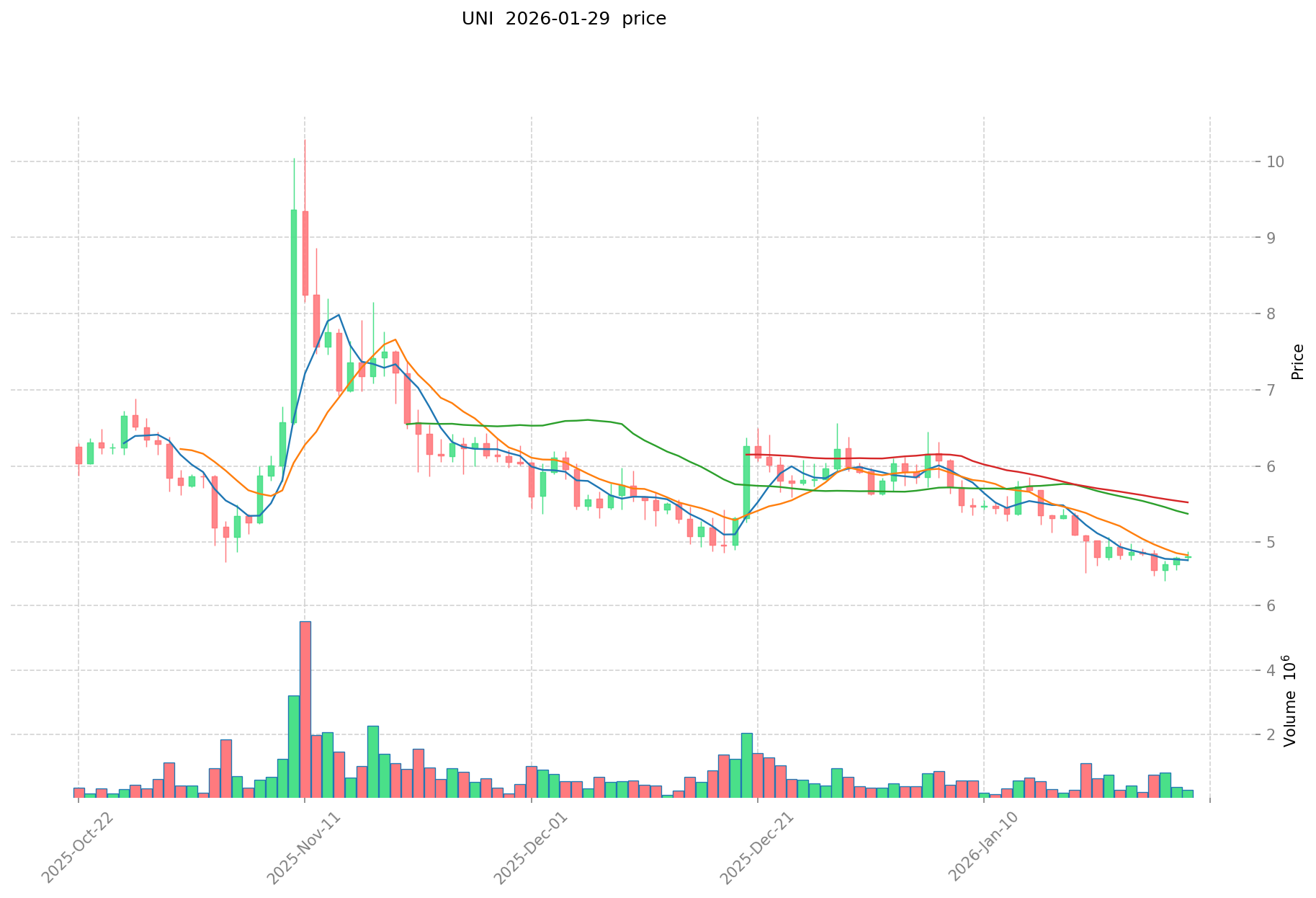
- Comparative Analysis: During recent market cycles, VNO declined from its peak of $2.999 to a low of $0.006412 (recorded on December 18, 2025), representing a significant correction. In contrast, UNI has shown a different trajectory, declining from $44.92 to $1.03 (recorded on September 17, 2020) during its early trading period, but has since stabilized at higher price levels.
Current Market Status (January 30, 2026)
- VNO Current Price: $0.007245
- UNI Current Price: $4.341
- 24-Hour Trading Volume: VNO $16,073.48 vs UNI $3,748,381.85
- Market Sentiment Index (Fear & Greed Index): 26 (Fear)
View Real-Time Prices:

II. Core Factors Influencing VNO vs UNI Investment Value
Tokenomics Comparison
-
UNI: The token's value mechanism is primarily derived from governance rights within the Uniswap ecosystem. UNI holders can participate in protocol governance decisions, such as deploying the protocol on additional chains. The token distribution model and protocol revenue allocation structure play significant roles in determining value capture capabilities.
-
VNO: Relevant tokenomics information was not available in the provided materials.
-
📌 Historical Pattern: UNI's transition from a governance token to a potential revenue-generating asset through fee mechanisms may reshape its value proposition. The balance between liquidity provider incentives, protocol revenue, and ecosystem development influences long-term token value dynamics.
Institutional Adoption and Market Application
-
Institutional Holdings: Analysis of institutional preference between VNO and UNI requires further data on institutional investment patterns.
-
Enterprise Adoption: UNI's utility extends through the Uniswap protocol's role in decentralized trading infrastructure. The protocol's dual capital structure includes both equity investors and token holders, with revenue distribution mechanisms potentially favoring equity stakeholders in certain configurations.
-
Regulatory Environment: Different jurisdictions maintain varying regulatory positions toward decentralized exchange tokens and governance mechanisms.
Technology Development and Ecosystem Building
-
UNI Technology Evolution: The protocol's development includes potential implementation of fee switches that could transform UNI from a governance-only token into a yield-bearing asset. Recent governance proposals, such as the "UNIfication" initiative, aim to strengthen the connection between token value and protocol growth.
-
VNO Technology Development: Specific technological advancement information was not available in the provided materials.
-
Ecosystem Comparison: UNI demonstrates significant positioning within DeFi infrastructure, particularly in decentralized exchange functionality. The protocol's oracle capabilities in Uniswap V3 may enhance value capture potential through increased market confidence and expanded use cases. Liquidity providers can benefit from trading fees while potentially supporting oracle data provision.
Macroeconomic Environment and Market Cycles
-
Performance Under Inflationary Conditions: The relationship between cryptocurrency governance tokens and inflation protection characteristics requires consideration of protocol revenue generation capacity and ecosystem adoption rates.
-
Macroeconomic Monetary Policy: Interest rate adjustments and dollar index movements can influence capital flows within cryptocurrency markets, affecting both governance tokens and their underlying protocol usage.
-
Geopolitical Factors: Cross-border transaction requirements and international regulatory developments may impact decentralized exchange adoption patterns and related token demand dynamics.
III. 2026-2031 Price Prediction: VNO vs UNI
Short-term Forecast (2026)
- VNO: Conservative $0.005796-$0.007245 | Optimistic $0.007245-$0.0107226
- UNI: Conservative $4.1135-$4.33 | Optimistic $4.33-$6.1053
Mid-term Forecast (2028-2029)
- VNO may enter a gradual growth phase, with estimated prices ranging from $0.00855527274 to $0.0149549051295
- UNI may enter an expansion phase, with estimated prices ranging from $4.74075679 to $11.1321588987
- Key drivers: institutional capital inflows, ETF developments, ecosystem expansion
Long-term Forecast (2030-2031)
- VNO: Baseline scenario $0.011224103769292-$0.01336521048975 | Optimistic scenario $0.016506034954841-$0.021622905790842
- UNI: Baseline scenario $6.733820199132-$9.58634125570875 | Optimistic scenario $9.35252805435-$13.612604583106425
View detailed price predictions for VNO and UNI
Disclaimer
VNO:
| Year |
Predicted High Price |
Predicted Average Price |
Predicted Low Price |
Price Change |
| 2026 |
0.0107226 |
0.007245 |
0.005796 |
0 |
| 2027 |
0.010241532 |
0.0089838 |
0.008175258 |
24 |
| 2028 |
0.0139383657 |
0.009612666 |
0.00855527274 |
32 |
| 2029 |
0.0149549051295 |
0.01177551585 |
0.010597964265 |
62 |
| 2030 |
0.019646859419932 |
0.01336521048975 |
0.01122677681139 |
84 |
| 2031 |
0.021622905790842 |
0.016506034954841 |
0.011224103769292 |
127 |
UNI:
| Year |
Predicted High Price |
Predicted Average Price |
Predicted Low Price |
Price Change |
| 2026 |
6.1053 |
4.33 |
4.1135 |
0 |
| 2027 |
7.096004 |
5.21765 |
4.17412 |
20 |
| 2028 |
8.98896742 |
6.156827 |
4.74075679 |
41 |
| 2029 |
11.1321588987 |
7.57289721 |
6.5126916006 |
74 |
| 2030 |
9.8201544570675 |
9.35252805435 |
6.733820199132 |
115 |
| 2031 |
13.612604583106425 |
9.58634125570875 |
7.956663242238262 |
120 |
IV. Investment Strategy Comparison: VNO vs UNI
Long-term vs Short-term Investment Strategies
-
VNO: May be suitable for investors with higher risk tolerance who are interested in liquid staking protocols within the Cronos ecosystem. The current price level reflects substantial distance from historical peaks, which could present different risk-reward profiles compared to more established assets.
-
UNI: May be suitable for investors seeking exposure to decentralized exchange infrastructure and DeFi governance mechanisms. The token's connection to Uniswap's trading volume and potential fee distribution mechanisms could align with investors evaluating protocol revenue dynamics.
Risk Management and Asset Allocation
-
Conservative Investors: A balanced approach might consider higher allocation to established protocol tokens with demonstrated adoption patterns (such as UNI at 70-80%) versus emerging ecosystem tokens (such as VNO at 20-30%), depending on individual risk parameters.
-
Aggressive Investors: Risk-tolerant portfolios might explore more balanced allocations (such as 40-60% distribution between established and emerging tokens), recognizing the higher volatility characteristics of smaller market cap assets.
-
Hedging Tools: Stablecoin reserves for rebalancing opportunities, derivatives instruments where available, and diversified cross-asset positioning can help manage portfolio volatility.
V. Potential Risk Comparison
Market Risk
-
VNO: Lower liquidity levels (24-hour trading volume of $16,073.48) may result in higher price volatility and potential execution challenges during market stress periods. The token's price movement from $2.999 to $0.007245 demonstrates substantial downside risk characteristics.
-
UNI: While demonstrating higher liquidity ($3,748,381.85 in 24-hour volume), the token remains subject to broader DeFi sector sentiment shifts and regulatory developments affecting decentralized exchanges. Market cycle dynamics and competitive pressures from alternative protocols represent ongoing considerations.
Technical Risk
-
VNO: Limited information regarding protocol development roadmap and technical infrastructure resilience requires additional evaluation. Ecosystem dependency on Cronos chain performance and adoption rates represents a concentration factor.
-
UNI: Protocol evolution dependencies include governance decisions regarding fee mechanisms and treasury management. Competition from alternative AMM designs and Layer 2 scaling solutions may influence market positioning over time.
Regulatory Risk
- Governance tokens and DeFi protocols face evolving regulatory frameworks across jurisdictions. Decentralized exchange tokens may encounter different regulatory treatment compared to other cryptocurrency categories. Ongoing policy developments regarding securities classification, tax treatment, and compliance requirements could impact both assets differently based on their structural characteristics and jurisdictional exposure.
VI. Conclusion: Which Is the Better Buy?
📌 Investment Value Summary:
-
VNO Characteristics: Positioned within the liquid staking sector on Cronos ecosystem, presenting early-stage risk-reward dynamics with substantial price depreciation from historical peaks. Limited trading volume suggests lower liquidity conditions.
-
UNI Characteristics: Established presence in DeFi infrastructure through Uniswap protocol, with governance rights and potential future revenue participation mechanisms. Higher trading volumes indicate improved liquidity conditions relative to VNO.
✅ Investment Considerations:
-
Beginning Investors: May benefit from focusing on more established protocol tokens with demonstrated adoption patterns, higher liquidity, and clearer value propositions. Understanding governance mechanisms and protocol economics represents an important foundation.
-
Experienced Investors: Could evaluate portfolio positioning based on risk tolerance, market cycle assessment, and conviction regarding specific protocol development trajectories. Diversification across different DeFi categories may help manage sector-specific risks.
-
Institutional Investors: Assessment factors may include liquidity depth for position sizing, regulatory clarity, protocol governance structures, and alignment with broader portfolio mandates. Due diligence on token economics and protocol revenue models remains essential.
⚠️ Risk Disclosure: Cryptocurrency markets exhibit high volatility characteristics. This content does not constitute investment advice. Market conditions, regulatory developments, and protocol-specific factors can significantly impact asset values. Investors should conduct independent research and consider their individual circumstances before making investment decisions.
VII. FAQ
Q1: What is the main difference between VNO and UNI in terms of their core use cases?
VNO is a liquid staking protocol token built on the Cronos ecosystem, while UNI is a governance token for the Uniswap decentralized exchange protocol. VNO focuses on providing staking solutions specifically for CRO tokens within the Cronos chain, representing a more specialized utility within a single ecosystem. In contrast, UNI serves as a governance mechanism for one of the largest decentralized exchanges, giving holders voting rights on protocol decisions such as fee structures, treasury management, and cross-chain deployments. UNI's broader application in DeFi infrastructure and its connection to substantial trading volumes ($3.7M+ daily) position it as a more established protocol token compared to VNO's emerging status in liquid staking.
Q2: Why does UNI have significantly higher trading volume than VNO?
UNI's 24-hour trading volume of $3,748,381.85 vastly exceeds VNO's $16,073.48 due to established market presence and institutional recognition. UNI launched in September 2020 and has become one of the foundational tokens in DeFi, supported by the Uniswap protocol's position as a leading decentralized exchange with billions in total value locked. This established infrastructure attracts institutional participants, liquidity providers, and traders seeking exposure to DeFi governance mechanisms. VNO, being a newer protocol focused on the Cronos ecosystem, has not yet achieved comparable market depth or recognition, resulting in limited liquidity that may present execution challenges during periods of market volatility.
Q3: Which token presents higher price volatility risk?
VNO presents higher price volatility risk based on historical performance and liquidity metrics. The token has experienced extreme price movements, declining from its peak of $2.999 (August 2023) to $0.007245 (current price as of January 30, 2026)—representing approximately a 99.7% decline. This substantial drawdown, combined with low trading volume, suggests that VNO may experience larger percentage price swings in response to relatively small order flows. UNI, while still subject to cryptocurrency market volatility, demonstrates more stable price action with higher liquidity cushioning against extreme movements. The 233x difference in trading volume between the two assets underscores VNO's heightened volatility profile and execution risk.
Q4: How do the tokenomics differ between VNO and UNI?
UNI's tokenomics center on governance rights with potential evolution toward revenue-sharing mechanisms through fee switches proposed in recent governance discussions. UNI holders can participate in protocol decisions and may benefit from future fee distribution models if implemented through governance votes. The token distribution includes both public token holders and equity investors, creating a dual capital structure. VNO's specific tokenomics information was not available in the provided materials, representing a transparency gap that investors should investigate before allocation decisions. Understanding token supply dynamics, vesting schedules, emission rates, and value capture mechanisms remains essential for evaluating long-term investment potential in either asset.
Q5: What regulatory risks should investors consider when comparing these tokens?
Both tokens face evolving regulatory frameworks, though potentially in different ways based on their functional characteristics. UNI, as a governance token for a decentralized exchange, may encounter scrutiny regarding securities classification, particularly as governance proposals consider implementing fee-sharing mechanisms that could be interpreted as profit-distribution features. Decentralized exchanges themselves face regulatory examination across multiple jurisdictions regarding compliance requirements and user protections. VNO, as a liquid staking protocol token, may face different regulatory considerations related to staking services and potential securities law implications. Both assets require investors to monitor jurisdiction-specific policy developments, tax treatment changes, and compliance framework evolution that could materially impact their operational viability and market valuations.
Q6: Based on price predictions, which token shows stronger growth potential through 2031?
According to the provided forecasts, UNI demonstrates stronger absolute price growth projections through 2031. UNI's predicted price range for 2031 spans $7.96 to $13.61, representing potential increases of 83-214% from the current $4.34 level. VNO's 2031 predictions range from $0.0112 to $0.0216, suggesting potential gains of 55-198% from the current $0.007245 price. However, percentage-based comparisons should be contextualized within risk profiles—VNO's lower price point and market cap mean higher percentage gains would be required to match UNI's absolute dollar appreciation. Investors should note that price predictions carry substantial uncertainty, particularly for emerging protocols like VNO, and should not be relied upon as the sole basis for investment decisions.
Q7: What portfolio allocation strategy might suit different investor risk profiles?
Conservative investors seeking DeFi exposure might consider a higher allocation to UNI (70-80%) versus VNO (20-30% if any), reflecting UNI's established market position, higher liquidity, and clearer governance value proposition. This approach prioritizes capital preservation while maintaining exposure to decentralized exchange infrastructure. Aggressive investors with higher risk tolerance might explore more balanced allocations (40-60% distribution), recognizing VNO's early-stage characteristics and potential for higher volatility-adjusted returns if the Cronos ecosystem expands significantly. Beginning investors should prioritize understanding before investing—focusing on established protocols like UNI allows for learning about governance mechanisms and DeFi economics with relatively lower execution risk compared to smaller market cap tokens. All investors should maintain stablecoin reserves for rebalancing opportunities during market dislocations.
Q8: What are the key catalysts that could impact the relative performance of VNO vs UNI?
For UNI, critical catalysts include governance decisions regarding fee switch implementation that would transform UNI from governance-only to revenue-generating tokens, regulatory clarity on decentralized exchange frameworks, competition from alternative AMM protocols and Layer 2 solutions, and broader DeFi sector adoption trends. Institutional participation in Uniswap governance and potential integration with traditional finance infrastructure could also drive demand. For VNO, key factors include Cronos ecosystem growth and adoption rates, development of the liquid staking protocol's features and security track record, partnership announcements within the Cronos ecosystem, and competitive positioning against alternative staking solutions. Both tokens remain sensitive to Bitcoin and Ethereum price movements, macroeconomic conditions affecting risk asset appetite, and overall cryptocurrency market cycle dynamics.
* The information is not intended to be and does not constitute financial advice or any other recommendation of any sort offered or endorsed by Gate.