This comprehensive investment analysis compares Victoria VR (VR) and Ethereum (ETH) as two distinct digital assets within the metaverse economy. VR represents emerging metaverse-focused technology with $65.8 million market cap and high volatility, having declined 99.4% from peak levels. ETH, ranking #2 with $401 billion market cap, serves as foundational smart contract infrastructure with institutional adoption and deflationary tokenomics. The article examines historical price trends, supply mechanisms, technical ecosystems, and 2026-2031 forecasts, offering allocation guidance for conservative and aggressive investors. While ETH demonstrates greater liquidity ($294.6M daily volume vs VR's $83K) and regulatory clarity, VR appeals to speculative traders seeking metaverse exposure. Real-time prices available on Gate platform. Investors must evaluate individual risk tolerance, portfolio diversification needs, and long-term conviction before positioning.
Introduction: Investment Comparison Between VR and ETH
In the cryptocurrency market, the comparison between VR vs ETH has always been a topic that investors cannot avoid. The two not only show significant differences in market cap ranking, application scenarios, and price performance, but also represent different crypto asset positioning.
Victoria VR (VR): Since its launch, it has gained market recognition through its positioning in providing virtual reality technology and a decentralized metaverse platform where users can create, explore, and earn rewards.
Ethereum (ETH): Since 2014, it has been regarded as the foundational platform for decentralized applications and smart contracts, ranking as one of the cryptocurrencies with the highest trading volume and market capitalization globally.
This article will comprehensively analyze the investment value comparison of VR vs ETH around historical price trends, supply mechanisms, institutional adoption, technological ecosystems, and future forecasts, attempting to answer the question that investors care about most:
"Which is the better buy right now?"
I. Historical Price Comparison and Current Market Status
VR (Coin A) and ETH (Coin B) Historical Price Trends
- 2021: VR reached a peak price of $0.615957 on December 11, 2021, reflecting strong initial market interest in the virtual reality metaverse sector.
- 2015: ETH launched at an initial offering price of approximately $0.308 and experienced significant growth as the smart contract platform gained adoption.
- 2025: VR recorded an all-time low of $0.00222735 on September 6, 2025, representing a decline from its historical peak, while ETH reached a new all-time high of $4,946.05 on August 25, 2025.
- Comparative analysis: During the 2021-2025 market cycle, VR declined from its peak of $0.615957 to its current range around $0.003918, experiencing a decline of approximately 99.4%, while ETH demonstrated more resilience, declining approximately 32.8% from its all-time high to current levels around $3,322.69.
Current Market Status (2026-01-18)
- VR current price: $0.003918
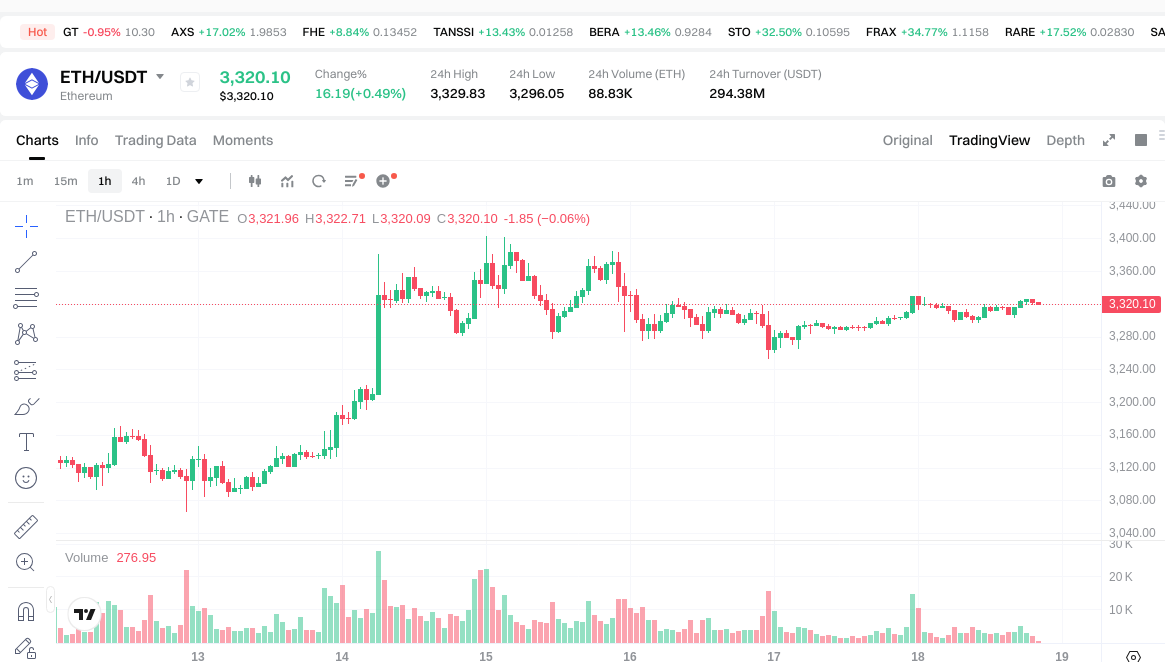
- ETH current price: $3,322.69
- 24-hour trading volume: VR $83,016.74 vs ETH $294,557,690.21
- Market capitalization: VR $65,822,400 (Rank #456) vs ETH $401,030,714,765 (Rank #2)
- 24-hour price change: VR +0.15% vs ETH +0.61%
- Market sentiment index (Fear & Greed Index): 49 (Neutral)
View real-time prices:
- Check VR current price Market Price
- Check ETH current price Market Price

II. Core Factors Influencing VR vs ETH Investment Value
Comparison of Supply Mechanisms (Tokenomics)
-
ETH: Following the implementation of EIP-1559 in 2021, Ethereum introduced a fee-burning mechanism that fundamentally altered its supply dynamics. This upgrade established a deflationary model where a portion of transaction fees is permanently removed from circulation, potentially creating scarcity pressures as network activity increases.
-
VR: Information regarding VR's supply mechanism was not identified in the reference materials.
-
📌 Historical Pattern: Supply mechanism adjustments have historically influenced price cycles by altering scarcity dynamics and investor expectations around long-term value accrual.
Institutional Adoption and Market Application
-
Institutional Holdings: ETH has demonstrated growing institutional interest, particularly following the approval of spot ETFs in 2024, which provided traditional financial institutions with regulated exposure to the asset.
-
Enterprise Adoption: ETH serves as the foundational layer for diverse applications including DeFi protocols, cross-border settlement systems, and enterprise blockchain solutions. The ecosystem's maturation has attracted development across financial services, supply chain management, and digital identity sectors.
-
National Policies: Regulatory approaches toward ETH vary significantly across jurisdictions, with some nations establishing clear frameworks for digital asset classification while others maintain more cautious stances pending further market development.
Technical Development and Ecosystem Building
-
ETH Technical Upgrades: The Dencun upgrade, implemented in early 2024, introduced Proto-Danksharding (EIP-4844) to enhance data availability and reduce transaction costs for Layer 2 solutions. This rollup-centric roadmap represents a strategic focus on scaling through modular architecture rather than monolithic expansion.
-
ETH Technical Development: The transition from proof-of-work to proof-of-stake through The Merge fundamentally restructured network security and energy efficiency, while establishing a foundation for future sharding implementations aimed at increasing throughput capacity.
-
Ecosystem Comparison: Ethereum maintains a substantial presence in DeFi applications, NFT marketplaces, and smart contract platforms. The ecosystem encompasses thousands of decentralized applications spanning various use cases, though adoption rates and user engagement continue to evolve alongside technological improvements.
Macroeconomic Conditions and Market Cycles
-
Performance in Inflationary Environments: Digital assets with deflationary supply characteristics may exhibit different correlations with traditional inflation hedges during periods of monetary expansion, though historical data remains limited for definitive conclusions.
-
Macroeconomic Monetary Policy: Interest rate adjustments and dollar index fluctuations can influence capital flows between digital assets and traditional financial instruments, affecting relative valuations across different market conditions.
-
Geopolitical Factors: Cross-border transaction demands and international regulatory developments can create varying pressures on digital asset adoption patterns, particularly for assets with established payment infrastructure or settlement capabilities.
III. 2026-2031 Price Prediction: VR vs ETH
Short-term Forecast (2026)
- VR: Conservative $0.0030-$0.0039 | Optimistic $0.0039-$0.0057
- ETH: Conservative $2,922-$3,320 | Optimistic $3,320-$3,752
Mid-term Forecast (2028-2029)
- VR may enter a consolidation phase, with estimated price range of $0.0047-$0.0075
- ETH may enter a growth phase, with estimated price range of $3,881-$5,581
- Key drivers: institutional capital inflows, ETF developments, ecosystem expansion
Long-term Forecast (2030-2031)
- VR: Base scenario $0.0049-$0.0066 | Optimistic scenario $0.0064-$0.0097
- ETH: Base scenario $2,966-$5,492 | Optimistic scenario $5,492-$6,097
View detailed price predictions for VR and ETH
Disclaimer
VR:
| Year |
Predicted High Price |
Predicted Average Price |
Predicted Low Price |
Price Change |
| 2026 |
0.0057013 |
0.003905 |
0.0029678 |
0 |
| 2027 |
0.005955906 |
0.00480315 |
0.003362205 |
22 |
| 2028 |
0.00613266192 |
0.005379528 |
0.00500296104 |
37 |
| 2029 |
0.0075404843976 |
0.00575609496 |
0.0046624369176 |
46 |
| 2030 |
0.00698070416274 |
0.0066482896788 |
0.004919734362312 |
69 |
| 2031 |
0.009744730596701 |
0.00681449692077 |
0.006405627105523 |
73 |
ETH:
| Year |
Predicted High Price |
Predicted Average Price |
Predicted Low Price |
Price Change |
| 2026 |
3751.7017 |
3320.09 |
2921.6792 |
0 |
| 2027 |
4808.818356 |
3535.89585 |
1909.383759 |
6 |
| 2028 |
4547.86924227 |
4172.357103 |
3922.01567682 |
25 |
| 2029 |
5580.9448609728 |
4360.113172635 |
3880.50072364515 |
31 |
| 2030 |
6014.340110332719 |
4970.5290168039 |
3926.717923275081 |
49 |
| 2031 |
6096.602365560823545 |
5492.4345635683095 |
2965.91466432688713 |
65 |
IV. Investment Strategy Comparison: VR vs ETH
Long-term vs Short-term Investment Strategies
-
VR: May appeal to investors with interest in metaverse sector exposure and tolerance for emerging market volatility. The asset's lower market capitalization and developmental stage suggest potential alignment with speculative positioning rather than core portfolio holdings.
-
ETH: May suit investors seeking exposure to established smart contract infrastructure and DeFi ecosystems. The asset's market position, institutional adoption trajectory, and technological development roadmap suggest potential alignment with longer-term digital asset allocation strategies.
Risk Management and Asset Allocation
-
Conservative Investors: Consider limited allocation structures such as VR: 5-10% vs ETH: 15-25% within a diversified digital asset portfolio, with remaining allocations to stablecoins or traditional assets based on individual risk profiles.
-
Aggressive Investors: May explore allocation ranges such as VR: 15-25% vs ETH: 30-45% within digital asset portfolios, acknowledging elevated volatility characteristics and concentration risks associated with higher exposure levels.
-
Hedging Instruments: Portfolio risk management approaches may incorporate stablecoin allocations for liquidity preservation, options strategies for downside protection, and cross-asset diversification to reduce correlation-based concentration risks.
V. Potential Risk Comparison
Market Risks
-
VR: The asset demonstrates elevated volatility characteristics, having experienced approximately 99.4% decline from peak levels. Trading volume of $83,016.74 reflects relatively limited liquidity, which may amplify price movements during periods of market stress or concentrated trading activity.
-
ETH: While maintaining stronger liquidity with $294,557,690.21 in 24-hour trading volume, the asset remains subject to broader digital asset market cycles, regulatory developments, and macroeconomic conditions that can influence valuation dynamics across varying timeframes.
Technical Risks
-
VR: Limited information regarding technical infrastructure, scalability solutions, and network security frameworks was identified in available materials, which may present evaluation challenges for investors assessing long-term technical viability.
-
ETH: The ongoing transition to rollup-centric architecture introduces implementation complexities around Layer 2 coordination, data availability guarantees, and cross-layer security assumptions that continue to evolve alongside ecosystem development.
Regulatory Risks
- Global regulatory frameworks for digital assets remain in development stages, with varying approaches across jurisdictions. ETH's classification and treatment under securities regulations, taxation frameworks, and custody requirements differ internationally, creating compliance considerations for institutional participants. VR's regulatory positioning was not specifically addressed in available materials, though emerging metaverse assets generally face similar classification uncertainties as broader digital asset categories.
VI. Conclusion: Which Is the Better Buy?
📌 Investment Value Summary:
-
VR Characteristics: The asset represents exposure to metaverse sector developments with speculative positioning in virtual reality applications. Current market capitalization of $65,822,400 and rank #456 reflects early-stage market presence with corresponding volatility profiles.
-
ETH Characteristics: The asset maintains established infrastructure for smart contract deployment, DeFi protocols, and NFT ecosystems. Market capitalization of $401,030,714,765 and rank #2 positioning reflects broader institutional recognition and ecosystem maturation, though subject to ongoing technical evolution and regulatory development.
✅ Investment Considerations:
-
New Investors: May consider prioritizing established assets with greater liquidity, regulatory clarity, and ecosystem documentation while maintaining limited exposure levels appropriate to individual risk tolerance and investment horizons.
-
Experienced Investors: May evaluate allocation strategies incorporating both established infrastructure assets and emerging sector exposures based on portfolio diversification objectives, risk management frameworks, and conviction around specific technological or adoption trends.
-
Institutional Investors: May focus on assets with developed custody solutions, regulatory framework clarity, and established market infrastructure while conducting thorough due diligence around technical roadmaps, governance structures, and ecosystem sustainability factors.
⚠️ Risk Disclosure: Cryptocurrency markets demonstrate elevated volatility characteristics with potential for significant capital loss. This analysis does not constitute investment advice, financial recommendations, or predictive guarantees regarding future performance outcomes.
VII. FAQ
Q1: What are the main differences between VR and ETH in terms of market positioning?
VR is positioned as an emerging metaverse-focused asset with a market cap of $65.8 million (rank #456), while ETH is an established smart contract platform with a market cap of $401 billion (rank #2). The fundamental distinction lies in their developmental stages: VR represents speculative exposure to virtual reality applications with limited liquidity ($83,016 daily volume), whereas ETH serves as foundational infrastructure for DeFi, NFTs, and decentralized applications with substantially higher liquidity ($294.6 million daily volume). ETH has undergone multiple network upgrades including The Merge and Dencun, establishing technical maturity, while VR's technical infrastructure details remain limited in available documentation.
Q2: How have VR and ETH performed historically in terms of price volatility?
VR has experienced extreme volatility, declining approximately 99.4% from its December 2021 peak of $0.616 to its current level around $0.004. ETH has demonstrated greater price resilience, declining approximately 32.8% from its August 2025 all-time high of $4,946 to current levels around $3,323. This disparity reflects differences in market maturity, liquidity depth, and institutional adoption. VR's trading range suggests elevated risk characteristics typical of lower-capitalization metaverse assets, while ETH's performance aligns with broader digital asset market cycles while maintaining stronger support levels due to ecosystem utility and institutional participation.
Q3: What supply mechanisms differentiate these two assets?
ETH implemented a significant supply mechanism change through EIP-1559 in 2021, introducing a fee-burning mechanism that creates deflationary pressure during periods of high network activity. This upgrade fundamentally altered Ethereum's tokenomics by permanently removing a portion of transaction fees from circulation, potentially enhancing scarcity dynamics over time. Additionally, The Merge transition to proof-of-stake reduced ETH issuance rates significantly. Information regarding VR's supply mechanism, including total supply limits, issuance schedules, or burning mechanisms, was not identified in available materials, representing a documentation gap that investors should address through additional research.
Q4: What are the projected price ranges for VR and ETH through 2031?
For 2026, VR projections range from $0.003-$0.006 (conservative to optimistic), while ETH projections range from $2,922-$3,752. By 2031, VR's projected range extends to $0.006-$0.010, representing potential growth of 73% from current levels under optimistic scenarios. ETH's 2031 projections range from $2,966-$6,097, representing potential growth of 65% under optimistic scenarios. These forecasts incorporate institutional adoption trends, technological developments, and macroeconomic conditions, though actual outcomes depend on numerous evolving factors including regulatory frameworks, ecosystem expansion, and broader market cycles.
Q5: What allocation strategies might suit different investor profiles?
Conservative investors might consider limited digital asset allocations such as 5-10% VR and 15-25% ETH within diversified portfolios, with remaining allocations to stablecoins or traditional assets. Aggressive investors may explore higher ranges such as 15-25% VR and 30-45% ETH, acknowledging elevated volatility characteristics. These allocation frameworks should incorporate individual risk tolerance, investment horizons, and portfolio diversification objectives. Risk management approaches may include stablecoin reserves for liquidity, options strategies for downside protection, and regular rebalancing protocols to manage concentration risks across different market conditions.
Q6: What are the primary technical risks associated with each asset?
VR faces documentation limitations regarding technical infrastructure, scalability solutions, and network security frameworks, which may present evaluation challenges for technical due diligence. The asset's early developmental stage and limited ecosystem documentation suggest potential risks around long-term technical viability and competitive positioning. ETH's technical risks center on its ongoing transition to rollup-centric architecture, which introduces coordination complexities around Layer 2 implementations, data availability guarantees, and cross-layer security assumptions. While ETH's technical roadmap is well-documented, execution risks remain around scaling solutions, network congestion management, and maintaining decentralization throughout infrastructure evolution.
Q7: How do regulatory considerations differ between VR and ETH?
ETH faces varying regulatory treatment across jurisdictions, with some nations establishing specific frameworks for digital asset classification while others maintain evolving stances. ETH's institutional adoption has increased following spot ETF approvals in 2024, though regulatory clarity around securities classification, taxation frameworks, and custody requirements continues to develop internationally. VR's regulatory positioning was not specifically addressed in available materials, though emerging metaverse assets generally encounter similar classification uncertainties. Investors should monitor jurisdiction-specific developments, potential securities regulations, cross-border transaction requirements, and evolving compliance frameworks applicable to both assets.
Q8: What liquidity considerations should investors evaluate?
Liquidity differences between these assets are substantial: ETH maintains 24-hour trading volume of $294.6 million compared to VR's $83,016, representing approximately 3,500x greater liquidity depth. This disparity significantly impacts execution quality, with VR positions potentially experiencing greater slippage during entry or exit, particularly for larger transaction sizes. ETH's liquidity profile supports institutional-scale transactions with minimal market impact, while VR's limited volume suggests suitability primarily for smaller position sizes. Investors should assess liquidity requirements against planned position sizes, holding periods, and potential need for rapid portfolio adjustments during volatile market conditions.
* The information is not intended to be and does not constitute financial advice or any other recommendation of any sort offered or endorsed by Gate.