This comprehensive analysis compares VTHO and LINK, two emerging blockchain tokens with distinct value propositions. VTHO serves as VeChainThor's gas token powering enterprise supply chain applications across fashion, food safety, and automotive sectors, while LINK operates as a decentralized oracle service token. The article examines historical price trends, tokenomics, institutional adoption, and ecosystem development across both assets. Current market data shows VTHO at $0.0008728 with lower liquidity, versus LINK at $13.782 with significantly higher trading volume. Price forecasts through 2031 project different growth trajectories based on institutional adoption and ecosystem expansion. Investment strategies vary by risk profile: conservative investors should allocate 60-70% to LINK; aggressive investors may increase VTHO exposure to 50-60%. The analysis addresses market risks, technical considerations, regulatory frameworks, and provides allocation recommendations for beginner, experienced, and instituti
Introduction: Investment Value, Price Prediction, and Risk Analysis of VTHO
In the cryptocurrency market, VeThor Token (VTHO) represents a distinctive utility-focused asset within the VeChainThor blockchain ecosystem. Since its launch in September 2017, VTHO has served as the gas token powering transactions, smart contract executions, and on-chain activities on the VeChain network.
As of January 18, 2026, VTHO is ranked 399th by market capitalization, with a current price of $0.0008728 and a circulating supply of approximately 97.5 billion tokens. The token operates within VeChain's dual-token model, which separates value storage (VET) from utility functionality (VTHO), aiming to ensure cost predictability and network scalability.
This article will comprehensively examine VTHO's investment characteristics through multiple dimensions:
"What factors influence VTHO's price dynamics and long-term value proposition?"
We will analyze historical price trends, supply mechanisms, ecosystem development, and associated risk factors to provide investors with an objective assessment framework for understanding VTHO's position in the evolving blockchain landscape.
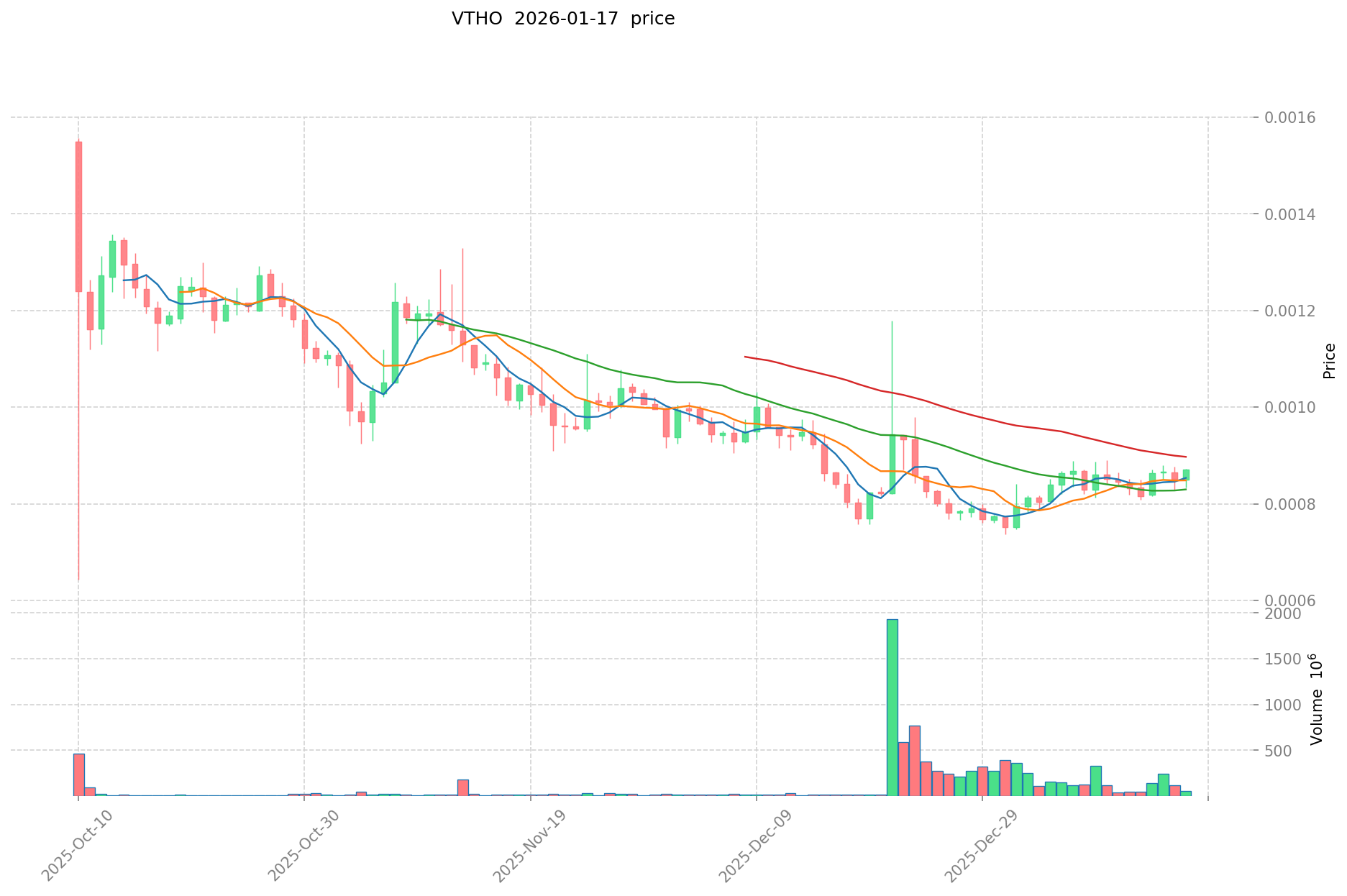
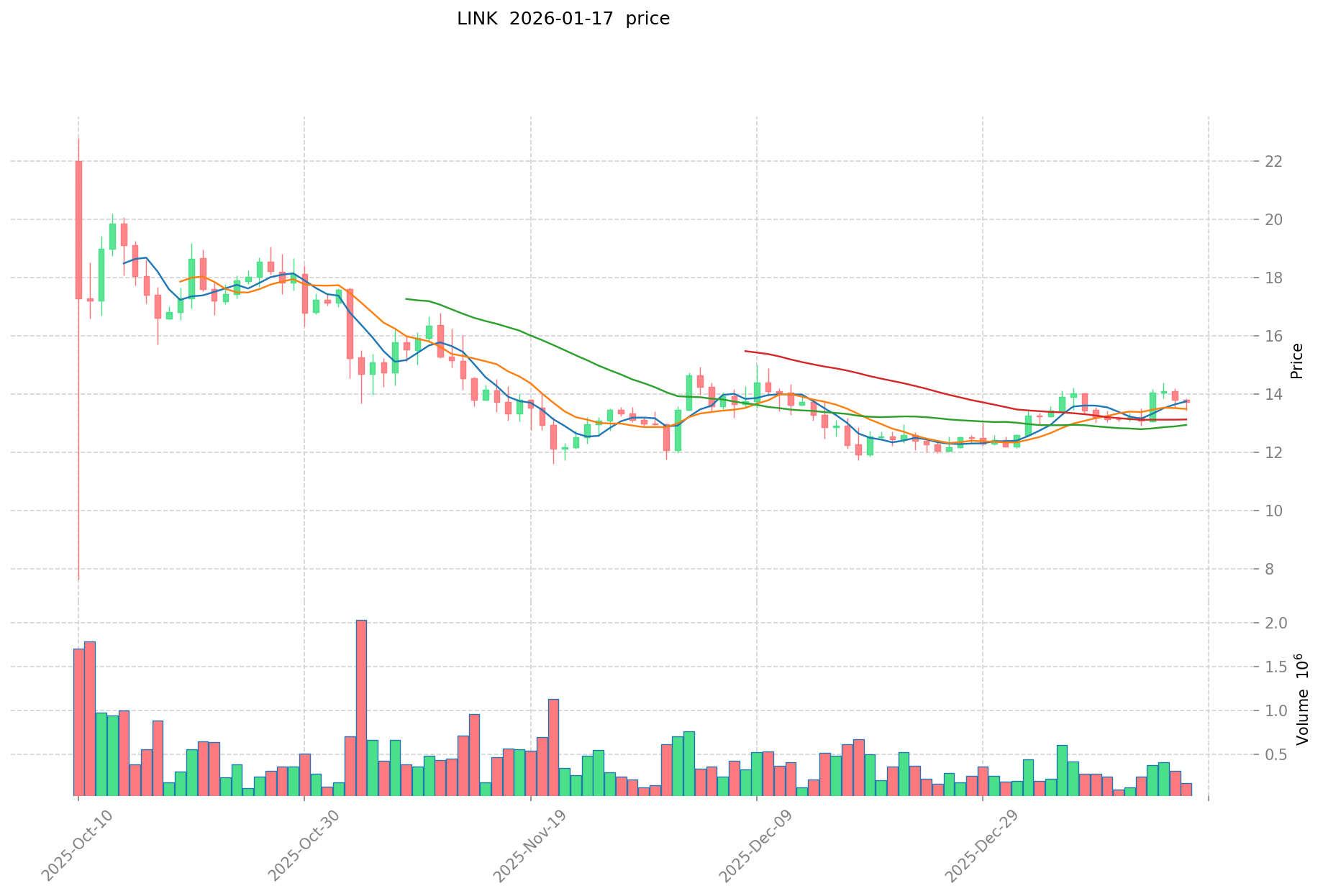
I. Historical Price Comparison and Current Market Status
VTHO (Coin A) and LINK (Coin B) Historical Price Trends
- 2018: VTHO reached a notable price level during the broader cryptocurrency market expansion, with its price peaking at approximately $0.047 in August 2018 before experiencing a significant correction.
- 2018-2021: LINK underwent substantial growth during this period, driven by increasing adoption of decentralized oracle solutions and partnerships with major technology companies, with its price reaching an all-time high of $52.70 in May 2021.
- Comparative Analysis: Throughout various market cycles, VTHO declined from its 2018 peak of $0.047 to a low of $0.00015 in March 2020, while LINK demonstrated relatively stronger resilience, maintaining higher support levels despite market-wide corrections.
Current Market Situation (2026-01-18)
- VTHO current price: $0.0008728
- LINK current price: $13.782
- 24-hour trading volume: VTHO $28,170 vs LINK $1,446,519
- Market Sentiment Index (Fear & Greed Index): 50 (Neutral)
View real-time prices:
II. Core Factors Influencing VTHO vs LINK Investment Value
Tokenomics Comparison
-
VTHO: VTHO operates under a dual-token model within the VeChainThor blockchain ecosystem. It is automatically generated by holding VET tokens and serves as the transaction fee currency on the network. The supply mechanism is designed to balance network operational costs with enterprise and regulatory requirements, maintaining a fee structure aligned with large-scale real-world deployments.
-
LINK: The reference materials do not provide specific information regarding LINK's supply mechanism or tokenomics structure.
-
📌 Historical Pattern: Supply mechanisms can influence price cycles by affecting token availability and demand dynamics within their respective ecosystems.
Institutional Adoption and Market Application
-
Institutional Holdings: The reference materials indicate that institutional participation influences VTHO value, though specific comparative data between VTHO and LINK institutional preference is not provided.
-
Enterprise Adoption: VTHO functions as a utility token essential for the VeChainThor blockchain's operation, supporting applications across fashion and luxury goods, food safety traceability (including overseas alcohol tracking platforms and cold chain solutions), and automotive industry digital maintenance logs. VeChain's core value proposition integrates blockchain technology with IoT devices, providing lifecycle digital management for physical products through RFID tags, QR codes, and sensors.
-
National Policies: Specific regulatory stances toward VTHO and LINK across different jurisdictions are not detailed in the provided materials.
Technological Development and Ecosystem Construction
-
VTHO Technology: VTHO plays a defined role in executing and measuring on-chain operations within the VeChainThor blockchain, facilitating large-scale real-world deployments. The VeChainThor platform features a four-layer technical architecture including blockchain abstraction layer and business application abstraction layer, supporting IoT integration for addressing connectivity and security challenges in IoT environments.
-
LINK Technology: The reference materials do not contain information regarding LINK's technological upgrades or development trajectory.
-
Ecosystem Comparison: VeChain's ecosystem extends beyond financial applications into logistics and supply chain management sectors, with documented use cases in fashion, food safety, and automotive industries. Specific comparative data regarding DeFi, NFT, payment, and smart contract implementations between VTHO and LINK ecosystems is not available in the provided materials.
Macroeconomic Environment and Market Cycles
-
Performance Under Inflation: Both VTHO and LINK investment values are influenced by macroeconomic conditions, though specific comparative analysis of anti-inflation properties is not provided in the reference materials.
-
Macro Monetary Policy: Market sentiment and macroeconomic factors affect the value fluctuations of both tokens, including considerations of interest rates and currency index movements.
-
Geopolitical Factors: Cross-border transaction demand and international developments may influence token adoption patterns, though specific comparative impacts on VTHO versus LINK are not detailed in the available materials.
III. 2026-2031 Price Forecast: VTHO vs LINK
Short-term Forecast (2026)
- VTHO: Conservative $0.000662872 - $0.0008722 | Optimistic $0.0008722 - $0.00122108
- LINK: Conservative $11.3037 - $13.785 | Optimistic $13.785 - $16.95555
Mid-term Forecast (2028-2029)
- VTHO may enter a consolidation phase, with projected prices ranging from $0.000804238176 to $0.001490206032 in 2028, and $0.00072168549264 to $0.00169729736232 in 2029
- LINK may experience fluctuating market conditions, with projected prices ranging from $17.08175512125 to $20.9389256325 in 2028, and $11.2023252133875 to $22.6011824480625 in 2029
- Key drivers: institutional capital flows, ETF developments, ecosystem expansion
Long-term Forecast (2031)
- VTHO: Baseline scenario $0.001362002950666 - $0.00166097920813 | Optimistic scenario $0.00166097920813 - $0.0023087610993
- LINK: Baseline scenario $20.020127412493762 - $21.761008057058437 | Optimistic scenario $21.761008057058437 - $24.807549185046618
View detailed price predictions for VTHO and LINK
Disclaimer
VTHO:
| Year |
Predicted High Price |
Predicted Average Price |
Predicted Low Price |
Price Change |
| 2026 |
0.00122108 |
0.0008722 |
0.000662872 |
0 |
| 2027 |
0.0013187664 |
0.00104664 |
0.0005442528 |
19 |
| 2028 |
0.001490206032 |
0.0011827032 |
0.000804238176 |
35 |
| 2029 |
0.00169729736232 |
0.001336454616 |
0.00072168549264 |
53 |
| 2030 |
0.0018050824271 |
0.00151687598916 |
0.000864619313821 |
73 |
| 2031 |
0.0023087610993 |
0.00166097920813 |
0.001362002950666 |
90 |
LINK:
| Year |
Predicted High Price |
Predicted Average Price |
Predicted Low Price |
Price Change |
| 2026 |
16.95555 |
13.785 |
11.3037 |
0 |
| 2027 |
21.36468225 |
15.370275 |
8.607354 |
11 |
| 2028 |
20.9389256325 |
18.367478625 |
17.08175512125 |
33 |
| 2029 |
22.6011824480625 |
19.65320212875 |
11.2023252133875 |
42 |
| 2030 |
22.394823825710625 |
21.12719228840625 |
19.43701690533375 |
53 |
| 2031 |
24.807549185046618 |
21.761008057058437 |
20.020127412493762 |
57 |
IV. Investment Strategy Comparison: VTHO vs LINK
Long-term vs Short-term Investment Strategies
-
VTHO: May appeal to investors focused on enterprise blockchain adoption and supply chain utility applications. The token's generation mechanism through VET holdings and its role in supporting real-world business operations suggest alignment with longer-term ecosystem development rather than speculative short-term positioning.
-
LINK: Suitable for investors seeking exposure to decentralized oracle infrastructure and broader DeFi ecosystem integration. The token's historical resilience during market corrections and established market positioning may accommodate both medium-term growth strategies and tactical allocation approaches.
Risk Management and Asset Allocation
-
Conservative Investors: A balanced approach might consider VTHO allocation at 30-40% and LINK allocation at 60-70%, reflecting LINK's more established market presence and liquidity profile relative to VTHO's specialized utility function.
-
Aggressive Investors: Growth-oriented portfolios could weight VTHO at 50-60% and LINK at 40-50%, acknowledging VTHO's potential upside from enterprise adoption expansion while maintaining LINK exposure for ecosystem diversification.
-
Hedging Tools: Stablecoin reserves, options strategies for downside protection, and cross-token portfolio combinations can help manage volatility across different market conditions.
V. Potential Risk Comparison
Market Risks
-
VTHO: The token demonstrates lower trading volume ($28,170 on the reference date) compared to more liquid assets, which may result in wider bid-ask spreads and increased price sensitivity to relatively smaller transaction volumes. Market sentiment shifts affecting enterprise blockchain adoption could influence VTHO's utility demand dynamics.
-
LINK: While benefiting from higher liquidity ($1,446,519 trading volume on the reference date), LINK's value proposition remains tied to oracle service demand within decentralized applications. Broader market downturns affecting DeFi ecosystem activity could impact price performance.
Technical Risks
-
VTHO: Network scalability considerations and the dual-token model's effectiveness in maintaining cost predictability during varying network demand conditions represent operational factors warranting monitoring. The token's utility function creates direct linkage between network activity levels and demand dynamics.
-
LINK: The reference materials do not provide specific information regarding LINK's technical risk factors, including network architecture vulnerabilities or infrastructure concentration concerns.
Regulatory Risks
- Global regulatory developments affecting utility tokens versus service-oriented tokens may create differentiated compliance landscapes. Enterprise-focused blockchain applications involving supply chain tracking and product verification may encounter specific regulatory considerations in jurisdictions with evolving digital asset frameworks. Cross-border transaction facilitation and data management requirements could influence adoption trajectories for both token categories.
VI. Conclusion: Which Is the Better Buy?
📌 Investment Value Summary:
-
VTHO Strengths: Defined utility function within VeChainThor ecosystem supporting enterprise applications across fashion, food safety, and automotive sectors. Dual-token model designed for transaction cost stability. Integration with IoT infrastructure for physical product lifecycle management. Potential for adoption expansion as enterprise blockchain implementations mature.
-
LINK Strengths: Established market positioning with demonstrated resilience through multiple market cycles. Higher liquidity profile facilitating entry and exit execution. Historical price performance indicating sustained demand for decentralized oracle services within blockchain ecosystem.
✅ Investment Recommendations:
-
Beginner Investors: Consider allocating smaller position sizes initially, focusing on understanding each token's ecosystem role and monitoring adoption metrics before increasing exposure. Prioritize liquidity considerations and risk tolerance assessment when establishing initial positions.
-
Experienced Investors: Evaluate portfolio diversification benefits by analyzing correlation patterns between utility-focused tokens and service-oriented assets. Monitor enterprise adoption indicators for VTHO and DeFi ecosystem developments for LINK to inform tactical allocation adjustments.
-
Institutional Investors: Assess alignment between token utility models and institutional investment mandates. Consider liquidity requirements, custody solutions, and regulatory compliance frameworks when evaluating allocation strategies. Monitor ecosystem development metrics and partnership announcements as indicators of long-term value proposition sustainability.
⚠️ Risk Warning: The cryptocurrency market exhibits substantial volatility. This analysis does not constitute investment advice. Conduct thorough independent research and consult qualified financial advisors before making investment decisions.
VII. FAQ
Q1: What is the fundamental difference between VTHO and LINK's value proposition?
VTHO serves as a gas token for executing transactions and smart contracts on the VeChainThor blockchain, automatically generated by holding VET tokens. Its value derives from enterprise adoption in supply chain management, product verification, and IoT integration across industries like fashion, food safety, and automotive sectors. LINK functions as a decentralized oracle service token, facilitating data connectivity between blockchain smart contracts and real-world information sources, with its value tied to DeFi ecosystem demand and oracle service utilization.
Q2: Why does VTHO have significantly lower liquidity compared to LINK?
As of January 18, 2026, VTHO recorded a 24-hour trading volume of $28,170 versus LINK's $1,446,519, reflecting LINK's more established market presence and broader integration across DeFi protocols. VTHO's lower liquidity stems from its specialized utility function within the VeChainThor ecosystem and relatively concentrated enterprise-focused adoption trajectory. This liquidity disparity may result in wider bid-ask spreads for VTHO and increased price sensitivity to smaller transaction volumes, which investors should consider when planning entry and exit strategies.
Q3: How does VTHO's dual-token model impact its price stability?
VeChainThor's dual-token architecture separates value storage (VET) from network utility (VTHO), aiming to maintain predictable transaction costs regardless of VET price fluctuations. VTHO is continuously generated by VET holders, with supply mechanisms designed to balance network operational requirements with enterprise budget planning needs. This structure theoretically insulates gas fees from speculative price movements affecting the value storage token, though VTHO's market price remains subject to broader cryptocurrency market dynamics and enterprise adoption trends.
Q4: What are the primary risk factors for VTHO compared to LINK?
VTHO faces enterprise adoption risk, where slower-than-expected blockchain implementation in supply chain and product verification sectors could limit utility demand. Its lower trading volume creates liquidity risk, potentially resulting in execution challenges during market volatility. LINK's primary risks include DeFi ecosystem dependency, where declines in decentralized application activity could reduce oracle service demand. Both tokens face regulatory uncertainty as global frameworks for utility tokens versus service-oriented tokens continue evolving, though specific compliance requirements may differ based on their operational functions.
Q5: Which token demonstrates better historical price resilience?
LINK exhibited relatively stronger price resilience through market cycles, maintaining higher support levels despite corrections and reaching an all-time high of $52.70 in May 2021. VTHO experienced significant volatility, declining from approximately $0.047 in August 2018 to $0.00015 in March 2020—a substantially deeper correction. This historical pattern suggests LINK's broader market adoption and liquidity provided greater stability during adverse market conditions, though past performance does not guarantee future results.
Q6: How should portfolio allocation differ between conservative and aggressive investors?
Conservative investors might consider allocating 30-40% to VTHO and 60-70% to LINK, reflecting LINK's established market positioning and superior liquidity profile. Aggressive investors seeking higher growth potential could weight VTHO at 50-60% and LINK at 40-50%, accepting increased volatility exposure in exchange for potential upside from enterprise blockchain adoption expansion. Both strategies should incorporate stablecoin reserves for risk management and position sizing appropriate to individual risk tolerance and investment timeframes.
Q7: What enterprise adoption indicators should investors monitor for VTHO?
Key metrics include announced partnerships with major corporations across fashion, food safety, and automotive sectors; transaction volume growth on the VeChainThor network indicating increased utility demand; IoT device integration milestones for product verification applications; and regulatory approval achievements for blockchain-based supply chain solutions in major markets. Additionally, monitor VET holder growth rates, as increased VET holdings directly correlate with VTHO generation and potential network utilization expansion.
Q8: What timeframe best suits VTHO versus LINK investment strategies?
VTHO appears better aligned with longer-term investment horizons (3-5+ years) given its dependence on gradual enterprise blockchain adoption maturation and supply chain digitalization trends. The token's utility function suggests value realization correlates with ecosystem development rather than short-term speculation. LINK's established market presence and higher liquidity may accommodate both medium-term growth strategies (1-3 years) and tactical allocation approaches, though its long-term value proposition remains tied to sustained DeFi ecosystem expansion and oracle service demand growth.
* The information is not intended to be and does not constitute financial advice or any other recommendation of any sort offered or endorsed by Gate.