This comprehensive guide compares WAL and KAVA, two distinct blockchain platforms with different investment profiles. WAL, launched in 2025, represents decentralized storage infrastructure built on Sui Network, while KAVA operates as a cross-chain DeFi hub since 2019. The article analyzes historical price trends, tokenomics, market adoption, and technical ecosystems to help investors evaluate both assets. Current pricing shows WAL at $0.1504 and KAVA at $0.09276, with varied risk profiles and growth projections through 2031. Through detailed investment strategies, risk assessment, and allocation recommendations, this analysis addresses which platform better suits conservative versus aggressive investors, providing data-driven insights for informed decision-making on Gate exchange.
Introduction: Investment Comparison Between WAL and KAVA
In the cryptocurrency market, the comparison between WAL vs KAVA continues to be a topic of interest for investors. The two assets exhibit notable differences in market capitalization ranking, application scenarios, and price performance, while representing distinct positioning within the crypto asset landscape.
Walrus (WAL): Launched in 2025, the project has gained market recognition through its positioning as a decentralized data storage network for rich media content. Built on the Sui Network, it offers an evolved approach to decentralized storage with programmable capacity and smart contract integration.
Kava (KAVA): Since its introduction in 2019, the platform has been recognized as a cross-chain decentralized financial hub, providing collateralized lending and stablecoin services for mainstream digital assets. It serves as a Layer 1 infrastructure connecting users with DeFi products including stablecoins, loans, and interest-bearing accounts.
This article will analyze the investment value comparison between WAL vs KAVA through historical price trends, supply mechanisms, institutional adoption, technical ecosystems, and future projections, while attempting to address the question most relevant to investors:
"Which is the better buy right now?"
I. Historical Price Comparison and Current Market Status
WAL and KAVA Historical Price Trends
- 2025: WAL recorded an all-time high of $0.9719 on March 27, 2025, reflecting strong early market interest following its recent launch. The token subsequently experienced significant price fluctuation.
- 2021: KAVA reached its historical peak of $9.12 on August 30, 2021, during a period of broader DeFi market expansion. The token has since undergone substantial price correction.
- Comparative Analysis: During the recent market cycle, WAL declined from its high of $0.9719 to a low of $0.1154 recorded on December 30, 2025, representing a drawdown of approximately 88%. In contrast, KAVA has experienced a more extended decline from its 2021 peak of $9.12 to a low of $0.071579 recorded on December 19, 2025, representing a decline exceeding 99%.
Current Market Status (January 16, 2026)
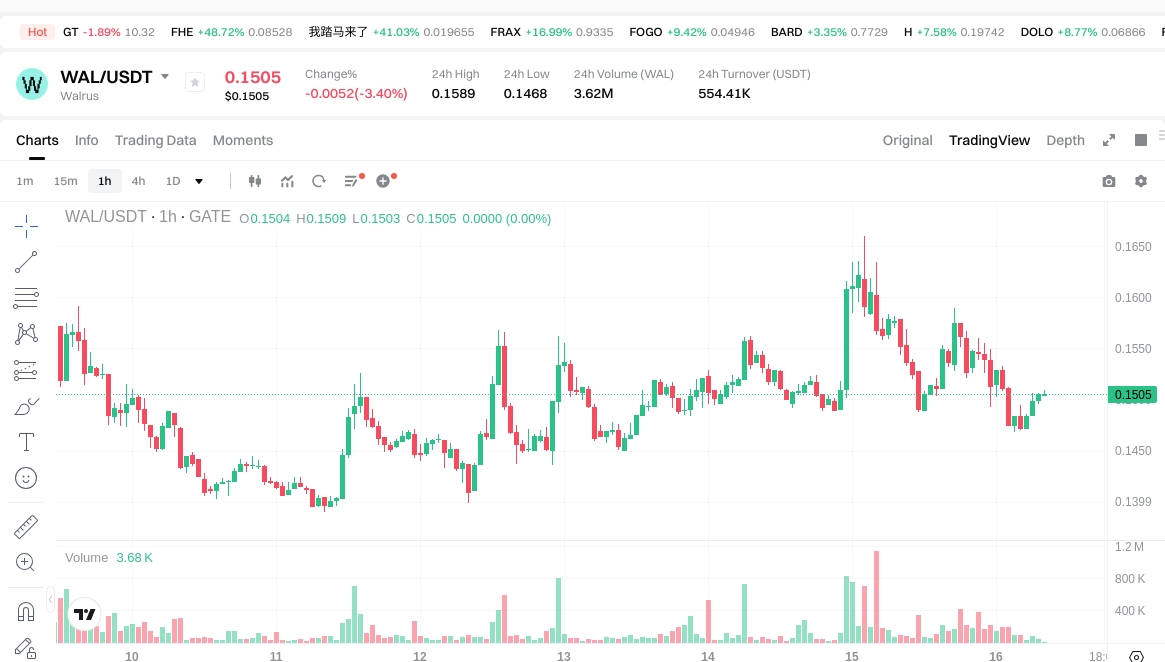
- WAL Current Price: $0.1504
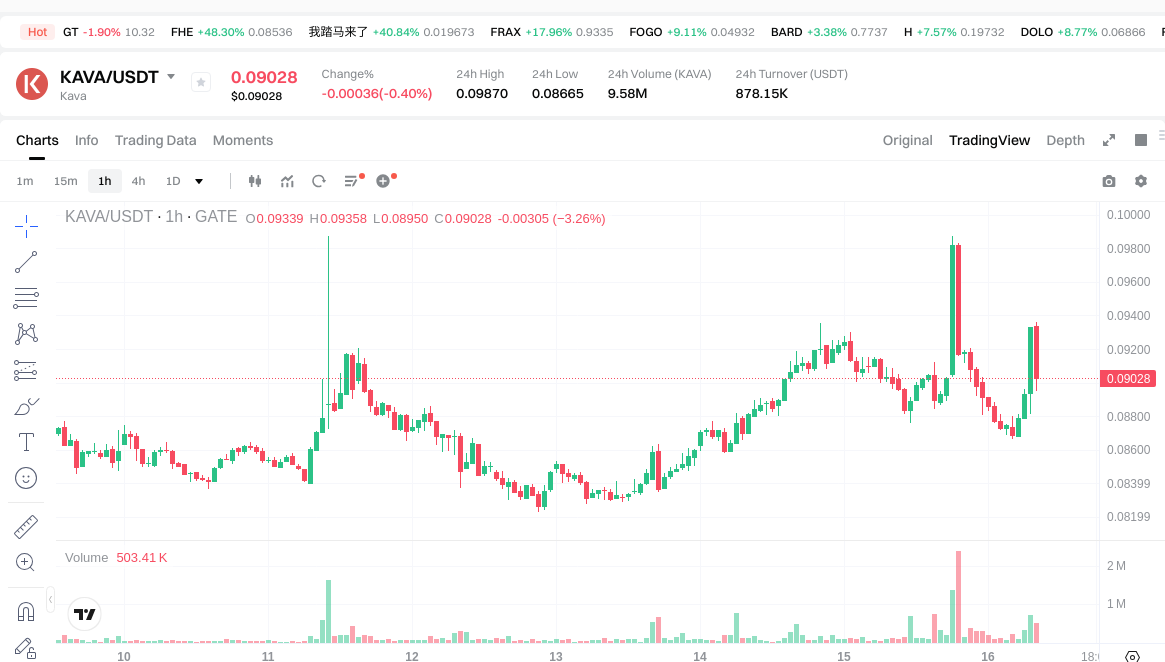
- KAVA Current Price: $0.09276
- 24-hour Trading Volume: WAL recorded $558,067.20 compared to KAVA's $841,627.06
- Market Sentiment Index (Fear & Greed Index): 61 (Greed)
View real-time prices:
II. Core Factors Influencing WAL vs KAVA Investment Value
Supply Mechanism Comparison (Tokenomics)
-
WAL: The supply mechanism details are not extensively documented in available materials. WAL is associated with Binance's HODLer rewards program, suggesting a distribution model tied to exchange incentives rather than a traditional supply schedule.
-
KAVA: KAVA operates within a blockchain ecosystem focused on validators and network security. While specific supply mechanics such as fixed caps or deflationary models are not detailed in the reference materials, KAVA's structure supports eco-friendly blockchain validation processes.
-
📌 Historical Pattern: Supply mechanisms typically influence price cycles by affecting circulating supply dynamics and market liquidity over time.
Institutional Adoption and Market Application
-
Institutional Holdings: Reference materials do not provide comparative data on institutional preference between WAL and KAVA.
-
Enterprise Adoption: Neither WAL nor KAVA is specifically mentioned in the materials regarding applications in cross-border payments, settlements, or corporate investment portfolios.
-
National Policies: Regulatory attitudes toward WAL and KAVA across different jurisdictions are not addressed in the available information.
Technical Development and Ecosystem Building
-
WAL Technical Upgrades: Information regarding specific technical developments for WAL is limited in the reference materials.
-
KAVA Technical Development: KAVA focuses on blockchain validator infrastructure with an emphasis on environmental sustainability, though detailed technical roadmaps are not provided.
-
Ecosystem Comparison: Neither project's involvement in DeFi, NFT, payment systems, or smart contract deployment is substantiated in the available materials.
Macroeconomic Environment and Market Cycles
-
Performance in Inflationary Environments: The materials do not contain specific analysis comparing anti-inflation properties of WAL versus KAVA.
-
Macroeconomic Monetary Policy: The impact of interest rates, US dollar index movements, and other monetary policy factors on both assets is not documented in the reference materials.
-
Geopolitical Factors: Cross-border transaction demand and international situation effects on WAL and KAVA are not addressed in available sources.
III. 2026-2031 Price Prediction: WAL vs KAVA
Short-term Forecast (2026)
- WAL: Conservative $0.089-$0.151 | Optimistic $0.108-$0.215
- KAVA: Conservative $0.059-$0.090 | Optimistic $0.072-$0.108
Medium-term Forecast (2028-2029)
- WAL may enter a consolidation phase with projected price range of $0.160-$0.326
- KAVA may experience volatility with projected price range of $0.085-$0.157
- Key drivers: institutional capital flows, ETF developments, ecosystem expansion
Long-term Forecast (2030-2031)
- WAL: Base scenario $0.210-$0.288 | Optimistic scenario $0.328-$0.456
- KAVA: Base scenario $0.094-$0.139 | Optimistic scenario $0.129-$0.220
View detailed price predictions for WAL and KAVA
Disclaimer
WAL:
| Year |
Predicted High Price |
Predicted Average Price |
Predicted Low Price |
Price Change |
| 2026 |
0.215215 |
0.1505 |
0.088795 |
0 |
| 2027 |
0.254171925 |
0.1828575 |
0.118857375 |
21 |
| 2028 |
0.279698832 |
0.2185147125 |
0.159515740125 |
45 |
| 2029 |
0.3263298716475 |
0.24910677225 |
0.184339011465 |
65 |
| 2030 |
0.388419734630812 |
0.28771832194875 |
0.210034375022587 |
91 |
| 2031 |
0.456393188191204 |
0.338069028289781 |
0.327926957441087 |
124 |
KAVA:
| Year |
Predicted High Price |
Predicted Average Price |
Predicted Low Price |
Price Change |
| 2026 |
0.107544 |
0.08962 |
0.0591492 |
-3 |
| 2027 |
0.12618496 |
0.098582 |
0.0640783 |
6 |
| 2028 |
0.157336872 |
0.11238348 |
0.0854114448 |
21 |
| 2029 |
0.14295178656 |
0.134860176 |
0.10519093728 |
45 |
| 2030 |
0.2041917924816 |
0.13890598128 |
0.1291825625904 |
49 |
| 2031 |
0.219582575207424 |
0.1715488868808 |
0.09435188778444 |
84 |
IV. Investment Strategy Comparison: WAL vs KAVA
Long-term vs Short-term Investment Strategies
-
WAL: May appeal to investors interested in emerging decentralized storage infrastructure and early-stage blockchain ecosystems. The asset's association with the Sui Network positions it within newer layer-1 infrastructure developments.
-
KAVA: May suit investors focused on established DeFi infrastructure and cross-chain financial services. The platform's positioning as a Layer 1 DeFi hub with lending and stablecoin capabilities targets users seeking exposure to decentralized financial products.
Risk Management and Asset Allocation
-
Conservative Investors: A balanced approach might involve allocating 30-40% to WAL and 60-70% to KAVA, considering KAVA's longer operational history since 2019 compared to WAL's 2025 launch.
-
Aggressive Investors: Higher-risk portfolios could allocate 60-70% to WAL and 30-40% to KAVA, reflecting WAL's potential for higher volatility given its recent market entry and earlier development stage.
-
Hedging Tools: Portfolio diversification strategies may include stablecoin positions, options contracts where available, and multi-asset combinations to manage exposure to individual token volatility.
V. Potential Risk Comparison
Market Risk
-
WAL: The token experienced an approximately 88% decline from its March 2025 high of $0.9719 to its December 2025 low of $0.1154, indicating substantial price volatility characteristic of newly launched assets.
-
KAVA: The token has declined over 99% from its August 2021 peak of $9.12 to its December 2025 low of $0.071579, reflecting extended downward pressure and broader DeFi market corrections.
Technical Risk
-
WAL: As a project built on the Sui Network launched in 2025, the asset carries execution risks associated with newer blockchain infrastructure, including network stability considerations during early operational phases.
-
KAVA: Operating as a cross-chain DeFi platform since 2019, technical considerations include validator network security and the complexity inherent in maintaining interoperability across multiple blockchain ecosystems.
Regulatory Risk
- Global regulatory developments in decentralized finance and digital asset classifications may affect both projects differently. WAL's decentralized storage focus and KAVA's DeFi lending services represent distinct regulatory consideration areas, though specific jurisdictional impacts are subject to evolving policy frameworks.
VI. Conclusion: Which Is the Better Buy?
📌 Investment Value Summary:
-
WAL Characteristics: The project represents exposure to decentralized storage infrastructure with smart contract integration capabilities. Built on the Sui Network, it offers positioning within newer blockchain ecosystems launched in 2025.
-
KAVA Characteristics: The platform provides exposure to established cross-chain DeFi infrastructure operational since 2019, with focus areas including collateralized lending, stablecoin services, and Layer 1 financial product connectivity.
✅ Investment Considerations:
-
New Investors: May benefit from understanding the fundamental differences between decentralized storage networks (WAL) and DeFi infrastructure platforms (KAVA) before allocation decisions. Educational resources and gradual position building may be appropriate approaches.
-
Experienced Investors: Could evaluate portfolio allocation based on risk tolerance, existing cryptocurrency holdings, and views on emerging storage solutions versus established DeFi platforms. Historical price volatility patterns suggest both assets carry substantial risk profiles.
-
Institutional Investors: May consider the respective use cases, operational histories, and technical infrastructure maturity levels when evaluating strategic allocations. Due diligence regarding network fundamentals and ecosystem development trajectories remains essential.
⚠️ Risk Disclosure: The cryptocurrency market exhibits substantial volatility. This analysis does not constitute investment advice. Market conditions, project developments, and regulatory environments may change materially. Investors should conduct independent research and consider their financial circumstances before making investment decisions.
VII. FAQ
Q1: What are the main differences between WAL and KAVA in terms of their core functions?
WAL focuses on decentralized data storage for rich media content built on the Sui Network, while KAVA operates as a cross-chain DeFi platform providing collateralized lending and stablecoin services. WAL represents newer blockchain storage infrastructure launched in 2025 with programmable capacity and smart contract integration capabilities. In contrast, KAVA has been operational since 2019 as a Layer 1 financial hub connecting users with DeFi products including stablecoins, loans, and interest-bearing accounts across multiple blockchain ecosystems.
Q2: How do the historical price performances of WAL and KAVA compare?
WAL experienced an 88% decline from its all-time high of $0.9719 (March 27, 2025) to its low of $0.1154 (December 30, 2025), while KAVA declined over 99% from its peak of $9.12 (August 30, 2021) to its low of $0.071579 (December 19, 2025). WAL's price volatility occurred over a shorter timeframe reflecting its recent market entry, whereas KAVA's extended drawdown spans multiple years following the 2021 DeFi market expansion. As of January 16, 2026, WAL trades at $0.1504 and KAVA at $0.09276, with WAL showing relatively stronger price retention from its historical peak compared to KAVA's more prolonged correction cycle.
Q3: What are the projected price ranges for WAL and KAVA through 2031?
For 2026, WAL's conservative forecast ranges from $0.089-$0.151 with an optimistic scenario of $0.108-$0.215, while KAVA projects $0.059-$0.090 conservatively and $0.072-$0.108 optimistically. By 2031, WAL's base scenario predicts $0.210-$0.288 with an optimistic range of $0.328-$0.456, compared to KAVA's base scenario of $0.094-$0.139 and optimistic scenario of $0.129-$0.220. These projections suggest WAL may experience higher absolute price growth potential from current levels, though both assets carry substantial uncertainty given cryptocurrency market volatility and the speculative nature of long-term price forecasting.
Q4: How should investors approach asset allocation between WAL and KAVA?
Conservative investors may consider allocating 30-40% to WAL and 60-70% to KAVA, reflecting KAVA's longer operational history since 2019 versus WAL's recent 2025 launch. Aggressive investors with higher risk tolerance could allocate 60-70% to WAL and 30-40% to KAVA, positioning for WAL's potential higher volatility and earlier development stage opportunities. Both strategies should incorporate risk management through portfolio diversification with stablecoin positions, options contracts where available, and multi-asset combinations to manage exposure to individual token price fluctuations across varying market conditions.
Q5: What are the primary risks associated with investing in WAL versus KAVA?
WAL carries execution risks associated with newer blockchain infrastructure on the Sui Network, including network stability considerations during early operational phases and the 88% price decline observed since launch. KAVA faces technical considerations related to validator network security and cross-chain interoperability complexity, alongside the over 99% decline from its 2021 peak reflecting sustained market pressure. Both assets are subject to evolving regulatory frameworks affecting decentralized storage networks and DeFi lending services respectively, though specific jurisdictional impacts remain uncertain as global digital asset policies continue developing.
Q6: Which investors are best suited for WAL versus KAVA investments?
WAL may appeal to investors interested in emerging decentralized storage infrastructure and early-stage blockchain ecosystems, accepting higher volatility for potential exposure to newer technological developments. KAVA may suit investors focused on established DeFi infrastructure with operational track records, seeking exposure to cross-chain financial services including lending and stablecoin products. New investors should prioritize understanding fundamental differences between storage networks and DeFi platforms before allocation, while experienced investors can evaluate based on existing portfolio composition, risk tolerance, and strategic views on infrastructure maturity versus innovation potential.
Q7: How do macroeconomic factors and market cycles affect WAL and KAVA differently?
While specific macroeconomic impact data is limited in available materials, both assets operate within the broader cryptocurrency market exhibiting sensitivity to liquidity conditions, interest rate environments, and risk sentiment cycles. WAL's recent 2025 launch means its price history reflects only the current market environment, lacking data across full market cycles. KAVA's longer operational period since 2019 encompasses the 2021 DeFi expansion and subsequent correction, providing more historical context for cyclical behavior. Neither asset has documented correlation patterns with inflation hedging, US dollar movements, or specific monetary policy impacts, requiring investors to monitor broader cryptocurrency market dynamics when evaluating both assets.
Q8: What technical and ecosystem developments differentiate WAL and KAVA?
WAL differentiates through its focus on decentralized storage for rich media content with programmable capacity and smart contract integration built on the Sui Network's infrastructure. KAVA's technical positioning centers on cross-chain validator infrastructure emphasizing environmental sustainability and Layer 1 connectivity for DeFi products. Available materials do not provide detailed technical roadmaps, specific upgrade schedules, or comprehensive ecosystem metrics for either project. Investors evaluating technical considerations should conduct independent research regarding network development activities, partnership announcements, and ecosystem expansion indicators beyond the scope of available reference materials.
* The information is not intended to be and does not constitute financial advice or any other recommendation of any sort offered or endorsed by Gate.