This comprehensive analysis compares WALLET and UNI, two distinct DeFi governance tokens with different market positioning and ecosystem focus. WALLET serves as a governance and rewards token for Ambire Wallet, a browser-based DeFi wallet featuring email authentication and gas management, while UNI functions as the governance token for Uniswap, an established automated market-making protocol on Ethereum with a fixed 1 billion token supply. The article examines critical investment factors including historical price trends—both tokens declined approximately 97-98% from peaks—current market status showing UNI's significantly higher trading volume of $1.8M versus WALLET's $20K daily volume, tokenomics structures, and five-year price predictions through 2031. Investment allocation strategies differentiate between conservative (70-80% UNI) and aggressive (50-60% UNI) portfolios, while risk analysis emphasizes UNI's established market presence and transparent documentation versus WALLET's limited available informati
Introduction: WALLET vs UNI Investment Comparison
In the cryptocurrency market, the comparison between WALLET and UNI remains a constant topic among investors. These two assets differ significantly in market capitalization ranking, application scenarios, and price performance, representing distinct positioning within the crypto asset landscape.
WALLET (Ambire Wallet): Launched as a browser-based cryptocurrency wallet application, WALLET serves dual purposes of rewarding Ambire wallet users and enabling governance functions. It operates as an open-source, non-custodial DeFi wallet featuring email authentication and innovative functionalities such as automatic gas management and hardware wallet support.
UNI (Uniswap): Since its 2020 launch, UNI has established itself as the governance token of the first automated market-making protocol built on the Ethereum blockchain. With a market ranking of 37 and holding 0.13% market dominance, UNI represents one of the established players in decentralized exchange infrastructure.
This article will examine historical price trends, supply mechanisms, technological ecosystems, and future prospects to provide a comprehensive analysis of WALLET vs UNI investment value comparison, addressing the question investors frequently ask:
"Which represents a more suitable investment opportunity at current market conditions?"
I. Historical Price Comparison and Current Market Status
WALLET (Coin A) and UNI (Coin B) Historical Price Trends
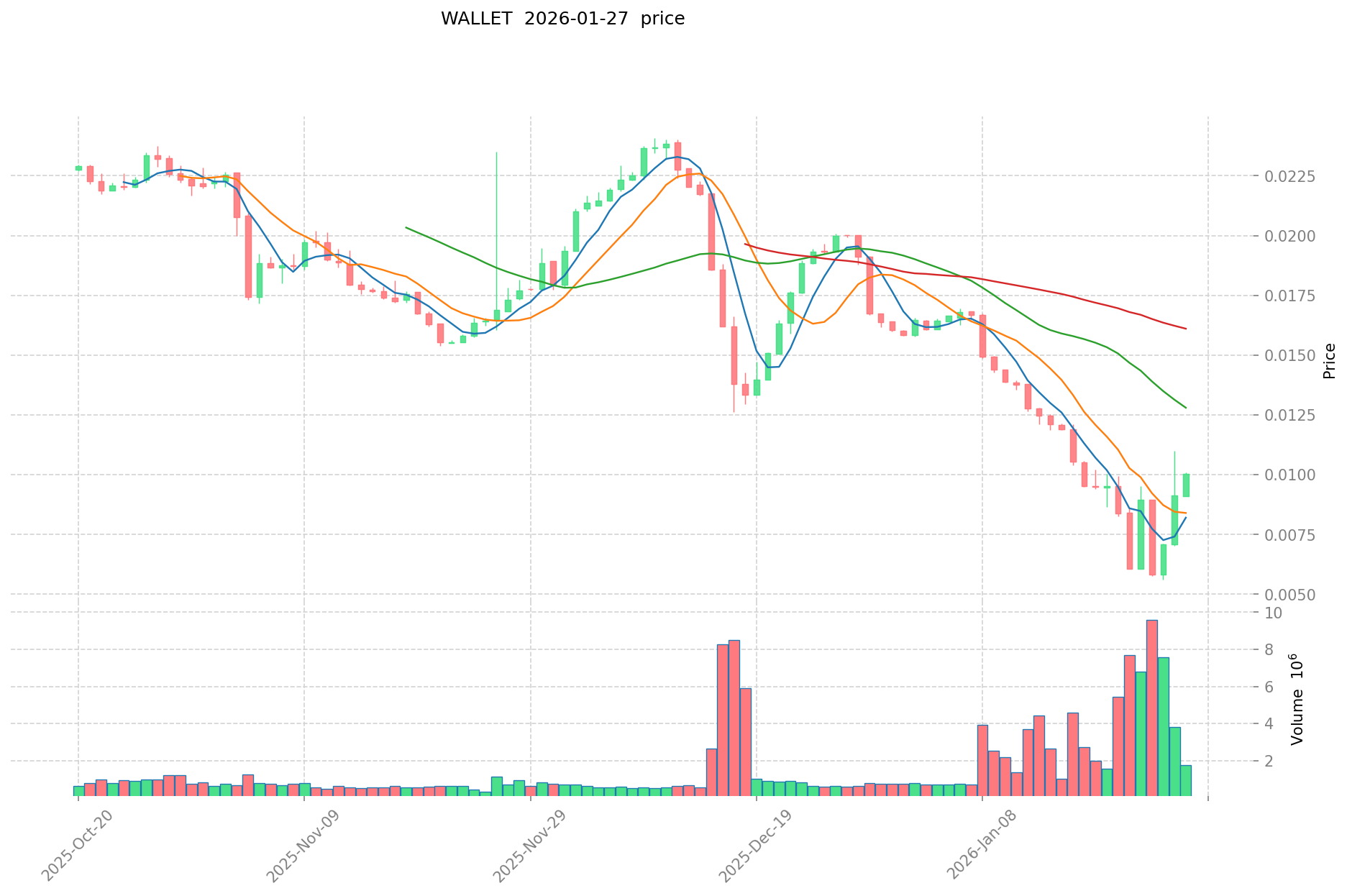
- 2022: WALLET recorded its all-time high of $0.199652 on February 4, 2022, during a period of broader market optimism in the cryptocurrency sector.
- 2023: WALLET reached its historical low of $0.00329061 on September 6, 2023, reflecting challenges faced during a prolonged market downturn.
- 2021: UNI achieved its all-time high of $44.92 on May 3, 2021, coinciding with the launch of Uniswap V3 on the Ethereum mainnet, which generated significant trading activity and positive market sentiment.
- 2020: UNI experienced its historical low of $1.03 on September 17, 2020, shortly after the token's initial distribution and before the protocol gained widespread adoption.
- Comparative Analysis: During the market cycle from 2021 to 2023, WALLET declined from its peak of $0.199652 to a low of $0.00329061, representing a decrease of approximately 98.35%. In contrast, UNI dropped from $44.92 to $1.03 during a similar timeframe, reflecting a decline of approximately 97.71%. Both assets experienced substantial corrections following their respective peaks, though UNI maintained higher absolute price levels throughout the period.
Current Market Status (January 28, 2026)
- WALLET Current Price: $0.010396
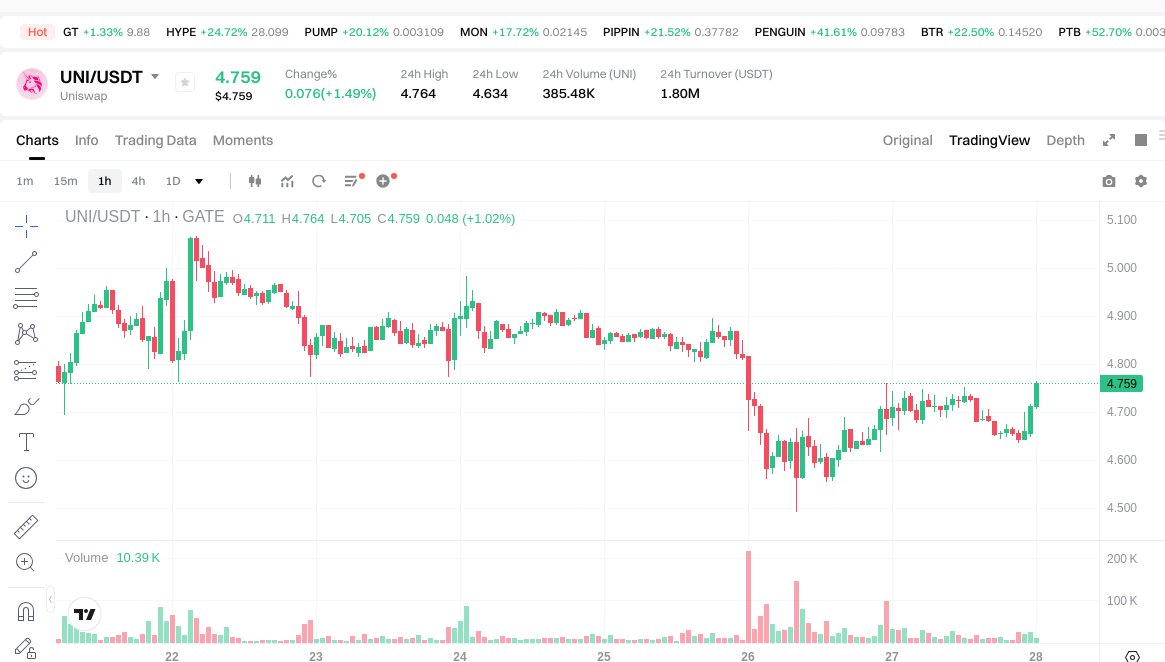
- UNI Current Price: $4.714
- 24-Hour Trading Volume: WALLET recorded $20,848.12 compared to UNI's $1,796,041.04
- Market Sentiment Index (Fear & Greed Index): 29 (Fear)
View real-time prices:
II. Core Factors Influencing WALLET vs UNI Investment Value
Supply Mechanism Comparison (Tokenomics)
-
UNI: Fixed total supply of 1 billion tokens. The distribution allocates 60% to Uniswap community members, 21.51% to team members and future employees (with a four-year vesting period), 17.80% to investors (also with a four-year vesting period), and 0.69% to advisors (with a four-year vesting period). This structured allocation aims to balance community incentives with team and investor interests.
-
WALLET: Information regarding the supply mechanism is not available in the reference materials.
-
📌 Historical Pattern: Token supply mechanisms can influence price cycles through scheduled unlocks and distribution phases. Vesting schedules may create selling pressure upon completion, while community-focused allocations can support long-term holder engagement.
Institutional Adoption and Market Application
-
Institutional Holdings: Reference materials do not provide specific data on institutional preference between UNI and WALLET.
-
Enterprise Adoption: Information on cross-border payment, settlement, or portfolio integration applications for either token is not available in the provided materials.
-
National Policies: The materials mention general regulatory considerations for token issuance (such as securities classification and VASP/CASP regulations) but do not specify jurisdictional stances toward UNI or WALLET individually.
Technical Development and Ecosystem Building
-
UNI Technical Framework: UNI operates as the governance token for Uniswap, a decentralized exchange (DEX) on Ethereum utilizing an automated market maker (AMM) model. The protocol facilitates ERC-20 token swaps and allows liquidity providers to earn fees based on their pool contributions. Governance proposals by UNI holders can influence protocol parameters such as fee structures.
-
WALLET Technical Development: Technical development details are not available in the reference materials.
-
Ecosystem Comparison: Uniswap functions within the DeFi ecosystem, supporting liquidity provision and token exchange. The materials reference its role in decentralized trading and governance, though specific comparisons with WALLET in DeFi, NFT, payment systems, or smart contract deployment are not provided.
Macroeconomic Environment and Market Cycles
-
Performance Under Inflation: The reference materials do not contain analysis on inflation-resistant characteristics of either token.
-
Macroeconomic Monetary Policy: The materials mention that factors such as interest rates and the US Dollar Index can influence cryptocurrency markets broadly, but specific impacts on UNI or WALLET are not detailed.
-
Geopolitical Factors: General observations note that cross-border transaction demand and international conditions may affect digital asset adoption, though token-specific analysis is absent from the provided context.
III. 2026-2031 Price Predictions: WALLET vs UNI
Short-term Prediction (2026)
- WALLET: Conservative $0.0063-$0.0106 | Optimistic $0.0106-$0.013
- UNI: Conservative $2.42-$4.75 | Optimistic $4.75-$6.65
Mid-term Prediction (2028-2029)
- WALLET may enter a gradual growth phase, with estimated price range of $0.012-$0.016
- UNI may enter an expansion phase, with estimated price range of $4.99-$10.45
- Key drivers: institutional capital inflows, ETF developments, ecosystem expansion
Long-term Prediction (2030-2031)
- WALLET: Baseline scenario $0.012-$0.017 | Optimistic scenario $0.017-$0.022
- UNI: Baseline scenario $5.23-$10.06 | Optimistic scenario $10.06-$14.39
View detailed price predictions for WALLET and UNI
Disclaimer: Price predictions are based on historical data analysis and market trend projections. Cryptocurrency markets are highly volatile and subject to numerous factors including regulatory changes, technological developments, and macroeconomic conditions. These predictions should not be considered as investment advice. Users should conduct their own research and consult with financial professionals before making any investment decisions.
WALLET:
| Year |
Predicted High Price |
Predicted Average Price |
Predicted Low Price |
Price Change |
| 2026 |
0.01298019 |
0.010553 |
0.0063318 |
1 |
| 2027 |
0.0148259097 |
0.011766595 |
0.0108252674 |
13 |
| 2028 |
0.0142269900145 |
0.01329625235 |
0.0120995896385 |
27 |
| 2029 |
0.01596348057141 |
0.01376162118225 |
0.010045983463042 |
32 |
| 2030 |
0.019915818174952 |
0.01486255087683 |
0.011741415192695 |
42 |
| 2031 |
0.022084264347881 |
0.017389184525891 |
0.012867996549159 |
67 |
UNI:
| Year |
Predicted High Price |
Predicted Average Price |
Predicted Low Price |
Price Change |
| 2026 |
6.6486 |
4.749 |
2.42199 |
0 |
| 2027 |
6.781572 |
5.6988 |
4.331088 |
20 |
| 2028 |
8.79866226 |
6.240186 |
4.9921488 |
32 |
| 2029 |
10.4519995407 |
7.51942413 |
5.4139853736 |
59 |
| 2030 |
11.142282675834 |
8.98571183535 |
8.5364262435825 |
90 |
| 2031 |
14.39151607549656 |
10.063997255592 |
5.23327857290784 |
113 |
IV. Investment Strategy Comparison: WALLET vs UNI
Long-term vs Short-term Investment Strategies
-
WALLET: May appeal to investors interested in DeFi wallet infrastructure and governance participation within emerging applications. The token's association with user-focused wallet functionality could attract those evaluating early-stage ecosystem development.
-
UNI: May appeal to investors seeking exposure to established decentralized exchange infrastructure and automated market-making protocols. The token's governance role in one of the prominent DeFi platforms could attract those evaluating more mature protocol ecosystems.
Risk Management and Asset Allocation
-
Conservative Investors: Consider allocating 20-30% to WALLET and 70-80% to UNI, reflecting UNI's relatively established market position and historical trading patterns.
-
Aggressive Investors: Consider allocating 40-50% to WALLET and 50-60% to UNI, acknowledging the higher volatility characteristics associated with both assets.
-
Hedging Tools: Portfolio diversification may include stablecoin allocations for liquidity management, options contracts where available, and cross-asset combinations to mitigate concentration risk.
V. Potential Risk Comparison
Market Risk
-
WALLET: The token exhibits limited historical trading volume ($20,848.12 in 24-hour volume as of January 28, 2026), which may result in heightened price volatility and liquidity constraints during periods of market stress.
-
UNI: While demonstrating higher trading volume ($1,796,041.04 in 24-hour volume), the token remains subject to broader DeFi sector dynamics, including liquidity pool performance fluctuations and competitive pressures from alternative DEX platforms.
Technical Risk
-
WALLET: Technical development details are not available in the reference materials, limiting assessment of protocol upgrade roadmaps, security audit frequency, or network performance characteristics.
-
UNI: As an Ethereum-based protocol, UNI inherits dependencies on Ethereum network performance, including gas fee variability and network congestion periods. Smart contract vulnerabilities, though mitigated through audits, remain a consideration in DeFi protocols.
Regulatory Risk
- Global regulatory frameworks continue to evolve regarding governance token classification, decentralized exchange operations, and virtual asset service provider requirements. Both WALLET and UNI may face varying regulatory interpretations across jurisdictions, potentially affecting token utility, listing availability, and compliance obligations. Regulatory developments in major markets could influence market access and operational parameters for both assets.
VI. Conclusion: Which Is the Better Buy?
📌 Investment Value Summary:
-
WALLET Characteristics: The token represents exposure to browser-based wallet infrastructure with governance functionality. Limited available information on supply mechanisms and technical roadmap presents challenges for comprehensive evaluation.
-
UNI Characteristics: The token provides governance participation in an established automated market-making protocol with defined tokenomics (1 billion fixed supply) and measurable trading activity within the DeFi ecosystem.
✅ Investment Considerations:
-
Beginner Investors: Consider focusing on assets with established market presence, transparent documentation, and observable historical patterns. Prioritize understanding fundamental protocol mechanics and governance structures before allocation decisions.
-
Experienced Investors: Evaluate both assets within broader portfolio context, considering correlation with existing holdings, liquidity requirements, and risk tolerance parameters. Monitor ecosystem developments, governance proposal activity, and competitive positioning.
-
Institutional Investors: Conduct comprehensive due diligence on regulatory compliance status, custody infrastructure availability, and audit trail documentation. Assess alignment with institutional mandates regarding asset classification and operational risk frameworks.
⚠️ Risk Disclaimer: Cryptocurrency markets demonstrate significant volatility characteristics. Historical price performance does not indicate future results. This analysis does not constitute investment advice. Market participants should conduct independent research and consult qualified financial professionals before making investment decisions.
VII. FAQ
Q1: What is the fundamental difference between WALLET and UNI tokens?
WALLET serves as a governance and rewards token for the Ambire Wallet application, a browser-based DeFi wallet with email authentication and gas management features. UNI functions as the governance token for Uniswap, an established automated market-making protocol on Ethereum that enables decentralized token exchanges. The primary distinction lies in their ecosystems: WALLET focuses on wallet infrastructure and user experience, while UNI operates within decentralized exchange infrastructure with a fixed supply of 1 billion tokens and measurable liquidity provision mechanisms.
Q2: Which token demonstrates higher trading liquidity?
UNI exhibits significantly higher trading liquidity with a 24-hour trading volume of $1,796,041.04 compared to WALLET's $20,848.12 as of January 28, 2026. This substantial difference—approximately 86 times greater volume for UNI—indicates that UNI holders may experience easier entry and exit positions with potentially lower slippage during transactions. Limited liquidity in WALLET may result in heightened price volatility and wider bid-ask spreads, particularly during periods of market stress or large order execution.
Q3: How do the historical price movements compare between these two assets?
Both tokens experienced substantial corrections following their respective peaks. WALLET declined approximately 98.35% from its February 2022 high of $0.199652 to its September 2023 low of $0.00329061. UNI decreased approximately 97.71% from its May 2021 peak of $44.92 to its September 2020 low of $1.03. While the percentage declines are similar, UNI maintained higher absolute price levels throughout the period and achieved its all-time high during the 2021 bull market coinciding with Uniswap V3 launch, whereas WALLET's peak occurred in early 2022.
Q4: What are the projected price ranges for 2026-2031?
For 2026, WALLET's conservative estimate ranges from $0.0063-$0.0106, with an optimistic scenario of $0.0106-$0.013. UNI's 2026 conservative range sits at $2.42-$4.75, with an optimistic projection of $4.75-$6.65. By 2031, WALLET's baseline scenario estimates $0.012-$0.017 (optimistic: $0.017-$0.022), while UNI's baseline projects $5.23-$10.06 (optimistic: $10.06-$14.39). These predictions reflect UNI's higher absolute price levels and established market positioning compared to WALLET's emerging infrastructure focus.
Q5: What allocation strategy suits different investor profiles?
Conservative investors may consider allocating 20-30% to WALLET and 70-80% to UNI, reflecting UNI's relatively established market position and historical trading patterns. Aggressive investors might allocate 40-50% to WALLET and 50-60% to UNI, acknowledging the higher volatility characteristics of both assets. This differentiation accounts for UNI's demonstrated liquidity advantages and transparent tokenomics versus WALLET's limited available information on supply mechanisms and technical development roadmaps. Portfolio diversification should include stablecoin allocations for liquidity management and consideration of risk tolerance parameters.
Q6: What are the primary risks associated with each token?
WALLET faces market risk from limited trading volume ($20,848.12 daily), potentially causing heightened price volatility and liquidity constraints. Technical risk assessment is limited due to unavailable development information in reference materials. UNI inherits Ethereum network dependencies, including gas fee variability and network congestion, while smart contract vulnerabilities remain considerations despite audit protocols. Both tokens face regulatory risk as global frameworks evolve regarding governance token classification and decentralized exchange operations, with varying interpretations across jurisdictions potentially affecting token utility and compliance obligations.
Q7: How do the tokenomics structures differ between WALLET and UNI?
UNI features a fixed total supply of 1 billion tokens with structured distribution: 60% allocated to community members, 21.51% to team members and future employees (four-year vesting), 17.80% to investors (four-year vesting), and 0.69% to advisors (four-year vesting). This allocation balances community incentives with team and investor interests while creating potential selling pressure upon vesting completion. Information regarding WALLET's supply mechanism, distribution schedule, and vesting parameters is not available in the reference materials, limiting comprehensive tokenomics comparison and long-term supply dynamics assessment.
Q8: Which token is more suitable for institutional investors?
Based on available data, UNI may present more accessible institutional evaluation criteria due to its transparent tokenomics (1 billion fixed supply), established market presence (rank 37 with 0.13% market dominance), and measurable trading activity within the DeFi ecosystem. Institutional investors typically require comprehensive documentation on regulatory compliance status, custody infrastructure availability, and audit trail transparency. WALLET's limited available information on technical development, supply mechanisms, and institutional adoption patterns presents challenges for standard institutional due diligence frameworks. Both assets require assessment of alignment with institutional mandates regarding asset classification and operational risk parameters.
* The information is not intended to be and does not constitute financial advice or any other recommendation of any sort offered or endorsed by Gate.