This comprehensive analysis compares WAVES and BAT, two distinct blockchain platforms with different market positioning and investment potential. WAVES operates as a customized blockchain infrastructure platform emphasizing token creation and scalability since 2016, while BAT functions as a digital advertising token within the Brave browser ecosystem since 2017. The article examines historical price trends, tokenomics, institutional adoption, and technological ecosystems, revealing both tokens have experienced significant volatility from their peaks. Current market data shows WAVES at $0.6737 and BAT at $0.2062 on Gate exchange. Price forecasts through 2031 suggest potential recovery patterns, with WAVES projected toward $0.64-$1.48 and BAT toward $0.31-$0.61 under baseline scenarios. Investment suitability varies by risk profile and market outlook, with conservative investors potentially favoring BAT's established browser ecosystem, while aggressive investors might allocate more toward WAVES' platform expans
Introduction: Investment Comparison Between WAVES and BAT
In the cryptocurrency market, the comparison between WAVES vs BAT has always been a topic that investors cannot avoid. The two not only have significant differences in market cap ranking, application scenarios, and price performance, but also represent different crypto asset positioning.
WAVES (WAVES): Since its launch in 2016, it has gained market recognition with its positioning as a customized blockchain token platform designed for large-scale business and consumption habits, emphasizing security, easy token manipulation, and addressing transaction speed and scalability issues.
BAT (BAT): Since its launch in 2017, it has been positioned as a digital asset for circulation between advertisers and users, solving advertising display and user incentive problems in browsers through the Brave browser-based decentralized digital advertising business.
This article will comprehensively analyze the investment value comparison of WAVES vs BAT around historical price trends, supply mechanisms, institutional adoption, technological ecosystems, and future predictions, and attempt to answer the question that investors are most concerned about:
"Which is the better buy right now?"
I. Historical Price Comparison and Current Market Status
WAVES and BAT Historical Price Trends
- 2022: WAVES experienced significant volatility, with its price declining from a peak of $61.30 in March 2022. This period marked a substantial correction following broader market pressures.
- 2021: BAT benefited from increased adoption within the Brave browser ecosystem, reaching a notable price level of $1.90 in November 2021, reflecting growing interest in privacy-focused digital advertising solutions.
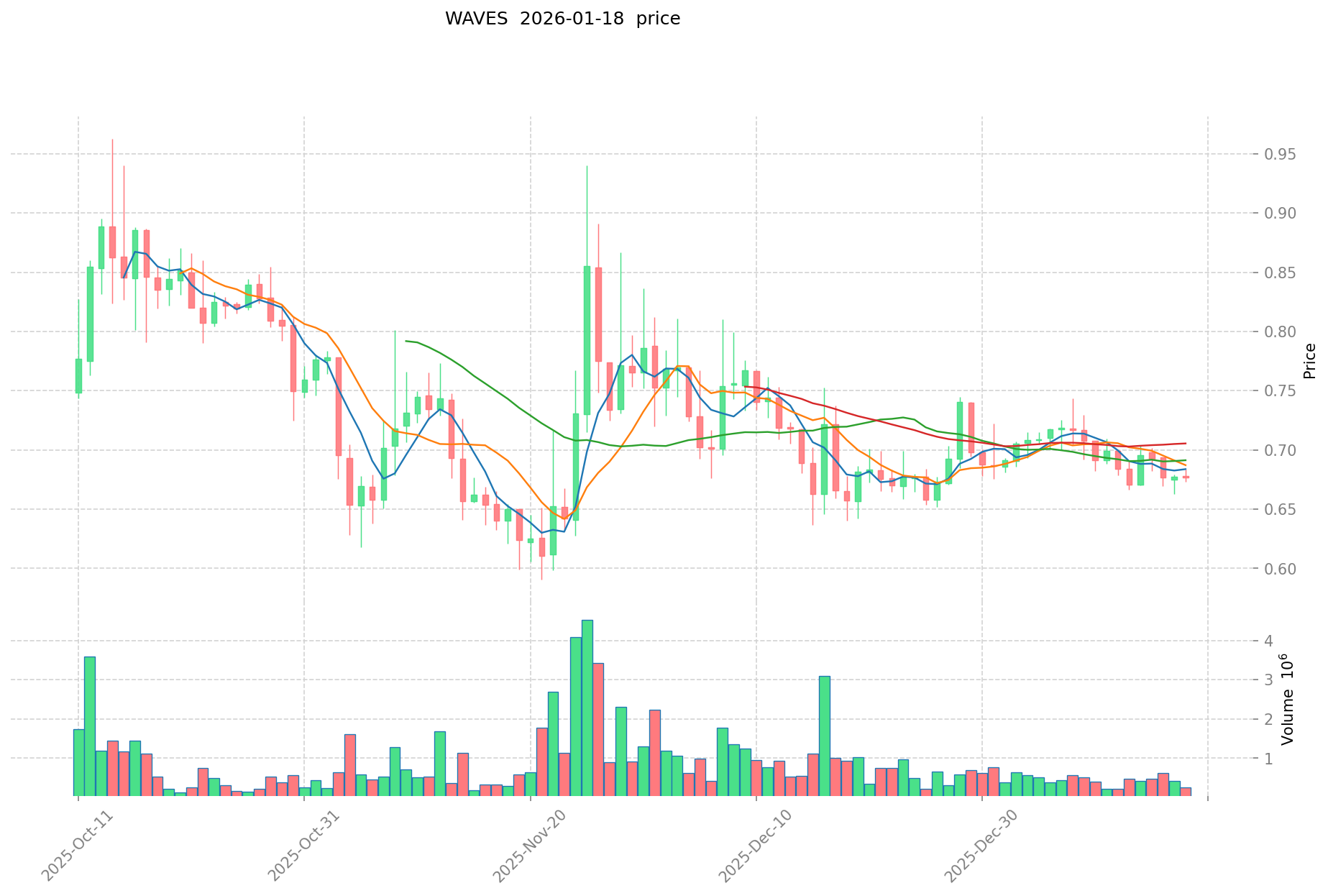
- Comparative Analysis: During the 2021-2022 market cycle, WAVES declined from its all-time high of $61.30 to current levels around $0.67, representing a substantial decrease. In comparison, BAT moved from its peak of $1.90 to approximately $0.21, showing a similar downward trend but from a lower absolute price point.
Current Market Status (2026-01-18)
- WAVES current price: $0.6737
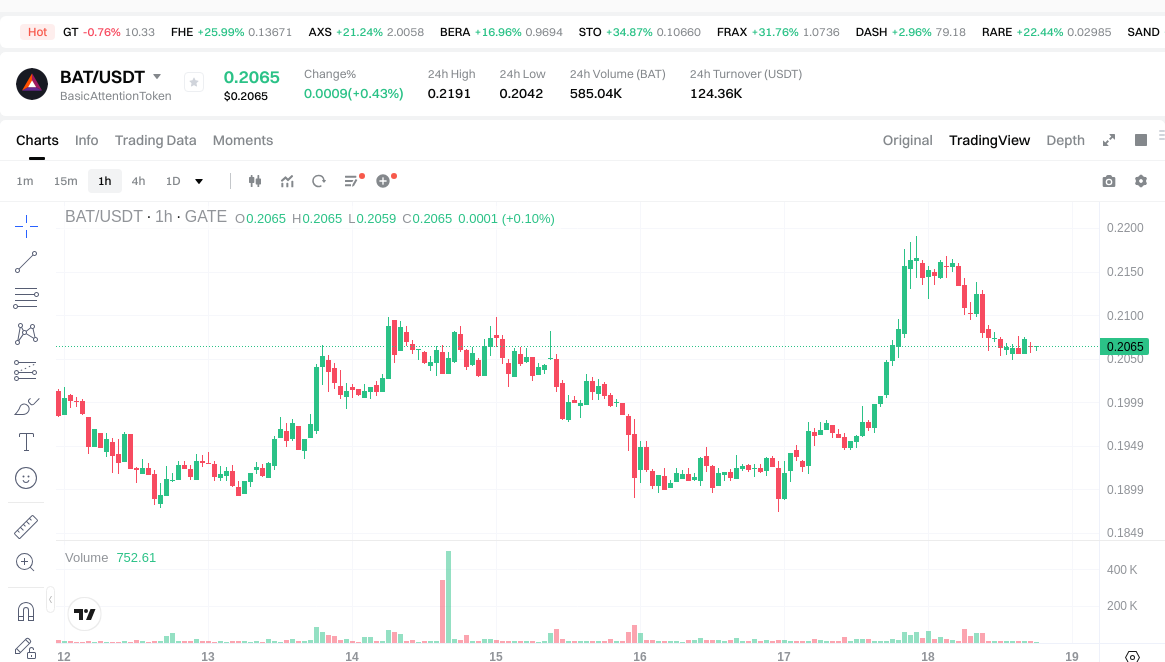
- BAT current price: $0.2062
- 24-hour trading volume: WAVES at $132,092.63 vs BAT at $124,335.97
- Market Sentiment Index (Fear & Greed Index): 49 (Neutral)
View real-time prices:
II. Core Factors Influencing Investment Value of WAVES vs BAT
Tokenomics and Supply Mechanism Comparison
-
BAT: BAT operates with a fixed supply model within the Brave browser ecosystem. The token serves as a medium of exchange between users, content creators, and advertisers in the digital advertising space. According to reference materials, approximately 66.65% of BAT tokens are distributed across various addresses, demonstrating a certain degree of decentralization, while concentrated holdings by large holders may potentially influence price volatility through substantial transactions.
-
WAVES: Information regarding WAVES' specific supply mechanism was not available in the provided materials. The token's valuation appears closely tied to its application within blockchain network infrastructure.
-
📌 Historical Pattern: Supply mechanisms can influence price cycles through their impact on token scarcity and market circulation dynamics, though specific historical data for these tokens was not detailed in the reference materials.
Institutional Adoption and Market Application
-
Institutional Holdings: The reference materials did not provide comparative data on institutional preference between WAVES and BAT.
-
Enterprise Adoption: BAT demonstrates growing adoption through the Brave browser platform among users and content creators in the digital advertising sector. The token's development trajectory appears significantly dependent on Brave browser penetration and overall cryptocurrency market sentiment. WAVES' enterprise application focuses on blockchain network utilization, though specific adoption metrics were not detailed in the provided materials.
-
Regulatory Environment: Both tokens face varying regulatory attitudes across different jurisdictions. BAT encounters regulatory considerations related to digital advertising and user data privacy, while both tokens remain subject to broader cryptocurrency regulatory frameworks that may impact their market performance.
Technology Development and Ecosystem Construction
-
BAT Technology Evolution: BAT functions as the core component of the Brave browser's attention economy model, facilitating value exchange within the digital advertising ecosystem. The platform continues to develop features enabling users to earn rewards for viewing advertisements while providing content creators with alternative monetization channels.
-
WAVES Technology Development: While the reference materials indicated WAVES relies on blockchain network applications, specific technical upgrades and their potential implications were not detailed in the provided documentation.
-
Ecosystem Comparison: BAT's ecosystem centers on digital advertising, user privacy, and content creator monetization within the Brave browser environment. The token demonstrates application in areas related to attention economy and advertising value distribution. Information regarding WAVES' specific positioning in DeFi, NFT, payment systems, or smart contract implementations was not available in the reference materials.
Macroeconomic Environment and Market Cycles
-
Performance in Inflationary Environments: The reference materials did not provide specific comparative analysis of which token demonstrates stronger inflation-resistant characteristics. Both tokens remain subject to broader cryptocurrency market dynamics and investor sentiment shifts.
-
Macroeconomic Monetary Policy: Interest rate fluctuations, US dollar index movements, and broader monetary policy decisions may influence both tokens through their impact on cryptocurrency market liquidity and investor risk appetite. However, specific correlation data was not available in the provided materials.
-
Geopolitical Factors: Cross-border transaction demand and international developments may affect cryptocurrency market sentiment generally. BAT faces challenges and opportunities related to global digital advertising market evolution and user adoption rates. WAVES' sensitivity to geopolitical factors appears related to blockchain infrastructure demand, though specific analysis was not detailed in the reference materials.
III. 2026-2031 Price Forecast: WAVES vs BAT
Short-term Forecast (2026)
- WAVES: Conservative $0.38-$0.67 | Optimistic $0.67-$0.86
- BAT: Conservative $0.20-$0.21 | Optimistic $0.21-$0.27
Mid-term Forecast (2028-2029)
- WAVES may enter a consolidation phase with projected price range of $0.74-$1.14
- BAT may enter a growth phase with projected price range of $0.24-$0.53
- Key drivers: institutional capital inflows, ETF developments, ecosystem expansion
Long-term Forecast (2030-2031)
- WAVES: Baseline scenario $0.64-$1.26 | Optimistic scenario $1.26-$1.48
- BAT: Baseline scenario $0.31-$0.52 | Optimistic scenario $0.52-$0.61
View detailed price predictions for WAVES and BAT
Disclaimer
WAVES:
| Year |
Predicted High Price |
Predicted Average Price |
Predicted Low Price |
Price Change |
| 2026 |
0.860672 |
0.6724 |
0.376544 |
0 |
| 2027 |
0.92750856 |
0.766536 |
0.46758696 |
13 |
| 2028 |
1.0079565132 |
0.84702228 |
0.7369093836 |
25 |
| 2029 |
1.140811957818 |
0.9274893966 |
0.473019592266 |
37 |
| 2030 |
1.47883546840887 |
1.034150677209 |
0.64117341986958 |
53 |
| 2031 |
1.394707310817917 |
1.256493072808935 |
1.14340869625613 |
86 |
BAT:
| Year |
Predicted High Price |
Predicted Average Price |
Predicted Low Price |
Price Change |
| 2026 |
0.274645 |
0.2065 |
0.200305 |
0 |
| 2027 |
0.33199005 |
0.2405725 |
0.170806475 |
16 |
| 2028 |
0.42655909975 |
0.286281275 |
0.240476271 |
38 |
| 2029 |
0.527501877315 |
0.356420187375 |
0.33859917800625 |
72 |
| 2030 |
0.60548661431265 |
0.441961032345 |
0.36682765684635 |
114 |
| 2031 |
0.539435538028689 |
0.523723823328825 |
0.308997055764006 |
153 |
IV. Investment Strategy Comparison: WAVES vs BAT
Long-term vs Short-term Investment Strategies
-
WAVES: May be suitable for investors focused on blockchain infrastructure development and platform ecosystem growth potential. The token's application in customized blockchain solutions could appeal to those monitoring enterprise adoption trends and network utility expansion.
-
BAT: May be suitable for investors interested in digital advertising market evolution and browser-based attention economy models. The token's integration with Brave browser and focus on user privacy in advertising could attract those seeking exposure to alternative monetization frameworks.
Risk Management and Asset Allocation
-
Conservative Investors: A balanced approach might consider WAVES 40-50% vs BAT 50-60%, given BAT's established browser ecosystem presence and WAVES' platform development stage. Conservative allocations typically prioritize established use cases and existing market adoption.
-
Aggressive Investors: A higher-risk portfolio might allocate WAVES 55-65% vs BAT 35-45%, considering potential upside from blockchain platform expansion and broader ecosystem development, though this approach carries increased volatility exposure.
-
Hedging Tools: Stablecoin positions for liquidity management, derivatives instruments where available for downside protection, and cross-asset diversification across different cryptocurrency categories to mitigate concentration risk.
V. Potential Risk Comparison
Market Risks
-
WAVES: Price volatility influenced by blockchain platform adoption rates, competition from alternative infrastructure solutions, and broader cryptocurrency market sentiment cycles. Historical price movements demonstrate significant sensitivity to market conditions.
-
BAT: Market performance tied to Brave browser user growth, digital advertising market dynamics, and cryptocurrency adoption in attention economy applications. Token value may experience fluctuations based on ecosystem development pace and competitive positioning.
Technical Risks
-
WAVES: Considerations regarding platform scalability, network performance under increased transaction volumes, and continued technical development to maintain competitive positioning in blockchain infrastructure space.
-
BAT: Platform dependency on Brave browser technical stability, user experience optimization, and integration challenges within evolving digital advertising landscapes. Ecosystem expansion relies on successful technical implementation and user adoption.
Regulatory Risks
- Both tokens face evolving regulatory frameworks across different jurisdictions. BAT encounters specific considerations related to digital advertising regulations, user data privacy laws, and browser-based cryptocurrency reward mechanisms. WAVES faces regulatory examination related to blockchain platform operations and token utility classifications. Regulatory developments may impact trading availability, compliance requirements, and market accessibility across different regions.
VI. Conclusion: Which Is the Better Buy?
📌 Investment Value Summary
-
WAVES Characteristics: Positioned as a blockchain platform infrastructure solution with applications in customized token creation and network services. Current price levels reflect substantial decline from historical peaks, presenting considerations for both value-oriented and risk-aware investors.
-
BAT Characteristics: Established presence within Brave browser ecosystem with defined use case in digital advertising and attention economy. Token demonstrates application in user reward mechanisms and content creator monetization, with market performance tied to browser adoption trends.
✅ Investment Considerations
-
New Investors: Consider starting with smaller position sizes across both tokens while developing understanding of blockchain infrastructure (WAVES) and digital advertising applications (BAT). Focus on risk management through diversification and avoid concentration in single assets.
-
Experienced Investors: May evaluate portfolio allocation based on individual risk tolerance, market cycle positioning, and thesis regarding blockchain platform adoption versus attention economy development. Consider implementing staged entry strategies and regular portfolio rebalancing.
-
Institutional Participants: Assessment may involve detailed analysis of ecosystem development metrics, regulatory compliance frameworks, liquidity profiles, and alignment with broader portfolio objectives. Due diligence regarding custody solutions, tax implications, and reporting requirements remains essential.
⚠️ Risk Disclosure: Cryptocurrency markets exhibit high volatility and significant price fluctuation risks. This analysis does not constitute investment advice, financial recommendations, or endorsements. Market conditions, regulatory environments, and project developments may change rapidly. Investors should conduct independent research, assess personal risk tolerance, and consult qualified financial advisors before making investment decisions. Past performance does not indicate future results.
VII. FAQ
Q1: What are the main differences between WAVES and BAT in terms of use cases?
WAVES focuses on blockchain platform infrastructure for customized token creation and network services, while BAT operates within the Brave browser ecosystem for digital advertising and attention economy applications. WAVES serves as a foundation for building blockchain solutions with emphasis on scalability and business applications, whereas BAT facilitates value exchange between advertisers, users, and content creators through a browser-based reward mechanism. The fundamental distinction lies in WAVES' positioning as infrastructure technology versus BAT's consumer-facing application in advertising monetization.
Q2: Which token demonstrates better price stability based on historical performance?
Both tokens have experienced significant volatility, with WAVES declining from $61.30 (March 2022) to current levels around $0.67, and BAT falling from $1.90 (November 2021) to approximately $0.21. The percentage declines are comparable, though WAVES showed higher absolute price volatility. Neither token demonstrates strong price stability characteristics, reflecting broader cryptocurrency market dynamics. Investors should note that past volatility patterns may continue, and both assets carry substantial price fluctuation risks typical of cryptocurrency markets.
Q3: How do regulatory risks differ between WAVES and BAT?
BAT faces specific regulatory considerations related to digital advertising regulations, user data privacy laws, and browser-based cryptocurrency reward mechanisms, as its application directly involves user engagement and advertising transactions. WAVES encounters regulatory examination primarily focused on blockchain platform operations and token utility classifications. Both tokens remain subject to evolving cryptocurrency frameworks across different jurisdictions, which may impact trading availability, compliance requirements, and market accessibility. Regulatory developments could affect each token differently based on their distinct application domains.
Q4: What is the projected price outlook for WAVES and BAT through 2031?
According to forecasting models, WAVES shows conservative 2026 estimates of $0.38-$0.67 with optimistic scenarios reaching $0.67-$0.86, potentially growing to $0.64-$1.48 by 2031 under baseline and optimistic conditions. BAT's conservative 2026 projections range from $0.20-$0.21, with optimistic scenarios at $0.21-$0.27, potentially reaching $0.31-$0.61 by 2031. However, these projections carry significant uncertainty and depend on factors including ecosystem development, market adoption, regulatory environment, and overall cryptocurrency market conditions. Past forecasting accuracy in cryptocurrency markets has been limited.
Q5: Which token is more suitable for conservative investors?
Conservative investors might consider a balanced allocation favoring BAT (50-60%) over WAVES (40-50%), given BAT's established integration within the Brave browser ecosystem and defined use case in digital advertising. BAT demonstrates clearer product-market fit with measurable user adoption through browser metrics, while WAVES represents earlier-stage blockchain infrastructure development. However, conservative investors should recognize that both tokens carry substantial volatility risks, and cryptocurrency exposure should represent only a modest portion of diversified portfolios. Risk management through position sizing and diversification remains essential regardless of allocation preferences.
Q6: How does institutional adoption compare between WAVES and BAT?
The reference materials provided limited specific data regarding institutional holdings or comparative institutional preference between WAVES and BAT. BAT shows growing adoption through Brave browser integration among users and content creators in digital advertising, though detailed institutional investment metrics were not available. WAVES' enterprise adoption focuses on blockchain network utilization, but specific institutional participation data was not detailed in provided documentation. Investors seeking information on institutional positioning should conduct additional research through regulatory filings, exchange data, and project announcements from both token ecosystems.
Q7: What are the primary technical risks associated with each token?
WAVES faces technical considerations regarding platform scalability, network performance under increased transaction volumes, and continued development to maintain competitive positioning within blockchain infrastructure space. Competition from alternative platform solutions and technical execution risks remain relevant factors. BAT's technical risks center on platform dependency upon Brave browser stability, user experience optimization, and integration challenges within evolving digital advertising landscapes. Ecosystem expansion relies on successful technical implementation, user retention, and competitive differentiation in the browser market. Both tokens face ongoing development requirements to maintain relevance in rapidly evolving cryptocurrency technology landscapes.
Q8: How should investors approach portfolio allocation between WAVES and BAT?
Portfolio allocation should reflect individual risk tolerance, investment timeframe, and market outlook regarding blockchain infrastructure versus attention economy development. Conservative approaches might favor BAT given its established browser ecosystem, while aggressive strategies might increase WAVES allocation based on platform development potential. A balanced framework could consider WAVES 40-50% versus BAT 50-60% for conservative investors, or WAVES 55-65% versus BAT 35-45% for higher-risk tolerance profiles. Regardless of allocation, investors should implement staged entry strategies, regular rebalancing, hedging through stablecoin positions where appropriate, and maintain cryptocurrency exposure as a limited portion of total investment portfolios aligned with personal financial circumstances.
* The information is not intended to be and does not constitute financial advice or any other recommendation of any sort offered or endorsed by Gate.