This comprehensive guide compares WEN and XLM, two distinct blockchain tokens with different market positioning. WEN, launched in 2024 on Solana, represents cultural tokenization with significant volatility and limited liquidity ($27,169 daily volume). XLM, established since 2014, serves cross-border payment infrastructure with higher trading volume ($719,681 daily) and institutional adoption. The article examines price trends, tokenomics, technical ecosystems, and market applications. Current prices show WEN at $0.000007232 and XLM at $0.20925. Conservative investors may prefer XLM's established infrastructure, while experienced traders might consider WEN's higher-risk exposure. Projections through 2031 indicate varying growth trajectories based on ecosystem development and institutional adoption.
Introduction: Investment Comparison Between WEN and XLM
In the cryptocurrency market, the comparison between WEN vs XLM has become a topic of interest for investors. These two assets exhibit distinct differences in market cap ranking, application scenarios, and price performance, representing fundamentally different positioning within the crypto asset landscape.
WEN (WEN): Launched in 2024, this project fractionalizes @weremeow's poem "A Love Letter to Wen Bros" into tradable units on the Solana network, representing a unique approach to digital asset ownership and cultural expression.
XLM (XLM): Since its inception in 2014, Stellar has established itself as a decentralized gateway for cross-border payments, enabling rapid and low-cost transfers of digital assets between banks, payment institutions, and individuals.
This article will provide a comprehensive analysis of WEN vs XLM investment value comparison, examining historical price trends, supply mechanisms, institutional adoption, technical ecosystems, and future projections, while attempting to address the question investors care about most:
"Which is the better buy right now?"
I. Historical Price Comparison and Current Market Status
WEN and XLM Historical Price Trends
- 2024: WEN experienced significant volatility following its launch in January 2024, reaching an all-time high of $0.00054199 in March 2024. The token saw considerable price fluctuations during its initial trading period.
- 2018: XLM reached its historical peak of $0.875563 in January 2018 during the broader cryptocurrency market boom. The token has since experienced multiple market cycles with varying degrees of volatility.
- Comparative analysis: During the 2024 market cycle, WEN declined from its peak of $0.00054199 to a low of $0.00000128, representing substantial volatility. Meanwhile, XLM has demonstrated relatively more stable trading patterns, though it remains considerably below its 2018 peak, currently trading at approximately 76% below its all-time high.
Current Market Status (2026-01-29)
- WEN current price: $0.000007232
- XLM current price: $0.20925
- 24-hour trading volume: WEN $27,169.43 vs XLM $719,681.83
- Market sentiment index (Fear & Greed Index): 29 (Fear)
View real-time prices:
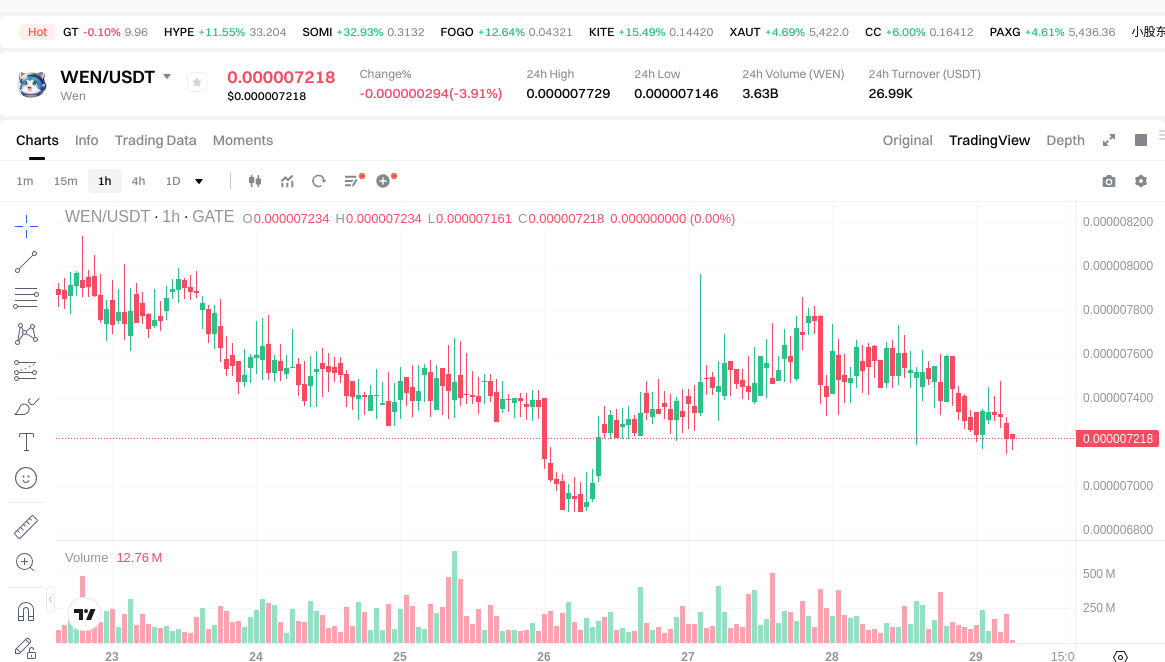
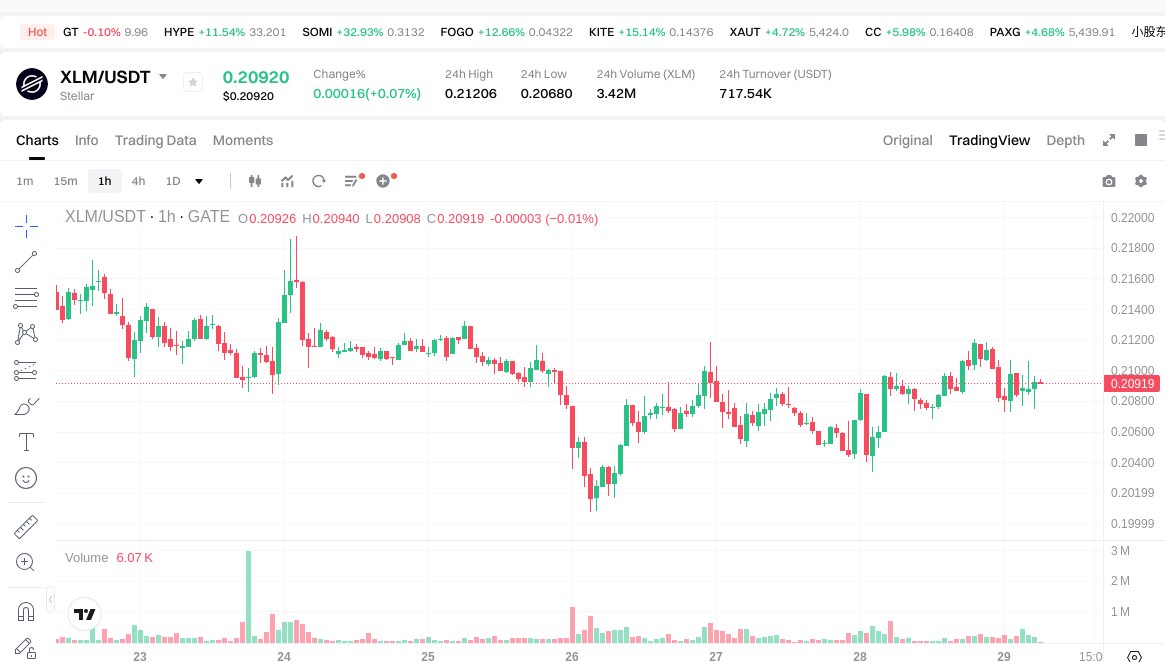
II. Core Factors Influencing WEN vs XLM Investment Value
Supply Mechanism Comparison (Tokenomics)
- WEN: Pricing mechanism is primarily driven by market demand, with supply-demand dynamics directly influencing price cycles.
- XLM: Price structure reflects the underlying value of its asset portfolio and investment composition.
- 📌 Historical Pattern: Changes in supply and demand dynamics directly impact price cycles, with demand growth contributing to potential price appreciation.
Institutional Adoption and Market Applications
- Institutional Holdings: Market data indicates varying levels of institutional interest between the two assets.
- Enterprise Adoption: XLM demonstrates applications in cross-border payment solutions and asset tokenization scenarios, with the network featuring core components including consensus protocols and built-in decentralized exchange functionality that enable rapid creation, transmission, and trading of various digital currencies.
- National Policy: Regulatory approaches toward these assets vary across different jurisdictions, requiring attention to policy developments and regulatory changes.
Technology Development and Ecosystem Building
- WEN Technology: Development is influenced by market demand factors and tokenization efficiency considerations.
- XLM Technology: The network infrastructure includes consensus protocols and decentralized exchange capabilities, enabling users to create, send, and trade various forms of digital currency.
- Ecosystem Comparison: XLM demonstrates presence in payment infrastructure and digital asset exchange functionality, with established protocol frameworks supporting multiple asset types.
Macroeconomic Conditions and Market Cycles
- Performance in Economic Environments: XLM presents growth potential in cross-border payment and asset tokenization sectors, though short-term price volatility represents a consideration for market participants.
- Monetary Policy Factors: Market dynamics and price movements are subject to influence from broader macroeconomic conditions and policy adjustments.
- Risk Considerations: XLM demonstrates established core value propositions within its target use cases, though market participants should anticipate price fluctuations and monitor policy developments that may affect asset performance.
III. 2026-2031 Price Prediction: WEN vs XLM
Short-term Forecast (2026)
- WEN: Conservative $0.00000498 - $0.0000072 | Optimistic $0.0000072 - $0.0000090
- XLM: Conservative $0.128 - $0.209 | Optimistic $0.209 - $0.287
Mid-term Forecast (2028-2029)
- WEN may enter a gradual growth phase, with projected price range of $0.0000084 - $0.0000134
- XLM may enter a moderate expansion phase, with projected price range of $0.164 - $0.359
- Key drivers: institutional capital inflows, ETF developments, ecosystem expansion
Long-term Forecast (2030-2031)
- WEN: Baseline scenario $0.0000067 - $0.000012 | Optimistic scenario $0.000012 - $0.000014
- XLM: Baseline scenario $0.212 - $0.323 | Optimistic scenario $0.323 - $0.408
View detailed price predictions for WEN and XLM
Disclaimer
WEN:
| Year |
Predicted High Price |
Predicted Average Price |
Predicted Low Price |
Price Change |
| 2026 |
0.0000090225 |
0.000007218 |
0.00000498042 |
0 |
| 2027 |
0.0000106375275 |
0.00000812025 |
0.0000041413275 |
12 |
| 2028 |
0.000011723610937 |
0.00000937888875 |
0.000008440999875 |
29 |
| 2029 |
0.000013400087301 |
0.000010551249843 |
0.000009812662354 |
45 |
| 2030 |
0.000012813965372 |
0.000011975668572 |
0.0000067063744 |
65 |
| 2031 |
0.0000135103505 |
0.000012394816972 |
0.000010783490766 |
71 |
XLM:
| Year |
Predicted High Price |
Predicted Average Price |
Predicted Low Price |
Price Change |
| 2026 |
0.2867273 |
0.20929 |
0.1276669 |
0 |
| 2027 |
0.307530726 |
0.24800865 |
0.1711259685 |
18 |
| 2028 |
0.29721356616 |
0.277769688 |
0.26665890048 |
32 |
| 2029 |
0.35936453385 |
0.28749162708 |
0.1638702274356 |
37 |
| 2030 |
0.33959948448825 |
0.323428080465 |
0.24903962195805 |
54 |
| 2031 |
0.407761952446248 |
0.331513782476625 |
0.21216882078504 |
58 |
IV. Investment Strategy Comparison: WEN vs XLM
Long-term vs Short-term Investment Strategies
- WEN: May attract investors interested in cultural tokenization concepts and emerging Solana-based assets, though the asset demonstrates considerable price volatility and limited established use cases.
- XLM: May appeal to investors seeking exposure to cross-border payment infrastructure and digital asset exchange functionality, with established protocol frameworks and demonstrated institutional applications.
Risk Management and Asset Allocation
- Conservative investors: WEN 5-10% vs XLM 15-25% (within overall crypto allocation)
- Aggressive investors: WEN 15-20% vs XLM 25-35% (within overall crypto allocation)
- Hedging instruments: stablecoin allocation, options strategies, cross-asset portfolio diversification
V. Potential Risk Comparison
Market Risk
- WEN: The asset exhibits substantial price volatility, with limited trading volume ($27,169.43 in 24-hour period) potentially affecting liquidity. Market sentiment indicators suggest cautious positioning (Fear & Greed Index: 29).
- XLM: Price movements reflect broader cryptocurrency market cycles, with current trading approximately 76% below historical peak levels. The asset demonstrates relatively higher trading volume ($719,681.83 in 24-hour period) compared to WEN.
Technical Risk
- WEN: Considerations include network scalability on the Solana platform and market adoption dynamics for cultural tokenization concepts.
- XLM: Technical considerations involve network stability, consensus protocol performance, and ongoing development of decentralized exchange infrastructure.
Regulatory Risk
- Global regulatory approaches toward digital assets may differentially impact these tokens based on their respective use cases. XLM's positioning in payment infrastructure may attract specific regulatory attention in cross-border transaction frameworks, while WEN's cultural tokenization model faces evolving regulatory treatment of digital collectibles and fractional ownership models.
VI. Conclusion: Which Is the Better Buy?
📌 Investment Value Summary:
- WEN advantages: Represents exposure to cultural tokenization concepts on the Solana network, with potential for growth if adoption of fractional digital ownership models expands.
- XLM advantages: Established infrastructure for cross-border payments and digital asset exchange, demonstrated institutional applications, and presence in payment solution frameworks with core protocol components supporting multiple asset types.
✅ Investment Recommendations:
- Beginner investors: Consider starting with XLM due to its established use cases and relatively higher trading volume, maintaining conservative position sizing within diversified portfolios.
- Experienced investors: May evaluate both assets based on risk tolerance and portfolio objectives, with WEN representing higher volatility exposure and XLM offering payment infrastructure positioning.
- Institutional investors: XLM may align with strategies focused on payment infrastructure and digital asset exchange capabilities, subject to institutional risk management frameworks and regulatory compliance requirements.
⚠️ Risk Disclosure: Cryptocurrency markets demonstrate extreme volatility. This content does not constitute investment advice.
VII. FAQ
Q1: What are the fundamental differences between WEN and XLM as investment assets?
WEN is a cultural tokenization project launched in 2024 that fractionalizes digital poetry on the Solana network, representing an experimental approach to digital asset ownership. XLM (Stellar) is an established payment infrastructure protocol since 2014, designed for cross-border transactions and digital asset exchange with institutional adoption. The primary distinction lies in their use cases: WEN focuses on cultural expression and collectible fractionalization, while XLM provides functional payment and asset transfer infrastructure with demonstrated enterprise applications.
Q2: Which asset demonstrates better liquidity and trading volume?
XLM significantly outperforms WEN in liquidity metrics. As of January 29, 2026, XLM's 24-hour trading volume reaches $719,681.83 compared to WEN's $27,169.43, representing approximately 26 times higher trading activity. This substantial difference indicates that XLM offers easier entry and exit positions with reduced slippage risk, making it more suitable for larger position sizes and institutional participation. The higher liquidity in XLM also contributes to more stable price discovery mechanisms and reduced susceptibility to manipulation.
Q3: How do the price volatility profiles compare between WEN and XLM?
WEN exhibits substantially higher volatility, having declined from its March 2024 peak of $0.00054199 to a low of $0.00000128, representing extreme price swings characteristic of newly launched tokens with limited market capitalization. XLM demonstrates relatively moderate volatility patterns, trading approximately 76% below its 2018 all-time high but maintaining more predictable price movements within established trading ranges. The current market sentiment (Fear & Greed Index: 29) suggests cautious positioning across both assets, though WEN's limited price history and lower trading volume amplify volatility risk compared to XLM's multi-year trading track record.
Q4: What are the projected returns for both assets over the next five years?
Based on conservative projections, WEN may trade between $0.00000498 and $0.000012 by 2031, representing potential appreciation from current levels of $0.000007232. XLM's conservative forecast suggests a range of $0.212 to $0.323 by 2031, compared to its current price of $0.20925. Optimistic scenarios project WEN reaching $0.000014 and XLM achieving $0.408 by 2031. However, these projections carry significant uncertainty, particularly for WEN given its brief trading history. XLM's forecasts benefit from established adoption patterns and infrastructure positioning, though both assets remain subject to broader cryptocurrency market cycles and macroeconomic conditions.
Q5: What regulatory considerations differentiate WEN and XLM?
XLM faces regulatory scrutiny related to payment infrastructure and cross-border transaction frameworks, as its core functionality involves facilitating international money transfers and asset exchange. Regulatory clarity or restrictions in payment services may directly impact XLM's adoption trajectory. WEN encounters evolving regulatory treatment of digital collectibles and fractional ownership models, with uncertainty surrounding how authorities classify cultural tokenization projects. The regulatory risk profile differs substantially: XLM operates in more defined regulatory territory with established compliance frameworks, while WEN navigates emerging regulatory approaches to novel digital asset categories.
Q6: How should portfolio allocation differ based on investor risk tolerance?
Conservative investors may consider allocating 5-10% to WEN and 15-25% to XLM within their overall cryptocurrency portfolio, recognizing WEN's experimental nature and XLM's established infrastructure positioning. Aggressive investors with higher risk tolerance might allocate 15-20% to WEN and 25-35% to XLM, accepting greater volatility exposure in exchange for potential upside. Both allocation strategies assume cryptocurrency represents a minority portion of total portfolio holdings. Risk management should include hedging instruments such as stablecoin reserves, options strategies for downside protection, and cross-asset diversification to mitigate cryptocurrency-specific volatility.
Q7: What ecosystem developments could significantly impact the relative value of WEN versus XLM?
For XLM, critical developments include institutional adoption of Stellar's payment infrastructure, expansion of supported asset types on the network, technological improvements to consensus protocols and transaction throughput, and integration with traditional financial institutions for cross-border settlement. Regulatory clarity in key jurisdictions regarding payment tokens would substantially affect XLM's growth trajectory. For WEN, value drivers include broader adoption of cultural tokenization concepts, expansion of the Solana ecosystem, development of secondary markets for fractionalized digital assets, and establishment of sustainable use cases beyond speculative trading. Both assets remain subject to overall cryptocurrency market sentiment and macroeconomic factors influencing risk asset allocation.
Q8: Which asset is more appropriate for beginner cryptocurrency investors?
XLM represents a more suitable entry point for beginner investors due to several factors: established trading history since 2014 providing price reference points, significantly higher liquidity reducing execution risk, demonstrated real-world applications in payment infrastructure offering fundamental value assessment, and relatively lower volatility compared to newly launched tokens. Beginners can more easily research XLM's technology, partnerships, and adoption metrics through extensive available information. WEN's brief trading history, extreme volatility, experimental use case, and limited liquidity present challenges for investors without experience in managing high-risk digital assets. Conservative position sizing and portfolio diversification remain essential regardless of asset selection.
* The information is not intended to be and does not constitute financial advice or any other recommendation of any sort offered or endorsed by Gate.