This comprehensive guide examines whale accumulation patterns and their pivotal influence on PEPE's market dynamics. The article synthesizes on-chain data analysis, technical indicators, support and resistance levels, and macroeconomic factors to provide investors with actionable market insights. Key sections explore whale behavior during volatility, trading volume analysis, and blockchain transaction patterns that signal accumulation phases. Technical analysis reveals critical support zones at $0.00000550 and $0.00000500, with resistance at $0.00000620-$0.00000685. The guide addresses PEPE's speculative nature, community-driven sentiment, and associated risks while offering strategies for tracking whale wallet activities through blockchain analytics. Designed for both retail and institutional participants, this analysis helps readers identify market turning points, optimize entry and exit timing through smart money flows, and implement disciplined risk management in volatile meme coin markets.
Understanding Whale Accumulation in PEPE
Whale accumulation plays a pivotal role in influencing the price movements of PEPE, a popular meme coin that has garnered significant attention from both retail and institutional investors. Whales, defined as large cryptocurrency holders who control substantial token quantities, often shape market trends through their strategic accumulation or distribution activities.
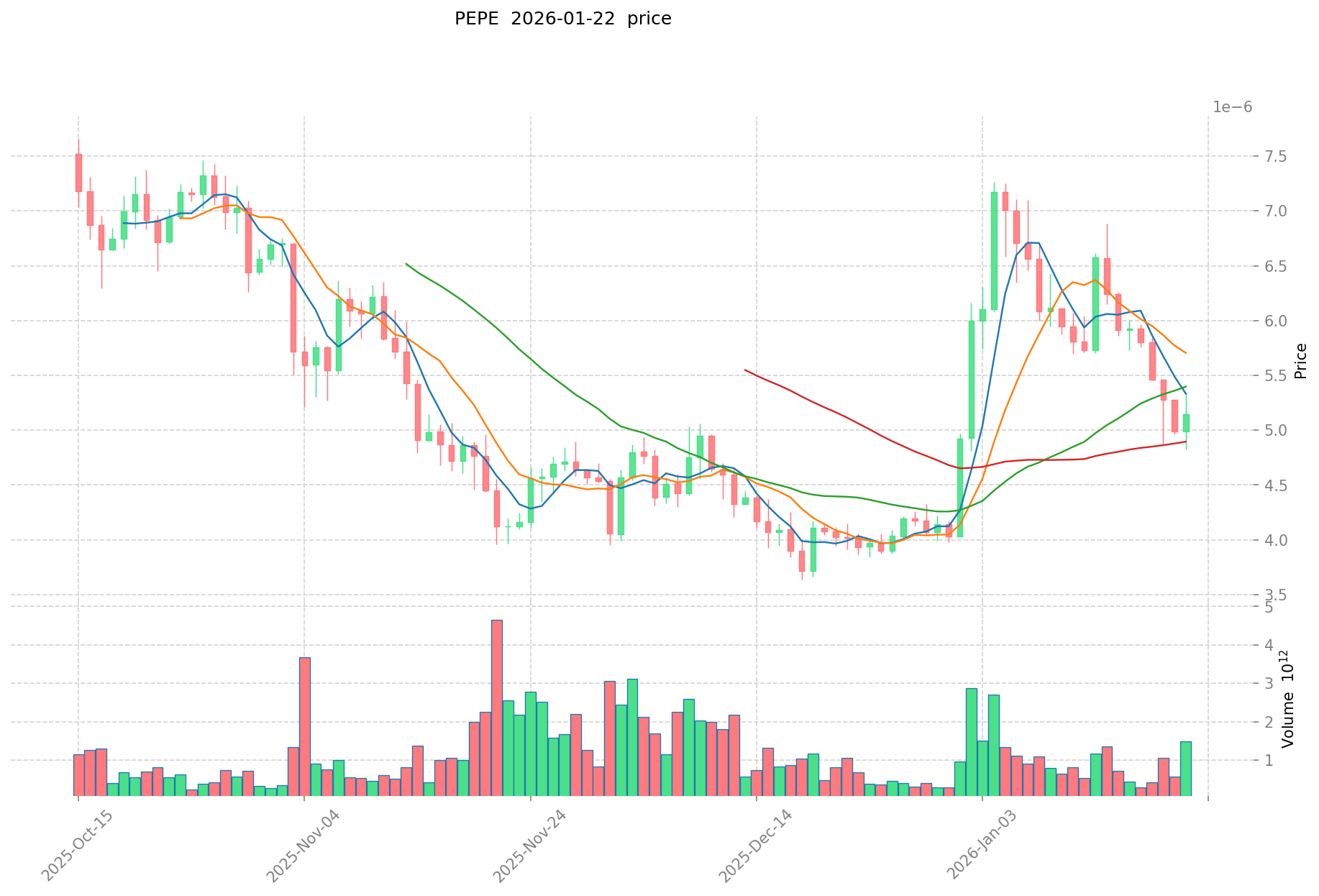 Historical data patterns suggest that whale activity in PEPE has consistently served as a leading indicator for potential price movements, even during periods of heightened market volatility.
The concept of whale accumulation refers to the strategic acquisition of large token quantities by major holders, typically during price consolidation or correction phases. This behavior pattern has been particularly evident in PEPE's trading history, where significant wallet addresses have demonstrated consistent buying pressure during market downturns. Understanding these accumulation patterns provides valuable insights into potential bullish recovery scenarios and helps market participants anticipate future price trajectories.
In this comprehensive analysis, we'll examine the intricate dynamics of whale accumulation in PEPE, explore critical support and resistance levels through technical analysis, and investigate the broader macroeconomic and social factors that influence its price movements. This multifaceted approach enables a deeper understanding of PEPE's market behavior and the forces driving its valuation.
Whale Accumulation and Selling Trends
Whale behavior offers critical insights into the market sentiment surrounding PEPE and serves as a barometer for institutional confidence. Observable data patterns reveal that whales have been actively accumulating PEPE during price dips, indicating strong conviction in the token's long-term value proposition. This accumulation strategy is often accompanied by substantial stablecoin inflows into PEPE trading pairs, suggesting that large holders are strategically positioning themselves for potential price breakouts.
The mechanics of whale accumulation typically involve gradual purchases spread across multiple transactions to minimize market impact. Sophisticated whales often employ strategies such as accumulating during low-volume periods or using over-the-counter (OTC) transactions to build positions without triggering significant price movements. These tactical approaches allow them to acquire substantial holdings while maintaining favorable entry prices.
However, whale activity represents a double-edged sword in cryptocurrency markets. While accumulation phases can generate bullish momentum and attract retail participation, large-scale distribution by whales can trigger significant price corrections and cascade liquidations. Historical examples in PEPE's trading history demonstrate how sudden whale selling events have led to rapid price declines of 20-30% within short timeframes. Therefore, monitoring whale wallet activity through blockchain analytics tools becomes essential for understanding PEPE's market dynamics and anticipating potential price movements before they materialize.
Key Support and Resistance Levels for PEPE
Technical analysis reveals critical support and resistance levels that have historically shaped PEPE's price trajectory and continue to influence trading decisions. These price zones represent areas where significant buying or selling pressure has emerged, creating inflection points that determine short-term trend directions.
Support Levels: The $0.00000550 level has consistently functioned as a strong price floor during consolidation periods, with multiple successful tests demonstrating its significance. This support zone has absorbed substantial selling pressure on numerous occasions, indicating concentrated buying interest from both whales and retail participants. Additionally, the $0.00000500 level serves as a secondary support zone, representing a psychological barrier and historical accumulation area. Price action near these support levels often triggers increased buying activity, as traders view these zones as attractive entry points.
Resistance Levels: On the upside, PEPE faces immediate resistance between $0.00000620 and $0.00000685, representing a consolidation zone where previous rallies have encountered profit-taking pressure. A decisive breakout above $0.00000685 with strong volume confirmation could pave the way for further upward movement toward the $0.00000750-$0.00000800 range. Historical price action suggests that breaching these resistance levels typically requires sustained whale accumulation and broader market support.
Traders and investors should closely monitor these levels alongside volume profiles, as they often dictate short-term price trends and provide valuable risk-reward reference points for position management. The interaction between price and these key levels frequently generates trading opportunities while also serving as stop-loss placement guides for risk management.
Technical Analysis of PEPE's Price Movements
Several technical indicators and chart patterns suggest that PEPE may be transitioning into an accumulation phase, characterized by decreasing volatility and consolidating price action. This phase typically precedes significant directional moves and represents a period where smart money accumulates positions before the next trend emerges.
Relative Strength Index (RSI): PEPE's RSI readings indicate that the token has approached oversold territory on multiple timeframes, historically a condition that precedes price reversals. When RSI values drop below 30, it suggests that selling pressure may be exhausted and a bounce becomes increasingly probable. The current RSI trajectory shows bullish divergence patterns, where price makes lower lows while RSI forms higher lows, indicating weakening bearish momentum.
Fibonacci Retracement Levels: PEPE is consolidating near key Fibonacci retracement zones, particularly the 0.618 and 0.786 levels, which are often regarded as golden ratio support areas. These mathematical levels have demonstrated remarkable accuracy in identifying potential reversal zones throughout PEPE's trading history. Price consolidation at these Fibonacci levels, combined with decreasing selling volume, often serves as a precursor to breakout movements.
Moving Average Analysis: The relationship between short-term and long-term moving averages provides additional context. PEPE's price interaction with the 50-day and 200-day moving averages suggests potential trend changes, with recent price action testing these dynamic support levels.
While these technical indicators collectively point toward a constructive scenario, it remains crucial to consider external factors such as broader market sentiment, Bitcoin's price trajectory, and macroeconomic conditions, which can override technical signals and influence PEPE's price movements independently.
On-Chain Data Insights
On-chain data provides invaluable insights into the underlying market dynamics surrounding PEPE, offering transparency that traditional markets cannot match. Blockchain analytics reveal the actual movement of tokens, wallet behavior, and transaction patterns that drive price action.
Trading Volume Analysis: Observable increases in trading volume indicate renewed interest in PEPE from both whales and retail investors. Volume spikes often precede significant price movements, as they reflect increased market participation and conviction. Analyzing volume profiles across different price levels helps identify accumulation and distribution zones, providing context for future price behavior.
Wallet Activity Metrics: An expansion in active wallet addresses suggests growing participation in the PEPE ecosystem, further supporting the thesis for potential recovery. The number of addresses holding PEPE for extended periods (often called "hodlers") has shown steady growth, indicating long-term confidence despite short-term volatility. Additionally, the distribution of PEPE across wallet sizes reveals whether accumulation is concentrated among whales or distributed more democratically across retail participants.
Exchange Flow Data: Monitoring token flows between exchanges and private wallets offers insights into holder intentions. Net outflows from exchanges typically indicate accumulation behavior, as tokens move to cold storage for long-term holding. Conversely, significant exchange inflows may signal preparation for selling activity.
Transaction Value Analysis: Examining the average transaction size and frequency of large transfers (typically defined as movements exceeding $100,000 in value) helps identify whale activity patterns and their potential market impact.
These comprehensive on-chain metrics underscore the growing demand dynamics for PEPE, even as the broader cryptocurrency market experiences periodic fluctuations and uncertainty.
The Impact of Macroeconomic Factors
Macroeconomic conditions exert significant influence on the price movements of speculative assets like PEPE, often determining the broader risk appetite that drives capital allocation decisions. Understanding these macro forces provides essential context for interpreting PEPE's price behavior within the larger financial ecosystem.
Monetary policy decisions by central banks, particularly regarding interest rates and quantitative easing programs, directly impact liquidity conditions in financial markets. Accommodative monetary policies that lower borrowing costs and increase money supply tend to drive capital toward higher-risk, higher-reward assets, including meme coins like PEPE. This liquidity influx can amplify both rallies and corrections, creating pronounced volatility cycles.
Inflation dynamics also play a crucial role in cryptocurrency valuations. During periods of elevated inflation concerns, some investors view cryptocurrencies as alternative stores of value, potentially increasing demand for tokens like PEPE. However, when central banks respond to inflation with aggressive rate hikes, risk assets typically face selling pressure as capital flows toward safer, yield-bearing instruments.
Global economic uncertainty, geopolitical tensions, and regulatory developments further influence market sentiment toward speculative cryptocurrencies. Major economic events, such as banking crises or significant policy announcements, can trigger rapid shifts in risk appetite that cascade through cryptocurrency markets.
For PEPE investors, staying informed about these broader economic trends becomes crucial for contextualizing price movements and making informed decisions. The correlation between macroeconomic conditions and PEPE's price action, while not always direct, provides important framework for understanding market cycles and timing investment strategies.
PEPE's market dynamics are profoundly influenced by social media trends and community-driven sentiment, distinguishing it from traditional financial assets and even many other cryptocurrencies. The meme coin's value proposition relies heavily on cultural relevance, viral marketing, and collective enthusiasm rather than fundamental utility or technological innovation.
Social media platforms, particularly Twitter, Reddit, and Telegram, serve as primary drivers of PEPE's price volatility. Viral trends, creative memes, and endorsements from influential figures can rapidly shift market sentiment, leading to significant price movements within hours. The decentralized nature of these communities means that sentiment can change quickly, creating both opportunities and risks for participants.
The psychology of FOMO (Fear of Missing Out) plays an outsized role in PEPE's price dynamics. When social media buzz intensifies and price begins rising, retail investors often rush to participate, creating self-reinforcing momentum. Conversely, negative sentiment or coordinated FUD (Fear, Uncertainty, and Doubt) campaigns can trigger equally dramatic selloffs.
Community engagement metrics, such as social media mentions, sentiment analysis scores, and trending rankings, have demonstrated predictive value for PEPE's short-term price movements. Sophisticated traders increasingly incorporate these alternative data sources into their analysis frameworks, recognizing that community sentiment often leads price action in meme coin markets.
While this community-driven dynamic creates opportunities for substantial short-term gains, it simultaneously highlights the speculative and unpredictable nature of PEPE as an investment asset. The lack of fundamental anchors means that price can deviate significantly from any rational valuation framework, driven purely by collective belief and momentum.
Whale Strategies During Market Volatility
Whales employ sophisticated strategies during periods of market volatility, leveraging their substantial capital reserves and market intelligence to accumulate positions at favorable prices. Understanding these strategies provides valuable insights into potential market turning points and helps smaller investors align their positioning with smart money flows.
Strategic accumulation during price dips represents a core whale strategy. By purchasing large quantities of PEPE during panic selling events or market corrections, whales position themselves to capitalize on subsequent recovery rallies. This contrarian approach requires conviction and patience, as accumulation often occurs during periods of maximum pessimism when retail sentiment remains bearish.
Whales frequently employ dollar-cost averaging (DCA) strategies, spreading their purchases across multiple price points and timeframes to build positions without causing excessive price impact. This methodical approach allows them to accumulate substantial holdings while maintaining average entry prices below key resistance levels.
Another common whale strategy involves creating liquidity through limit orders at strategic support levels. By placing large buy orders at predetermined price points, whales establish price floors that absorb selling pressure and signal confidence to the broader market. These visible support levels often attract additional buying interest from retail participants who interpret whale activity as bullish validation.
Whale behavior significantly impacts market liquidity and influences retail investor sentiment. When blockchain analytics reveal sustained whale accumulation, it often triggers FOMO among smaller investors who view such activity as insider validation of PEPE's potential. This psychological effect can amplify price movements and create self-fulfilling prophecies.
However, whales also employ distribution strategies during euphoric market phases, gradually selling into strength to realize profits. Recognizing the difference between accumulation and distribution phases becomes crucial for avoiding unfavorable entry points and protecting capital during market reversals.
Speculative Nature and Associated Risks
As a meme coin, PEPE embodies inherently speculative characteristics and carries elevated risk levels that distinguish it from more established cryptocurrencies and traditional financial assets. Understanding these risks is essential for appropriate position sizing and risk management.
The primary risk stems from PEPE's lack of fundamental value drivers or utility beyond its cultural and community appeal. Unlike cryptocurrencies with specific use cases, technological innovations, or economic models, PEPE's value derives almost entirely from collective belief and market sentiment. This creates extreme vulnerability to rapid sentiment shifts that can trigger severe price corrections.
Volatility represents another defining characteristic of PEPE's risk profile. Price swings of 20-50% within single trading sessions are not uncommon, creating challenges for risk management and position sizing. Such volatility can quickly turn profitable positions into significant losses, particularly for leveraged traders or those with inadequate stop-loss discipline.
Liquidity risk becomes pronounced during market stress periods. While PEPE maintains reasonable liquidity during normal market conditions, panic selling events can cause liquidity to evaporate rapidly, resulting in severe slippage and difficulty executing large orders at desired prices. This liquidity dynamic disproportionately affects larger position holders who cannot exit quickly without significant market impact.
Regulatory uncertainty poses additional risks to meme coins. As regulatory frameworks for cryptocurrencies continue evolving globally, meme coins without clear utility face potential classification challenges and possible restrictions that could impair their tradability or value.
Market manipulation risks also warrant consideration. The concentrated holder distribution and relatively smaller market capitalization make PEPE susceptible to price manipulation by large holders or coordinated groups. Pump-and-dump schemes, though less common in established tokens, remain possible threats.
Despite these substantial risks, PEPE offers potential rewards for investors with appropriate risk tolerance and capital allocation strategies. The key lies in recognizing PEPE as a speculative, high-risk asset suitable only for capital that investors can afford to lose entirely. Proper position sizing, typically limiting meme coin exposure to a small percentage of overall portfolio value, helps manage downside risk while maintaining upside participation.
Conclusion
Whale accumulation in PEPE serves as a critical driver of its price movements, offering valuable insights into market sentiment, capital flows, and potential future trends. By synthesizing on-chain data analysis, technical indicators, macroeconomic factors, and community sentiment, investors can develop a comprehensive understanding of the complex dynamics influencing PEPE's valuation.
The interplay between whale accumulation patterns and retail participation creates distinct market phases that present both opportunities and risks. Recognizing these phases through careful analysis of support and resistance levels, volume profiles, and blockchain metrics enables more informed decision-making and strategic positioning.
However, given PEPE's fundamentally speculative nature and elevated risk profile, approaching this asset with appropriate caution and risk management discipline remains essential. The lack of intrinsic value drivers means that price movements are primarily sentiment-driven, creating vulnerability to rapid reversals that can quickly erode capital.
Successful navigation of PEPE's market requires continuous monitoring of multiple data streams: whale wallet activity, technical chart patterns, support and resistance levels, on-chain metrics, macroeconomic trends, and social media sentiment. This multifaceted analytical approach helps identify potential inflection points and manage risk exposure effectively.
For investors willing to embrace the inherent volatility and risks, PEPE presents an intriguing opportunity within the cryptocurrency ecosystem. The token's strong community support, periodic whale accumulation phases, and potential for explosive price movements create possibilities for substantial returns. However, these potential rewards must be balanced against the very real risks of significant capital loss.
Ultimately, PEPE's future trajectory will depend on sustained whale confidence, broader cryptocurrency market conditions, regulatory developments, and the community's ability to maintain engagement and cultural relevance. Staying informed, maintaining disciplined risk management, and approaching PEPE as a speculative allocation rather than a core holding will be crucial for navigating the ever-evolving landscape of this distinctive meme coin.
FAQ
What is Whale Accumulation and why is PEPE whale buying behavior important?
Whale accumulation refers to large investors buying significant PEPE amounts, signaling confidence and potentially driving price momentum. Their substantial transaction volume influences market sentiment, liquidity, and can trigger broader investor interest, making whale activity a key indicator of market direction.
How to identify and track whale wallet activities in PEPE?
Monitor on-chain data using blockchain explorers to track large PEPE transactions and wallet movements. Analyze transaction amounts, wallet holding patterns, and accumulation trends. Use on-chain analytics tools to identify dormant wallets becoming active, sudden balance changes, and address clustering. Watch for sustained buying pressure and wallet consolidation, which often signal whale accumulation phases and potential market movements.
What impact does whale accumulation of PEPE tokens have on price and market dynamics?
Whale accumulation of PEPE typically signals strong bullish sentiment, potentially driving prices higher as large holders reduce available supply. This concentrated ownership can increase volatility and influence market direction, often triggering retail investor interest and amplifying price movements in both directions.
What market signals and price trends do PEPE whale accumulations typically indicate?
PEPE whale accumulation signals bullish sentiment and potential upward price momentum. Large holder purchases often precede significant rallies, indicating confidence in future value appreciation. Sustained accumulation typically suggests whales expect price increases, potentially triggering broader market participation and trend reversals toward bullish cycles.
Monitor whale transaction amounts and wallet movements to identify accumulation or distribution signals. When whales accumulate, consider entering positions; during distribution phases, exercise caution. Track on-chain metrics and correlation patterns with market movements to time entries and exits more effectively.
What risks and opportunities does PEPE whale accumulation bring?
Whale accumulation in PEPE creates dual dynamics. Opportunities include potential price momentum as large holders build positions, increased market liquidity, and strengthened ecosystem confidence. Risks involve potential price volatility during rapid accumulation phases and concentration risk if whales subsequently execute large sell orders, impacting market stability and retail investor positions.
How many whales are currently active in the PEPE market, and what is their position ratio?
Currently, approximately 50-100 major whales actively participate in PEPE markets, collectively holding around 15-25% of total circulating supply. These large holders significantly influence price movements and market dynamics through their accumulation and distribution activities.
* The information is not intended to be and does not constitute financial advice or any other recommendation of any sort offered or endorsed by Gate.