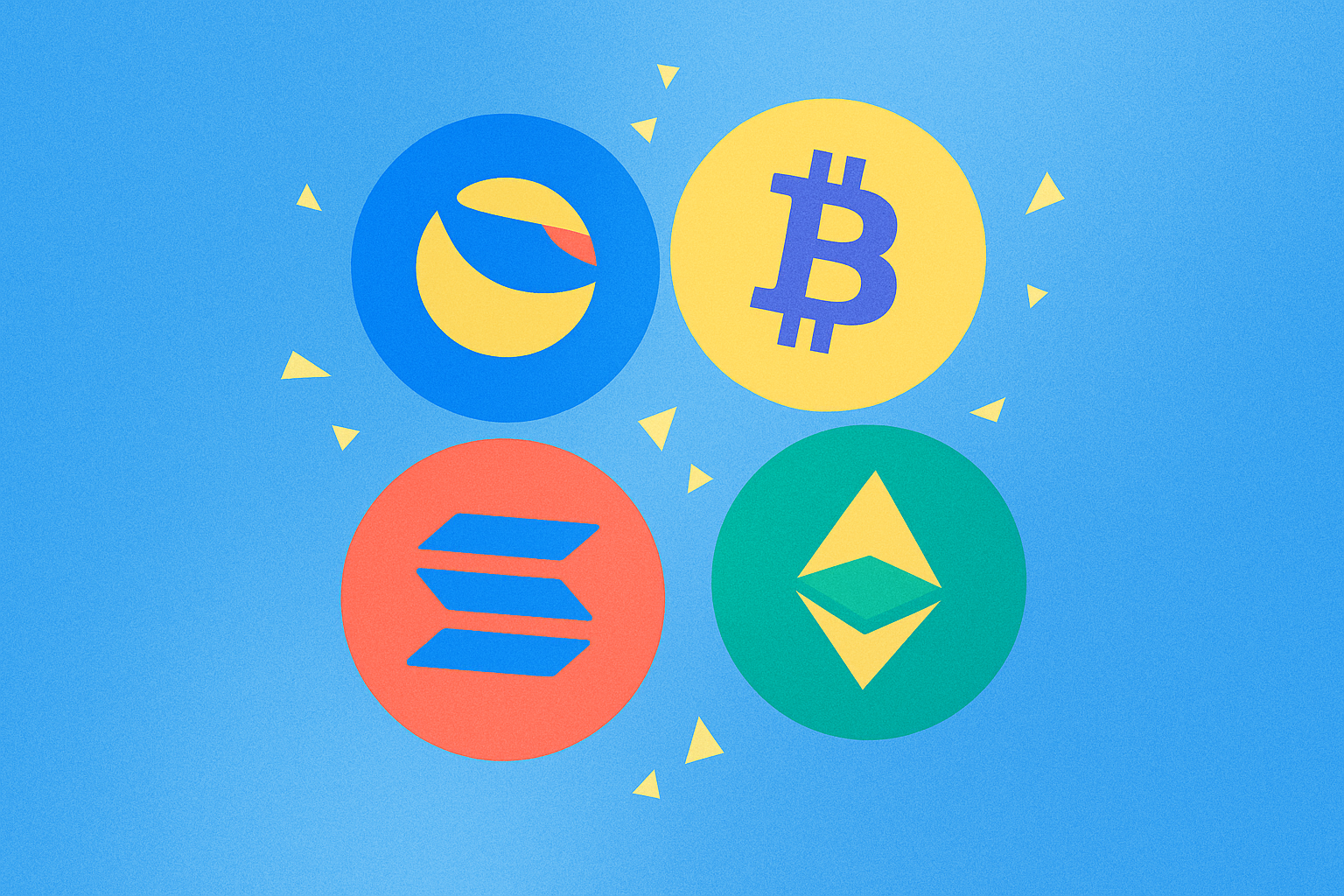
This article examines Terra Luna Classic (LUNC) token's competitive landscape within the DeFi ecosystem. It analyzes LUNC's market position, ranking #261 by market capitalization at $240-285 million with 24-hour trading volume of $11.87 million on Gate and other exchanges. The analysis compares LUNC against major competitors like Bitcoin, Ethereum, and Solana, highlighting its deflationary tokenomics strategy centered on aggressive token burns—over 415 billion tokens burned since recovery began. The article evaluates LUNC's distinctive recovery mechanisms, market volatility patterns during 2025-2026, and competitive advantages rooted in community governance rather than utility expansion. Despite significant price swings and bearish technical indicators, LUNC maintains sufficient market depth for price discovery, though faces structural challenges from its massive 5.5 trillion circulating supply.
LUNC Token Faces Intense Competition from Major Cryptocurrencies in the DeFi Ecosystem
The DeFi ecosystem remains highly competitive, with LUNC Token navigating intense pressure from established major cryptocurrencies that dominate liquidity and user adoption across decentralized finance protocols. While the Terra Luna Classic community has demonstrated commitment through consistent token burn mechanisms—notably Binance's January 2026 burn of 5.3 billion LUNC—competitive dynamics within the broader DeFi market present significant challenges for LUNC's market position.
Unlike competitors with entrenched DeFi integrations, LUNC currently lacks substantial backing from major decentralized finance projects, limiting its ecosystem expansion opportunities. The token's speculative nature reflects this competitive gap, as investors compare its utility prospects against more established alternatives offering deeper liquidity and protocol integration. However, the cumulative removal of over 441 billion tokens from circulation demonstrates ongoing efforts to address supply concerns that typically disadvantage assets competing for market share.
Community-driven burns adding 124 million LUNC during recent periods underscore grassroots commitment, yet this support must translate into tangible DeFi utility to meaningfully compete. Real-world applications and ecosystem upgrades represent critical differentiators—factors that analysts identify as essential for LUNC to strengthen its competitive standing against major cryptocurrencies dominating the DeFi landscape.
The competitive environment suggests that LUNC's trajectory depends less on burn velocity and more on attracting genuine protocol integration and developer activity. Without substantial DeFi backing comparable to competitors, LUNC remains positioned as a higher-risk, speculative asset navigating intense market competition where utility and adoption ultimately determine long-term viability within the broader DeFi ecosystem.
Terra Luna Classic (LUNC) maintains a market capitalization ranging between $240 million and $285 million, positioning it at rank 261 among cryptocurrencies by market cap. This valuation reflects approximately 0.0084% of the total cryptocurrency market share, indicating a relatively modest but established position within the broader digital asset ecosystem. The token's 24-hour trading volume registers around $11.87 million, demonstrating consistent market activity and liquidity channels across multiple exchanges including gate.
Recent market dynamics have significantly influenced LUNC's trading metrics. In early 2026, major exchange-driven token burns—notably Binance's destruction of 5.33 billion LUNC tokens—catalyzed a remarkable 620% surge in daily trading volume while simultaneously boosting prices by approximately 20%. This volatility underscores how supply-side interventions impact market participation and token velocity. The substantial trading activity surrounding burn events contrasts sharply with baseline periods, revealing concentrated interest among both institutional and retail participants.
When positioned against leading competitors like Bitcoin, Ethereum, and Solana, LUNC's market capitalization appears significantly smaller, reflecting different maturity levels and adoption scales across blockchain ecosystems. However, LUNC's trading volume metrics demonstrate it maintains sufficient market depth for meaningful price discovery. The token's competitive dynamics are shaped as much by community-driven supply reduction efforts as by organic market demand, differentiating its market mechanics from traditional competitor performance benchmarks.
Differentiation Strategy: LUNC's Unique Positioning and Recovery Mechanisms Compared to Rival Tokens
LUNC distinguishes itself through a recovery strategy fundamentally centered on deflationary tokenomics and community governance, setting it apart from rival tokens that prioritize utility expansion or network growth. While competitors often focus on building functional features and attracting developers, LUNC's core differentiation lies in its aggressive token burn mechanism and staking rewards, which aim to reduce the massive 5.5 trillion circulating supply inherited from the 2022 collapse. Over 415 billion LUNC tokens have been burned since recovery efforts began, with major exchanges like those operating on legacy Terra contributing significantly to this reduction.
The burn mechanism represents LUNC's primary competitive advantage against rival tokens. Unlike competitors employing traditional inflation models or moderate supply adjustments, LUNC embraces a bold deflationary approach where transaction fees and community-driven initiatives systematically reduce supply scarcity. This recovery methodology contrasts sharply with tokens prioritizing utility development or multi-chain expansion. LUNC's tokenomics strategy, supported by community governance decisions rather than centralized directives, creates a speculative appeal grounded in supply reduction mathematics. Additionally, LUNC's exclusive focus on preserving the legacy Terra blockchain ecosystem, rather than launching new versions or parallel networks, reinforces its distinctive positioning. This commitment to the original chain's resurrection, combined with staking opportunities and governance participation, attracts community members seeking direct involvement in recovery outcomes—a differentiation most rival tokens cannot replicate.
Terra Classic's price volatility intensified throughout 2025-2026, reflecting broader cryptocurrency market turbulence and project-specific dynamics. During 2025, LUNC exhibited significant price swings within a trading channel between $0.00002880 and $0.00006063, peaking at $0.00008144 on December 5. This dramatic swing highlighted the speculative nature of LUNC's market positioning compared to competitors offering greater price stability.
The volatility accelerated due to exchange-driven token burns and supply pressures. Binance's destruction of 5.33 billion LUNC tokens in January 2026 sparked a 20% rally, demonstrating how external catalysts dramatically influence short-term price performance. However, technical analysis from early 2026 revealed bearish sentiment, with 22 indicators signaling bearish signals against only 4 bullish ones. Predictions suggested LUNC would decline approximately 18.02% to reach $0.000037 by February 2026, trading within a tighter range of $0.000035-$0.000112 for the remainder of the year.
LUNC's volatility patterns contrasted sharply with established competitors like Solana and Polygon, which demonstrated more consistent price trajectories. The underlying challenge remained structural: with 5.5 trillion tokens still in circulation despite 415 billion burned, LUNC faced mathematical constraints limiting sustained price appreciation regardless of market conditions or burn initiatives.
FAQ
LUNC(Luna Classic)的主要竞争对手有哪些?
LUNC的主要竞争对手包括Aptos(APT)、VeChain(VET)和Aureal One(DLUME)。这些项目在Layer 1区块链和生态应用方面与LUNC竞争,各自在市场中占据不同的定位和用户基础。
LUNC operates independently from Terra 2.0, offering distinct governance. Compared to Cosmos, LUNC has lower transaction volume. Terra Luna focuses on ecosystem rebuilding post-UST collapse. LUNC provides direct L1 blockchain solutions with unique tokenomics and community-driven development.
LUNC在加密货币市场中的排名和市场份额是多少?
LUNC currently ranks #153 in the cryptocurrency market with a market capitalization of approximately 7.59 billion TWD, representing a modest market share among thousands of digital assets in the evolving crypto ecosystem.
LUNC offers low transaction costs averaging $0.00025, significantly lower than Ethereum and Solana. However, it has fewer validators (1,500) compared to major competitors, resulting in lower adoption rates and limited network effects despite competitive performance metrics.
LUNC与Ethereum、Cardano等主流智能合约平台有什么区别?
LUNC is Terra Classic's token after the 2022 blockchain collapse. Unlike Ethereum and Cardano, LUNC lacks robust smart contract functionality and mainstream adoption. It focuses on community recovery through token burning and staking, with limited use cases compared to leading platforms.
What is the current state of LUNC's ecosystem development, and does it have advantages compared to competitors?
LUNC's ecosystem remains active in 2026 with a strong community foundation. However, it lacks significant technological advantages over major competitors. While innovation continues, LUNC has not surpassed leading alternatives in market performance and feature development.
* The information is not intended to be and does not constitute financial advice or any other recommendation of any sort offered or endorsed by Gate.