Tenset (10SET) is an innovative cryptocurrency investment platform launched in 2021, combining deflationary tokenomics with ETF 2.0 elements and hedge fund principles. Operating on BSC blockchain, it bridges cryptocurrency and traditional markets through decentralized staking mechanisms and scarcity features. As of January 2026, the platform boasts 25,106 token holders with a market cap of $4,973,081.71, trading at $0.03187 on Gate exchange. The comprehensive guide covers Tenset's technical architecture including PoSA consensus, market performance metrics, and DeFi applications. Despite facing 72.17% year-over-year price decline and limited exchange availability, Tenset maintains strong community engagement and positions itself as a distinctive investment vehicle for cryptocurrency enthusiasts seeking exposure to hybrid traditional-crypto markets.
Tenset's Positioning and Significance
In 2021, Tenset launched Tenset (10SET), aiming to address challenges in cryptocurrency investment and asset management.
As a deflationary token with ETF 2.0 elements and hedge fund principles, Tenset plays a key role in bridging cryptocurrency and traditional markets.
As of 2026, Tenset has established itself as an innovative asset in the crypto investment space, with 25,106 holders and an active development community.
This article will provide an in-depth analysis of its technical architecture, market performance, and future potential.
Origin and Development History
Birth Background
Tenset was created in 2021, aiming to solve inefficiencies in cryptocurrency investment and the gap between crypto and traditional financial markets.
It emerged during the blockchain technology boom, with the goal of providing a hybrid system combining staking, deflationary mechanisms, and scarcity to change the status quo.
Tenset's launch brought new possibilities to cryptocurrency investors and those seeking exposure to traditional markets through crypto assets.
Important Milestones
- 2021: Token launch on BSC (BNB Smart Chain), implementing deflationary tokenomics and ETF 2.0 elements.
- The project has continuously evolved its staking mechanisms and scarcity features to enhance value proposition.
- 2021: Price reached historical peak of $6.48 during the broader crypto market rally.
- Tenset has maintained listing on Gate.com, providing liquidity and accessibility to global users.
Under the support of its community and development team, Tenset continues to optimize its technology, security, and real-world applications.
How Does Tenset Work?
No Central Control
Tenset operates on a decentralized blockchain network distributed globally, free from control by banks or governments.
These nodes collaborate to validate transactions, ensuring the system is transparent and attack-resistant, giving users greater autonomy and enhancing network resilience.
Blockchain Core
Tenset's blockchain is a public, immutable digital ledger that records every transaction.
Transactions are grouped into blocks and linked through cryptographic hashes to form a secure chain.
Anyone can view the records, establishing trust without intermediaries.
The token is deployed on BSC, leveraging its infrastructure for efficient transaction processing.
Ensuring Fairness
Tenset utilizes the BNB Smart Chain's Proof of Staked Authority (PoSA) consensus mechanism to validate transactions and prevent fraudulent activities such as double-spending.
Validators maintain network security through staking and running nodes, earning rewards in the process.
Its innovation includes deflationary tokenomics that reduce circulating supply over time.
Secure Transactions
Tenset uses public-private key cryptography to protect transactions:
- Private keys (similar to secret passwords) are used to sign transactions
- Public keys (similar to account numbers) are used to verify ownership
This mechanism ensures fund security while maintaining transaction transparency on the blockchain.
The deflationary model and staking features provide additional layers of value preservation for holders.
Circulating Supply Overview
As of January 29, 2026, Tenset's circulating supply stands at 156,042,726.95 tokens, with a total supply of 156,042,726.95 tokens and a maximum supply cap of 210,000,000 tokens. The current circulating supply represents approximately 74.31% of the maximum supply, indicating a deflationary model with room for future token releases. The token operates under a deflationary mechanism that influences its supply-demand dynamics through staking and scarcity features.
Price Fluctuations
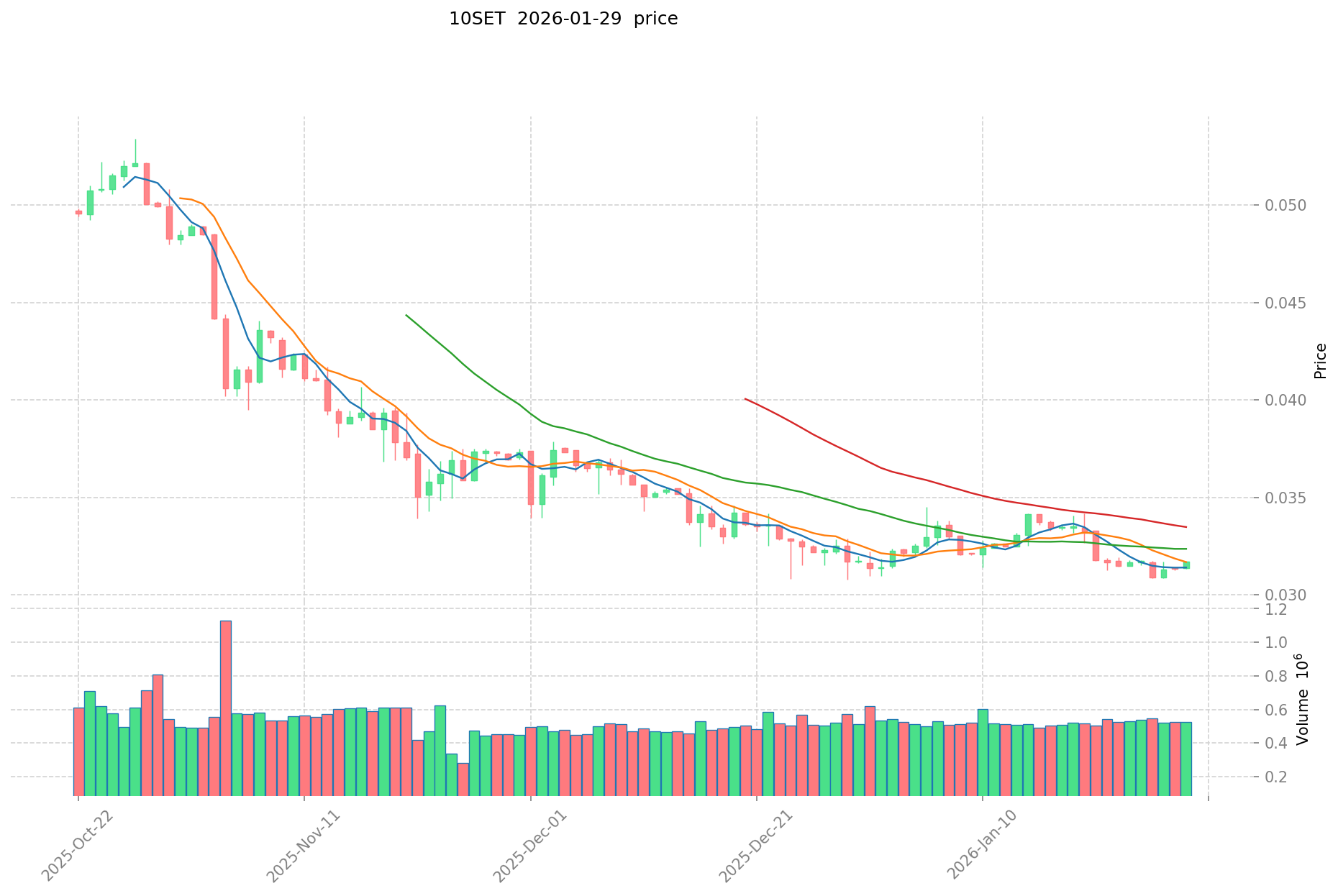
Tenset reached its historical peak price of $6.48 on May 30, 2021, during a period of broader market momentum and increased interest in cryptocurrency projects. The token experienced its lowest price point of $0.02757133 on January 7, 2026, reflecting recent market pressures and volatility in the cryptocurrency sector. As of January 29, 2026, Tenset is trading at $0.03187, showing a 1.04% increase over the past 24 hours. However, the token has experienced a significant decline of 72.17% over the past year, with a change of -$0.0826 from its price twelve months prior. These fluctuations demonstrate the impact of market sentiment, adoption trends, and external factors on the token's valuation.
Click to view the current 10SET market price
On-Chain Metrics
- 24-Hour Trading Volume: $17,864.64 (indicating current market activity levels)
- Holder Addresses: 25,106 addresses (reflecting community participation and token distribution)
- Market Capitalization: $4,973,081.71 (representing 0.00015% market dominance in the cryptocurrency sector)
Tenset Ecosystem Applications and Partners
Core Use Cases
Tenset's ecosystem supports multiple applications:
- DeFi: The platform provides decentralized staking mechanisms, enabling token holders to earn passive income through staking rewards.
- Investment Infrastructure: Tenset operates as a deflationary token with ETF2.0 elements, bridging cryptocurrency and traditional markets through hedge fund principles.
Strategic Partnerships
Tenset continues to build its ecosystem through strategic collaborations that enhance its technological capabilities and market presence.
These partnerships provide a solid foundation for Tenset's ecosystem expansion.
Challenges and Controversies
Tenset faces several challenges:
- Market Volatility: The token has experienced significant price fluctuations, with a 1-year decline of 72.17%
- Competitive Pressure: Competition from other blockchain platforms and investment tokens in the crypto space
- Limited Exchange Presence: Currently available on only 2 exchanges, which may affect liquidity and accessibility
These issues have sparked discussions within the community and market, while also driving Tenset's continued innovation.
Tenset's community demonstrates notable activity, with 25,106 token holders as of January 2026.
The platform's deflationary model and staking features have attracted a dedicated user base.
New feature implementations and market movements continue to energize the community.
Social media discussions present varied perspectives:
- Supporters praise Tenset's deflationary mechanism, staking rewards, and hybrid approach combining crypto with traditional market principles, viewing it as an innovative investment vehicle.
- Critics focus on price volatility, limited exchange availability, and market performance challenges.
Recent trends reflect mixed sentiment given the significant year-over-year price decline.
Trending Topics
Community discussions center on Tenset's tokenomics model, staking opportunities, and price recovery potential,
showcasing both its innovative approach and the obstacles it faces in achieving wider adoption.
- Official Website: Visit Tenset Official Site for features, use cases, and latest updates.
- Blockchain Explorer: BSC Scan provides detailed transaction and contract information.
- X Platform: Tenset maintains an active presence on X at @TenseT_io,
sharing updates on technology developments, community initiatives, and partnership announcements.
Tenset Future Roadmap
- Ongoing Development: Continued enhancement of staking mechanisms and deflationary features
- Ecosystem Goals: Expansion of partnerships and exchange listings to increase accessibility
- Long-term Vision: Establishing Tenset as a bridge between cryptocurrency and traditional investment markets
How to Participate in Tenset?
- Purchase Channels: Buy 10SET on supported exchanges or decentralized platforms
- Storage Solutions: Use compatible BSC wallets such as MetaMask or Trust Wallet for secure storage
- Staking Participation: Engage in staking programs to earn rewards
- Community Engagement: Follow official channels for updates and participate in community discussions
Summary
Tenset represents an innovative approach to cryptocurrency investment through its deflationary tokenomics, ETF2.0 elements, and staking rewards.
Its dedicated community, unique value proposition, and hybrid investment model distinguish it within the cryptocurrency landscape.
Despite facing market volatility and limited exchange presence, Tenset's innovative structure and clear vision position it as a noteworthy project in the decentralized finance space.
Whether you're a newcomer or experienced investor, Tenset offers an interesting perspective on bridging traditional and crypto markets.
FAQ
What is Crypto 10SET? What are its core functions?
Crypto 10SET is the native token of the Tenset blockchain initiative, bridging traditional finance and cryptocurrency. Its core function enables seamless operations and interactions within the Tenset ecosystem.
Crypto 10SET和其他加密货币指数产品有什么区别?
Crypto 10SET基于前十大加密货币构建,不依赖美元等中心化货币,采用原生加密货币计价。相比之下,其他指数产品多以传统法币为计价单位,Crypto 10SET更能代表纯净的加密市场表现。
How to buy and trade Crypto 10SET?
Create an account on a crypto exchange, set up your wallet, purchase stablecoins like USDT, then swap them for 10SET tokens. You can trade 10SET on major exchanges with high liquidity and trading volume.
What are the risks to pay attention to when investing in Crypto 10SET?
Investing in 10SET carries high risk with potential total loss of capital. Prices are highly volatile and unpredictable. This asset is not suitable for all investors and requires strong risk tolerance.
What cryptocurrencies are included in Crypto 10SET? How are the weights allocated?
Crypto 10SET comprises Bitcoin, Ethereum, Binance Coin, XRP, Cardano, Polkadot, Chainlink, Litecoin, Stellar, and Dogecoin. Weights are dynamically allocated based on market capitalization, ensuring the index reflects the leading digital assets in the ecosystem.
* The information is not intended to be and does not constitute financial advice or any other recommendation of any sort offered or endorsed by Gate.