This comprehensive guide explores Cardano (ADA), a third-generation blockchain platform launched by IOHK in 2017 to address scalability and energy efficiency challenges. The article examines Cardano's layered architecture, which separates settlement and computation layers, and its innovative Proof of Stake consensus mechanism that reduces energy consumption compared to traditional blockchain systems. It covers ADA's market performance, including current circulation of 36.68 billion tokens and recent price dynamics, alongside practical applications in decentralized finance and smart contracts. The guide details Cardano's ecosystem expansion, strategic partnerships, and active community engagement across social platforms. Readers will discover how to purchase and stake ADA on Gate, participate in governance, and understand both opportunities and challenges including market volatility and competitive pressures. The content provides actionable insights for newcomers and experienced cryptocurrency participants int
Cardano's Positioning and Significance
In 2017, Input Output Hong Kong (IOHK) launched Cardano (ADA), aiming to address scalability limitations, energy inefficiency, and lack of formal verification in existing blockchain systems.
As a third-generation blockchain platform built on peer-reviewed research, Cardano plays a key role in decentralized finance (DeFi), governance, and identity management.
As of 2026, Cardano has become one of the top 15 cryptocurrencies by market capitalization, with a circulating supply of over 36.68 billion ADA and an active development community.
This article will provide an in-depth analysis of its technical architecture, market performance, and future potential.
Origin and Development History
Birth Background
Cardano was created by Charles Hoskinson and the IOHK team in 2017, aiming to solve the scalability trilemma and provide a more sustainable blockchain infrastructure.
It emerged during the blockchain technology boom, with the goal of delivering a scientifically rigorous, peer-reviewed platform for secure financial applications and transforming the status quo.
The launch of Cardano brought new possibilities for individuals, organizations, and governments seeking reliable financial infrastructure.
Major Milestones
- 2017: Mainnet launch, introducing a layered architecture separating settlement and computation.
- 2020: Shelley upgrade introduced decentralized staking and delegation mechanisms.
- 2021: Alonzo upgrade enabled smart contract functionality, expanding ecosystem applications.
- 2023: Ecosystem expansion, with DeFi protocols and NFT platforms gaining traction.
With support from the Cardano Foundation, IOHK, and Emurgo, Cardano continues to optimize its technology, security, and real-world applications.
How Does Cardano Work?
No Central Control
Cardano operates on a decentralized network of computers (nodes) distributed globally, free from control by banks or governments.
These nodes collaborate to validate transactions, ensuring system transparency and attack resistance, granting users greater autonomy and enhancing network resilience.
Blockchain Core
Cardano's blockchain is a public, immutable digital ledger that records every transaction.
Transactions are grouped into blocks and linked through cryptographic hashing to form a secure chain.
Anyone can view the records, establishing trust without intermediaries.
The layered architecture separates the settlement layer (Cardano Settlement Layer) from the computation layer (Cardano Computation Layer), further enhancing performance and flexibility.
Ensuring Fairness
Cardano employs Ouroboros Proof of Stake (PoS) to validate transactions and prevent fraud such as double-spending.
Validators (stake pool operators) maintain network security through staking ADA and running validation nodes, earning ADA rewards in return.
Its innovation includes energy efficiency and scientifically proven security guarantees through formal verification.
Secure Transactions
Cardano uses public-private key cryptography to protect transactions:
- Private keys (like secret passwords) are used to sign transactions
- Public keys (like account numbers) are used to verify ownership
This mechanism ensures fund security while maintaining pseudonymous transactions.
Additional security features include multi-signature support and ongoing research into zero-knowledge proof integration.
Circulation Overview
As of January 13, 2026, Cardano's circulating supply stands at 36.68 billion ADA tokens, with a total supply of 45 billion ADA. The maximum supply is capped at 45 billion tokens, representing a fixed supply model.
The circulating supply accounts for approximately 81.52% of the total supply, with tokens gradually entering the market through the protocol's issuance mechanism.
The platform's layered architecture supports both a settlement layer for ADA transactions and a separate computing layer for smart contract execution, providing flexibility for future upgrades and maintenance.
Price Fluctuations
Cardano reached its all-time high of $3.09 on September 2, 2021, driven by increased market interest in its proof-of-stake consensus mechanism and smart contract capabilities.
The lowest recorded price was $0.0193 on March 13, 2020, during a period of broader market uncertainty.
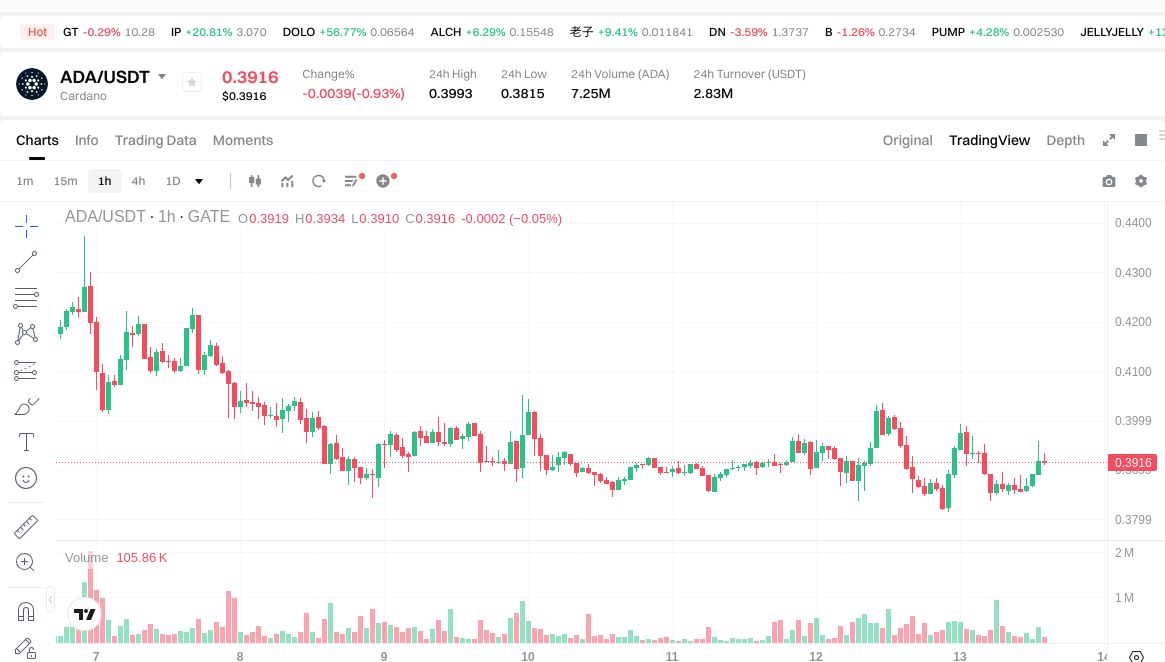
As of January 13, 2026, ADA trades at approximately $0.391, reflecting a 1.36% decrease over the past 24 hours and a 7.47% decline over the past 7 days. The token has experienced a 59.57% decrease over the past year, indicating shifts in market sentiment and adoption patterns.
Click to view current ADA market price
On-Chain Metrics
- 24-Hour Trading Volume: Approximately $2.87 billion (indicating active market participation)
- Market Capitalization: $14.34 billion (reflecting current valuation)
- Fully Diluted Valuation: $17.60 billion (representing potential maximum market cap)
- Market Dominance: 0.53% (showing position within the broader cryptocurrency market)
Cardano Ecosystem Applications and Partnerships
Core Use Cases
Cardano's ecosystem supports multiple applications:
- Smart Contracts: As a technology platform built in layers, Cardano enables the development of smart contracts through its separate computing layer, providing support for future businesses and operations.
- Digital Financial Applications: Cardano serves as a platform capable of running financial applications currently used by individuals, organizations, and governments worldwide, offering digital cash solutions for secure and fast direct transfers.
Strategic Partnerships
Cardano continues to expand its ecosystem through technical development and community engagement. The platform's layered architecture provides a solid foundation for ecosystem expansion, allowing for flexible maintenance and upgrades through soft forks.
Controversies and Challenges
Cardano faces the following challenges:
- Technical Issues: As a developing blockchain platform, Cardano continues to work on completing its settlement layer and establishing its computing layer for smart contracts.
- Market Competition: With a market cap ranking of 11 and a market share of 0.53%, Cardano operates in a competitive environment alongside other blockchain platforms.
- Price Volatility: Recent performance shows a 7-day decline of 7.47% and a 30-day decline of 4.02%, reflecting market fluctuations that generate ongoing discussion within the community.
These issues have sparked discussions within the community and market, while also driving Cardano's continuous innovation.
Cardano's community demonstrates notable activity, with a circulating supply of 36.68 billion ADA and a circulation ratio of 81.52%. The platform has attracted significant market interest with a 24-hour trading volume of 2.87 million.
Sentiment on social platforms shows diverse perspectives:
- Supporters praise Cardano's layered architecture, flexible maintenance capabilities, and vision as a technology platform for financial applications, viewing it as a significant innovation in digital currency.
- Critics focus on price fluctuations and the challenges of ongoing development, noting the recent decline of 59.57% over one year.
Recent trends indicate mixed sentiment reflecting the broader market conditions.
Popular Topics
Community discussions center on Cardano's technological development, including the completion of its settlement layer and the establishment of its computing layer for smart contracts, demonstrating both its transformative potential and the challenges in achieving mainstream adoption.
- Official Website: Visit Cardano Official Website for features, use cases, and latest updates.
- White Paper: Cardano Documentation provides details on its technical architecture, objectives, and vision.
- Community Engagement: Participate in discussions on Cardano Forum and Reddit to stay connected with the community.
- Development Resources: Access GitHub repositories to explore the codebase and contribute to development.
Cardano Future Roadmap
- Ongoing Development: Completion of the settlement layer running ADA, followed by establishment of a separate computing layer for smart contract processing
- Ecosystem Goals: Expansion of the platform to support various financial applications for individuals, organizations, and governments
- Long-term Vision: Become a comprehensive technology platform representing the future of digital currency with secure and fast direct transfer capabilities
How to Participate in Cardano?
- Purchase Channels: Buy ADA on Gate.com and other supported exchanges
- Storage Solutions: Securely store ADA using compatible cryptocurrency wallets
- Community Participation: Engage with the community through Cardano Forum and Reddit
- Ecosystem Building: Visit Cardano Documentation and GitHub to develop applications or contribute code
Summary
Cardano redefines digital currency through blockchain technology, offering transparency, security, and efficient transfer capabilities through its layered architecture. Its active community, comprehensive resources, and technological vision distinguish it in the cryptocurrency space. Despite facing challenges including market volatility and ongoing development requirements, Cardano's innovative approach and clear roadmap position it as a notable player in the future of decentralized technology. Whether you are a newcomer or an experienced participant, Cardano merits attention and engagement.
FAQ
What is ADA (Cardano)? How does it work?
ADA is Cardano's native token for transaction fees and network governance. It uses a proof-of-stake mechanism reducing energy consumption. Maximum supply is 45 billion ADA. Holders can stake ADA to earn rewards and participate in protocol decisions through decentralized governance.
What is the difference between ADA, Bitcoin, and Ethereum?
ADA is the token of Cardano blockchain, while Bitcoin is the first cryptocurrency and Ethereum is a smart contract platform. ADA focuses on smart contracts and sustainability, Bitcoin on decentralized payments, and Ethereum on DeFi applications.
How to buy and store ADA cryptocurrency?
Purchase ADA by first acquiring base cryptocurrencies on exchanges, then trade for ADA using crypto-to-crypto pairs. Store ADA securely in cold wallets or hardware wallets for long-term holding, or use software wallets for convenient access.
What is the mining principle of ADA? Can ordinary users participate?
ADA uses Proof of Stake consensus, not traditional mining. Users can earn rewards by staking ADA tokens in stake pools without expensive hardware. This makes participation accessible to ordinary users compared to proof-of-work cryptocurrencies.
What are the practical application scenarios of Cardano blockchain?
Cardano blockchain enables decentralized finance (DeFi), smart contracts, and real-world applications across finance, supply chain management, and public services. Its scalable infrastructure supports various use cases with proven deployments.
What are the risks of investing in ADA? How is its security?
ADA faces volatility, regulatory uncertainty, and competition from other blockchains. Security is robust through PoS consensus and experienced developers, yet ecosystem adoption remains limited. Price fluctuates with Bitcoin cycles and market sentiment.
What is the future development outlook and value potential of ADA?
ADA demonstrates strong long-term potential, particularly with successful protocol upgrades. Market adoption, smart contract capabilities, and ecosystem expansion drive growth prospects. As Cardano continues advancing, ADA's utility and value proposition are expected to strengthen significantly in the Web3 landscape.
* The information is not intended to be and does not constitute financial advice or any other recommendation of any sort offered or endorsed by Gate.