This comprehensive guide explores ALEPH and Aleph.im, a revolutionary decentralized cloud computing platform launched in 2020 to address blockchain infrastructure fragmentation and centralized cloud service limitations. The article examines Aleph.im's core technology stack, including distributed nodes, blockchain-based consensus mechanisms, and cross-chain messaging capabilities that enable secure, decentralized storage and computation for Web3 applications. With 186.4 million circulating tokens and a market cap of $5.7 million as of January 2026, ALEPH demonstrates the platform's market positioning. This guide details ecosystem applications, technical architecture, market performance metrics, community sentiment, participation methods through Gate.com, and future roadmap objectives. Whether you're a developer seeking decentralized infrastructure solutions or a crypto investor exploring Web3 opportunities, this guide provides essential insights into ALEPH's innovative role in shaping next-generation blockchai
Aleph.im (ALEPH) Positioning and Significance
In 2020, the Aleph.im team launched Aleph.im (ALEPH), aiming to address challenges in decentralized infrastructure, including fragmented cross-chain data storage, inefficient cloud computing alternatives, and the need for secure, decentralized messaging solutions.
As a cross-blockchain second-layer network and decentralized cloud computing platform, Aleph.im plays a key role in decentralized application infrastructure, data storage, and cross-chain messaging.
As of 2026, Aleph.im has established itself as a foundational infrastructure provider in the decentralized cloud computing space, serving developers and projects requiring decentralized storage and computation solutions.
This article will deeply analyze its technical architecture, market performance, and future potential.
Origin and Development History
Birth Background
Aleph.im was created by the Aleph.im team in 2020, aiming to solve the lack of decentralized alternatives to centralized cloud services, cross-blockchain data fragmentation, and the need for secure peer-to-peer communication infrastructure.
It emerged during the rapid expansion of blockchain ecosystems, with the goal of providing developers with a unified, decentralized layer for storage, computing, and messaging across multiple blockchains.
The launch of Aleph.im brought new possibilities to developers, dApps, and blockchain projects seeking decentralized infrastructure solutions.
Important Milestones
- 2020: Platform launch, establishing the foundation for cross-chain decentralized storage and messaging services.
- 2022: Network expansion with enhanced decentralized computing capabilities and improved cross-chain interoperability.
- 2024: Growing ecosystem adoption, with increasing integration by DeFi protocols and Web3 applications utilizing decentralized storage and computation.
With the support of the Aleph.im community and development team, the platform continues to optimize its technology, security, and real-world applications.
How Does Aleph.im Work?
No Central Control
Aleph.im operates on a globally distributed decentralized network of nodes, eliminating reliance on centralized cloud providers or intermediaries.
These nodes collaborate to validate and store data, ensuring transparency and resistance to attacks, granting users greater autonomy and enhancing network resilience.
Blockchain Core
Aleph.im's architecture leverages a public, immutable distributed ledger that records data operations and transactions across multiple blockchains.
Data is organized and secured through cryptographic methods, forming a reliable cross-chain infrastructure.
Anyone can verify data integrity without intermediaries, establishing trust through transparency.
The platform's cross-blockchain capabilities enable seamless data synchronization and messaging across different networks, enhancing interoperability.
Ensuring Fairness
Aleph.im employs a node-based consensus mechanism to validate data operations and prevent unauthorized modifications.
Node operators maintain network security by running infrastructure and providing storage and computational resources, earning ALEPH rewards for their participation.
Its innovation includes efficient cross-chain communication and decentralized cloud computing without compromising performance.
Secure Transactions
Aleph.im uses public-private key cryptography to protect data operations:
- Private keys (similar to secret passwords) are used to sign data requests
- Public keys (similar to account identifiers) are used to verify ownership
This mechanism ensures data security, with transactions maintaining pseudonymous privacy.
Additional security features include distributed data storage across multiple nodes and encryption protocols.
Circulation Overview
As of January 29, 2026, ALEPH has a circulating supply of 186,431,941.41 tokens, with a total supply of 500,000,000 and a maximum supply capped at 500,000,000 tokens. The circulating supply represents approximately 37.29% of the total supply. The controlled release of tokens into the market influences its supply-demand dynamics.
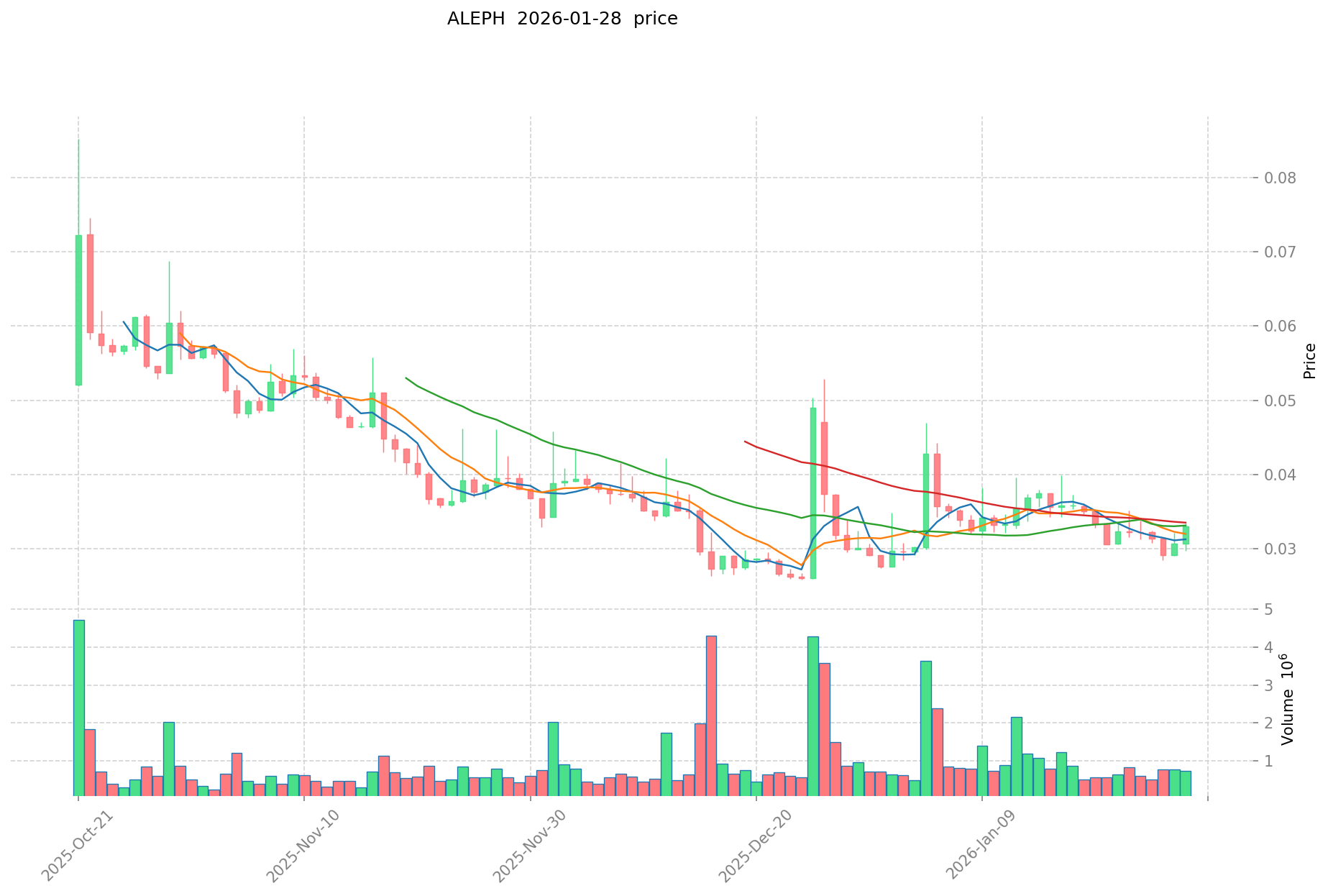
Price Volatility
ALEPH reached a notable price level of $0.875793 on January 21, 2022, reflecting positive market sentiment during that period. The token experienced its lowest price of $0.00623944 on September 27, 2020, during earlier market conditions. These price movements reflect shifts in market sentiment, adoption trends, and external factors affecting the cryptocurrency market.
Click to view the current ALEPH market price
On-Chain Metrics
- Holder Count: 13,561 addresses (indicating network participation)
- 24-Hour Trading Volume: $97,164.06 (reflecting market activity)
- Market Capitalization: $5,695,495.81 (representing current valuation)
- Fully Diluted Market Cap: $15,275,000 (based on maximum supply)
Aleph.im Ecosystem Applications and Partners
Core Use Cases
Aleph.im's ecosystem supports multiple applications:
- Decentralized Cloud Computing: The platform provides distributed storage and computing resources, enabling secure, scalable infrastructure for Web3 applications.
- Cross-Chain Messaging: Aleph.im facilitates inter-blockchain communication and data synchronization, promoting interoperability across different blockchain networks.
Strategic Partnerships
Aleph.im continues to expand its technical capabilities and market presence through strategic collaborations.
These partnerships provide a solid foundation for Aleph.im's ecosystem expansion.
Controversies and Challenges
Aleph.im faces the following challenges:
- Technical Hurdles: Scaling infrastructure to meet growing demand while maintaining decentralization
- Competition Pressure: Emergence of alternative decentralized cloud computing solutions in the blockchain space
These issues have sparked discussions within the community and market, while also driving Aleph.im's continuous innovation.
Aleph.im's community demonstrates activity with 13,561 token holders as of January 29, 2026.
The platform's focus on decentralized infrastructure attracts developers and projects seeking alternatives to centralized cloud services.
Sentiment on X shows varied perspectives:
- Supporters praise Aleph.im's decentralized architecture and cross-chain capabilities, viewing it as essential infrastructure for Web3.
- Critics focus on price volatility and market performance challenges.
Recent trends indicate mixed sentiment as the token price has declined approximately 71.3% over the past year.
Popular Topics
X users discuss Aleph.im's technical developments, decentralized storage solutions, and cross-blockchain messaging capabilities,
showcasing both its transformative potential and the challenges in gaining mainstream adoption.
- Official Website: Visit Aleph.im Official Website and Aleph.im Console for features, use cases, and latest developments.
- X Updates: On X platform, Aleph.im maintains an active presence via @aleph_im,
sharing updates on technical upgrades, community activities, and ecosystem developments.
- Developer Resources: Access technical documentation through GitHub repositories for integration and development.
Aleph.im Future Roadmap
- Ecosystem Goals: Expand decentralized cloud computing services and cross-chain messaging capabilities
- Long-term Vision: Establish itself as critical infrastructure for decentralized applications and Web3 services
How to Participate in Aleph.im?
- Purchase Channels: Buy ALEPH on Gate.com and other supporting exchanges
- Storage Solutions: Store securely using Ethereum-compatible wallets, as ALEPH operates on the Ethereum network (contract address: 0x27702a26126e0b3702af63ee09ac4d1a084ef628)
- Ecosystem Building: Visit GitHub documentation to develop applications or contribute to the codebase
- Community Engagement: Join discussions on Reddit to stay informed about project developments
Summary
Aleph.im redefines decentralized infrastructure through blockchain technology, offering transparency, security, and cross-chain interoperability.
With a total supply of 500 million tokens and approximately 37.29% currently circulating, the project maintains its focus on building decentralized cloud computing and messaging solutions.
Despite facing market volatility and competitive pressures, Aleph.im's innovative approach to decentralized infrastructure positions it as a noteworthy player in the Web3 space.
Whether you are new to crypto or an experienced participant, Aleph.im offers opportunities to engage with decentralized cloud technology.
FAQ
What is ALEPH token? What are its main functions and uses?
ALEPH is the native token of the aleph.im network, used to pay for storage, computation, and synchronization services. It operates across multiple blockchains connected through bridges, enabling users to access decentralized infrastructure and services.
What are the core technologies and innovations of the ALEPH project?
ALEPH's core technologies include multimodal content intelligent parsing, team-level knowledge collaboration, and localized domestic model compliance solutions, designed to improve research efficiency and data compliance.
Where can I buy ALEPH tokens?
ALEPH tokens are available on multiple major cryptocurrency exchanges. You can purchase ALEPH through various platforms that support the token, with ALEPH/USDT being among the most actively traded pairs across exchanges.
What are the differences and advantages of ALEPH compared to other mainstream cryptocurrency projects?
ALEPH stands out through superior security and decentralization using advanced cryptographic algorithms and distributed network storage. It offers enhanced privacy protection, efficient transaction processing, and robust infrastructure for Web3 applications, positioning it as a next-generation blockchain solution.
What are the main risks of investing in ALEPH tokens?
ALEPH token investments face market volatility risks and regulatory uncertainties. Cryptocurrency prices fluctuate significantly, and the market remains speculative. Investors should assess their risk tolerance carefully before participating.
ALEPH项目的团队背景和发展路线图如何?
ALEPH team focuses on multimodal content intelligence and knowledge collaboration. Roadmap includes localized domestic models, compliance partnerships, and enhanced research efficiency through automated paper analysis and team-level knowledge sharing.
What is the total supply of ALEPH? How is the token allocation mechanism structured?
ALEPH has a total supply of 500 million tokens. Token allocation occurs through presales and reward mechanisms. As of January 2026, the circulating supply is approximately 186.4 million tokens.
* The information is not intended to be and does not constitute financial advice or any other recommendation of any sort offered or endorsed by Gate.