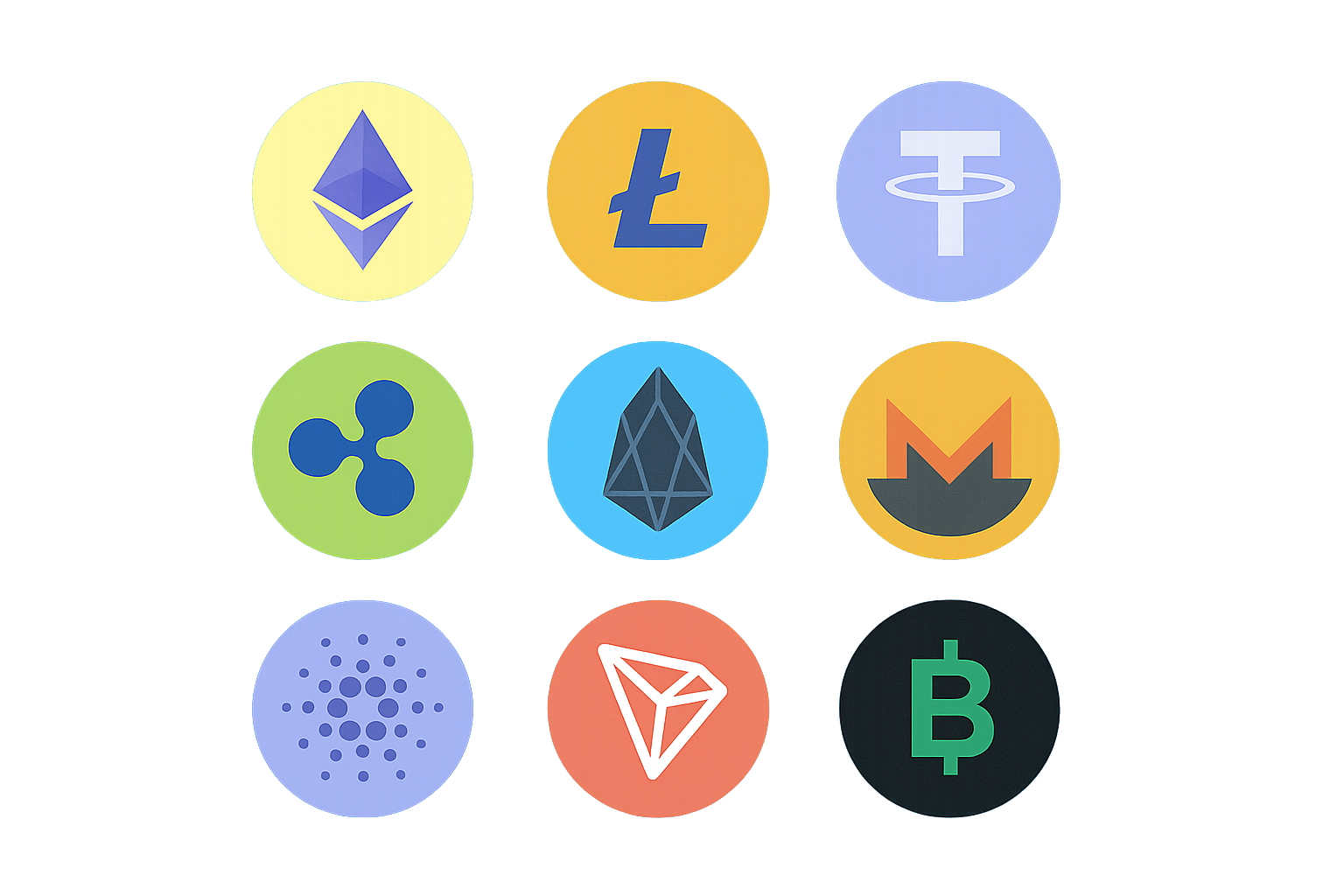
What are altcoins? Explore their definition, history, and a comprehensive introduction to alternative cryptocurrencies. Discover the top 10 altcoins—including Ethereum, Litecoin, and Cardano—and learn how to identify high-potential altcoins. This detailed guide is designed for beginners interested in investing on Gate and understanding the distinctions between altcoins and Bitcoin.
In recent years, the cryptocurrency market has seen explosive growth, with over 2,000 different altcoins. "Altcoin," short for "alternative coin," refers to any cryptocurrency other than Bitcoin. So, what are altcoins, and more importantly, how do they differ from Bitcoin?
The first altcoin appeared alongside Bitcoin in 2011. Namecoin was launched to decentralize web domain registration and also serve as a digital currency alternative to Bitcoin. Namecoin’s emergence marked a new era, proving that blockchain technology could be applied far beyond simple payments.
As of now, more than 2,000 altcoins are in circulation globally. This diverse competition hasn’t diminished Bitcoin’s dominance; instead, it has propelled the entire crypto space forward. Importantly, not all altcoins are directly related to Bitcoin or aim to replace it. Many bring unique value by addressing specific issues Bitcoin can’t solve, or they serve entirely different roles within the blockchain ecosystem.
Top 10 Altcoins
Litecoin (LTC). Like Bitcoin, Litecoin is a digital currency designed for decentralized payments. Created in 2011 by Charlie Lee, a former Google engineer, Litecoin sought to improve on Bitcoin’s limitations. It features much faster transaction confirmation times (about 2.5 minutes versus Bitcoin’s 10 minutes), lower transaction fees, and a higher maximum supply (84 million LTC compared to 21 million BTC). The Litecoin community often says, “BTC is digital gold, LTC is digital silver,” highlighting Litecoin’s practical, complementary role in everyday payments.
Ethereum (ETH). Ether is a second-generation digital currency developed by Vitalik Buterin. Beyond serving as a payment method, Ethereum is a global distributed computing platform. It supports smart contracts, powers decentralized applications (DApps), and is the leading platform for initial coin offerings (ICOs). Ethereum has ushered in a new era for blockchain, enabling developers to build complex applications—from decentralized finance (DeFi) to non-fungible tokens (NFTs).
EOS Token (EOS). EOS is a next-generation, semi-decentralized digital currency and blockchain designed to power decentralized applications (DApps) and decentralized autonomous organizations (DAOs). Developed by Block.one, EOS addresses scalability and transaction speed challenges. It competes directly with Ethereum as a smart contract platform, processing thousands of transactions per second with zero end-user transaction fees.
Bitcoin Cash (BCH). Bitcoin Cash is a hard fork of Bitcoin created in summer 2017 after prolonged debate around Bitcoin’s scalability. BCH tackled Bitcoin’s slow confirmations, high energy use, and costly fees by increasing block size from 1MB to 8MB (and later to 32MB). This lets Bitcoin Cash process more transactions per block, reducing fees and speeding up confirmations, making it a more practical option for everyday payments.
Ripple (XRP). XRP is a payment-focused digital token developed by Ripple Labs, used as a liquidity source for real-time cross-border fiat payments. Unlike most altcoins, XRP is purpose-built for financial institutions and banks, enabling them to move money internationally quickly and cost-effectively. For this reason, XRP is often called the “bank coin.” Ripple has partnered with hundreds of financial institutions worldwide, making XRP one of the most widely adopted altcoins for real-world use.
Tether (USDT). Tether is the most popular stablecoin, pegged to the US dollar at a 1:1 ratio. Each Tether token maintains a value of $1 and can be redeemed for fiat currency anytime. Tether acts as a bridge between crypto and fiat, allowing traders to avoid crypto market volatility while keeping assets on exchanges. Tether is issued on multiple blockchains, including Ethereum, TRON, and Bitcoin’s Omni Layer.
TRON (TRX). TRON is a semi-centralized digital currency designed for digital content and entertainment systems. Founded by Justin Sun, TRON aims to build a global decentralized entertainment ecosystem. TRX is used to share content and directly compensate creators, cutting out intermediaries like social media platforms and streaming services. TRON also supports smart contracts and DApps, focusing on gaming and entertainment.
Monero (XMR). Monero is a decentralized, privacy-focused cryptocurrency designed for fully anonymous, untraceable payments. Launched in 2014, Monero uses advanced cryptography—ring signatures, stealth addresses, and RingCT—to hide sender, recipient, and transaction amounts. Monero is faster and more scalable than Bitcoin and is especially favored by users who demand absolute financial privacy.
Cardano (ADA). ADA is the native token of the Cardano platform, a blockchain project built on peer-reviewed scientific research. Cardano is a third-generation cryptocurrency, addressing the limitations of both Bitcoin (first generation) and Ethereum (second generation). It powers smart contracts, DApps, side chains, and distributed computing with higher performance and lower energy use. Cardano uses the Ouroboros Proof of Stake consensus, considered more environmentally friendly than Bitcoin’s Proof of Work.
IOTA (MIOTA). IOTA is a unique blockchain project designed for the future Internet of Things (IoT). Unlike most blockchains, IOTA uses Tangle, a form of Directed Acyclic Graph (DAG), rather than a linear chain. This allows for fast, feeless machine-to-machine transactions between IoT devices. MIOTA can also be used for everyday payments, featuring zero transaction fees and theoretically unlimited scalability.
Conclusion
Cryptocurrencies on the market each embody unique ideas and applications, reflecting the diversity and depth of the blockchain ecosystem. Some altcoins are highly specialized, focusing on fields like privacy (Monero), IoT (IOTA), or digital entertainment (TRON). Still, most altcoins share the ambition to outperform Bitcoin by improving or changing key technical factors such as transaction speed, fees, scalability, or functionality.
The top 10 list features a spectrum of altcoins: smart contract and DApp platforms (Ethereum, EOS, Cardano); advanced payment coins (Litecoin, Bitcoin Cash, Ripple); utility tokens with specific applications (TRON, IOTA); and asset-backed stablecoins (Tether). This variety gives users more options and drives innovation and healthy competition across the blockchain industry.
Understanding the distinctions among altcoins and how they differ from Bitcoin is critical for anyone entering the crypto market. Every altcoin has its own strengths and weaknesses, suiting different use cases and investment objectives. As blockchain technology evolves, we can expect even more altcoins with breakthrough features, continually expanding the possibilities for digital assets and distributed ledger technology.
FAQ
What is an altcoin? How is an altcoin different from Bitcoin?
An altcoin is a digital currency that serves as an alternative to Bitcoin. They differ in technology, intended use, and consensus mechanisms. Bitcoin is the original digital currency; altcoins offer more diverse features and applications.
What are the most popular altcoins today?
The most popular altcoins are Ethereum (ETH), Binance Coin (BNB), Tether (USDT), XRP, and USD Coin (USDC). These cryptocurrencies have the largest market capitalizations and highest trading volumes.
Are altcoins safe to invest in? What are the main risks?
Altcoins are highly risky due to significant price volatility and smaller market size. Key risks include price manipulation, low liquidity, and instability. Investors should be cautious and only invest what they can afford to lose.
How can you choose a promising altcoin? What are the key criteria for evaluating altcoins?
Evaluate altcoins by reviewing market cap, active development, strong community, innovative technology, and strategic partnerships. Analyze trading volume, liquidity, and project vision to gauge long-term growth potential.
Can altcoins replace Bitcoin in the future?
Some altcoins have the potential to replace Bitcoin, but the future remains uncertain. So far, no altcoin has proven itself able to fully replace Bitcoin.
* The information is not intended to be and does not constitute financial advice or any other recommendation of any sort offered or endorsed by Gate.