ARPA is a decentralized privacy-preserving computation network established in 2018, addressing critical data security challenges in blockchain ecosystems through advanced secure multi-party computation technology. The platform operates as a protocol layer serving mainstream blockchains, enabling enterprises across financial services, credit verification, marketing, and healthcare to collaborate on sensitive data without exposing confidential information. With 982.17 million circulating tokens and a market cap of $13.66 million, ARPA demonstrates active market participation across 28 exchanges including Gate. The network utilizes cryptographic protocols and distributed nodes to ensure verifiable computation results while maintaining complete data privacy for all participants. ARPA's ecosystem continues expanding through strategic partnerships and technical innovation, positioning itself as a critical infrastructure solution for privacy-focused blockchain applications. Current market performance shows 11.88% ap
ARPA's Positioning and Significance
In 2018, the ARPA team launched ARPA (ARPA), aiming to address data privacy concerns and the lack of secure multi-party computation solutions in blockchain ecosystems.
As a privacy-preserving computation network, ARPA plays a critical role in blockchain infrastructure, data security, and enterprise collaboration.
As of 2026, ARPA has established itself as a specialized privacy computing protocol layer, serving mainstream public blockchains with its secure multi-party computation technology.
This article will provide an in-depth analysis of its technical architecture, market performance, and future potential.
Origin and Development History
Birth Background
ARPA was created by the ARPA team in 2018, aiming to solve data privacy challenges and enable secure multi-party data collaboration without revealing sensitive information.
It emerged during the blockchain technology boom, with the goal of providing enterprises with privacy-preserving computation capabilities while maintaining data security and changing the status quo.
ARPA's launch brought entirely new possibilities for enterprises requiring secure data integration, analysis, and sharing across financial services, credit verification, marketing, and healthcare sectors.
Important Milestones
- 2018: Project establishment, focusing on multi-party secure computation technology.
- 2020: Integration with multiple mainstream public blockchains, expanding protocol compatibility.
- 2021: Price reached notable levels as ecosystem adoption grew across financial and healthcare applications.
- The project continues optimizing its privacy computation capabilities and expanding real-world applications.
With support from the development team and community, ARPA continues enhancing its technology, security features, and practical applications.
How ARPA Works
No Central Control
ARPA operates on a decentralized network of computers (nodes) distributed globally, free from control by banks or governments.
These nodes collaborate to verify computations, ensuring system transparency and attack resistance, granting users greater autonomy and improving network resilience.
Blockchain Core
ARPA's blockchain serves as a public, immutable digital ledger recording privacy-preserving computation activities.
Transactions and computation results are grouped into blocks, linked through cryptographic hashing to form a secure chain.
Anyone can view records while maintaining data privacy, establishing trust without intermediaries.
The network's unique privacy computation protocol enables multiple parties to jointly compute functions without exposing input values or intermediate results.
Ensuring Fairness
ARPA employs advanced cryptographic techniques and multi-party secure computation protocols to validate computations and prevent data breaches.
Network participants maintain security through operating computation nodes and executing privacy-preserving protocols, receiving ARPA token rewards.
Its innovation includes enabling verifiable computation results while keeping all input data and intermediate processes private.
Secure Computation
ARPA uses advanced cryptographic methods to protect data during computation:
- Private keys (similar to secret passwords) authorize computation participation
- Public verification (similar to account numbers) validates computation integrity
This mechanism ensures data security throughout the computation process, maintaining privacy for all participating parties.
The platform's multi-party secure computation technology allows enterprises to collaborate on data analysis without exposing sensitive information.
Circulation Overview
As of January 25, 2026, ARPA's circulating supply stands at 982,174,603.29 tokens, with a total supply of 1,999,999,999.99. The circulating supply represents approximately 49.11% of the total supply.
New tokens enter the market through ARPA's token distribution mechanism, which influences its supply-demand dynamics. The current circulation ratio indicates a controlled release strategy that manages market liquidity while maintaining long-term token availability.
Price Volatility
ARPA reached its highest price of $0.268622 on November 3, 2021, driven by favorable market conditions during the broader cryptocurrency market expansion. The token experienced significant growth during this period, reflecting increased investor interest in privacy computing solutions.
Its lowest price was $0.003394, recorded on March 13, 2020, coinciding with the broader cryptocurrency market downturn during global economic uncertainty. These price movements demonstrate the token's sensitivity to market sentiment, adoption trends, and external macroeconomic factors.
Recent price performance shows modest gains, with 0.57% increase over 24 hours, 5.13% growth over 7 days, and 11.88% appreciation over 30 days. However, the 1-year performance indicates a decline, reflecting changing market conditions in the privacy computing sector.
Click to view current ARPA market price
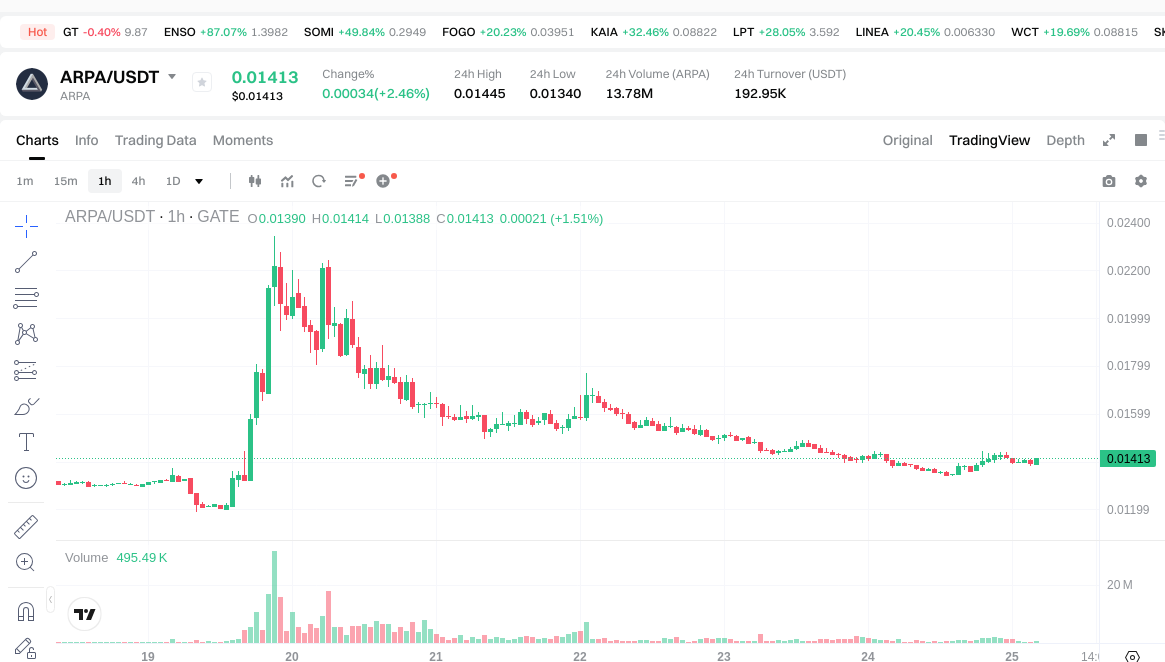
On-Chain Metrics
- Daily Trading Volume: $186,899.59 (demonstrates ongoing market activity and liquidity)
- Token Holders: 26,627 addresses (reflects the distribution and adoption of ARPA tokens across the ecosystem)
- Market Capitalization: $13,662,048.73 (indicates the current market valuation based on circulating supply)
ARPA Ecosystem Applications and Strategic Partnerships
Core Use Cases
ARPA's ecosystem supports multiple applications across various domains:
- Financial Services: ARPA enables secure multi-party computation for financial transactions, providing privacy-preserving data collaboration solutions.
- Credit Reporting: The network facilitates secure data sharing and integration among credit institutions while maintaining data privacy.
- Marketing & Healthcare: ARPA supports collaborative analytics in marketing campaigns and medical data research, enabling parties to jointly compute insights without exposing sensitive information.
Strategic Partnerships
ARPA has established collaborations with various blockchain ecosystems, enhancing its technical capabilities and market reach through its compatibility layer for mainstream public chains.
These partnerships provide a solid foundation for ARPA's ecosystem expansion.
Challenges and Considerations
ARPA faces several industry-wide challenges:
- Technical Complexity: Implementing multi-party secure computation at scale requires sophisticated cryptographic protocols
- Market Competition: The privacy-preserving computation space includes various competing solutions and blockchain platforms
- Adoption Barriers: Enterprise adoption of privacy computing technologies requires education and integration efforts
These challenges continue to drive ARPA's ongoing innovation and development efforts.
ARPA maintains an active community with 26,627 token holders as of January 2026.
The project is available on 28 exchanges, facilitating broad market participation.
Community discussions center around privacy computing applications and technological developments.
ARPA maintains official presence on X platform at @arpaofficial, where the team shares updates on:
- Technical developments in privacy computing protocols
- Integration updates with blockchain platforms
- Community engagement initiatives
- Partnership announcements
The community also engages through Discord channels, discussing implementation use cases and network developments.
Discussion Topics
Community members actively discuss ARPA's privacy computing technology, multi-chain compatibility, and enterprise adoption potential,
reflecting both the transformative possibilities and the practical considerations of implementing privacy-preserving solutions.
- Official Website: Visit ARPA Network Official Site for features, use cases, and latest updates.
- Blockchain Explorers: View ARPA token activity on Ethereum Explorer and BSC Explorer
- X Updates: On X platform, ARPA uses @arpaofficial for announcements covering technology updates, ecosystem developments, and partnership news.
ARPA Development Roadmap
- Ongoing Development: Continue enhancing multi-party secure computation protocols to improve performance and scalability
- Ecosystem Goals: Expand privacy computing capabilities across multiple blockchain platforms
- Long-term Vision: Establish ARPA as a privacy computing infrastructure layer for blockchain ecosystems
How to Participate in ARPA?
- Purchase Options: Acquire ARPA on Gate.com and other supported exchanges
- Storage Solutions: Securely store ARPA tokens using compatible wallets that support ETH and BSC networks
- Network Participation: Engage with the community through official Discord channels
- Ecosystem Building: Explore privacy computing applications and integration opportunities
Summary
ARPA leverages blockchain technology and cryptographic innovation to provide privacy-preserving computation solutions, offering secure multi-party data collaboration, verifiable computation, and cross-chain compatibility.
Its active community, technical resources, and market presence position it within the privacy computing sector.
While facing adoption challenges and technical complexity, ARPA's focus on privacy-preserving technology and multi-chain compatibility reflects its commitment to addressing data security needs in the blockchain space.
Whether you're exploring privacy solutions or interested in secure computation technologies, ARPA represents an approach worth monitoring in the evolving landscape of blockchain privacy infrastructure.
FAQ
What is ARPA and how does it work?
ARPA is a decentralized computation network enabling secure multi-party computation and privacy-preserving data analysis. It works by distributing computational tasks across nodes, allowing users to perform complex calculations while maintaining data privacy through cryptographic protocols.
What are the uses and value of ARPA tokens?
ARPA tokens power the ARPA Network, enabling secure multi-party computation and privacy-preserving data solutions. The token serves as governance asset and utility fuel for network operations, driving adoption in Web3 privacy infrastructure with substantial long-term appreciation potential.
How to buy and store ARPA tokens?
Purchase ARPA on major cryptocurrency platforms using fiat or other cryptocurrencies. Transfer tokens to a secure wallet supporting ERC-20 standards, such as MetaMask or hardware wallets like Ledger for optimal security and full control.
What are the main application scenarios of ARPA project?
ARPA's primary applications include decentralized random number generation for blockchain games and NFTs, secure computation services for DeFi protocols, privacy-preserving data analysis, and trustless oracle solutions. It enables developers to integrate verifiable randomness and confidential computing capabilities into their Web3 applications.
What risks should I pay attention to when investing in ARPA?
ARPA investment involves market volatility, liquidity risks, and regulatory uncertainty. Cryptocurrency markets are highly speculative. Token price fluctuations can be significant. Consider your risk tolerance and investment capacity before participating.
What are ARPA's advantages compared to other privacy computing projects?
ARPA offers superior scalability, lower computational costs, and faster transaction processing. Its innovative threshold cryptography enables efficient multi-party computation while maintaining robust security standards across decentralized networks.
* The information is not intended to be and does not constitute financial advice or any other recommendation of any sort offered or endorsed by Gate.