This comprehensive guide explores ASTR Token, the native asset of Astar Network launched in 2022 to address blockchain interoperability and Web3 adoption challenges. ASTR serves as a unified bridge connecting Astar Network and Soneium ecosystems, with over 848,881 holders as of 2026. The article covers ASTR's technical architecture utilizing Proof-of-Stake consensus and multi-VM environments, current market metrics including circulating supply of 8.277 billion tokens and trading on Gate.com, and core applications in DeFi, Web3 infrastructure, and Layer 2 solutions. It examines strategic partnerships with Sony Block Solutions Labs, community engagement on social platforms, and the token's role in advancing mainstream blockchain adoption. The guide also addresses market volatility, adoption barriers, and ASTR's long-term vision of connecting Web3 ecosystems globally while offering practical participation methods through exchanges, staking, and ecosystem development.
Astar Token's Positioning and Significance
In 2022, the Astar Network team launched Astar Token (ASTR), aiming to address the challenges of web3 adoption, blockchain interoperability, and accessibility for mainstream users.
As a unified asset bridging multiple blockchain ecosystems, Astar Token plays a key role in decentralized finance, web3 applications, and cross-chain solutions.
As of 2026, Astar Token has established itself as a core asset connecting Astar Network and Soneium ecosystems, with over 848,881 holders and an active developer community.
This article will provide an in-depth analysis of its technical architecture, market performance, and future potential.
Origin and Development History
Birth Background
Astar Token was created by the Astar Network team in 2022, aiming to solve the challenges of blockchain interoperability, web3 accessibility, and mainstream adoption.
It emerged during the expansion of blockchain technology and growing demand for scalable solutions, with the goal of enabling seamless connectivity between different blockchain ecosystems and empowering developers and users to unlock web3's full potential.
Astar Token's launch brought new possibilities for developers, enterprises, and users seeking interoperable blockchain solutions.
Key Milestones
- 2022: Mainnet launch on January 17, establishing the foundation for multi-VM environment and ecosystem development.
- 2024: Strategic partnership with Sony Block Solutions Labs announced, introducing Soneium as an advanced Layer 2 solution.
- 2025: Integration between Astar Network and Soneium ecosystems accelerated, with ASTR token serving as the unified asset across both platforms.
- 2026: Ecosystem expansion continues, with ASTR token facilitating governance, staking, and cross-ecosystem interoperability.
With support from the Astar Foundation and strategic partners including Sony Block Solutions Labs, Astar Token continues to enhance its technology, security, and real-world applications.
How Astar Token Works?
No Central Control
Astar Token operates on decentralized networks spanning multiple ecosystems, free from control by banks or governments.
Nodes distributed globally collaborate to validate transactions, ensuring system transparency and attack resistance, granting users greater autonomy and enhancing network resilience.
Blockchain Core
Astar Token's infrastructure consists of interconnected blockchain systems: Astar Network serves as the governance and staking layer, while Soneium functions as the adoption layer.
Transactions are recorded on a public, immutable digital ledger, grouped into blocks and linked through cryptographic hashing to form a secure chain.
Anyone can view the records, establishing trust without intermediaries.
The architecture leverages Ethereum's OP Stack for high-speed, low-cost transactions and provides a multi-VM environment for enhanced scalability and flexibility.
Ensuring Fairness
Astar Network employs a Proof-of-Stake (PoS) consensus mechanism to validate transactions and prevent fraudulent activities such as double-spending.
Validators maintain network security through staking ASTR tokens and operating nodes, earning ASTR rewards for their participation.
Innovative features include support for multiple virtual machines and cross-ecosystem interoperability between Astar Network and Soneium.
Secure Transactions
Astar Token utilizes public-private key cryptography to protect transactions:
- Private keys (similar to secret passwords) are used to sign transactions
- Public keys (similar to account numbers) are used to verify ownership
This mechanism ensures fund security while maintaining pseudonymous transaction privacy.
Additional security features include integration with Ethereum's security model through Soneium's Layer 2 solution and multi-signature capabilities for enhanced protection.
Circulating Supply Overview
As of January 17, 2026, Astar Token's circulating supply stands at 8,277,448,917 tokens, with a total supply of 8,617,595,433 tokens and an unlimited maximum supply, indicating an inflationary model.
The token serves as the unifying asset across the Astar collective, bridging Astar Network and Soneium ecosystems. As new tokens enter the market through network operations, they influence supply and demand dynamics within both interconnected ecosystems.
Price Volatility
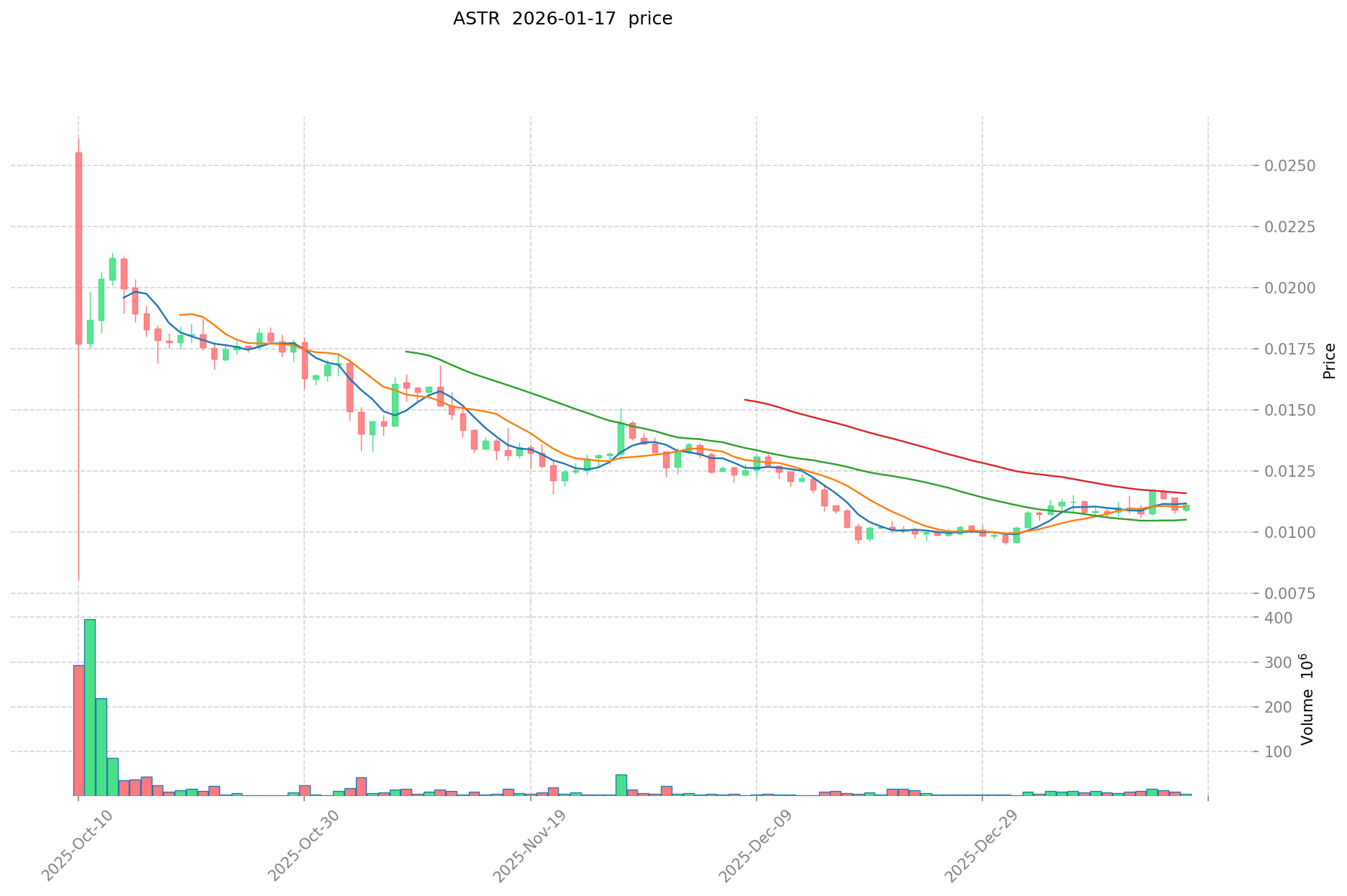
Astar Token reached a notable price level of $0.421574 on January 17, 2022, driven by broader market momentum and growing interest in Japan-originated Web3 projects.
Its lowest recorded price was $0.00948783, occurring on January 1, 2026, reflecting market correction phases and broader cryptocurrency sector adjustments.
These price movements illustrate the impact of market sentiment, adoption trends, and external factors on the token's valuation. Over the past year, the token has experienced significant price adjustments, with the current price at $0.011459 as of January 17, 2026.
Click to view current ASTR market price
On-Chain Metrics
- Market Capitalization: $94,851,287.14 (reflecting current circulating supply valuation)
- 24-Hour Trading Volume: $40,626.99 (indicating market activity levels)
- Token Holders: 848,881 addresses (demonstrating widespread distribution and community participation)
- Market Dominance: 0.0029% (representing its position within the broader cryptocurrency market)
Astar Token Ecosystem Applications and Partners
Core Use Cases
Astar Token's ecosystem supports multiple applications:
- Web3 Infrastructure: Astar Network provides a secure and scalable multi-VM environment, offering decentralized governance and staking capabilities.
- Layer 2 Solutions: Soneium, developed by Sony Block Solutions Labs, leverages Ethereum's OP Stack for high-speed, low-cost transactions tailored to entertainment and consumer applications.
- DeFi and Payments: The ecosystem enables consumer-friendly applications, payment solutions, and decentralized finance to facilitate mainstream web3 adoption.
Strategic Partnerships
Astar has established collaboration with Sony Block Solutions Labs, enhancing its technological capabilities and market influence through the Soneium ecosystem.
These partnerships provide a solid foundation for Astar Token's ecosystem expansion.
Controversies and Challenges
Astar Token faces the following challenges:
- Technical Challenges: Scaling and performance optimization across multi-VM environments
- Market Competition: Competition from other blockchain platforms in the web3 infrastructure space
- Adoption Barriers: Bridging the gap between traditional applications and blockchain technology
These issues have sparked discussions within the community and market, driving Astar Token's continuous innovation.
Astar Token's community demonstrates notable activity, with 848,881 token holders as of January 17, 2026.
On X platform, related posts and hashtags (such as #ASTR and #AstarNetwork) generate regular engagement.
Ecosystem developments and partnerships with Soneium have energized community participation.
Sentiment on X shows varied perspectives:
- Supporters praise Astar Token's multi-VM architecture, interoperability features, and its role as "a bridge between Astar Network and Soneium ecosystems".
- Critics focus on price volatility and market cap fluctuations.
Recent trends indicate moderate optimism around ecosystem developments.
Popular Topics
X users actively discuss Astar Token's interoperability vision, Soneium integration, and web3 mainstream adoption potential,
showcasing both its transformative capabilities and the challenges in achieving widespread adoption.
- Official Website: Visit Astar Network official website for features, use cases, and latest updates.
- White Paper: Astar White Paper details its technical architecture, objectives, and vision.
- X Updates: On X platform, Astar Network maintains an active presence through @AstarNetwork,
with posts covering technical upgrades, community activities, and partnership announcements, generating significant community engagement.
Astar Token Future Roadmap
- Ongoing Development: Enhancing interoperability between Astar Network and Soneium, improving transaction efficiency and scalability
- Ecosystem Goals: Expanding developer adoption and consumer-friendly applications
- Long-term Vision: Becoming a key infrastructure for connecting web3 ecosystems and bringing blockchain technology to billions worldwide
How to Participate in Astar Token?
- Purchase Channels: Buy ASTR on Gate.com and other cryptocurrency exchanges
- Storage Solutions: Use compatible cryptocurrency wallets to securely store ASTR
- Participate in Governance: Engage in community governance through Astar Network's governance mechanisms
- Build in the Ecosystem: Visit Astar GitHub to develop DApps or contribute to the codebase
Summary
Astar Token redefines web3 infrastructure through blockchain technology, providing interoperability, scalability, and seamless ecosystem bridging.
Its active community, rich resources, and strategic positioning make it distinctive in the cryptocurrency field.
Despite facing market volatility and adoption challenges, Astar Token's innovative approach and clear roadmap position it as a noteworthy player in the future of decentralized technology.
Whether you are a newcomer or an experienced participant, Astar Token deserves attention and engagement.
FAQ
What is ASTR? What are the functions of Astar Network's native token?
ASTR is Astar Network's native token used for paying transaction fees, staking, and governance. It incentivizes developers and supports the network's operation and growth.
How to buy and trade ASTR tokens? Which exchanges are supported?
ASTR tokens can be purchased and traded on major cryptocurrency exchanges. The most active trading pair is ASTR/USDT with significant daily trading volume. You can access ASTR through decentralized exchanges and various trading platforms supporting the token.
What is the total supply of ASTR tokens and current circulating supply?
ASTR has a total supply of 8.617 billion tokens with a current circulating supply of 8.277 billion tokens, representing a circulation rate of 96.05%.
What are the benefits of holding ASTR tokens? Can I stake them?
ASTR tokens support staking to earn rewards. When you stake ASTR through dApp Staking, you receive staking rewards, with a portion distributed to the selected DApp. Different dApp choices don't affect your total staking yield.
What are the advantages of Astar Network compared to other Layer 2 solutions?
Astar Network offers superior throughput and lower latency than competing Layer 2 solutions, enabling faster transactions and reduced fees. Its unique Polkadot parachain integration provides enhanced interoperability and scalability. The platform combines efficient architecture with strong security, delivering optimal performance for Web3 applications.
What are the risk factors of ASTR tokens? What should I pay attention to when investing?
ASTR token risks include early investor sell-offs and market volatility. Monitor token unlocking schedules and management decisions. Conduct thorough due diligence before investing, as market risks are inherent in cryptocurrency assets.
* The information is not intended to be and does not constitute financial advice or any other recommendation of any sort offered or endorsed by Gate.