This article provides a detailed guide to Cosmos's blockchain network, exploring its origin and significance as a solution for interoperability among blockchains. It highlights Cosmos's technical architecture, market performance, and ecosystem applications, addressing challenges like technical hurdles and regulatory risks. The content is aimed at blockchain enthusiasts and developers interested in Cosmos's role in shaping decentralized technologies. Keywords focus on Cosmos, ATOM, interoperability, and blockchain network. Buy ATOM on Gate and engage in Cosmos governance to fully participate in the ecosystem.
Cosmos's Positioning and Significance
In 2016, Jae Kwon and Ethan Buchman launched Cosmos (ATOM), aiming to solve the interoperability challenges between different blockchains. As the "Internet of Blockchains," Cosmos plays a crucial role in enabling cross-chain communication and scalability in the blockchain ecosystem.
As of 2025, Cosmos has become a fundamental infrastructure for the blockchain industry, boasting a thriving ecosystem of interconnected chains and a vibrant developer community. This article will delve into its technical architecture, market performance, and future potential.
Origin and Development History
Birth Background
Cosmos was created by Jae Kwon and Ethan Buchman in 2016 to address the lack of interoperability and scalability in the blockchain space. It was born during the blockchain technology boom, aiming to create an ecosystem where different blockchains could communicate and interact seamlessly.
Cosmos's introduction brought new possibilities for blockchain developers and users, enabling the creation of interconnected yet sovereign blockchains.
Important Milestones
- 2019: Mainnet launch, achieving the first inter-blockchain communication.
- 2020: Introduction of the Inter-Blockchain Communication (IBC) protocol, enabling cross-chain interoperability.
- 2021: Stargate upgrade, significantly enhancing network capabilities and introducing full IBC functionality.
- 2022: Ecosystem expansion, with numerous chains and applications built on Cosmos technology.
With the support of the Interchain Foundation and a growing community, Cosmos continues to optimize its technology, security, and real-world applications.
How Does Cosmos Work?
Decentralized Control
Cosmos operates on a decentralized network of computers (nodes) spread across the globe, free from control by any single entity. These nodes collaborate to validate transactions, ensuring system transparency and attack resistance, thus granting users greater autonomy and enhancing network resilience.
Blockchain Core
Cosmos's blockchain is a public, immutable digital ledger that records every transaction. Transactions are grouped into blocks and linked through cryptographic hashes, forming a secure chain. Anyone can view the records, establishing trust without intermediaries.
Cosmos's unique Hub and Zone architecture allows for the creation of multiple interconnected yet sovereign blockchains, enhancing scalability and interoperability.
Ensuring Fairness
Cosmos uses a Proof-of-Stake (PoS) consensus mechanism called Tendermint to validate transactions and prevent fraudulent activities like double-spending. Validators secure the network by staking ATOM tokens and running nodes, receiving rewards for their participation.
Its innovative features include fast finality, high throughput, and energy efficiency compared to Proof-of-Work systems.
Secure Transactions
Cosmos utilizes public-private key cryptography to secure transactions:
- Private keys (like secret passwords) are used to sign transactions
- Public keys (like account numbers) are used to verify ownership
This mechanism ensures fund security while maintaining pseudonymity for transactions. Additionally, Cosmos supports advanced features like multi-signature accounts and threshold cryptography for enhanced security.
Circulation Overview
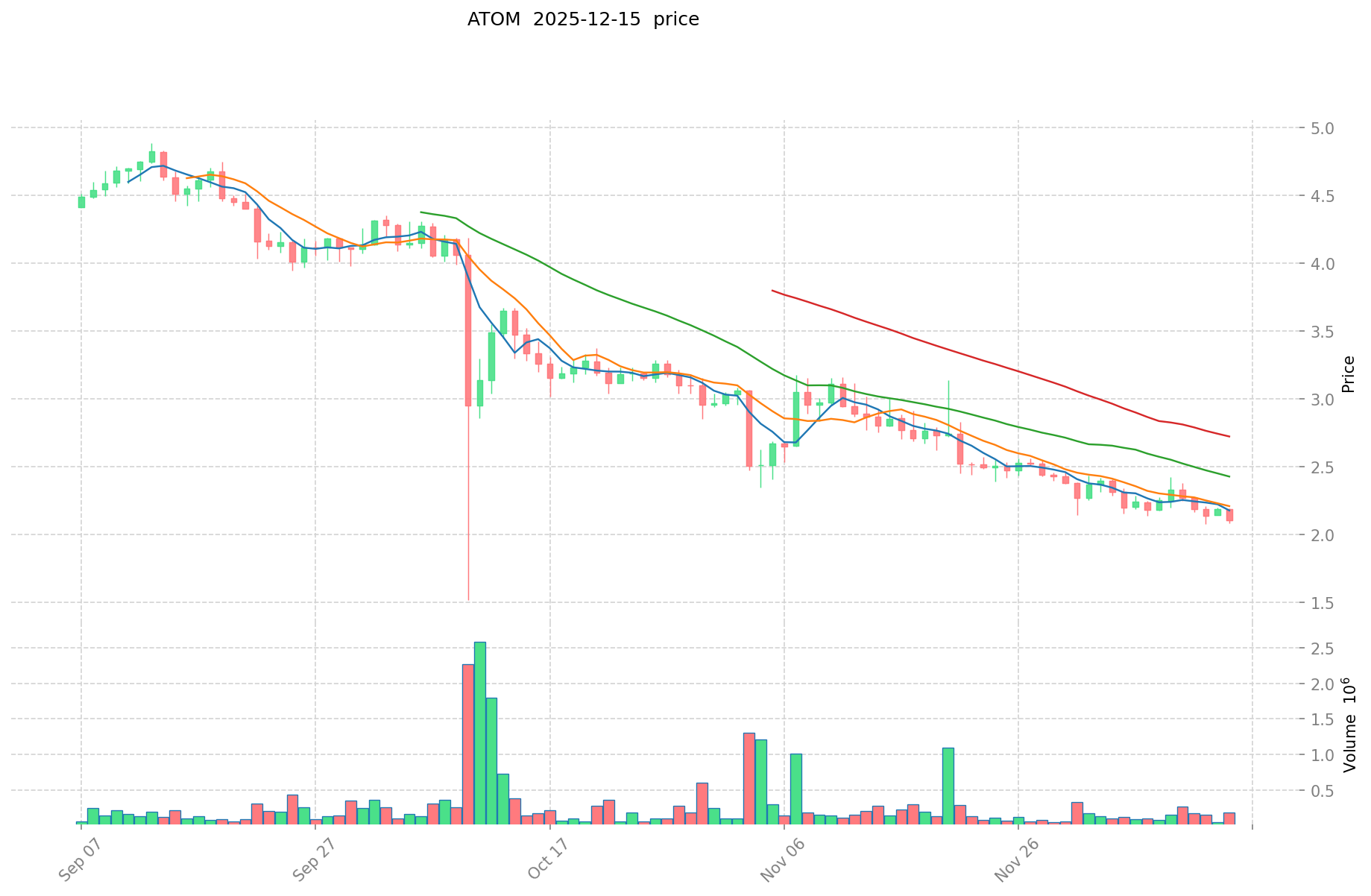
As of December 16, 2025, ATOM's circulating supply is 483,125,091.836632 coins, with a total supply of 483,125,091.836632.
Price Fluctuations
ATOM reached its all-time high of $44.45 on January 17, 2022, driven by the overall bullish cryptocurrency market.
Its lowest price was $1.16, occurring on March 13, 2020, likely due to the global market crash triggered by the COVID-19 pandemic.
These fluctuations reflect market sentiment, adoption trends, and external factors.
Click to view the current ATOM market price
On-Chain Metrics
- Daily Transaction Volume: $1,168,674.82764 (indicating network activity)
- Active Addresses: 62,275 (reflecting user engagement)
Cosmos Ecosystem Applications and Partnerships
Core Use Cases
Cosmos' ecosystem supports various applications:
- Interoperability: Projects like IBC (Inter-Blockchain Communication) enable cross-chain communication and asset transfers.
- DeFi: Platforms such as Osmosis provide decentralized trading and liquidity provision.
Strategic Collaborations
Cosmos has established partnerships with several blockchain projects to enhance its interoperability and expand its ecosystem. These partnerships contribute to Cosmos' vision of creating an "Internet of Blockchains."
Controversies and Challenges
Cosmos faces the following challenges:
- Technical Hurdles: Ensuring seamless interoperability between diverse blockchain networks.
- Regulatory Risks: Potential regulatory scrutiny as cross-chain activities increase.
- Competitive Pressure: Rising competition from other interoperability-focused blockchain projects.
These issues drive ongoing discussions within the community and market, spurring continuous innovation in the Cosmos ecosystem.
Fan Enthusiasm
Cosmos' community is vibrant, with significant growth in active addresses and transaction volumes.
On X, hashtags like #Cosmos and #ATOM frequently trend, with monthly post volumes reaching substantial numbers.
Factors such as new protocol upgrades and ecosystem expansions ignite community excitement.
Sentiment on X shows a mix of opinions:
- Supporters praise Cosmos for its interoperability solutions and robust ecosystem growth.
- Critics focus on concerns about complexity in cross-chain operations and potential security risks.
Recent trends indicate generally positive sentiment, especially surrounding new project launches within the Cosmos ecosystem.
Hot Topics
X users actively discuss Cosmos' role in facilitating cross-chain communication, the potential of IBC, and the future of multi-chain networks.
These discussions highlight both the transformative potential of Cosmos and the challenges in achieving widespread adoption of interoperable blockchain systems.
- Official Website: Visit Cosmos official website for features, use cases, and latest updates.
- Whitepaper: The Cosmos whitepaper details its technical architecture, goals, and vision.
- X Updates: On X, Cosmos uses @cosmos and has a large follower base.
Posts cover topics such as technical upgrades, community events, and partnership news, generating significant engagement.
Cosmos Future Roadmap
- Ongoing: Continuous improvements to the Inter-Blockchain Communication (IBC) protocol.
- Ecosystem Goals: Support an expanding network of interconnected blockchains and decentralized applications.
- Long-term Vision: Become the standard for interoperable blockchain networks, facilitating a truly interconnected crypto ecosystem.
How to Participate in Cosmos?
- Purchase Channels: Buy ATOM on Gate.com
- Storage Solutions: Use non-custodial wallets supporting the Cosmos ecosystem for secure storage
- Governance Participation: Engage in community decisions through the Cosmos Hub governance system
- Ecosystem Building: Access Cosmos SDK documentation to develop applications or contribute code
Summary
Cosmos is redefining blockchain interoperability, offering solutions for cross-chain communication and asset transfers. Its active community, rich resources, and strong market presence make it stand out in the cryptocurrency landscape. Despite facing challenges such as regulatory uncertainties and technical complexities, Cosmos' innovative spirit and clear roadmap position it as a key player in the future of decentralized technologies. Whether you're a newcomer or an experienced participant, Cosmos is worth watching and engaging with as it continues to shape the interconnected future of blockchain networks.
FAQ
What is the definition of an atom?
An atom is the smallest unit of matter that retains the properties of an element. It consists of a nucleus with protons and neutrons, surrounded by electrons.
What are atoms made of?
Atoms are composed of protons, neutrons, and electrons. Protons and neutrons form the nucleus, while electrons orbit around it.
What is a simple atom?
A simple atom is a hydrogen atom, consisting of one proton and one electron. It's the most basic form of an atom in the universe.
What is an example of an atom?
A hydrogen atom is a classic example of an atom. It's the simplest and most abundant element in the universe.
* The information is not intended to be and does not constitute financial advice or any other recommendation of any sort offered or endorsed by Gate.