This comprehensive guide explores Cosmos (ATOM), the revolutionary blockchain protocol designed as the "Internet of Blockchains" that solves interoperability challenges through its innovative IBC protocol and Tendermint consensus mechanism. The article examines Cosmos's technical architecture, including its modular blockchain design and decentralized network structure, while analyzing its market performance with a circulating supply of 487.9 million ATOM tokens and $1.29 billion market capitalization as of January 2026. Readers will discover core use cases spanning cross-chain communication, DeFi applications, and developer tools, alongside practical guidance on purchasing ATOM via Gate, securing tokens, and participating through staking mechanisms. Whether you're a blockchain developer, investor, or enthusiast interested in next-generation interoperability solutions, this guide provides essential insights into Cosmos's ecosystem expansion, community engagement, and strategic positioning in the competitive mu
Cosmos's Position and Significance
In 2014, Jae Kwon and Ethan Buchman introduced the foundational concepts that led to Cosmos (ATOM), aiming to address blockchain interoperability challenges and scalability limitations.
As "the Internet of Blockchains", Cosmos plays a critical role in cross-chain communication and decentralized application development.
As of 2026, Cosmos has established itself as a significant infrastructure project in the multi-chain ecosystem, with an active developer community and growing adoption across various blockchain applications.
This article will provide an in-depth analysis of its technical architecture, market performance, and future potential.
Origin and Development Timeline
Genesis Background
Cosmos was conceptualized by Jae Kwon and Ethan Buchman in 2014, aiming to solve the lack of interoperability between blockchains and the limitations of single-chain architectures.
It emerged during the expansion of blockchain technology beyond Bitcoin, with the goal of enabling independent blockchains to communicate and exchange value seamlessly.
Cosmos's launch brought new possibilities for developers seeking to build application-specific blockchains.
Key Milestones
- 2016: Tendermint Core development began, introducing Byzantine Fault Tolerance consensus mechanism.
- 2017: Initial Coin Offering raised funds to support the development of the Cosmos ecosystem.
- 2019: Cosmos Hub mainnet launched, enabling the Inter-Blockchain Communication (IBC) protocol foundation.
- 2021: IBC protocol went live, facilitating cross-chain transfers and communication between compatible blockchains.
- Recent years: The ecosystem expanded with numerous application-specific chains building on Cosmos SDK.
With support from the Interchain Foundation and a global developer community, Cosmos continues to enhance its technology, security, and real-world applications.
How Cosmos Works
Decentralized Control
Cosmos operates on a distributed network of independent blockchains (called zones) connected through hubs, eliminating reliance on central authorities.
These interconnected chains collaborate through the IBC protocol to facilitate value and data exchange, ensuring system transparency and resilience while granting participants greater autonomy.
Blockchain Foundation
Cosmos utilizes a modular blockchain architecture where each chain maintains its own ledger while being able to communicate with others.
The Cosmos Hub serves as a central connection point, with zones maintaining sovereignty while participating in the broader ecosystem.
Transactions are recorded immutably across respective chains, with the IBC protocol enabling trustless cross-chain interactions.
The Cosmos SDK allows developers to build custom blockchains efficiently, while Tendermint Core provides the consensus and networking layers.
Ensuring Consensus
Cosmos employs Tendermint Byzantine Fault Tolerance (BFT) consensus mechanism to validate transactions and maintain network security.
Validators secure the network by staking ATOM tokens and participating in block production, earning rewards for their contributions.
The mechanism combines Bonded Proof-of-Stake (BPoS) with PBFT, where validator voting power is proportional to their staked tokens, and consensus requires two-thirds majority agreement.
This approach offers fast finality and energy efficiency compared to traditional Proof-of-Work systems.
Secure Transactions
Cosmos uses cryptographic key pairs to protect transactions:
- Private keys (similar to secret passwords) are used to authorize transactions
- Public keys (similar to account identifiers) are used to verify ownership and receive assets
This mechanism ensures fund security while maintaining pseudonymous transaction privacy.
The IBC protocol incorporates additional security measures through light client verification and fraud proofs.
Circulation Overview
As of January 14, 2026, Cosmos (ATOM) has a circulating supply of 487,968,234.45 tokens, with a total supply of 487,968,234.45 tokens. The network operates under a dynamic issuance model where new tokens enter circulation through staking rewards and validator incentives, influencing its supply-demand dynamics. The current circulating supply represents approximately 124.82% of the max supply figure, reflecting the network's tokenomics structure.
Price Volatility
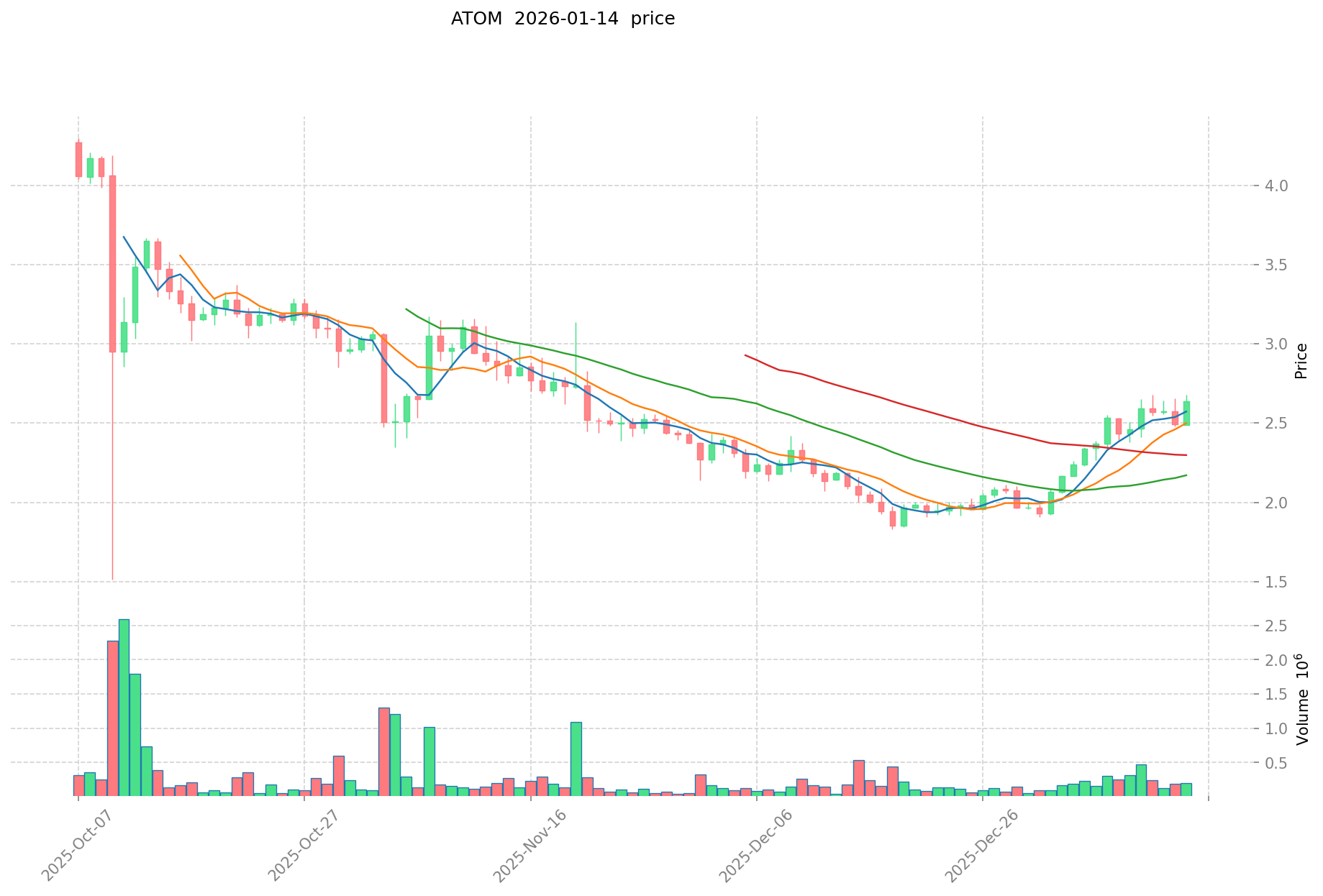
Cosmos (ATOM) reached a notable price level of $44.45 on January 17, 2022, driven by favorable market conditions and increased adoption of its interoperability solutions during a period of heightened interest in blockchain infrastructure. Its lowest recorded price was $1.16 on March 13, 2020, occurring during broader market volatility that affected digital assets across the sector. These price movements reflect evolving market sentiment, adoption patterns, and the influence of external market factors on the cryptocurrency ecosystem.
Click to view current ATOM market price
On-Chain Metrics
- Holder Addresses: 62,275 addresses (indicating the distribution of token ownership across the network)
- Market Capitalization: $1.29 billion (representing the total market value of circulating tokens)
- 24-Hour Trading Volume: $526,273.87 (reflecting market liquidity and trading activity)
Cosmos Ecosystem Applications and Partners
Core Use Cases
Cosmos's ecosystem supports diverse applications across multiple domains:
- Cross-Chain Communication: Through the Inter-Blockchain Communication (IBC) protocol, Cosmos enables seamless interoperability between different blockchains, facilitating decentralized asset transfers and data exchange.
- Decentralized Finance (DeFi): Various projects within the Cosmos ecosystem leverage Tendermint consensus to build efficient DeFi platforms, offering functionalities such as staking and liquidity provision.
- Developer Tools: Cosmos SDK provides a modular framework that allows developers to focus on application-layer innovation without dealing with underlying protocol complexities.
Strategic Partnerships
Cosmos has established collaborations within the blockchain ecosystem to enhance its technical capabilities and expand market reach. These partnerships contribute to the ecosystem's development by fostering innovation and improving cross-chain connectivity standards. The cooperative framework strengthens Cosmos's position as an infrastructure provider for blockchain interoperability.
Challenges and Controversies
Cosmos faces several challenges in its development:
- Technical Complexity: While IBC protocol enables cross-chain communication, its implementation requires sophisticated coordination mechanisms between validators and zones.
- Competitive Landscape: The blockchain interoperability space features multiple competing solutions, each offering different approaches to cross-chain connectivity.
- Adoption Barriers: Expanding the ecosystem requires continuous efforts to attract developers and projects to build on Cosmos infrastructure.
These challenges have sparked ongoing discussions within the community and drive continuous improvement in the platform's technology stack.
Cosmos maintains an active community presence with engagement across multiple channels. The project's forum at https://forum.cosmos.network/ serves as a central hub for technical discussions and governance proposals. As of January 14, 2026, the network has attracted attention from blockchain enthusiasts and developers interested in interoperability solutions.
On X platform (Twitter: https://twitter.com/cosmos), discussions around Cosmos reflect diverse perspectives:
- Supporters highlight Cosmos's modular architecture, Tendermint consensus mechanism, and the innovative IBC protocol as key technological advantages in the blockchain interoperability space.
- Critical Voices raise questions about ecosystem complexity, validator centralization concerns, and competition from alternative Layer-1 solutions.
The sentiment varies with market conditions and technological developments within the ecosystem.
Popular Topics
X users frequently discuss Cosmos's IBC protocol capabilities, ecosystem expansion through zones and hubs, validator participation mechanisms, and the role of ATOM token in network security through staking.
Cosmos Future Roadmap
Cosmos continues to develop its ecosystem with focus on:
- Interoperability Enhancement: Ongoing improvements to IBC protocol to support more complex cross-chain interactions
- Ecosystem Expansion: Attracting diverse projects to build zones and hubs within the Cosmos network
- Long-Term Vision: Establishing Cosmos as a foundational infrastructure for blockchain internet where independent chains can communicate efficiently
How to Participate in Cosmos?
- Purchase Options: ATOM is available on Gate.com and other cryptocurrency platforms
- Storage Solutions: Secure storage options include both hardware and software wallet solutions compatible with Cosmos network
- Network Participation: Users can participate in network security through staking mechanisms using validators
- Ecosystem Contribution: Developers can access resources at https://github.com/cosmos/cosmos-sdk to build applications using Cosmos SDK
Summary
Cosmos represents a significant approach to blockchain interoperability through its Tendermint consensus mechanism and IBC protocol. The platform offers modular architecture that enables developers to build customized blockchains while maintaining communication capabilities with other chains in the ecosystem.
With an active community presence across forums, social media, and development channels, Cosmos has established itself as a notable project in the cross-chain communication space. The network's focus on sovereignty and interoperability presents a distinct model for blockchain connectivity.
While facing challenges common to complex blockchain infrastructure projects, including technical coordination requirements and competitive pressure, Cosmos's continued development and ecosystem growth demonstrate ongoing commitment to its vision of creating an internet of blockchains.
Whether you are interested in blockchain interoperability, developing decentralized applications, or participating in network validation, Cosmos offers multiple entry points for engagement with its ecosystem.
FAQ
What is ATOM and what problem does Cosmos solve?
ATOM is the native cryptocurrency of Cosmos, designed to solve blockchain interoperability challenges. Cosmos creates an interconnected network of independent blockchains that can communicate and transact seamlessly with each other, often referred to as the Internet of Blockchains.
How does Cosmos (ATOM) differ from Bitcoin and Ethereum?
Cosmos (ATOM) enables interoperability between multiple blockchains, unlike Bitcoin's single-chain design. Unlike Ethereum's smart contracts focus, Cosmos prioritizes scalability and cross-chain communication through its IBC protocol, allowing independent blockchains to interact seamlessly.
What is the use case of ATOM token and how does staking work?
ATOM token enables staking to secure the Cosmos network and earn rewards. Stakers validate transactions, receive monthly income as the network grows, and participate in governance decisions.
How does the Cosmos ecosystem and Inter-Blockchain Communication (IBC) protocol work?
Cosmos uses the IBC protocol to enable different blockchains to interact, transfer assets, and exchange information. Off-chain relayers monitor blockchains and transmit data between connected chains, facilitating seamless cross-chain communication and interoperability within the Cosmos network.
What are the risks and security considerations of investing in ATOM?
ATOM investment risks include market volatility, liquidity constraints, and blockchain-specific vulnerabilities. Security considerations involve smart contract risks and network stability dependence. Regulatory changes may also impact value.
How can I buy, store, and stake ATOM tokens?
Buy ATOM on major exchanges, store in secure wallets like Ledger or MetaMask, and stake through Cosmos Station or Osmosis to earn rewards.
* The information is not intended to be and does not constitute financial advice or any other recommendation of any sort offered or endorsed by Gate.