This comprehensive guide explores BounceAuction (AUCTION), a decentralized token exchange platform launched in 2021 to revolutionize DeFi token distribution. The article covers BounceAuction's positioning within the cryptocurrency ecosystem, its blockchain-based auction mechanisms, and current market performance with a circulating supply of 7.09 million tokens and trading price of $4.848. Readers will discover how the platform operates through fixed and dynamic exchange rate pools on Ethereum and Binance Smart Chain, understand its tokenomics and price fluctuations, and learn about community engagement. The guide provides practical guidance on purchasing AUCTION on Gate and participating in governance, alongside detailed insights into auction mechanisms, security features, and ecosystem opportunities. Ideal for both newcomers and experienced crypto participants seeking to understand decentralized bidding systems and DeFi innovation.
BounceAuction's Positioning and Significance
In 2021, the Bounce team launched BounceAuction (AUCTION), aiming to solve inefficiencies in decentralized token distribution and the lack of flexible auction mechanisms in DeFi.
As a decentralized token exchange platform offering both fixed and dynamic auction pools, BounceAuction plays a key role in decentralized finance (DeFi) and token distribution.
As of 2026, BounceAuction has established itself within the DeFi ecosystem, with a market cap ranking around 649th position and a circulating supply of approximately 7.09 million tokens. The platform continues to attract users seeking innovative token swap mechanisms and governance participation.
This article will provide an in-depth analysis of its technical architecture, market performance, and future potential.
Origin and Development History
Birth Background
BounceAuction was created by the Bounce team in 2021, aiming to solve limitations in traditional token distribution models and provide more flexible, decentralized auction mechanisms.
It emerged during the DeFi boom and the expansion of decentralized token issuance, with the goal of empowering users with customizable token exchange pools and democratic governance through its native token.
BounceAuction's launch brought new possibilities for DeFi participants, project teams, and token issuers.
Important Milestones
- 2021: Platform launch on Ethereum and Binance Smart Chain, introducing fixed and dynamic rate token exchange pools.
- 2021: Token conversion from BOT to AUCTION at a 1:100 ratio, establishing AUCTION as the platform's native governance and utility token.
- The platform has continued to develop its auction infrastructure and governance mechanisms, enabling users to participate in liquidity mining, governance voting, and transaction fee dividends.
Under the support of the Bounce community and development team, BounceAuction continues to optimize its technical capabilities, security features, and real-world applications.
How BounceAuction Works?
No Central Control
BounceAuction operates on decentralized blockchain networks (Ethereum and Binance Smart Chain), removing control from banks or governments.
These distributed networks validate transactions collaboratively, ensuring transparency and resistance to attacks, granting users greater autonomy and enhancing network resilience.
Blockchain Core
BounceAuction's infrastructure is built on public, immutable digital ledgers that record every transaction.
Transactions are grouped into blocks and linked through cryptographic hashes to form secure chains.
Anyone can view records, establishing trust without intermediaries.
The platform supports deployment on multiple blockchain networks, allowing users to choose between Ethereum and Binance Smart Chain based on their preferences for speed and cost.
Ensuring Fairness
BounceAuction leverages the underlying consensus mechanisms of its host blockchains (Ethereum's Proof of Stake and Binance Smart Chain's Proof of Staked Authority) to validate transactions and prevent fraudulent activities.
Validators on these networks maintain security through staking and block validation, receiving rewards in the respective native tokens.
The platform's innovation includes flexible auction mechanisms that allow creators to set fixed or dynamic exchange rates, with automatic refund mechanisms to protect participants.
Secure Transactions
BounceAuction uses public-private key cryptography to protect transactions:
- Private keys (like secret passwords) are used to sign transactions
- Public keys (like account numbers) are used to verify ownership
This mechanism ensures fund security while transactions maintain pseudonymous privacy on the blockchain.
The platform implements smart contract-based auction pools with built-in rules for token distribution, bounce levels (maximum deposit caps), and automatic asset returns, providing additional security layers for participants.
Circulating Supply Overview
As of January 21, 2026, AUCTION's circulating supply stands at 7,090,336.07 tokens, with a total supply of 7,640,963.07 tokens and a maximum supply of 10,000,000 tokens. The circulating supply represents approximately 70.90% of the maximum supply, indicating a controlled release mechanism.
AUCTION originated from the BOT token through a 1:100 conversion ratio (each BOT token exchanged for 100 AUCTION tokens). The platform distributes BOT tokens daily to users who successfully submit token transactions through liquidity mining, while token holders can participate in governance voting and receive transaction fee dividends of 0.20% from all trading amounts.
Price Fluctuations
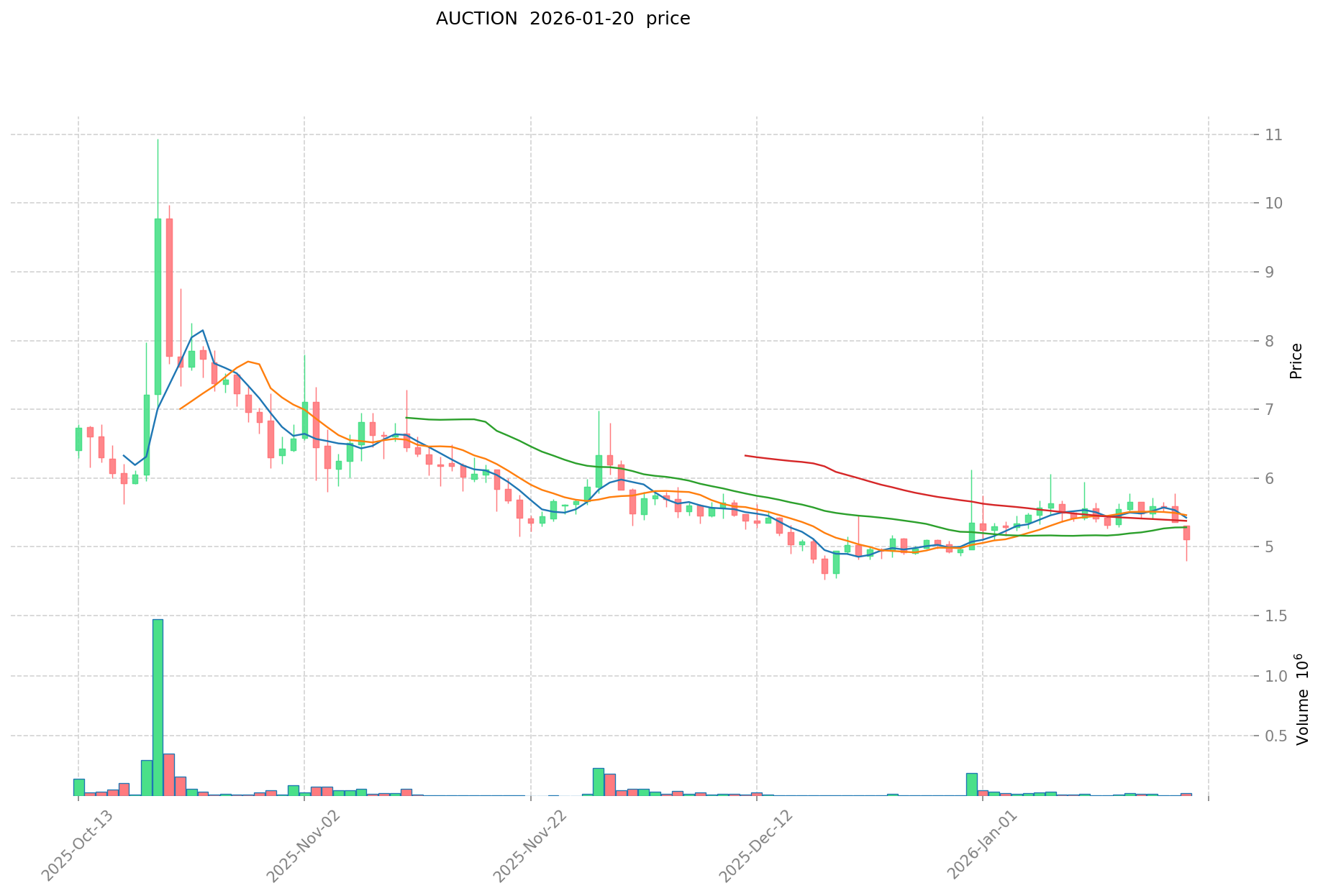
AUCTION reached a notable price level of $70.44 on April 12, 2021, during a period of significant market activity in the decentralized exchange sector. The token's lowest recorded price was $3.16 on October 11, 2025, reflecting broader market conditions and sector-specific developments.
As of the latest data, AUCTION is trading at $4.848, showing a 24-hour change of -5.25%, a 7-day change of -11.93%, and a 1-year change of -62.88%. The 24-hour trading range spans from $4.817 to $5.175, with a total trading volume of $84,766.84. These price movements reflect ongoing market dynamics, adoption patterns, and various external factors affecting the decentralized finance sector.
The current market capitalization stands at approximately $34.37 million, with a fully diluted valuation of $37.04 million, representing a market cap to FDV ratio of 70.9%.
Click to view current AUCTION market price
On-Chain Metrics
- Token Holders: 9,284 addresses hold AUCTION tokens, indicating the breadth of community participation
- Exchange Listings: The token is available on 36 different exchanges, providing multiple access points for traders
- Market Dominance: AUCTION represents 0.0011% of the total cryptocurrency market capitalization
BounceAuction Ecosystem Applications and Strategic Partners
Core Use Cases
BounceAuction's ecosystem supports multiple applications:
- Decentralized Token Exchange: The platform enables users to create fixed or dynamic exchange rate token swap pools, providing decentralized auction mechanisms.
- Liquidity Mining: BOT tokens are distributed daily to users who successfully complete token transactions, promoting ecosystem participation and liquidity provision.
Strategic Partnerships
BounceAuction operates on Ethereum and Binance Smart Chain, leveraging these blockchain infrastructures to enhance its technical capabilities and market reach.
These foundational partnerships provide a solid basis for BounceAuction's ecosystem expansion.
Controversies and Challenges
BounceAuction faces the following challenges:
- Technical Considerations: The platform operates with fixed and dynamic exchange rate mechanisms that require careful parameter settings to ensure fair token distribution.
- Market Volatility: With a 24-hour price change of -5.25% and 7-day change of -11.93%, the token experiences notable price fluctuations.
- Competition Pressure: The decentralized exchange landscape continues to evolve with various platforms offering similar token swap functionalities.
These factors have sparked discussions within the community and markets, while also driving BounceAuction's continuous innovation.
BounceAuction's community shows active participation, with the token held by approximately 9,284 holders.
On X platform, related posts and hashtags (such as #AUCTION) generate ongoing discussions.
Factors such as platform feature updates and governance participation opportunities contribute to community engagement.
Sentiment on X presents varied perspectives:
- Supporters praise BounceAuction's decentralized token exchange mechanism and governance features, viewing it as an innovative approach to token distribution.
- Observers focus on price movements and market dynamics, with the token trading at $4.848 as of January 21, 2026.
Recent trends reflect the broader market sentiment affecting decentralized finance platforms.
Trending Topics
X users discuss BounceAuction's token economics, auction mechanisms, and platform governance,
showcasing both its innovative potential and the considerations involved in decentralized token exchanges.
- Official Website: Visit BounceAuction Official Website for features, use cases, and latest updates.
- Social Media: On X platform, BounceAuction maintains an active presence through @bounce_finance, with posts covering platform developments, community events, and governance updates.
- Blockchain Explorer: Track AUCTION transactions on Etherscan for on-chain activity and token movements.
BounceAuction Future Roadmap
- Platform Enhancement: Continue developing fixed and dynamic exchange rate mechanisms to improve user experience
- Ecosystem Goals: Expand governance participation and liquidity mining opportunities for token holders
- Long-term Vision: Establish BounceAuction as a leading decentralized token exchange platform
How to Participate in BounceAuction?
- Purchase Options: Acquire AUCTION on Gate.com and other supported exchanges
- Storage Solutions: Use compatible Ethereum wallets such as MetaMask to securely store AUCTION tokens
- Participate in Governance: Stake BOT tokens to participate in governance voting and receive daily rewards
- Build the Ecosystem: Visit the official website to learn about creating token swap pools and participating in platform activities
Summary
BounceAuction redefines token distribution through blockchain technology, offering decentralized exchange mechanisms, governance participation, and liquidity mining opportunities.
Its active community, available resources, and market presence position it within the cryptocurrency landscape.
Despite facing market volatility and competitive dynamics, BounceAuction's innovative approach and platform features make it a notable player in decentralized token exchanges.
Whether you're new to crypto or an experienced participant, BounceAuction offers opportunities worth exploring.
FAQ
What is Crypto Auction? How does it work?
Crypto Auction is a decentralized bidding mechanism where digital assets sell to highest bidders. Participants place bids using cryptocurrencies, with smart contracts automating execution and settlement. Transparent, immutable, and peer-to-peer transactions occur without intermediaries.
Common crypto auction types include English auctions(ascending price),Dutch auctions(descending price),sealed-bid auctions,and Vickrey auctions. NFT platforms often use fixed-price sales and timed auctions. DeFi protocols employ batch auctions for token distributions and liquidations. Each type serves different purposes in blockchain ecosystems.
How do I participate in crypto auctions? What conditions are required?
To participate in crypto auctions, you need a digital wallet with sufficient funds, create an account on the auction platform, complete identity verification, and place bids during the auction period. Most auctions require minimum bid amounts and may have eligibility requirements based on location or account status.
What are the differences between crypto auctions and traditional auctions?
Crypto auctions operate on blockchain with transparent, immutable records and instant settlement. They enable 24/7 global participation, programmable smart contracts, and tokenized assets. Traditional auctions require intermediaries, face geographic limits, and involve slower settlement processes.
What are the risks of participating in crypto auctions and how to protect yourself?
Key risks include price volatility, liquidity constraints, and smart contract vulnerabilities. Protect yourself by conducting thorough due diligence, verifying project authenticity, using secure wallets, starting with small amounts, and understanding auction mechanics before participating.
What role do smart contracts play in crypto auctions?
Smart contracts automate auction processes by executing bids, verifying payments, and transferring assets without intermediaries. They ensure transparency, security, and trustless transactions while eliminating manual errors and reducing transaction costs in cryptocurrency auctions.
Notable crypto auction platforms include OpenSea for NFTs, SuperRare for digital art, Foundation for creator auctions, and Rarible for decentralized auctions. Projects like Cryptopunks and Bored Ape Yacht Club also facilitate significant auction activity within their communities.
What are the fees and costs of crypto auctions?
Crypto auction fees vary by platform and auction type. Typical costs include platform fees (2-5%), gas fees for blockchain transactions (varies by network), and seller commissions. Some auctions charge buyer premiums. Total costs depend on network congestion and specific platform pricing models.
What legal and tax issues are involved in crypto auctions?
Crypto auctions involve capital gains taxes on profits, regulatory compliance varying by jurisdiction, KYC/AML requirements, and potential classification as securities subject to financial regulations. Always consult local tax authorities and legal experts for specific obligations.
* The information is not intended to be and does not constitute financial advice or any other recommendation of any sort offered or endorsed by Gate.