AURASOL is a community-driven memecoin launched on Solana blockchain on May 30, 2024, capitalizing on the viral 'aura' concept from TikTok and Instagram with over 200 million combined reels. Operating as a fair-launch token with organic growth, AURASOL has attracted approximately 33,900 holders and maintains active social media presence across multiple platforms. The project features a total supply of 1 billion tokens, current market capitalization of $21.62 million, and trades on Gate and multiple exchanges at $0.02244 as of January 2026. Despite experiencing typical memecoin volatility with -21.42% monthly decline, AURASOL demonstrates 222.18% annual growth, reflecting strong community momentum. The ecosystem centers on social engagement and grassroots participation rather than traditional partnerships. AURASOL represents an entry point into memecoin culture intersecting social media trends with blockchain technology for community-driven participants.
aura's Positioning and Significance
In 2024, the aura community launched aura (AURASOL), aiming to capture the viral "aura" concept popularized on social media platforms like TikTok and Instagram, addressing the need for community-driven memecoins that reflect cultural trends and social influence.
As a memecoin on the Solana blockchain, aura plays a key role in the memecoin and social media-driven crypto sectors.
As of 2026, aura has become a community-led memecoin with significant social media presence, with approximately 33,900 token holders and an active community across multiple platforms.
This article will provide an in-depth analysis of its technical foundation, market performance, and future potential.
Origin and Development History
Background of Creation
aura was created by its community on May 30, 2024, aiming to capture the viral "aura" concept that gained over 200 million combined reels on TikTok and Instagram, representing social clout and personal vibe.
It emerged during the memecoin boom on Solana, with the goal of creating a cult-like movement that unites people around a common cultural mission.
aura's launch brought new possibilities for community-driven token holders and social media enthusiasts.
Important Milestones
- 2024: Token launched with fair distribution on Solana, achieving wide token distribution and organic community growth.
- 2024-2025: Community takeover established, with social media dominance across multiple platforms.
- 2025: Token holder base expanded, reaching approximately 33,900 holders.
- 2026: Continued community engagement and social media presence maintained throughout market fluctuations.
With community support and organic growth, aura continues to maintain its social media presence and token holder engagement.
How aura Works?
No Central Control
aura operates on the decentralized Solana blockchain network with nodes distributed globally, free from bank or government control.
These nodes collaboratively validate transactions, ensuring the system remains transparent and attack-resistant, granting users greater autonomy and enhancing network resilience.
Blockchain Foundation
aura's blockchain foundation is the Solana network, a public and immutable digital ledger that records every transaction.
Transactions are grouped into blocks and linked through cryptographic hashes to form a secure chain.
Anyone can view the records, establishing trust without intermediaries.
Solana's high-performance architecture supports fast transaction processing and low fees.
Ensuring Fairness
aura operates on Solana's Proof of Stake (PoS) consensus mechanism to validate transactions and prevent fraudulent activities such as double spending.
Validators maintain network security through staking SOL tokens and running validator nodes, receiving rewards for their participation.
The innovation includes Solana's high throughput capability and energy-efficient consensus.
Secure Transactions
aura utilizes public-private key cryptography to protect transactions:
- Private keys (similar to secret passwords) are used to sign transactions
- Public keys (similar to account numbers) are used to verify ownership
This mechanism ensures fund security while transactions maintain pseudonymous privacy.
The token follows the SPL-20 standard on Solana, benefiting from the blockchain's built-in security features.
Circulating Supply Overview
As of January 23, 2026, aura (AURASOL) has a circulating supply of 963,285,471.45 tokens, with a total supply of 963,287,566 tokens and a maximum supply capped at 1,000,000,000 tokens. The circulating supply represents approximately 100% of the total supply, indicating that nearly all issued tokens are currently in circulation.
The token distribution reflects a fair-launch model with organic growth, characterized by wide distribution among tokenholders. This community-driven approach has contributed to a broad holder base of approximately 33,900 addresses, supporting decentralized ownership patterns.
Price Volatility
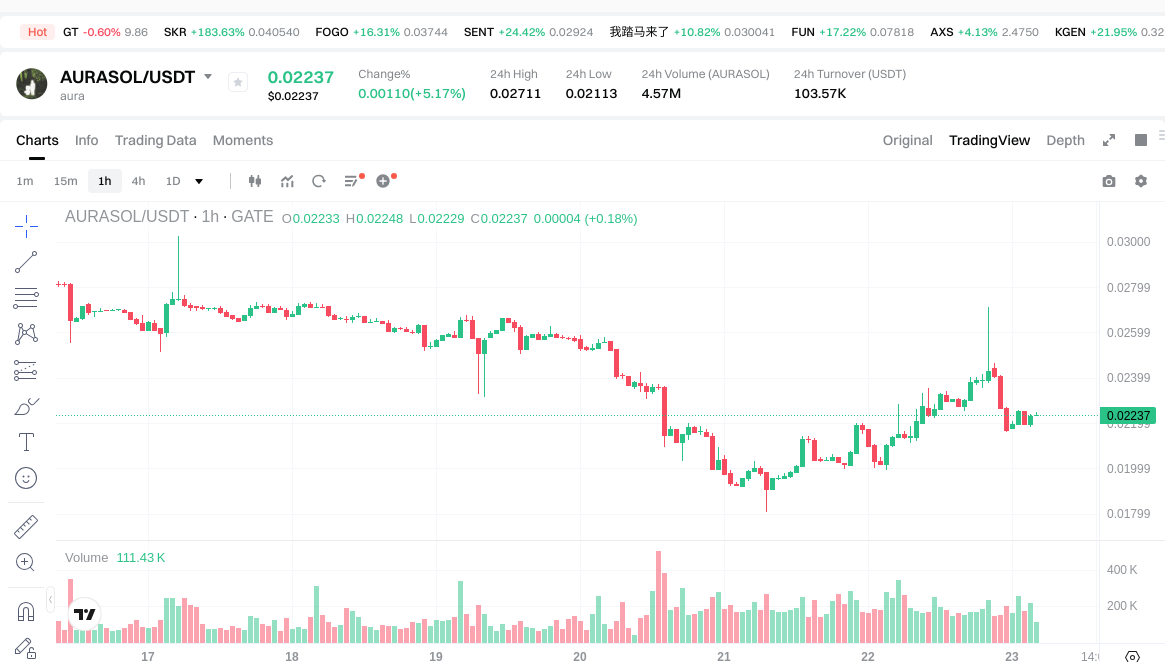
aura (AURASOL) reached a notable price level of $0.29951 on June 18, 2025, driven by community momentum and social media engagement across platforms. The token's lowest recorded price was $0.01807 on January 20, 2026, reflecting broader market conditions and sentiment shifts.
As of January 23, 2026, AURASOL trades at $0.02244, showing a 5.8% increase over the past 24 hours. However, the token has experienced price fluctuations with a -19.01% change over 7 days and a -21.42% decline over 30 days. Despite short-term volatility, the token demonstrates a 222.18% increase over the past year, indicating significant growth from its earlier price levels.
The 24-hour trading range spans from $0.02113 to $0.02711, with a daily trading volume of approximately $103,498.91, reflecting ongoing market activity and interest.
Click to view current AURASOL market price
On-Chain Metrics
- Market Capitalization: Approximately $21.62 million, representing 0.00068% of the total cryptocurrency market
- Active Holder Addresses: Around 33,900 addresses, demonstrating community participation and token distribution
- Exchange Listings: Available on 5 exchanges, providing liquidity access points for traders
- Fully Diluted Valuation: $21.62 million, with market cap to FDV ratio at 100%, indicating minimal future dilution from additional token releases
aura Ecosystem Applications and Partners
Core Use Cases
aura's ecosystem is centered around community-driven memecoin culture:
- Social Media Engagement: The project leverages viral "aura" concept popularized on TikTok and Instagram, with over 200 million combined reels, driving community participation and brand awareness.
- Community Movement: aura has evolved into a cult-like movement, uniting holders around a common mission and organic growth through social media dominance.
Strategic Partnerships
As a fair-launched memecoin with organic growth, aura's strength lies in its community-driven approach rather than traditional corporate partnerships. The project has achieved wide distribution across tokenholders, with approximately 33,900 holders contributing to its decentralized nature.
Controversies and Challenges
aura faces several challenges typical of memecoin projects:
- Market Volatility: Price fluctuations remain significant, with recent 7-day and 30-day declines of approximately 19% and 21% respectively.
- Competition Pressure: The memecoin sector on Solana blockchain continues to expand, with numerous projects competing for community attention and market share.
- Sustainability Questions: As with many memecoins, questions about long-term utility and value proposition persist within the broader crypto community.
These challenges have sparked ongoing discussions among community members and market observers about the project's evolution and future direction.
Fan Enthusiasm
aura's community demonstrates notable engagement, with approximately 33,900 tokenholders participating in the ecosystem. The project has achieved fair distribution through its organic launch mechanism.
On X platform, the community actively promotes the project through the hashtag campaign, contributing to social media presence. The memecoin's concept of "aura" tied to social clout and personal vibe has resonated with younger demographics familiar with TikTok and Instagram trends.
Community enthusiasm has been driven by social media virality, fair-launch mechanics, and collective movement culture.
X platform sentiment shows mixed perspectives:
- Supporters praise aura's community-driven approach, fair launch distribution, and organic growth model, viewing it as a genuine grassroots movement in the memecoin space.
- Critics focus on typical memecoin volatility, lack of fundamental utility, and speculative nature of the asset.
Recent trends indicate community resilience despite market corrections, with ongoing engagement across social platforms.
Hot Topics
X platform users actively discuss aura's community takeover narrative, social media dominance strategy, and position within the Solana memecoin ecosystem, reflecting both its cultural appeal and the challenges of maintaining momentum in a competitive landscape.
- Official Website: Visit aura Official Site for project features, community updates, and latest developments.
- X Activity: On X platform, aura maintains active presence through @auracoinsolana, sharing community updates, memes, and engagement activities that reinforce the project's social-first approach.
- Blockchain Explorer: Track aura token activity on Solana Explorer for transaction transparency and on-chain metrics.
aura Future Roadmap
As a community-driven memecoin, aura's development path focuses on organic growth and community engagement rather than traditional technical roadmaps. The project continues to evolve based on community participation and social media presence, maintaining its position within the Solana memecoin ecosystem.
How to Participate in aura?
- Purchase Channels: Buy aura on Gate.com and other supporting exchanges
- Storage Solutions: Use Solana-compatible wallets such as Phantom or Solflare for secure storage of SPL-20 tokens
- Community Participation: Engage with the community through X platform at @auracoinsolana and join discussions around the aura movement
- Social Engagement: Share and create content related to the "aura" concept on TikTok, Instagram, and other social platforms to contribute to the project's viral growth
Summary
aura represents a community-driven memecoin on Solana blockchain that captures the viral "aura" concept from social media platforms. Through its fair-launch mechanism, organic growth, and cult-like community movement, the project has achieved notable distribution among approximately 33,900 holders.
Despite facing market volatility and competition within the memecoin sector, aura's social-first approach and engaged community position it as a noteworthy participant in the Solana memecoin ecosystem. The project launched on May 30, 2024, with a total supply of 1 billion tokens and currently trades on multiple platforms including Gate.com.
Whether you are exploring memecoin culture or seeking community-driven crypto projects, aura offers an entry point into the intersection of social media trends and blockchain technology. As with all cryptocurrency investments, participants should conduct thorough research and understand the inherent risks of memecoin projects.
FAQ
What is AURASOL and what problem does it solve in the crypto market?
AURASOL is a blockchain-based platform designed to enhance decentralized finance accessibility and efficiency. It solves liquidity fragmentation issues across DeFi protocols by providing unified access to multiple trading venues and optimizing transaction execution costs for users in the crypto ecosystem.
How can I buy and store AURASOL tokens?
Purchase AURASOL through major crypto platforms using fiat or other cryptocurrencies. Store tokens in secure wallets like hardware wallets, MetaMask, or Trust Wallet for optimal security and control.
What is the tokenomics of AURASOL and what is its current market status?
AURASOL features a fixed supply with strategic allocation across community, development, and treasury. Currently showing strong market momentum with increasing trading volume and growing holder base. Token designed for long-term value appreciation within the Web3 ecosystem.
Is AURASOL a legitimate project and what are the associated risks?
AURASOL operates as a web3 project with transparent smart contracts and active community governance. Like all crypto projects, it carries market volatility risks. Investors should conduct thorough due diligence on tokenomics, team background, and use case fundamentals before participation.
What are the differences between AURASOL and other similar cryptocurrency projects?
AURASOL distinguishes itself through its unique consensus mechanism, enhanced energy efficiency, and superior transaction throughput. It offers faster confirmation times, lower fees, and stronger community governance compared to traditional blockchain projects, making it more scalable and accessible.
* The information is not intended to be and does not constitute financial advice or any other recommendation of any sort offered or endorsed by Gate.