This comprehensive guide explores AVAX, the native token of Avalanche blockchain, launched in 2020 to solve scalability and interoperability challenges. Discover Avalanche's innovative three-chain architecture delivering sub-second finality and thousands of transactions per second. Learn about current market performance, with AVAX trading at $13.77 and a $5.93 billion market cap. Explore the thriving ecosystem including DeFi protocols, NFT platforms, and gaming applications. The guide covers technical foundations, strategic partnerships, community sentiment, and practical participation methods through Gate. Whether you're evaluating Layer 1 platforms or seeking blockchain investment opportunities, this resource provides essential insights into Avalanche's technology, market position, and future potential in decentralized finance.
Avalanche's Positioning and Significance
In 2020, Emin Gün Sirer, Kevin Sekniqi, and Ted Yin launched Avalanche (AVAX), aiming to address challenges in blockchain scalability, interoperability, and transaction finality.
As an open-source platform for launching decentralized applications and interoperable blockchains, Avalanche plays a key role in DeFi, smart contract applications, and digital payments.
As of 2026, Avalanche has established itself as a significant Layer 1 blockchain ecosystem, with an active developer community and growing adoption.
This article will provide an in-depth analysis of its technical architecture, market performance, and future potential.
Origin and Development History
Birth Background
Avalanche was created by Emin Gün Sirer, Kevin Sekniqi, and Ted Yin in 2020, aiming to solve blockchain scalability limitations, slow transaction finality, and interoperability challenges.
It emerged during the rapid evolution of blockchain technology and growing demand for DeFi infrastructure, with the goal of providing a highly scalable platform with sub-second finality and Ethereum compatibility to transform the landscape.
Avalanche's launch brought new possibilities for developers and DeFi protocols seeking enhanced performance.
Key Milestones
- 2020: Mainnet launch in July, achieving high throughput and 1-second transaction finality.
- Subsequent years: Continued ecosystem expansion with growth in DeFi protocols and NFT platforms on the network.
- Ongoing development: Platform enhancements focused on interoperability and developer tooling, supported by the Avalanche Foundation and developer community.
Under the support of the Avalanche Foundation and its global community, Avalanche continues to optimize its technology, security, and real-world applications.
How Avalanche Works
Decentralized Control
Avalanche operates on a decentralized network of computers (nodes) distributed globally, free from control by banks or governments.
These nodes collaborate to validate transactions, ensuring system transparency and attack resistance, granting users greater autonomy and enhancing network resilience.
Blockchain Foundation
Avalanche's blockchain is a public, immutable digital ledger that records every transaction.
Transactions are grouped into blocks and linked through cryptographic hashes to form a secure chain.
Anyone can view the records, establishing trust without intermediaries.
The platform utilizes subnet architecture to further enhance performance and customization capabilities.
Ensuring Fairness
Avalanche employs the Avalanche consensus protocol (a variant of Proof-of-Stake) to validate transactions and prevent fraud such as double-spending.
Validators maintain network security through staking AVAX tokens and participating in consensus, earning AVAX rewards in return.
Its innovation includes sub-second finality and high transaction throughput exceeding thousands of transactions per second.
Secure Transactions
Avalanche uses public-private key cryptography to protect transactions:
- Private keys (like secret passwords) are used to sign transactions
- Public keys (like account numbers) are used to verify ownership
This mechanism ensures fund security while transactions maintain pseudonymity.
The platform's architecture provides additional security through validator participation requirements and network-wide consensus verification.
Circulation Overview
As of January 13, 2026, Avalanche's circulating supply stands at 430,481,321.01 tokens, with a total supply of 462,150,311.90 AVAX. The maximum supply is capped at 720,000,000 tokens, establishing a fixed supply model that may influence long-term scarcity dynamics.
New tokens enter the market through network validation rewards and staking mechanisms, affecting supply-demand dynamics. The current circulating supply represents approximately 59.79% of the total supply, with the remaining tokens allocated for future network development and ecosystem growth.
Price Volatility
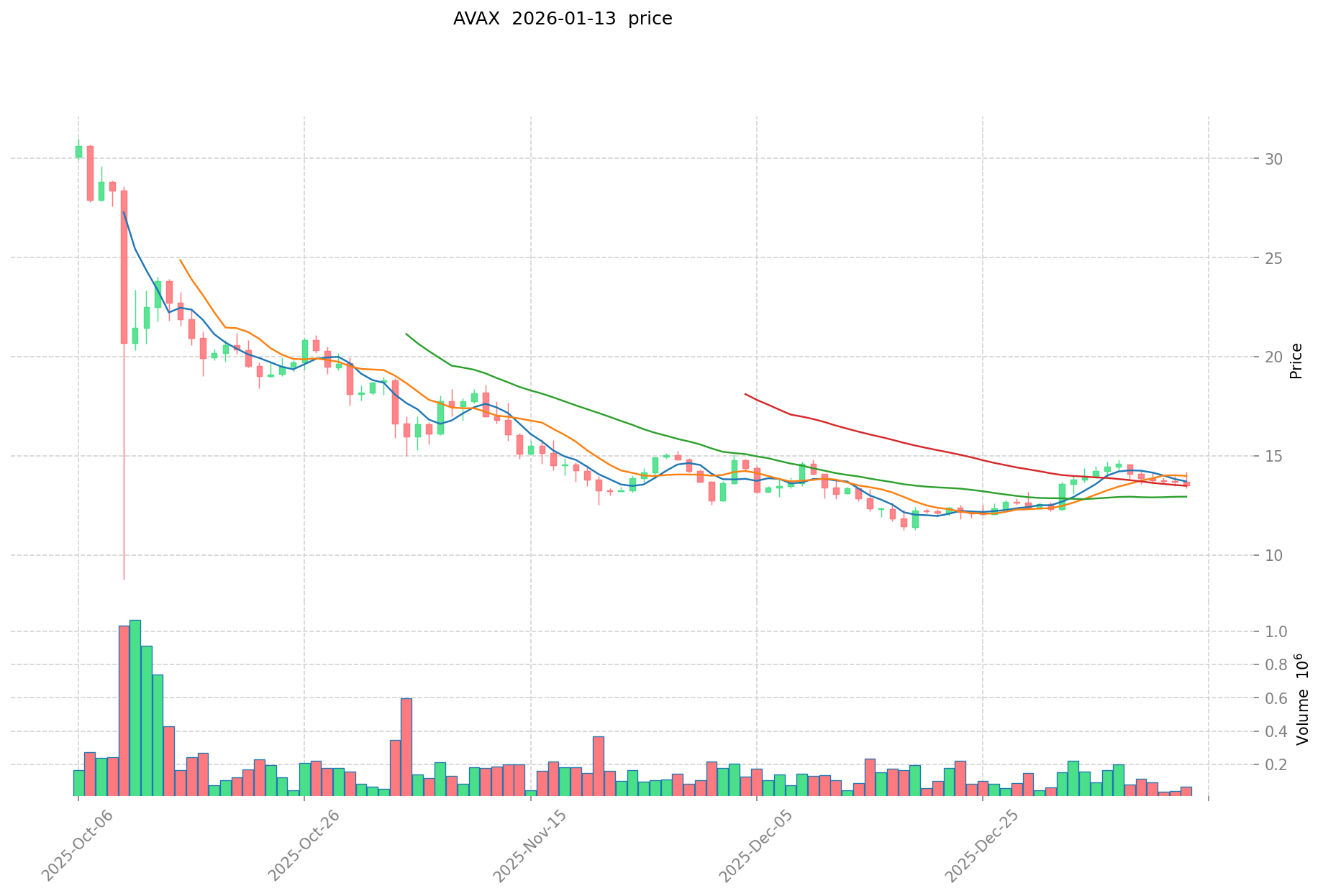
Avalanche reached its all-time high of $144.96 on November 21, 2021, during a period characterized by increased market activity and growing institutional interest in alternative Layer 1 blockchain platforms.
The lowest price of $2.80 occurred on December 31, 2020, shortly after the mainnet launch when market awareness and adoption were still in early stages.
Recent price movements show mixed signals: a 1.47% increase over the past 24 hours to $13.77, while experiencing a -4.10% decline over the past 7 days and a -62.28% decrease year-over-year. These fluctuations reflect broader market sentiment, evolving adoption trends, and external macroeconomic factors affecting the digital asset sector.
Click to view current AVAX market price
On-Chain Metrics
- 24-Hour Trading Volume: Approximately 702,890 AVAX (indicating current market liquidity and trading activity)
- Total Market Capitalization: $5.93 billion (reflecting the network's overall market valuation)
- Holder Addresses: 118,649 active holders (demonstrating user base distribution and community engagement)
- Market Dominance: 0.19% of the total cryptocurrency market capitalization
Avalanche Ecosystem Applications and Partners
Core Use Cases
Avalanche's ecosystem supports multiple applications:
- DeFi: Projects like Trader Joe and Aave provide decentralized trading and lending services.
- NFT and Gaming: Platforms such as Kalao and Crabada drive innovation in digital collectibles and blockchain gaming.
Strategic Partnerships
Avalanche has established collaborations with various technology providers and blockchain projects, enhancing its technical capabilities and market presence.
These partnerships provide a solid foundation for Avalanche's ecosystem expansion.
Controversies and Challenges
Avalanche faces the following challenges:
- Technical Issues: Network congestion during peak usage periods
- Regulatory Risks: Evolving regulatory frameworks for blockchain platforms across different jurisdictions
- Competitive Pressure: Competition from other Layer 1 blockchains
These issues have sparked discussions within the community and market, while also driving Avalanche's continuous innovation.
Avalanche's community demonstrates significant activity, with the platform supporting numerous decentralized applications and projects.
On X platform, related posts and hashtags (such as #AVAX) frequently gain traction.
New feature releases and ecosystem developments have energized community engagement.
Sentiment on X shows varied perspectives:
- Supporters praise Avalanche's fast transaction finality, Ethereum compatibility, and scalable architecture, viewing it as "a leading platform for DeFi and enterprise applications".
- Critics focus on price volatility and competitive challenges in the Layer 1 space.
Recent trends indicate sentiment correlates with broader market conditions and project developments.
Hot Topics
X users actively discuss Avalanche's subnet technology, cross-chain compatibility, and ecosystem growth, showcasing both its transformative potential and the challenges in achieving widespread adoption.
- Official Website: Visit Avalanche Official Website for features, use cases, and latest updates.
- Blockchain Explorers: Avalanche Explorer and C-Chain Explorer provide on-chain data and transaction details.
- X Updates: On X platform, Avalanche maintains an active presence through @avax, sharing updates on technical upgrades, community events, and partnership announcements, generating engagement from the community.
Avalanche Future Roadmap
- Ongoing Development: Continued enhancement of subnet technology and interoperability features, improving scalability and customization capabilities
- Ecosystem Goals: Expanding DeFi protocols, NFT platforms, and enterprise blockchain solutions
- Long-term Vision: Establishing Avalanche as a leading platform for institutional and retail blockchain applications
How to Participate in Avalanche?
- Purchase Channels: Acquire AVAX on Gate.com and other major cryptocurrency platforms
- Storage Solutions: Securely store AVAX using compatible wallets that support Avalanche network
- Participate in Governance: Engage in community decisions through governance mechanisms
- Build the Ecosystem: Visit developer documentation to build DApps or contribute code to the Avalanche ecosystem
Summary
Avalanche redefines blockchain technology through its platform, offering fast transaction finality, Ethereum compatibility, and flexible subnet architecture.
Its active community, rich resources, and market position distinguish it in the cryptocurrency field.
Despite facing regulatory considerations and competitive dynamics, Avalanche's innovative approach and development roadmap position it as a significant player in the future of decentralized technology.
Whether you are a newcomer or experienced participant, Avalanche presents opportunities worth exploring and engaging with.
FAQ
What is AVAX (Avalanche) and how does it work?
AVAX is the native token of Avalanche blockchain, enabling thousands of transactions per second. It uses three interconnected blockchains: C-Chain for smart contracts, X-Chain for transactions, and P-Chain for validator coordination and subnet management.
What are the main features and advantages of Avalanche blockchain?
Avalanche offers high-speed transactions, ultra-low fees, and Ethereum-compatible smart contracts. Its three-chain architecture includes C-Chain for dApps, E-Chain for NFTs, and customizable subnets for unlimited scalability.
How is AVAX different from Ethereum and other layer-1 blockchains?
AVAX offers superior speed with 4,500 transactions per second and maintains Ethereum compatibility, providing enhanced scalability and versatility. It balances throughput efficiency with broad ecosystem support, distinguishing it from other layer-1 networks.
Where can I buy AVAX and how do I store it safely?
Purchase AVAX on reputable cryptocurrency exchanges. For secure storage, use hardware wallets like Ledger or Trezor to keep your private keys offline and protected from cyber threats.
What is the current use case and ecosystem of AVAX?
AVAX powers a diverse ecosystem including DeFi protocols, NFT platforms, gaming applications, and tokenized real-world assets on the Avalanche blockchain. Its use cases continue expanding across Web3 sectors.
What are the risks and considerations before investing in AVAX?
AVAX investments carry market volatility, regulatory uncertainty, and technology execution risks. Consider network adoption rates, competitive landscape, and development milestones. Conduct thorough research before committing capital.
* The information is not intended to be and does not constitute financial advice or any other recommendation of any sort offered or endorsed by Gate.