Band Protocol is a decentralized oracle network launched in 2019 to address blockchain data accessibility challenges. As a leading data infrastructure provider serving DeFi, GameFi, and AI applications, Band delivers real-time external data feeds with zero counterparty risk through a delegated proof-of-stake consensus mechanism. With 34,450 token holders and strong community engagement, Band operates on Cosmos-based technology enabling faster transaction finality. This guide explores Band's technical architecture, market dynamics, and ecosystem partnerships. Learn how BAND tokens incentivize validators, access trading on Gate, and participate in the growing Web3 data infrastructure landscape. Discover why Band positions itself as essential infrastructure connecting blockchains and large language models.
Band's Position and Significance
In 2019, the Band Protocol team launched Band (BAND), aiming to address data accessibility and reliability challenges in blockchain applications.
As a decentralized oracle platform providing real-time data feeds for blockchain and AI systems, Band plays a crucial role in DeFi, GameFi, and AI agent applications.
As of 2026, Band has become a data infrastructure provider serving multiple blockchain ecosystems, with 34,450 token holders and an active developer community.
This article will provide an in-depth analysis of its technical architecture, market performance, and future potential.
Origin and Development History
Background
Band was created by the Band Protocol team in 2019, aiming to solve the challenge of reliably feeding external data to smart contracts and AI systems.
It emerged during the rapid expansion of DeFi and the growing need for trustless data oracles, with the goal of enabling developers to access real-time information with zero counterparty risk.
Band's launch brought new possibilities for blockchain developers, institutions, and AI application builders.
Key Milestones
- 2019: Mainnet launch, achieving decentralized data aggregation capabilities.
- Band continuously optimizes its technology, security, and real-world applications with support from its community and development team.
How Does Band Work?
No Central Control
Band operates on a decentralized network of computers (nodes) distributed globally, free from control by banks or governments.
These nodes collaborate to validate data requests, ensuring the system remains transparent and attack-resistant, granting users greater autonomy and enhancing network resilience.
Blockchain Core
Band's blockchain is a public, immutable digital ledger that records data transactions.
Transactions are grouped into blocks and linked through cryptographic hashes to form a secure chain.
Anyone can view the records, establishing trust without intermediaries.
The platform's data infrastructure is specifically designed for blockchain and large language model applications, further enhancing its utility.
Ensuring Fairness
Band employs a delegated proof-of-stake (DPoS) consensus mechanism to validate data requests and prevent malicious data feeds.
Validators maintain network security through operating oracle nodes and staking BAND tokens, earning BAND rewards in return.
Its innovation includes providing battle-tested, real-time data infrastructure for both financial protocols and autonomous AI systems.
Secure Transactions
Band uses public-private key cryptography to protect transactions:
- Private keys (similar to secret passwords) are used to sign transactions
- Public keys (similar to account numbers) are used to verify ownership
This mechanism ensures fund security while maintaining transaction integrity.
The platform's design enables developers, institutions, and users to access data feeds with minimal trust assumptions.
Circulating Supply Overview
As of January 19, 2026, Band's circulating supply stands at 170,261,255.82 tokens, with a total supply of 170,836,557.14 tokens. The circulating supply represents approximately 99.66% of the total supply, indicating a high level of token distribution in the market. The maximum supply is set as unlimited (∞), suggesting a potential inflationary token model that may influence long-term supply dynamics.
Price Fluctuations
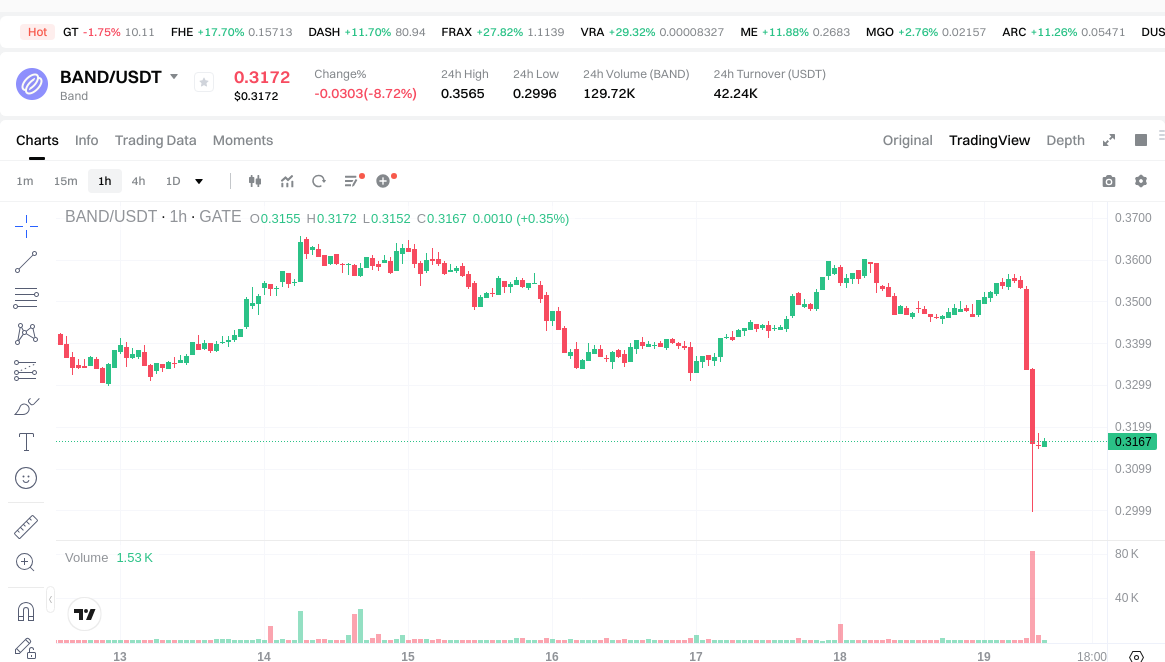
Band reached its peak price of $22.83 on April 15, 2021, during a period characterized by significant growth in the blockchain data infrastructure sector and broader cryptocurrency market enthusiasm. The token experienced its lowest price of $0.203625 on November 25, 2019, which occurred during the early stages of the project's market presence. As of the latest update, Band is trading at $0.3164, showing price movements of -0.19% over 1 hour, -8.69% over 24 hours, and -6.43% over 7 days. These fluctuations reflect ongoing market dynamics, user adoption trends, and external factors affecting the cryptocurrency ecosystem.
Click to view the current BAND market price
On-Chain Metrics
- Holder Count: Approximately 34,450 addresses hold Band tokens, demonstrating a substantial user base and community participation in the network.
Band Ecosystem Applications and Partners
Core Use Cases
Band's ecosystem supports multiple applications:
- DeFi: Band Protocol enables smart contracts to securely access real-time external data, providing decentralized oracle services for DeFi protocols.
- GameFi: Through its data infrastructure, Band powers blockchain gaming applications with reliable off-chain data feeds.
- AI Agents: Band facilitates autonomous AI systems by delivering real-time information access with zero counterparty risk.
Strategic Partnerships
Band has established collaborations to enhance its technical capabilities and market influence.
These partnerships provide a solid foundation for Band's ecosystem expansion.
Controversies and Challenges
Band faces the following challenges:
- Market Competition: Pressure from other oracle solutions and blockchain data providers in the rapidly evolving Web3 space
- Price Volatility: The token has experienced significant fluctuations, with a 1-year decline of 77.3%
These issues have sparked discussions within the community and markets, while also driving Band's continuous innovation.
Band's community demonstrates activity with 34,450 token holders.
The project maintains presence across social platforms including X (Twitter) and Reddit, where community members discuss technical developments and ecosystem growth.
Sentiment on X shows mixed perspectives:
- Supporters praise Band's battle-tested data infrastructure and zero counterparty risk design, viewing it as essential infrastructure for blockchain and AI applications.
- Critics focus on price performance concerns and competitive landscape challenges.
Recent trends reflect the broader market conditions affecting oracle and data infrastructure projects.
Popular Topics
X users discuss Band's role in AI and blockchain integration, data reliability, and market positioning,
showcasing both its transformative potential and the challenges in achieving mainstream adoption.
- Official Website: Visit Band Protocol for features, use cases, and latest updates.
- X Updates: On X platform, Band Protocol uses @bandprotocol,
with posts covering technical upgrades, community activities, and ecosystem developments.
- Block Explorers: Cosmoscan and Etherscan for on-chain data tracking.
- Development Resources: GitHub repository for technical documentation and code contributions.
Band Future Roadmap
- Technology Focus: Continued enhancement of data infrastructure for AI engines and blockchain applications
- Ecosystem Goals: Expanding support for DeFi, GameFi, and AI agent applications
- Long-term Vision: Establishing Band as the foundational data layer connecting blockchains and large language models
How to Participate in Band?
- Purchase Options: Buy BAND on Gate.com and other supporting exchanges
- Storage Solutions: Securely store using compatible wallets; BAND is available on Ethereum (contract: 0xBA11D00c5f74255f56a5E366F4F77f5A186d7f55)
- Community Engagement: Follow Band Protocol on X and join r/bandprotocol for updates
- Ecosystem Building: Visit the GitHub repository to explore development opportunities
Summary
Band Protocol redefines blockchain data infrastructure through its oracle technology, providing real-time data access, security, and zero counterparty risk for decentralized applications.
Its open architecture, proven infrastructure, and focus on AI and blockchain integration position it uniquely in the crypto space.
Despite facing market volatility and competitive pressures, Band's technical foundation and clear focus on data infrastructure make it a noteworthy project in decentralized technology's evolution.
Whether you're new to crypto or an experienced participant, Band Protocol's role in connecting off-chain data with blockchain applications merits attention.
FAQ
What is BAND token? What are the core functions of Band Protocol project?
BAND token is the native asset of Band Protocol, enabling decentralized applications to access real-world data through oracle services. Its core function is providing tamper-proof data for DeFi smart contracts and blockchain applications.
What is the purpose of BAND token and what role does it play in the ecosystem?
BAND token incentivizes node operators and participants in Band Protocol, facilitating decentralized data oracle services. It is also used for governance decisions within the Band Protocol ecosystem.
How to buy and store BAND tokens? Which exchanges are supported?
BAND tokens can be purchased on major centralized exchanges through trading pairs like BAND/USDT. For storage, use secure wallets such as hardware wallets, MetaMask, or official protocol wallets. Always enable two-factor authentication and keep private keys safe.
What is the difference between BAND and other oracle projects like Chainlink?
Band Protocol uses DPoS consensus on Cosmos for faster data finality(3-second block time)and cross-chain capability, while Chainlink relies on third-party data providers on Ethereum. Band emphasizes validator incentives for accuracy, whereas Chainlink depends on external node operators.
What are the risks of investing in BAND tokens? What security issues should be noted?
BAND token risks include market volatility, technology risks, and regulatory changes. Security concerns involve using secure wallets and protecting private keys. Thorough market research before investing is essential.
Band Protocol的发展前景和路线图是什么?
Band Protocol focuses on cross-chain data query capabilities and performance optimization. It offers faster transaction finality through BandChain technology with 3-second block times. The protocol benefits from strong backing by Sequoia and Binance Lab, positioning it competitively in the oracle market with expanding ecosystem partnerships.
* The information is not intended to be and does not constitute financial advice or any other recommendation of any sort offered or endorsed by Gate.