Bitcoin Cash (BCH) is a cryptocurrency forked from Bitcoin in 2017, designed to address scalability limitations and high transaction fees through larger block sizes. As the 12th largest cryptocurrency by market cap ($12.17 billion as of 2026), BCH operates on a decentralized network using Proof of Work consensus to enable fast, low-cost peer-to-peer transactions. With 19.98 million circulating tokens and over 22.5 million active holders, BCH supports diverse applications including daily payments and cross-border remittances. This guide explores BCH's technical architecture, market performance with historical price data, active ecosystem partnerships with payment processors, and community engagement on social platforms. Despite facing regulatory uncertainties and competition from alternative blockchain solutions, BCH maintains strong development momentum and merchant adoption. Learn how to purchase BCH on Gate and participate in the network, while understanding both the opportunities and challenges in this sig
BitcoinCash's Position and Significance
In 2017, ViaBTC launched BitcoinCash (BCH), aiming to address scalability limitations and high transaction fees in the original Bitcoin network.
As a hard fork of Bitcoin following Satoshi's on-chain scaling vision, BitcoinCash plays a key role in peer-to-peer electronic cash and global payment systems.
As of 2026, BitcoinCash has become the 12th largest cryptocurrency by market capitalization, with a market cap of approximately $12.17 billion and an active development community.
This article will deeply analyze its technical architecture, market performance, and future potential.
Origin and Development History
Birth Background
BitcoinCash was created by ViaBTC in 2017, aiming to solve Bitcoin's scalability issues and enable low-cost, fast peer-to-peer transactions.
It was born during the Bitcoin scaling debate, with the goal of providing a practical electronic cash system for everyday transactions and restoring the original vision.
BitcoinCash's launch brought new possibilities for merchants and users seeking efficient cryptocurrency payments.
Important Milestones
- 2017: Mainnet launched through a hard fork from Bitcoin, implementing 8MB block size for increased transaction capacity.
- 2017-2018: Network evolved with new transaction signature algorithms and difficulty adjustment mechanisms.
- Various periods: Development continued through decentralized teams working on multiple client implementations.
- Ongoing: Ecosystem growth with increasing merchant adoption and payment infrastructure development.
With support from a decentralized community of developers and advocates, BitcoinCash continues to optimize its technology, security, and real-world applications.
How BitcoinCash Works?
No Central Control
BitcoinCash operates on a decentralized network of computers (nodes) distributed globally, free from control by banks or governments.
These nodes collaborate to validate transactions, ensuring system transparency and attack resistance, granting users greater autonomy and enhancing network resilience.
Blockchain Core
BitcoinCash's blockchain is a public, immutable digital ledger that records every transaction.
Transactions are grouped into blocks and linked through cryptographic hashes to form a secure chain.
Anyone can view the records and establish trust without intermediaries.
On-chain scaling through larger block sizes enables higher transaction throughput while maintaining decentralization.
Ensuring Fairness
BitcoinCash employs Proof of Work (PoW) to validate transactions and prevent fraud such as double-spending.
Miners maintain network security through computational work to solve cryptographic puzzles and receive BCH rewards.
Its innovation includes a new difficulty adjustment algorithm that responds more quickly to hashrate changes.
Secure Transactions
BitcoinCash uses public-private key cryptography to protect transactions:
- Private keys (like secret passwords) are used to sign transactions
- Public keys (like account numbers) are used to verify ownership
This mechanism ensures fund security while transactions maintain pseudonymity.
New transaction signature formats provide additional protection against certain types of attacks.
Circulation Overview
As of January 13, 2026, BitcoinCash's circulating supply stands at 19,980,040.52 BCH, with a total supply of 19,980,090.52 BCH and a maximum supply cap of 21,000,000 BCH, following a fixed issuance model similar to Bitcoin.
New coins enter the market through block mining rewards, which influence its supply and demand dynamics.
The current circulation ratio has reached 95.14% of the maximum supply, indicating a mature distribution phase.
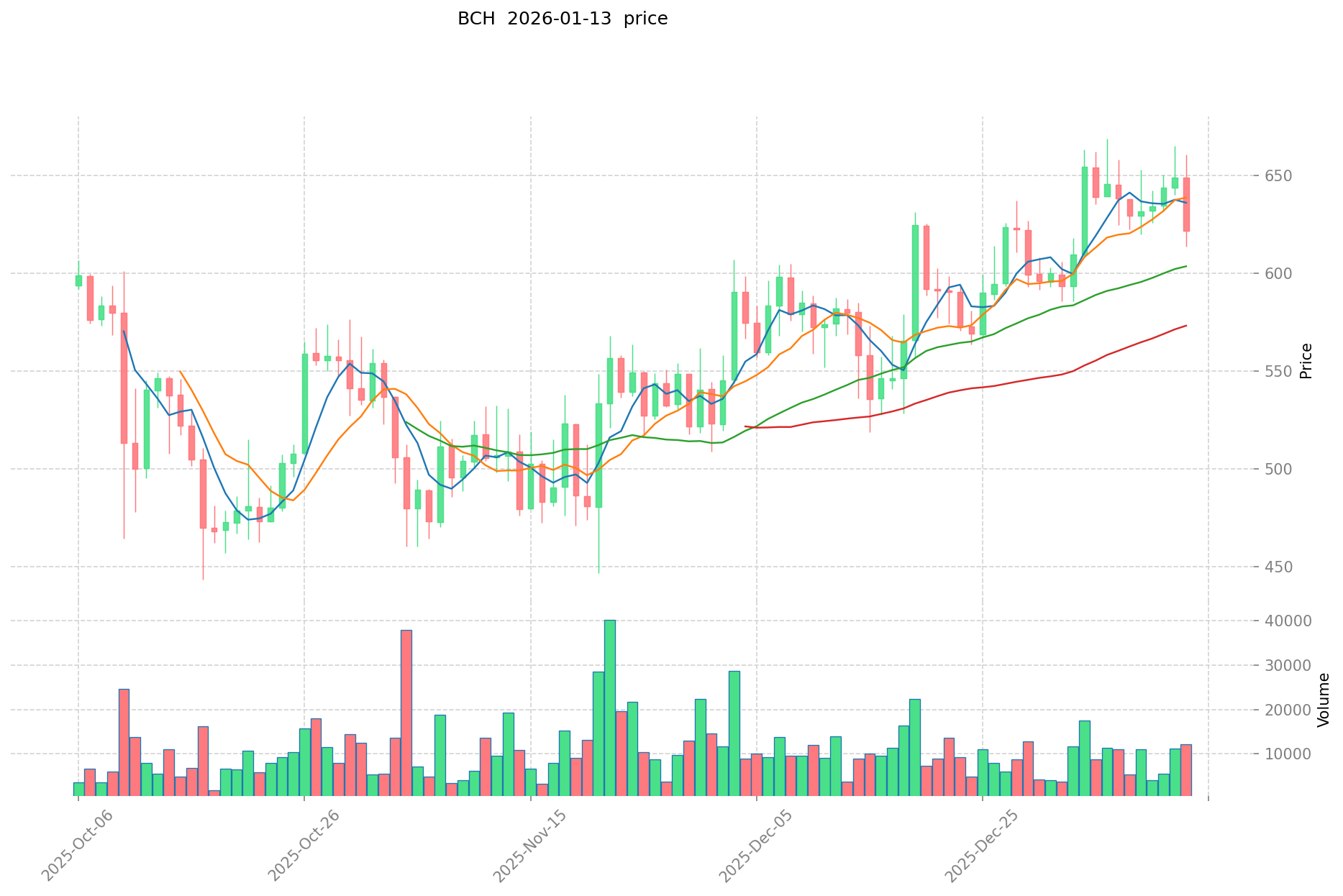
Price Volatility
BitcoinCash reached its all-time high of $3,785.82 on December 20, 2017, driven by the initial hard fork momentum and heightened market interest in alternative scaling solutions.
Its lowest price of $76.93 occurred on December 16, 2018, influenced by the broader cryptocurrency market downturn and reduced investor sentiment.
These fluctuations reflect market sentiment shifts, adoption trends, and external regulatory factors.
Click to view current BCH market price
On-Chain Metrics
- Daily Trading Volume: $5.71 million (as of January 13, 2026, indicating network activity levels)
- Active Addresses: Over 22.5 million holders (reflecting widespread user participation)
- Market Capitalization: $12.17 billion with a market dominance of 0.37% (demonstrating its position in the cryptocurrency ecosystem)
BitcoinCash Ecosystem Applications and Partnerships
Core Use Cases
BitcoinCash's ecosystem supports multiple applications:
- Peer-to-Peer Payments: BCH enables fast, low-cost transactions for everyday commerce, functioning as digital cash for daily spending.
- Remittances: Cross-border payment solutions leverage BCH's low transaction fees and settlement speed.
Strategic Cooperation
BitcoinCash has established collaborations with payment processors and merchant service providers, enhancing its adoption capability and market reach.
These partnerships provide a solid foundation for BCH's ecosystem expansion.
Controversies and Challenges
BitcoinCash faces the following challenges:
- Technical Issues: Network capacity debates and ongoing optimization requirements
- Regulatory Risks: Evolving cryptocurrency regulations across jurisdictions
- Competition Pressure: The rise of other blockchain platforms and payment solutions
These issues have sparked discussions within the community and market, while also driving BCH's continuous innovation.
BitcoinCash's community demonstrates strong vitality, with 19,980,040 circulating addresses and consistent on-chain activity.
On X platform, related posts and hashtags (such as #BCH) frequently trend, with substantial engagement.
Price movements and protocol upgrades ignite community enthusiasm.
Sentiment on X presents polarization:
- Supporters praise BCH's on-chain scaling capabilities, low transaction fees, considering it "true peer-to-peer electronic cash".
- Critics focus on market volatility, adoption challenges, and competition from other cryptocurrencies.
Recent trends show sentiment fluctuating with market conditions and development milestones.
Hot Topics
X users actively discuss BCH's scaling philosophy, merchant adoption rates, and positioning within the broader cryptocurrency landscape,
showcasing both its transformative potential and obstacles toward mainstream adoption.
- Official Website: Visit BitcoinCash Official Site for features, use cases, and latest updates.
- White Paper: The original Bitcoin whitepaper by Satoshi Nakamoto forms the foundation, detailing the technical architecture and vision for peer-to-peer electronic cash.
- Community Engagement: BCH maintains active presence on platforms including Reddit at r/btc,
with discussions covering protocol developments, adoption news, and community initiatives, generating consistent community interaction.
BitcoinCash Future Roadmap
- Ongoing Development: Continuous improvements to transaction throughput and network efficiency
- Ecosystem Goals: Expanding merchant acceptance and payment infrastructure
- Long-Term Vision: Becoming global peer-to-peer electronic cash for everyday transactions
How to Participate in BitcoinCash?
- Purchase Channels: Buy BCH on Gate.com and other major exchanges
- Storage Solutions: Securely store using hardware wallets or software wallets supporting BCH
- Network Participation: Run a node or participate in mining to support network security
- Ecosystem Building: Visit development resources to build payment applications or contribute to protocol development
Summary
BitcoinCash redefines digital currency through blockchain technology, providing fast transactions, low fees, and on-chain scaling.
Its active community, abundant resources, and market presence distinguish it within the cryptocurrency space.
Despite facing regulatory uncertainties and competitive pressures, BCH's commitment to peer-to-peer electronic cash and clear development direction position it as a significant player in decentralized payment technology.
Whether you're a newcomer or experienced participant, BitcoinCash merits attention and engagement.
FAQ
What is Bitcoin Cash (BCH)? How was it created?
Bitcoin Cash (BCH) is a cryptocurrency forked from Bitcoin in August 2017 to solve scalability and transaction fee issues. It increased block size from 1 MB to 8 MB initially, enabling faster transactions and lower costs. BCH focuses on practical daily payments and peer-to-peer electronic cash functionality.
What is the difference between BCH and BTC (Bitcoin)?
BCH and BTC differ mainly in block size. BTC has 1 MB blocks limiting transactions, while BCH has 8 MB blocks enabling higher transaction volume and faster processing.
What are the main uses and advantages of BCH?
BCH enables fast, low-cost peer-to-peer transactions for everyday payments. It offers greater privacy and anonymity compared to traditional financial systems, with larger block sizes enabling faster processing and lower fees than Bitcoin.
How to buy and store BCH?
Buy BCH on trading platforms by selecting spot trading and entering your desired amount. Store BCH securely in a personal wallet to ensure safety and full control of your assets.
How are BCH transaction speed and fees?
BCH processes up to 224 transactions per second with fees typically ranging from $0.003 to $0.095, offering fast and low-cost transactions compared to other cryptocurrencies.
Is BCH Safe? What Risks Should Be Noted?
BCH is generally secure with strong cryptography, but face risks from concentrated holdings, market volatility, and liquidity issues. Use secure wallets and monitor large holder movements. Exercise caution during extreme market conditions.
* The information is not intended to be and does not constitute financial advice or any other recommendation of any sort offered or endorsed by Gate.