Bless is a decentralized edge computing network launched in 2024 to address inefficiencies in centralized cloud computing and AI resource allocation. Operating on the Binance Smart Chain as a BEP-20 token, Bless provides distributed CPU and GPU computing power near end users, reducing latency and costs for AI and machine learning applications. As of 2026, the network has attracted over 5,452 token holders and is listed on 18 exchanges including Gate.com, with a circulating supply of 1.84 billion tokens and market cap of $16.2 million. This comprehensive guide explores Bless's technical architecture, market dynamics, ecosystem applications, and community sentiment. Whether you're a developer seeking computational resources or an investor interested in decentralized infrastructure, this article examines Bless's positioning in the competitive blockchain computing landscape and its potential for democratizing access to AI infrastructure.
Bless's Positioning and Significance
In 2024, the Bless Network team launched Bless (BLESS), aiming to address the inefficiency and centralization challenges in AI and machine learning computing resource allocation.
As a decentralized edge computing network, Bless plays a key role in AI, machine learning, and advanced data processing.
As of 2026, Bless has become an emerging player in the decentralized computing infrastructure space, with over 5,452 holders and an active development ecosystem.
This article will provide an in-depth analysis of its technical architecture, market performance, and future potential.
Origin and Development History
Birth Background
Bless was created by the Bless Network team in 2024, aiming to solve the inefficiency of centralized cloud computing and the lack of accessible on-demand computing resources for AI and machine learning applications.
It emerged during the rapid expansion of AI adoption and the growing demand for decentralized infrastructure, with the goal of providing distributed CPU and GPU power near end users to reduce latency and costs.
The launch of Bless brought new possibilities for developers and enterprises seeking scalable computing solutions.
Important Milestones
- 2024: The network launched, establishing a decentralized edge computing infrastructure for AI workloads.
- 2025: Token listing and expansion, with BLESS listed on 18 exchanges including Gate.com, driving ecosystem growth.
- 2025: Community growth reached over 5,000 holders, demonstrating increasing adoption of the network.
- 2026: Continued development of the computing network, maintaining active node participation and resource provisioning.
With support from the community and foundation, Bless continues to optimize its technology, security, and real-world applications.
How Does Bless Work?
No Central Control
Bless operates on a decentralized network of computing nodes distributed globally, eliminating dependence on centralized cloud providers.
These nodes collaborate to provide computing resources and validate transactions, ensuring the system remains transparent and resistant to single points of failure, giving users greater autonomy and enhancing network resilience.
Blockchain Foundation
Bless's blockchain is a public, immutable digital ledger that records network activities and resource allocation.
Transactions are grouped into blocks and linked through cryptographic hashes to form a secure chain.
Anyone can view the records, establishing trust without intermediaries.
The network leverages edge computing architecture to bring computational power closer to end users, reducing latency for AI and machine learning tasks.
Ensuring Fairness
Bless operates on the BEP-20 standard on the Binance Smart Chain, utilizing the underlying consensus mechanism to validate transactions and prevent fraudulent activities.
Network participants contribute by providing computing resources and maintaining infrastructure, receiving BLESS token rewards in return.
Its innovation includes democratizing access to distributed computing power for AI applications.
Secure Transactions
Bless uses public-private key cryptography to protect transactions:
- Private keys (like secret passwords) are used to sign transactions
- Public keys (like account numbers) are used to verify ownership
This mechanism ensures fund security while maintaining transactions that are transparent on-chain.
The network maintains security through the established BEP-20 token standard on BSC, benefiting from the underlying blockchain's security features.
Circulation Overview
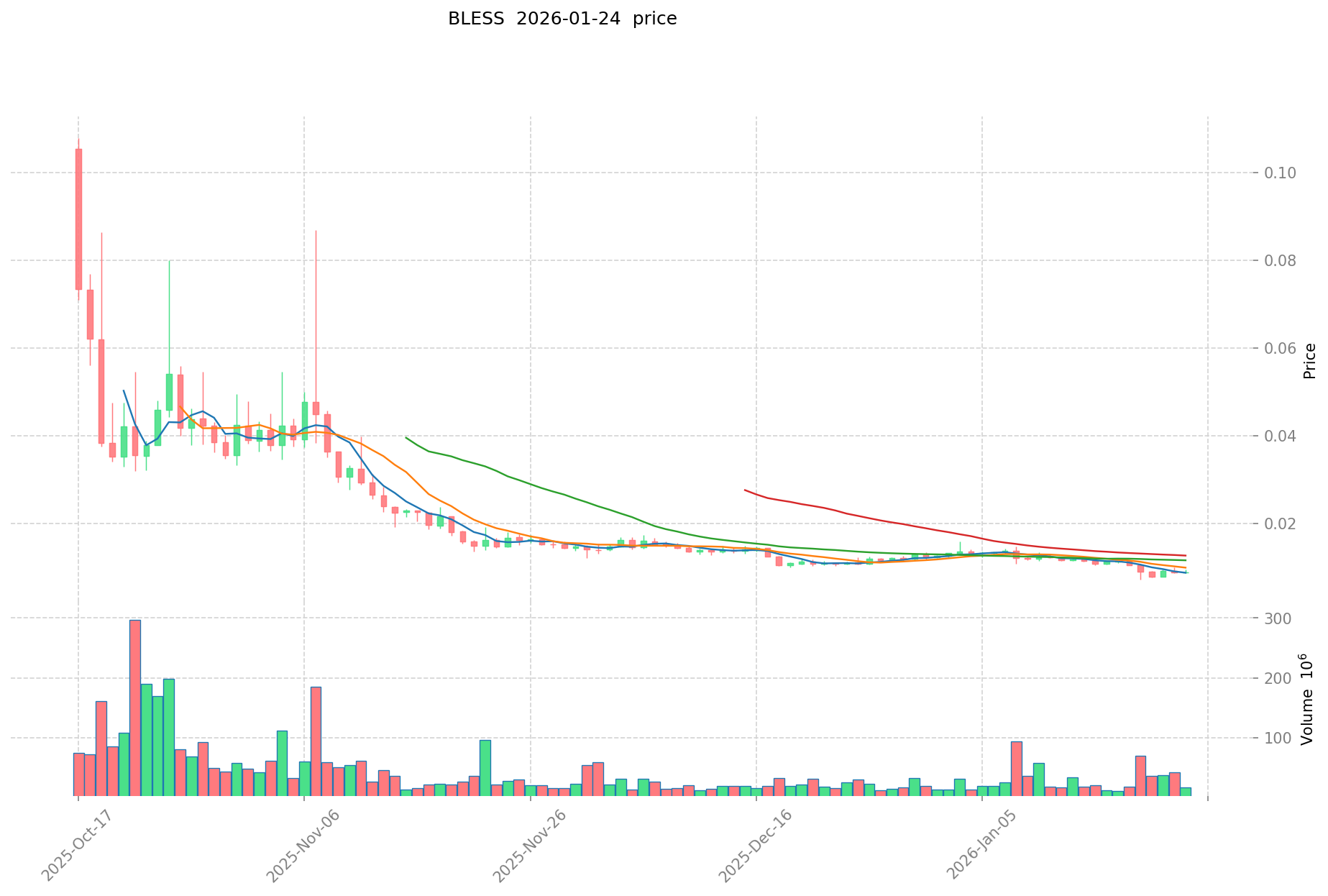
As of January 24, 2026, Bless's circulating supply is 1,841,666,667 tokens, with a total supply of 10,000,000,000 tokens, indicating a fixed supply model.
The circulating supply represents approximately 18.42% of the total supply, with tokens entering the market through various distribution mechanisms that influence supply and demand dynamics.
Price Fluctuation
Bless reached a notable price level of $0.2304 on October 15, 2025, driven by market conditions and network adoption.
Its lowest price was $0.00712, occurring on January 19, 2026, reflecting market sentiment shifts and external factors.
These fluctuations demonstrate the impact of market dynamics, adoption trends, and broader cryptocurrency market conditions on the token's valuation.
Click to view current BLESS market price
On-Chain Metrics
- Holder Count: 5,452 addresses (reflecting user participation and token distribution)
- 24-Hour Trading Volume: $171,150.04 (indicating current market activity)
- Market Capitalization: $16,226,925.00 (representing the circulating token value)
Bless Ecosystem Applications and Partners
Core Use Cases
Bless's ecosystem supports multiple applications:
- Edge Computing: Bless provides on-demand CPU and GPU power for AI, machine learning, and advanced data tools near end users, enabling decentralized computing resources.
- AI and Machine Learning Infrastructure: The network facilitates distributed computational tasks, supporting high-performance computing needs for developers and enterprises.
Strategic Partnerships
While specific partnership details are not extensively documented in the available materials, Bless's decentralized edge computing network architecture positions it to collaborate with developers and projects requiring computational resources.
These collaborative opportunities provide a foundation for Bless's ecosystem expansion.
Challenges and Considerations
Bless faces several challenges:
- Technical Considerations: Scaling decentralized computing infrastructure and maintaining service quality across distributed nodes
- Competitive Landscape: Operating in a space with other blockchain-based computing solutions
- Market Volatility: Price fluctuations, with a 21.05% decrease over 7 days and 21.33% decline over 30 days
These factors have generated discussions within the community and market, while also driving Bless's ongoing development.
Bless's community shows active participation, with 5,452 holders as of the latest data.
The token is listed on 18 exchanges, facilitating accessibility for users globally.
Trading activity reflects community interest, with a 24-hour trading volume of $171,150.
Sentiment on X displays varied perspectives:
- Supporters highlight Bless's decentralized edge computing capabilities and its potential to democratize access to computational resources, viewing it as infrastructure for the future of AI and machine learning.
- Critics focus on price volatility and market uncertainties, noting the token's decline from its peak.
Recent trends indicate cautious sentiment given the 37.42% decline over the past year from the all-time high of $0.2304 recorded on October 15, 2025.
Trending Topics
X users discuss Bless's computational power distribution model, token economics, and adoption challenges,
showcasing both its transformative potential in decentralized computing and the hurdles in achieving mainstream adoption.
- Official Website: Visit Bless official website for features, use cases, and latest updates.
- White Paper: Bless White Paper details its technical architecture, objectives, and vision.
- X Updates: On X platform, Bless maintains an active presence via @theblessnetwork,
sharing updates on technical developments, community initiatives, and ecosystem growth.
Bless Future Roadmap
While specific roadmap details are not extensively documented in the available materials, Bless's focus remains on:
- Enhancing decentralized edge computing infrastructure
- Expanding computational capacity and node network
- Building developer tools and ecosystem support
How to Participate in Bless?
- Purchase Options: Buy BLESS on Gate.com and other cryptocurrency exchanges
- Storage Solutions: Store BLESS securely using compatible BEP-20 wallets
- Community Engagement: Join the Bless Discord to connect with the community
- Blockchain Explorer: Track transactions via BSC Explorer
Summary
Bless leverages blockchain technology to create a decentralized edge computing network, offering accessible computational resources for AI, machine learning, and data processing.
Its community of over 5,000 holders, presence on 18 exchanges, and clear technical focus position it within the decentralized infrastructure sector.
Despite facing market volatility and competitive pressures, Bless's innovative approach to distributed computing gives it relevance in the evolving landscape of decentralized technology.
Whether you're a newcomer or experienced participant, Bless presents opportunities for engagement in decentralized computing infrastructure.
FAQ
What is BLESS crypto token and what is its main purpose?
BLESS is a utility token designed to power decentralized governance and community rewards within its blockchain ecosystem. It enables holders to participate in protocol decisions, earn staking rewards, and access exclusive platform features, creating value through active network participation.
How can I buy and store BLESS tokens?
You can purchase BLESS tokens through decentralized exchanges or peer-to-peer platforms. Store them securely in a Web3 wallet like MetaMask, Trust Wallet, or hardware wallets for enhanced security and full control.
What are the risks and security considerations when investing in BLESS?
BLESS investment carries market volatility risks, smart contract vulnerabilities, and regulatory uncertainties. Ensure wallet security with strong passwords, enable two-factor authentication, and use hardware wallets for large holdings. Only invest funds you can afford to lose.
How does BLESS differ from other similar cryptocurrency projects?
BLESS stands out through its innovative governance model, enhanced security features, and community-driven development approach. It offers superior transaction efficiency, lower fees, and unique tokenomics designed for sustainable growth and long-term value appreciation.
BLESS features a total supply of 1 billion tokens with strategic distribution across community rewards, ecosystem development, and team allocation. The tokenomics is designed to ensure sustainable growth and long-term value appreciation through deflationary mechanisms and staking incentives.
BLESS is actively traded across major cryptocurrency platforms with strong trading volume. The token demonstrates solid market performance with consistent price stability and growing adoption within the Web3 ecosystem. Current metrics show positive momentum and healthy liquidity levels.
* The information is not intended to be and does not constitute financial advice or any other recommendation of any sort offered or endorsed by Gate.