Bless is a decentralized edge computing network launched in 2025 to address inefficiencies in AI and machine learning infrastructure allocation. Built on blockchain technology with the BEP-20 token standard on BSC, Bless eliminates centralized cloud provider dependence by distributing CPU and GPU computing resources globally through edge nodes. The platform serves developers, AI researchers, and enterprises seeking cost-effective, on-demand computational power with reduced latency. As of January 2026, Bless has attracted over 5,400 token holders with a circulating supply of 1.84 billion tokens and market cap of $16.4 million, available for trading on Gate. The ecosystem supports edge computing, machine learning infrastructure, and real-time data processing applications while facing challenges in scalability, market competition, and adoption. With active community engagement and a development roadmap focused on enhancing GPU resources and expanding AI application support, Bless positions itself as emerging inf
Bless's Positioning and Significance
In 2025, the Bless team launched Bless (BLESS), aiming to address the inefficiencies in edge computing resource allocation and the accessibility challenges of AI and machine learning infrastructure.
As a decentralized edge computing network, Bless plays a key role in AI infrastructure, machine learning, and advanced data processing.
As of 2026, Bless has established itself as an emerging player in the decentralized computing space, with over 5,400 holders and an active development community.
This article will provide an in-depth analysis of its technical architecture, market performance, and future potential.
Origin and Development History
Birth Background
Bless was created by the Bless Network team in 2025, aiming to solve the centralization and high costs of cloud computing resources, particularly for AI and machine learning workloads.
It emerged during the rapid expansion of AI technology and growing demand for decentralized infrastructure, with the goal of providing on-demand, cost-effective CPU and GPU power near end users to transform the landscape.
The launch of Bless brought new possibilities for developers, AI researchers, and enterprises seeking decentralized computing solutions.
Major Milestones
- 2025: Network launched, implementing decentralized edge computing infrastructure for AI workloads.
- 2025: Token deployment on BSC (BEP-20 standard), establishing accessible on-chain governance and reward mechanisms.
- 2025: Listed on Gate.com and other major exchanges, expanding market accessibility and liquidity.
- 2026: Community growth surpassed 5,400 holders, demonstrating increasing adoption.
With the support of the Bless Network Foundation and global community, Bless continues to optimize its technology, security, and real-world applications.
How Bless Works?
No Central Control
Bless operates on a decentralized network of computing nodes distributed globally, eliminating dependence on centralized cloud providers or intermediaries.
These nodes collaborate to provide computing resources and validate transactions, ensuring system transparency and attack resistance, granting users greater autonomy and enhancing network resilience.
Blockchain Foundation
Bless's infrastructure utilizes blockchain technology as a public, immutable digital ledger that records resource allocation and transactions.
Transactions are grouped into blocks and linked through cryptographic hashes to form a secure chain.
Anyone can view records, establishing trust without intermediaries.
The network leverages edge computing architecture to deliver CPU and GPU power closer to end users, reducing latency and improving efficiency for AI and machine learning applications.
Ensuring Fairness
Bless employs a consensus mechanism to validate transactions and resource allocations, preventing fraud and ensuring network integrity.
Network participants maintain security through node operation and resource provision, earning BLESS token rewards.
Its innovations include bringing computing power to the network edge, optimizing for AI workloads with reduced latency.
Secure Transactions
Bless uses public-private key cryptography to protect transactions:
- Private keys (like secret passwords) are used to sign transactions
- Public keys (like account numbers) are used to verify ownership
This mechanism ensures fund security while transactions maintain pseudonymous privacy.
The BEP-20 token standard on BSC provides additional security features including smart contract-based governance and transparent on-chain verification.
Circulation Overview
As of 24 January 2026, Bless has a circulating supply of 1,841,666,667 BLESS tokens, with a total supply of 10,000,000,000 BLESS. The maximum supply is capped at 10,000,000,000 BLESS, indicating a fixed supply model. The circulating supply represents approximately 18.42% of the total supply, suggesting a controlled release mechanism that may influence supply-demand dynamics over time.
Price Fluctuations
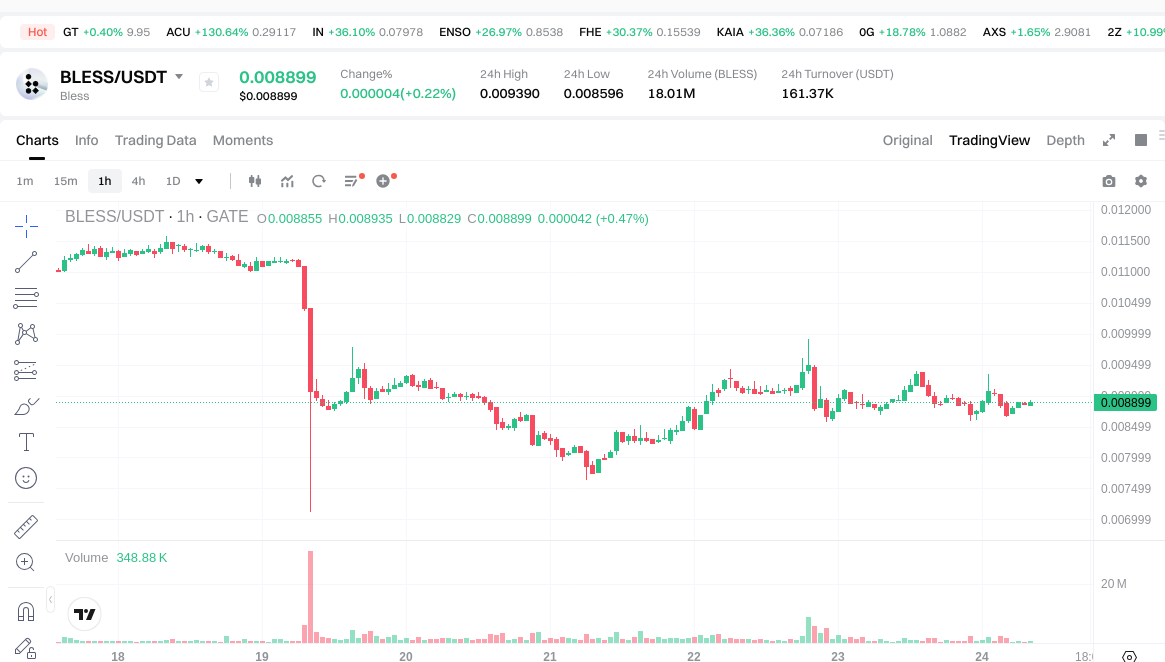
Bless reached a notable price point of $0.2304 on 15 October 2025, driven by market activity during that period. The lowest recorded price was $0.00712, occurring on 19 January 2026. These price movements reflect varying market sentiment, adoption trends, and external factors affecting the broader cryptocurrency ecosystem. Currently trading at $0.008897, BLESS has experienced a 0.28% increase over the past 24 hours, though it has declined by 20.38% over the past 7 days and 18.86% over the past 30 days.
Click to view the current BLESS market price
On-Chain Metrics
- Holder Count: Approximately 5,437 addresses hold BLESS tokens, reflecting the current level of community participation and token distribution.
- 24-Hour Trading Volume: $161,148.70, indicating active trading activity on exchanges.
- Market Capitalization: $16,385,308.34, representing BLESS's current market valuation based on circulating supply.
- Fully Diluted Market Cap: $88,970,000, calculated based on the maximum supply, providing insight into potential future valuation.
Bless Ecosystem Applications and Partners
Core Use Cases
Bless's ecosystem supports multiple applications:
- Edge Computing: Providing decentralized CPU and GPU resources for AI workloads, enabling distributed computational power near end users.
- Machine Learning Infrastructure: Supporting advanced data processing tools, facilitating real-time data analysis and model training.
Strategic Partnerships
Bless is building its technological capabilities through collaborations with computing infrastructure providers and AI development communities.
These partnerships provide a foundation for Bless's ecosystem expansion.
Challenges and Considerations
Bless faces the following challenges:
- Technical Considerations: Network scalability and resource allocation optimization
- Market Competition: Competition from established cloud computing providers and other decentralized computing networks
- Adoption Barriers: User education and integration with existing AI development workflows
These factors contribute to ongoing discussions within the community and drive continuous innovation for Bless.
Bless's community shows notable activity, with 5,437 token holders as of January 24, 2026.
On X platform, related posts and hashtags (such as #Bless) generate community discussions.
The launch of new features and network developments contribute to community engagement.
Sentiment on X shows varied perspectives:
- Supporters highlight Bless's decentralized computing approach and edge network architecture, viewing it as infrastructure for distributed AI applications.
- Observers note price volatility and early-stage development status.
Recent trends reflect varied market sentiment with ongoing community discussions.
Popular Topics
X users discuss Bless's decentralized computing model, token utility, and network growth,
showcasing both its technological potential and considerations for broader adoption.
- Official Website: Visit Bless Official Website for features, use cases, and latest updates.
- Whitepaper: Bless Whitepaper details its technical architecture, objectives, and vision.
- X Updates: On X platform, Bless uses @theblessnetwork for community engagement,
sharing technical updates, community activities, and network announcements.
Bless Future Roadmap
- Network Development: Enhancing edge computing capabilities and GPU resource allocation, improving network performance and accessibility
- Ecosystem Goals: Expanding support for AI and machine learning applications
- Long-term Vision: Becoming decentralized infrastructure for computational resources
How to Participate in Bless?
- Purchase Options: Trade Bless on Gate.com and other supported platforms
- Storage Solutions: Store securely using compatible BSC wallets
- Network Participation: Contribute computing resources to the Bless network
- Community Engagement: Visit Discord to connect with the community
Summary
Bless aims to redefine distributed computing through blockchain technology, providing decentralized edge computing resources for AI and machine learning applications.
Its growing community, technical documentation, and market presence position it within the decentralized computing sector.
Despite facing market volatility and competitive landscape challenges, Bless's focus on edge computing infrastructure and development roadmap indicate its role in decentralized technology evolution.
Whether you're new to the space or an experienced participant, Bless represents an interesting project in distributed computing infrastructure.
FAQ
What is BLESS crypto token and what does it do?
BLESS is a utility token designed for the Web3 ecosystem. It enables governance participation, transaction rewards, and access to exclusive community features. BLESS holders can stake tokens to earn yield and participate in decentralized decision-making processes within the protocol.
How can I buy and store BLESS tokens?
You can purchase BLESS tokens through decentralized exchanges or peer-to-peer platforms. Store them securely in a Web3 wallet like MetaMask or hardware wallets such as Ledger for maximum security and full asset control.
What is the total supply and tokenomics of BLESS?
BLESS has a maximum total supply of 1 billion tokens. The tokenomics feature a deflationary mechanism with token burning, community rewards allocation, and strategic reserves for ecosystem development and long-term sustainability.
Is BLESS a legitimate project and what are the associated risks?
BLESS is a legitimate cryptocurrency project with transparent development team and active community support. Like all crypto assets, it carries market volatility risks. Investors should conduct thorough research before participation.
What blockchain network does BLESS operate on?
BLESS operates on multiple blockchain networks including Ethereum, Binance Smart Chain, and Polygon, providing users with flexible cross-chain accessibility and optimized transaction efficiency across leading DeFi ecosystems.
Who are the team members and backers behind BLESS?
BLESS is backed by leading crypto investors and venture firms. The team comprises experienced blockchain developers, product strategists, and community advocates dedicated to advancing decentralized finance innovation and ecosystem growth.
* The information is not intended to be and does not constitute financial advice or any other recommendation of any sort offered or endorsed by Gate.