BitcoinOS is a groundbreaking platform that enables smart contracts and DeFi applications on Bitcoin through zero-knowledge proof technology, without modifying Bitcoin's base protocol. Launched in 2025 and available on Gate, BitcoinOS addresses Bitcoin's programmability limitations while preserving its security model, attracting nearly $1 billion in BTC TVL subscriptions from institutional investors. The platform operates on a decentralized architecture with zero-knowledge verification systems ensuring transaction security and fairness. With a circulating supply of 890.4 million BOS tokens and 2,880 token holders, BitcoinOS demonstrates early-stage growth potential. The article provides comprehensive coverage of its technical architecture, market performance metrics, institutional use cases, community sentiment, and phased multi-chain expansion roadmap across Cardano, EVM, and SVM ecosystems. Despite technical complexity and market competition challenges, BitcoinOS represents a significant innovation in Bitco
BitcoinOS's Positioning and Significance
In 2025, the BitcoinOS team launched BitcoinOS (BOS), aiming to address Bitcoin's programmability limitations without altering its base protocol.
As the first platform enabling smart contracts on Bitcoin through zero-knowledge proofs, BitcoinOS plays a crucial role in Bitcoin DeFi and cross-chain interoperability.
As of 2026, BitcoinOS has attracted nearly $1 billion in BTC TVL subscriptions and is building momentum with 2,880 token holders. The platform has established an active presence across 9 exchanges and is expanding its ecosystem footprint.
This article will provide an in-depth analysis of its technical architecture, market performance, and future potential.
Origin and Development History
Birth Background
BitcoinOS was created by its development team in 2025, aiming to solve Bitcoin's lack of native programmability and limited DeFi infrastructure.
It emerged during the maturation of zero-knowledge proof technology and growing institutional demand for Bitcoin-based financial applications, with the goal of enabling smart contracts and DeFi on Bitcoin while preserving its security model.
BitcoinOS's launch brought new possibilities for Bitcoin holders and institutional investors seeking programmable Bitcoin assets.
Key Milestones
- October 2025: Token launch on Gate.com, establishing initial market presence with trading pairs.
- 2025: Initial deployment on Cardano blockchain, demonstrating cross-chain compatibility approach.
- 2025-2026: Secured commitments for institutional Bitcoin applications with nearly $1 billion in BTC TVL subscriptions.
- Planned: Expansion to EVM and SVM ecosystems to broaden interoperability scope.
With support from its development team and early institutional partners, BitcoinOS continues to refine its technology, security framework, and real-world applications.
How BitcoinOS Works
No Central Control
BitcoinOS operates on a decentralized network architecture that leverages Bitcoin's security without requiring modifications to Bitcoin's base protocol.
The platform uses distributed validation mechanisms to ensure transparency and resistance to centralized control, giving users greater autonomy while maintaining network resilience.
Blockchain Foundation
BitcoinOS builds upon blockchain technology to create verifiable, transparent records of smart contract executions and cross-chain operations.
Through zero-knowledge proof technology, the platform enables programmability while maintaining cryptographic security guarantees.
All operations remain auditable without compromising the underlying security model.
The platform's multi-chain approach, starting with Cardano and expanding to EVM and SVM ecosystems, enhances interoperability and scalability.
Ensuring Fairness
BitcoinOS utilizes zero-knowledge proof verification systems to validate transactions and smart contract executions, preventing fraudulent activities.
Validators maintain network security through cryptographic verification processes, ensuring the integrity of cross-chain operations.
Its innovation includes enabling Bitcoin programmability without consensus changes to the Bitcoin protocol.
Secure Transactions
BitcoinOS employs public-private key cryptography to protect transactions:
- Private keys (similar to secret passwords) are used to authorize operations
- Public keys (similar to account numbers) are used to verify ownership
This mechanism ensures fund security while maintaining appropriate transparency levels.
The platform incorporates zero-knowledge proof technology to enable privacy-preserving verification and cross-chain asset security.
Tokenomics and Burn Mechanism
The BOS token has a maximum supply of 21 billion tokens, with 890.4 million tokens currently in circulation (4.24% of total supply).
The platform features a buy-and-burn mechanism that activates once the platform reaches maturity, designed to create deflationary pressure on token supply over time.
This mechanism aligns long-term token holder interests with platform growth and adoption.
Circulation Overview
As of February 02, 2026, BitcoinOS has a circulating supply of 890,400,000 tokens, with a total supply of 21,000,000,000 tokens and a maximum supply capped at 21,000,000,000 tokens, indicating a fixed supply model.
The current circulation ratio stands at approximately 4.24% of the total supply, reflecting the early stage of token distribution.
BOS tokens feature a buy-and-burn mechanism designed to activate once the platform reaches maturity, which may influence future supply dynamics.
Price Volatility
BitcoinOS reached a notable price level of $0.0143 on October 29, 2025, driven by market enthusiasm surrounding its launch and initial use case focusing on institutional Bitcoin adoption.
The token's lowest price of $0.001596 occurred on January 28, 2026, reflecting market corrections and broader crypto market fluctuations.
These price movements illustrate the impact of market sentiment, adoption trends, and external factors on the token's valuation.
Click to view the current BOS market price
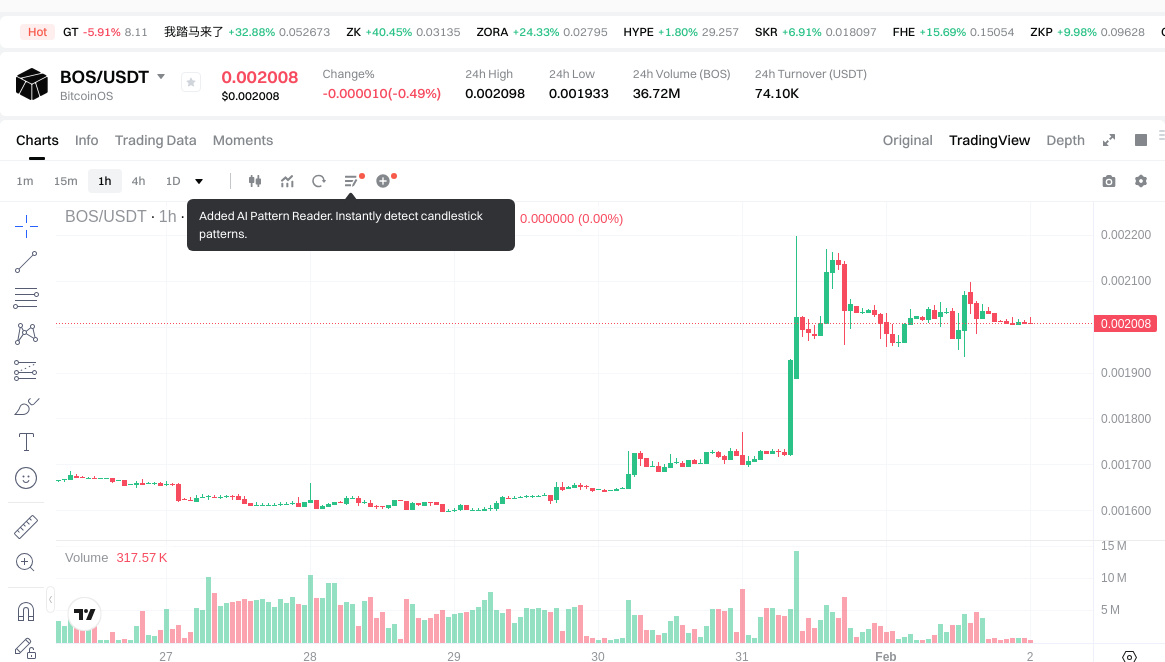
On-Chain Metrics
- Holder Count: Approximately 2,880 addresses hold BOS tokens, indicating growing community participation
- Market Capitalization: The current market cap stands at approximately $1.79 million, with a fully diluted valuation of $42.19 million
- 24-Hour Trading Volume: $74,120.25, demonstrating active market engagement
BitcoinOS Ecosystem Applications and Strategic Partnerships
Core Use Cases
BitcoinOS's ecosystem supports multiple application scenarios:
- Institutional-Grade Bitcoin: The platform focuses on institutional Bitcoin solutions, with nearly $1 billion in BTC TVL subscriptions, providing secure and compliant DeFi infrastructure.
- Cross-Chain DeFi: Through zero-knowledge proof technology, BitcoinOS enables smart contracts and decentralized financial applications while maintaining Bitcoin's network security.
Strategic Collaborations
BitcoinOS has established its technical foundation through multi-chain deployment strategy.
The platform will launch first on Cardano before expanding to EVM and SVM ecosystems, enhancing its interoperability capabilities and market reach.
Controversies and Challenges
BitcoinOS faces several challenges:
- Technical Complexity: Implementing zero-knowledge proofs without modifying Bitcoin's base protocol requires sophisticated engineering solutions
- Market Competition: Competition from other Bitcoin programmability solutions and established smart contract platforms
- Adoption Timeline: The phased rollout across different ecosystems may affect the speed of ecosystem development
These issues have sparked discussions within the community while driving continuous innovation.
BitcoinOS's community shows growing interest, with the token holder count reaching 2,880 addresses.
On X platform, discussions around BitcoinOS focus on its unique approach to Bitcoin programmability.
The launch on Cardano and subsequent multi-chain expansion plans have generated community enthusiasm.
Sentiment on X presents diverse perspectives:
- Supporters praise BitcoinOS's innovative zero-knowledge proof implementation and Bitcoin security guarantee, viewing it as "unlocking Bitcoin's full potential".
- Observers monitor token economics performance, cross-chain deployment progress, and institutional adoption rates.
Recent trends show interest in the platform's development milestones and ecosystem growth.
Trending Topics
X users actively discuss BitcoinOS's institutional focus, cross-chain interoperability strategy, and buy-and-burn mechanism activation timeline,
reflecting both its transformative potential and the complexities of bridging Bitcoin with programmable functionality.
- Official Website: Visit BitcoinOS Official Site for features, use cases, and latest developments.
- White Paper: BitcoinOS White Paper details its technical architecture, objectives, and vision for programmable Bitcoin.
- X Updates: On X platform, BitcoinOS maintains an active presence at @BTC_OS,
posting content covering technical innovations, institutional partnerships, and ecosystem milestones, generating engagement from the crypto community.
BitcoinOS Future Roadmap
- Phase I: Launch on Cardano, establishing initial smart contract capabilities and DeFi infrastructure
- Phase II: Expand to EVM and SVM ecosystems, enhancing cross-chain interoperability and developer accessibility
- Ecosystem Goals: Build institutional-grade Bitcoin applications and expand DeFi use cases
- Long-term Vision: Become the standard platform for programmable Bitcoin without compromising its base protocol security
- Token Mechanism: Activate buy-and-burn mechanism upon platform maturity to enhance token value dynamics
How to Participate in BitcoinOS?
- Purchase Options: Buy BOS on Gate.com and other supporting exchanges
- Storage Solutions: Securely store BOS using compatible wallets supporting ERC-20 and ADA standards
- Community Engagement: Follow official channels on X and Discord for updates and community discussions
- Ecosystem Building: Monitor developer documentation releases for opportunities to build applications on BitcoinOS
Summary
BitcoinOS introduces programmability to Bitcoin through zero-knowledge proof technology, offering smart contract capabilities, DeFi applications, and cross-chain interoperability while maintaining Bitcoin's security.
Its focus on institutional use cases, strategic multi-chain expansion, and innovative technical approach position it uniquely in the crypto landscape.
Despite facing technical implementation challenges and market competition, BitcoinOS's clear roadmap and institutional focus demonstrate potential in the evolving Bitcoin ecosystem.
Whether you're exploring Bitcoin's programmability or seeking institutional-grade solutions, BitcoinOS represents an interesting development worth monitoring.
FAQ
What is BOS (EOSIO) and what problem does it solve?
BOS (Business Operating System) is an EOSIO-based platform supporting decentralized applications. It solves real-world problems by leveraging blockchain technology to enhance the EOSIO ecosystem and enable practical DApp development.
How can I buy and store BOS tokens?
You can buy BOS tokens through crypto platforms' spot trading sections. Enter your desired amount and complete the purchase. For storage, use secure wallets with high-level encryption protection to keep your tokens safe.
What is the difference between BOS and EOS?
EOS is a top-down management system focusing on high-level strategy, while BOS is a bottom-up approach emphasizing detailed operations. BOS provides more granular control at the operational level compared to EOS's strategic focus.
What are the main use cases and features of the BOS blockchain?
BOS provides a scalable, open-source content moderation system enabling users to govern their online experiences. It supports decentralized applications and smart contracts with developer-friendly infrastructure.
Is BOS a safe investment and what are the potential risks?
BOS offers growth potential but carries market volatility risks. Key concerns include crypto sector competition, regulatory uncertainty, and price fluctuations. Success depends on market conditions and project development. Conduct thorough research before investing.
How does BOS governance and staking work?
BOS governance allows token holders to vote on network changes and protocol upgrades. Staking enables users to lock tokens to support network operations and earn rewards. This decentralized system ensures community control and network security.
* The information is not intended to be and does not constitute financial advice or any other recommendation of any sort offered or endorsed by Gate.