Bitcoin SV (BSV) is a blockchain platform launched in 2018 to restore Satoshi Nakamoto's original Bitcoin vision through enhanced scalability and larger block sizes. This comprehensive guide explores BSV's decentralized architecture, Proof of Work consensus mechanism, and enterprise-level capabilities for peer-to-peer electronic cash systems. With a circulating supply of 19.97 million BSV and market cap of $397.70 million, the platform serves both payment and data management applications. The article examines BSV's technical infrastructure, market performance trends, ecosystem partnerships, and community engagement while addressing regulatory challenges. Ideal for enterprises seeking scalable blockchain solutions and users exploring cryptocurrency alternatives, this guide provides actionable insights for purchasing BSV on Gate and participating in its growing ecosystem.
BitcoinSV's Positioning and Significance
In 2018, Bitcoin SV (BSV) was launched following a hard fork of the Bitcoin Cash (BCH) blockchain, aiming to address scalability limitations and restore the original vision outlined in Satoshi Nakamoto's white paper.
As a peer-to-peer electronic cash system designed for enterprise-level blockchain applications, BitcoinSV plays a significant role in distributed data networks and large-scale transaction processing.
As of 2026, BitcoinSV has established itself with a circulating supply of approximately 19.97 million BSV and a market capitalization of around $397.70 million, maintaining an active development community.
This article will analyze its technical architecture, market performance, and future potential in depth.
Origin and Development History
Birth Background
BitcoinSV was created through a blockchain hard fork in 2018, aiming to solve the challenges of scalability and protocol stability that diverged from Bitcoin's original design philosophy.
It emerged during the ongoing evolution of blockchain technology and debates over scaling solutions, with the goal of delivering a stable, scalable protocol that adheres to the original Bitcoin white paper to transform the landscape.
The launch of BitcoinSV brought new possibilities for enterprises seeking robust blockchain infrastructure and users requiring efficient peer-to-peer electronic cash systems.
Important Milestones
- 2018: Mainnet launch following the Bitcoin Cash hard fork, implementing a focus on larger block sizes and protocol stability.
- 2020: Major protocol upgrade introducing enhanced scalability features and removal of default block size limits.
- 2021: Market activity increased, with price movements reflecting broader cryptocurrency market dynamics.
- Ongoing: Continued ecosystem development with focus on enterprise adoption and technical infrastructure improvements.
With the support of the Bitcoin SV community and development teams, BitcoinSV continues to optimize its technology, security, and real-world applications.
How BitcoinSV Works?
No Central Control
BitcoinSV operates on a decentralized network of computers (nodes) distributed globally, free from control by banks or governments.
These nodes collaborate to validate transactions, ensuring the system remains transparent and resistant to attacks, granting users greater autonomy and enhancing network resilience.
Blockchain Core
BitcoinSV's blockchain is a public, immutable digital ledger that records every transaction.
Transactions are grouped into blocks and linked through cryptographic hashing to form a secure chain.
Anyone can view the records, establishing trust without intermediaries.
The protocol emphasizes larger block sizes and increased transaction throughput to enhance performance.
Ensuring Fairness
BitcoinSV employs Proof of Work (PoW) to validate transactions and prevent fraudulent activities such as double-spending.
Miners maintain network security through computational work and block validation, earning BSV rewards.
Its approach focuses on maintaining protocol stability and supporting high transaction volumes.
Secure Transactions
BitcoinSV uses public-private key cryptography to protect transactions:
- Private keys (similar to secret passwords) are used to sign transactions
- Public keys (similar to account numbers) are used to verify ownership
This mechanism ensures fund security while transactions maintain pseudonymous characteristics.
The protocol supports various transaction types and advanced scripting capabilities for diverse use cases.
Circulation Overview
As of January 15, 2026, BitcoinSV has a circulating supply of 19,974,750 coins, with a total supply of 19,974,762.5 and a maximum supply capped at 21,000,000 coins, following a fixed supply model similar to Bitcoin's deflationary design.
The circulating supply represents approximately 95.12% of the total supply, indicating that the majority of BSV tokens have already entered circulation. New coins enter the market through block mining rewards, which follow Bitcoin's original protocol design, influencing the supply-demand dynamics of the asset.
Price Fluctuations
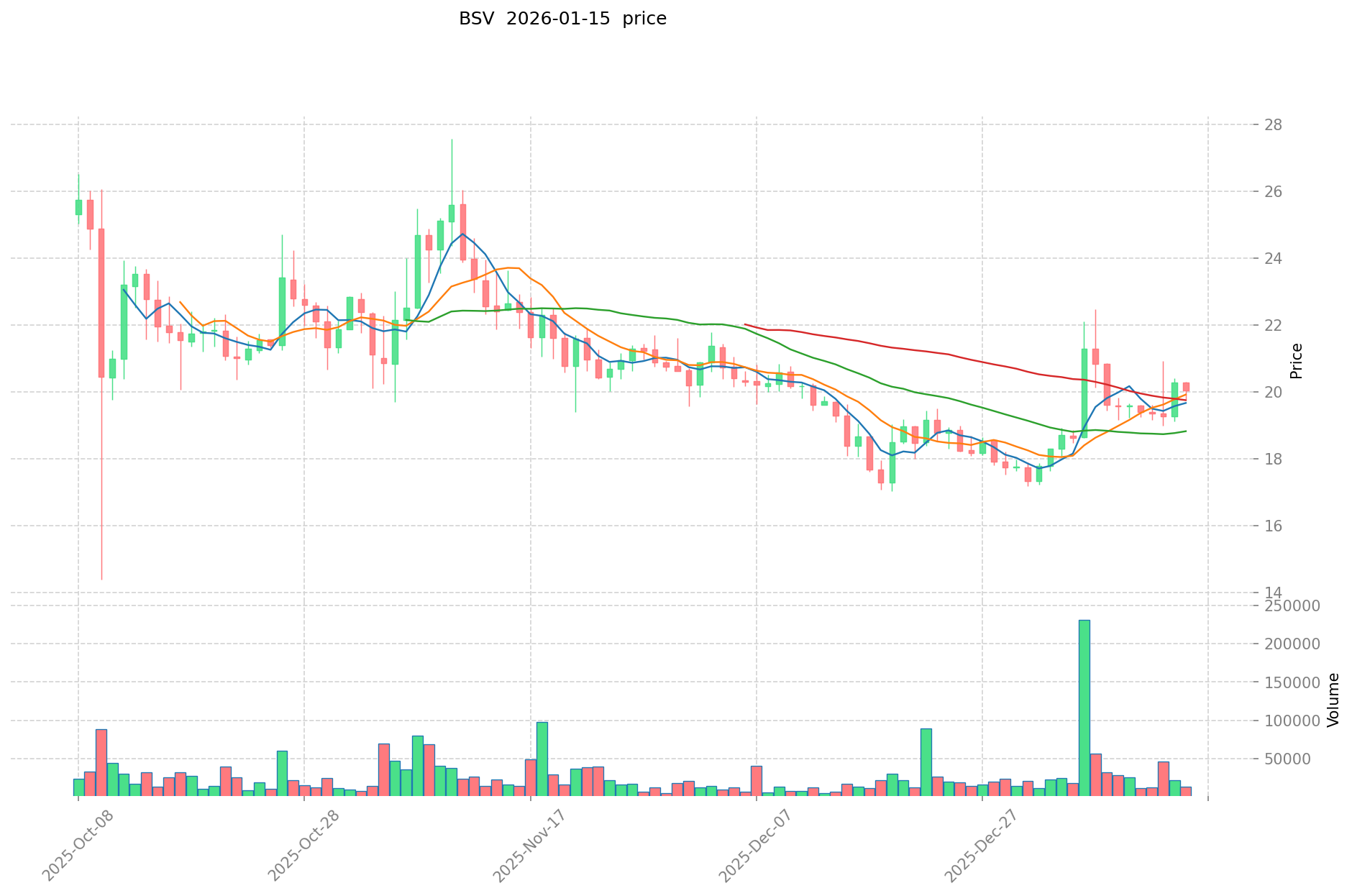
BitcoinSV reached a notable price point of $489.75 on April 17, 2021, during a period of broader cryptocurrency market momentum and increased interest in blockchain scalability solutions.
The asset recorded a lower price point of $17.06 on December 19, 2025, reflecting market volatility and broader industry challenges during that period.
These price movements illustrate the dynamic nature of cryptocurrency markets, influenced by factors including market sentiment, adoption patterns, regulatory developments, and macroeconomic conditions.
Click to view the current BSV market price
On-Chain Metrics
- Holder Addresses: Approximately 10,811,392 addresses hold BSV, reflecting the distribution and user base of the network
- 24-Hour Trading Volume: $278,147.49, indicating current market activity and liquidity levels
- Market Capitalization: $397,697,272.50, representing BSV's position in the cryptocurrency market
BitcoinSV Ecosystem Applications and Partners
Core Use Cases
BitcoinSV's ecosystem supports multiple applications:
- Enterprise Blockchain Solutions: Projects building on BSV leverage its scalability to provide data management and transaction processing capabilities.
- Digital Payment Systems: Applications utilizing BSV's peer-to-peer electronic cash design enable low-cost microtransactions and payment solutions.
Strategic Collaborations
BitcoinSV has established partnerships that enhance its technical capabilities and market presence.
These collaborations provide a solid foundation for BSV's ecosystem expansion.
Controversies and Challenges
BitcoinSV faces the following challenges:
- Technical Issues: Ongoing discussions around network efficiency and infrastructure development
- Regulatory Risks: Uncertainty surrounding cryptocurrency regulations in various jurisdictions
- Competitive Pressure: Competition from other blockchain platforms with similar scalability goals
These issues have sparked discussions within the community and market, while also driving BSV's continuous innovation.
BitcoinSV's community demonstrates notable activity, with the network supporting over 10.8 million holders.
On X platform, relevant posts and hashtags (such as #BSV) generate engagement within the blockchain community.
Developments in blockchain applications and technological advancements continue to energize community participation.
Sentiment on X shows diverse perspectives:
- Supporters praise BSV's scalability features and adherence to the original Bitcoin vision, viewing it as a platform for enterprise blockchain applications.
- Critics focus on market volatility and competitive positioning within the broader cryptocurrency landscape.
Recent trends reflect varying market conditions and development milestones.
Trending Topics
X users discuss BSV's enterprise adoption potential, scalability capabilities, and positioning within the blockchain industry,
showcasing both its innovative potential and the challenges in achieving mainstream adoption.
- Official Website: Visit BitcoinSV Official Site for features, use cases, and latest updates.
- GitHub Repository: BitcoinSV GitHub provides technical documentation and development resources.
- Blockchain Explorer: WhatsOnChain offers real-time network data and transaction tracking.
BitcoinSV Future Roadmap
- Ongoing Development: Continuous improvements in network infrastructure and scalability capabilities, enhancing transaction processing and data handling
- Ecosystem Goals: Supporting enterprise-level blockchain applications and expanding use cases
- Long-term Vision: Establishing BSV as a scalable blockchain infrastructure for data management and payment systems
How to Participate in BitcoinSV?
- Purchase Options: Buy BSV on Gate.com and other cryptocurrency exchanges
- Storage Solutions: Securely store BSV using compatible cryptocurrency wallets
- Network Participation: Engage with the BSV network through running nodes or developing applications
- Ecosystem Building: Visit development documentation to build applications or contribute to the codebase
Summary
BitcoinSV, through blockchain technology, aims to fulfill the original Bitcoin vision, offering scalability, stability, and peer-to-peer electronic cash functionality.
Its active community, development resources, and market presence position it within the cryptocurrency landscape.
Despite facing regulatory uncertainties and competitive challenges, BSV's focus on scalability and enterprise applications gives it a distinctive position in decentralized technology.
Whether you are new to cryptocurrency or an experienced participant, BitcoinSV presents opportunities for exploration and engagement.
FAQ
What is Bitcoin SV (BSV) and how does it differ from Bitcoin?
Bitcoin SV (BSV) is a fork of Bitcoin Cash designed to restore Bitcoin's original vision with larger blocks and lower fees. Unlike Bitcoin, BSV supports smart contracts and NFTs, offering faster transactions and greater scalability for everyday use.
What are the main features and advantages of BSV?
BSV enables peer-to-peer transactions without intermediaries, offers low transaction fees ideal for micropayments, confirms transactions within seconds, and supports smart contracts and tokens on a single efficient blockchain layer.
How can I buy and store Bitcoin SV (BSV)?
Purchase Bitcoin SV on centralized exchanges or through crypto wallets. Store BSV in non-custodial wallets like hardware or software wallets for enhanced security and full asset control.
What is the history and background of Bitcoin SV?
Bitcoin SV emerged from a 2018 split advocating large block sizes and Bitcoin's original peer-to-peer electronic cash vision. Developers believed Bitcoin had strayed from Satoshi Nakamoto's original design principles.
Is Bitcoin SV safe and what are the risks involved?
Bitcoin SV carries significant risks including extreme price volatility, limited mainstream adoption, and regulatory uncertainty. While the blockchain technology is secure, market liquidity and acceptance remain concerns for investors.
What is the current use case and adoption of BSV?
Bitcoin SV is increasingly adopted in enterprise solutions and practical applications. BSV demonstrates strong utility growth across various sectors, with rising demand driven by its scalability and real-world use cases in data management and business operations.
* The information is not intended to be and does not constitute financial advice or any other recommendation of any sort offered or endorsed by Gate.