BeatSwap (BTX) is a full-stack IP rights RWA platform transforming creative content management through blockchain technology. Launched in 2024, it addresses inefficiencies in licensing attribution, IP monetization, and creator compensation by establishing transparent, on-chain infrastructure for managing creative rights. The platform leverages a metadata oracle, License-to-Earn mechanism, and non-transferable IP Licensing Index to validate licensing events and enable fair value distribution. BeatSwap's ecosystem includes Space for creator-fan engagement, RWA Launcher for tokenizing IP rights, and RWA DEX for trading rights-based assets on Gate.com. As of February 2026, BTX has 224.7 million circulating tokens with 1,839 holders and millions of recorded transactions, positioning itself as an emerging protocol at the intersection of RWA and creative industries, despite facing market volatility and adoption challenges.
BeatSwap's Positioning and Significance
In 2024, the BeatSwap team launched BeatSwap (BTX), aiming to address challenges in IP rights management, transparent licensing attribution, and monetization inefficiencies for digital creators.
As a full-stack IP rights RWA platform, BeatSwap plays a critical role in creative rights management, digital content monetization, and creator-fan engagement.
As of 2026, BeatSwap has established itself as an emerging protocol in the intersection of RWA and creative IP, with millions of on-chain transactions and a rapidly growing user base of over 1,800 holders.
This article will explore its technical architecture, market performance, and future potential.
Origin and Development History
Background
BeatSwap was created by the BeatSwap team around 2024, aiming to solve the lack of transparent licensing records, inefficient IP monetization, and the absence of verifiable attribution in the digital content industry.
It emerged during the expansion of RWA narratives and blockchain adoption in creative industries, with the goal of establishing transparent infrastructure for managing creative rights through authenticated metadata and verifiable licensing activity.
BeatSwap's launch brought new possibilities for creators, rights holders, and fans to interact with IP assets in digital environments.
Key Milestones
- 2024: Platform launch introduced the metadata oracle and IP Licensing Index for structuring creative IP rights on-chain.
- 2024-2025: Development of user-facing modules including Space for creator-fan engagement, RWA Launcher for tokenizing rights, and RWA DEX for trading rights-based assets.
- December 2025: BTX reached an all-time high price of $0.05451, reflecting growing market interest.
- January 2026: BTX was listed on Gate.com, expanding accessibility and trading volume.
With support from its active community and ongoing development, BeatSwap continues to optimize its protocol, security features, and real-world applications.
How BeatSwap Works?
Decentralized Rights Management
BeatSwap operates through a protocol that structures and authenticates the lifecycle of creative IP rights on-chain, independent of centralized intermediaries.
Its metadata oracle standardizes authorship, rights attribution, and licensing records, ensuring transparency and enabling IP to function as verifiable RWAs.
This approach grants creators and rights holders greater autonomy while enhancing system integrity and resistance to manipulation.
Blockchain Foundation
BeatSwap leverages blockchain technology to maintain a public, immutable ledger of IP licensing events and metadata records.
Transactions and licensing activities are grouped into blocks and linked through cryptographic hashing, forming a secure and transparent chain.
Anyone can verify records without requiring trusted intermediaries, establishing trust through code rather than institutions.
Licensing Validation Mechanism
BeatSwap employs a non-transferable IP Licensing Index to validate licensing events and anchor reward distribution.
Authentic user interaction data—such as plays, views, and engagement—are recorded on-chain as licensing events through the License-to-Earn (L2E) mechanism, enabling users to earn BTX based on transparent contributions.
This system prevents fraudulent claims and ensures fair attribution of value to genuine participants.
Additionally, the Vault-to-Earn (V2E) mechanism allows users to capture future IP value through structured participation.
Secure and Transparent Transactions
BeatSwap utilizes public-private key cryptography to secure transactions and rights transfers:
- Private keys (similar to secret passwords) are used to sign transactions and authorize rights-related actions
- Public keys (similar to account identifiers) are used to verify ownership and authenticity
This mechanism ensures asset security while maintaining transparent and verifiable records of all licensing and trading activities.
The protocol's architecture supports authenticated metadata, lifecycle modeling, and verifiable licensing activity, providing robust infrastructure for managing creative rights in digital ecosystems.
Circulation Overview
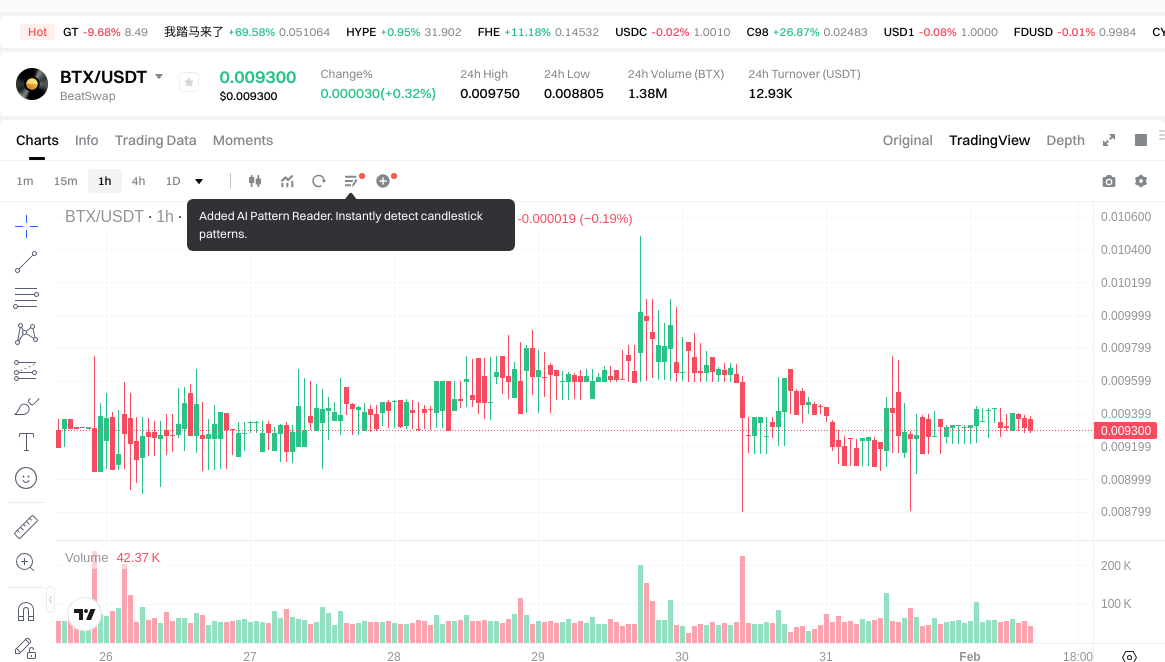
As of 01 February 2026, BeatSwap's circulating supply stands at 224,755,243 BTX, with a total supply of 1,500,000,000 BTX. The current circulation ratio is approximately 14.98%, indicating that a significant portion of tokens remains to be released into the market. The maximum supply is capped at 1,500,000,000 BTX, establishing a fixed supply model that may influence long-term scarcity dynamics.
Price Volatility
BTX reached a notable price level of $0.05451 on 11 December 2025, driven by initial market enthusiasm and user adoption during the platform's early growth phase. The token experienced its lowest price point of $0.0087 on 19 January 2026, reflecting broader market adjustments and potential short-term volatility. These fluctuations illustrate the evolving market sentiment, adoption patterns, and the influence of external factors on the asset's valuation.
Click to view the current BTX market price
On-Chain Metrics
- 24-Hour Trading Volume: $12,937.99 (reflecting current market activity levels)
- Holder Count: 1,839 addresses (indicating early-stage user participation)
- Market Capitalization: $2,086,402.92 (representing the circulating market value)
BeatSwap Ecosystem Applications and Partners
Core Use Cases
BeatSwap's ecosystem supports diverse applications:
- IP Rights Management: BeatSwap Space enables creator-fan engagement, providing transparent authorship verification and licensing record management.
- RWA Trading: RWA DEX facilitates decentralized trading of rights-based assets, while RWA Launcher supports tokenization of creative IP rights.
Strategic Collaborations
The reference materials do not provide specific information about BeatSwap's strategic partnerships. The platform focuses on building infrastructure for creative rights management in digital environments through its protocol architecture.
Challenges and Controversies
BeatSwap faces several challenges:
- Market Competition: The platform operates in an evolving RWA sector with emerging competitors developing similar IP rights solutions
- Adoption Barriers: Converting traditional creative industry participants to blockchain-based licensing models requires education and infrastructure development
- Technical Complexity: Maintaining accurate metadata oracle standards and non-transferable IP Licensing Index requires continuous technical refinement
These issues have prompted ongoing community discussions and drive the platform's continuous innovation efforts.
BeatSwap's community demonstrates growing activity, with 224,755,243 circulating tokens held by 1,839 addresses. The platform has recorded millions of on-chain transactions, reflecting increasing user participation in its License-to-Earn (L2E) mechanism.
On X platform, sentiment around BeatSwap shows mixed perspectives:
- Supporters highlight BeatSwap's innovative IP rights infrastructure and creator-centric ecosystem, viewing it as infrastructure for transparent creative rights management.
- Critics focus on price volatility and early-stage ecosystem development, noting the token's performance decline from its peak.
Recent trends indicate ongoing community interest in the platform's L2E and Vault-to-Earn (V2E) mechanisms.
Trending Topics
X users discuss BeatSwap's metadata oracle system, licensing validation mechanisms, and tokenization of creative rights, showcasing both its transformative potential and the challenges in bridging traditional IP management with blockchain technology.
BeatSwap Additional Resources
- Official Website: Visit BeatSwap Official Site for features, use cases, and latest developments.
- Whitepaper: BeatSwap Documentation details its technical architecture, goals, and vision for on-chain IP rights management.
- X Updates: On X platform, BeatSwap actively engages through @BeatXswap, sharing updates on protocol enhancements, licensing events, and ecosystem growth.
BeatSwap Future Roadmap
The reference materials do not provide specific roadmap details. The platform continues developing its protocol infrastructure for authenticating and structuring creative IP rights lifecycles on-chain.
How to Participate in BeatSwap?
- Purchase Channels: Acquire BTX on Gate.com and other supporting exchanges
- Storage Solutions: Store BTX securely using compatible BSC wallets such as MetaMask or hardware wallets
- Ecosystem Participation: Engage with BeatSwap Space for creator-fan interactions or explore RWA Launcher for IP tokenization opportunities
- Development Contribution: Access BeatSwap Documentation to understand protocol architecture and potential integration opportunities
Summary
BeatSwap redefines creative IP management through blockchain technology, offering verifiable on-chain asset creation, transparent licensing records, and creator-centric rewards mechanisms. Its innovative L2E and V2E models, combined with authenticated metadata infrastructure, position it as notable infrastructure in the RWA sector. Despite facing market volatility and ecosystem adoption challenges, BeatSwap's protocol-focused approach and expanding on-chain activity demonstrate its commitment to building transparent infrastructure for managing creative rights in digital environments. Whether you are exploring IP tokenization or interested in RWA innovations, BeatSwap represents an emerging approach worth monitoring.
FAQ
What is BTX (Bitcore) and how does it work?
BTX (Bitcore) is an open-source cryptocurrency forked from Bitcoin. It uses the Timetravel 10 algorithm and was developed by BitPay. BTX operates as a hybrid blockchain, combining Bitcoin's principles with enhanced features for improved transaction efficiency and security.
What are the main features and use cases of BTX cryptocurrency?
BTX offers fast transaction processing, enhanced privacy protection, and community-driven governance. Primary use cases include secure peer-to-peer transfers, private transactions, and decentralized application development.
How can I buy, store, and trade BTX tokens safely?
Purchase BTX on reputable exchanges, secure tokens in a self-custody or hardware wallet for long-term storage, and trade on trusted decentralized or centralized platforms with strong security measures.
What is the difference between BTX and Bitcoin?
BTX and Bitcoin differ in block size, transaction speed, and fees. BTX features larger blocks enabling faster processing and lower transaction costs, optimizing for everyday payments. Bitcoin prioritizes decentralization and security with smaller blocks. Both use similar proof-of-work technology but serve different use cases.
What are the risks and security considerations when investing in BTX?
BTX investments face market volatility, regulatory uncertainty, and cybersecurity threats. Implement strong wallet security, use reputable storage solutions, and stay informed on regulatory developments to mitigate risks.
What is the current market cap and future prospects of BTX?
As of January 2026, BTX has a market cap of $1.46 billion. With growing institutional adoption and technological innovations, BTX is positioned for significant growth potential in the coming years.
* The information is not intended to be and does not constitute financial advice or any other recommendation of any sort offered or endorsed by Gate.