This comprehensive guide explores Swarm (BZZ), a decentralized storage and content distribution protocol launched by the Ethereum Foundation in 2021. As a core Web3 infrastructure component, Swarm addresses critical data storage inefficiencies through a globally distributed node network, eliminating centralized intermediaries. The article examines BZZ's technical architecture featuring cryptographic security and incentive mechanisms, analyzing current market performance with 63.1M circulating supply and $0.1899 trading price on Gate. You'll discover Swarm's ecosystem applications, strategic role alongside Ethereum's smart contracts, and community engagement among 24,475 token holders. Whether evaluating investment potential or technical participation, this guide covers acquisition methods, node operation requirements, competitive positioning versus Filecoin and Arweave, and essential risk considerations for navigating the decentralized storage landscape.
Swarm's Positioning and Significance
In 2021, the Ethereum Foundation launched Swarm (BZZ), aiming to address decentralized storage inefficiencies and data availability challenges in the Web3 ecosystem.
As a distributed storage platform and content distribution service protocol, Swarm plays a critical role in decentralized storage, data bandwidth provision, and Ethereum's Web3 infrastructure.
As of 2026, Swarm has established itself as a core infrastructure component of Ethereum's Web3 stack, with 24,475 token holders and an active developer community.
This article will provide an in-depth analysis of its technical architecture, market performance, and future potential.
Origin and Development History
Birth Background
Swarm was created by the Ethereum Foundation in 2021, designed to solve the challenge of decentralized data storage and bandwidth provision for Ethereum's on-chain data.
It emerged during the rapid expansion of blockchain technology and growing demand for Web3 infrastructure, with the goal of enabling secure, distributed storage and content delivery without centralized intermediaries.
Swarm's launch brought new possibilities for decentralized application developers and Web3 users seeking reliable data storage solutions.
Important Milestones
- 2021: Mainnet launch on June 13, 2021, with token generation event (TGE) enabling decentralized storage network functionality.
- 2021: Initial listing on Gate.com and other platforms, establishing market presence.
- 2025: Network evolution with continued development of storage infrastructure and bandwidth optimization.
With support from the Ethereum Foundation and the Swarm community, the project continues to refine its technology, security, and real-world applications.
How Does Swarm Work?
No Central Control
Swarm operates on a decentralized network of nodes distributed globally, eliminating dependence on centralized storage providers or intermediaries.
These nodes collaborate to store and retrieve data, ensuring system transparency and resistance to single points of failure, granting users greater autonomy and enhancing network resilience.
Blockchain Core
Swarm's architecture is built as a native service layer for Ethereum Web3.0, working alongside smart contracts and Whisper to form the three pillars of Ethereum's decentralized web.
Data is distributed across the network in chunks, with content addressing and cryptographic proofs ensuring integrity.
Anyone can participate in storage provision, establishing trust without intermediaries through built-in incentive mechanisms.
Ensuring Fairness
Swarm utilizes incentive mechanisms and bandwidth compensation protocols to validate storage operations and prevent fraudulent behavior.
Storage providers maintain network integrity through providing storage capacity and bandwidth, earning BZZ token rewards.
Innovations include postage stamps for bandwidth compensation and decentralized content distribution.
Secure Transactions
Swarm employs cryptographic techniques to protect data and transactions:
- Private keys (similar to secret passwords) secure data access
- Public keys (similar to account identifiers) verify ownership and access rights
This mechanism ensures data security while maintaining pseudonymous access patterns.
Additional features include content addressing and erasure coding for enhanced data reliability.
Circulating Supply Overview
As of 25 January 2026, Swarm's circulating supply stands at 63,149,437.84 BZZ tokens, with a total supply of 63,149,437.84 tokens, representing a 100% circulation rate. The token operates under a fixed supply model with a maximum supply capped at 63,149,437 BZZ.
Price Fluctuations
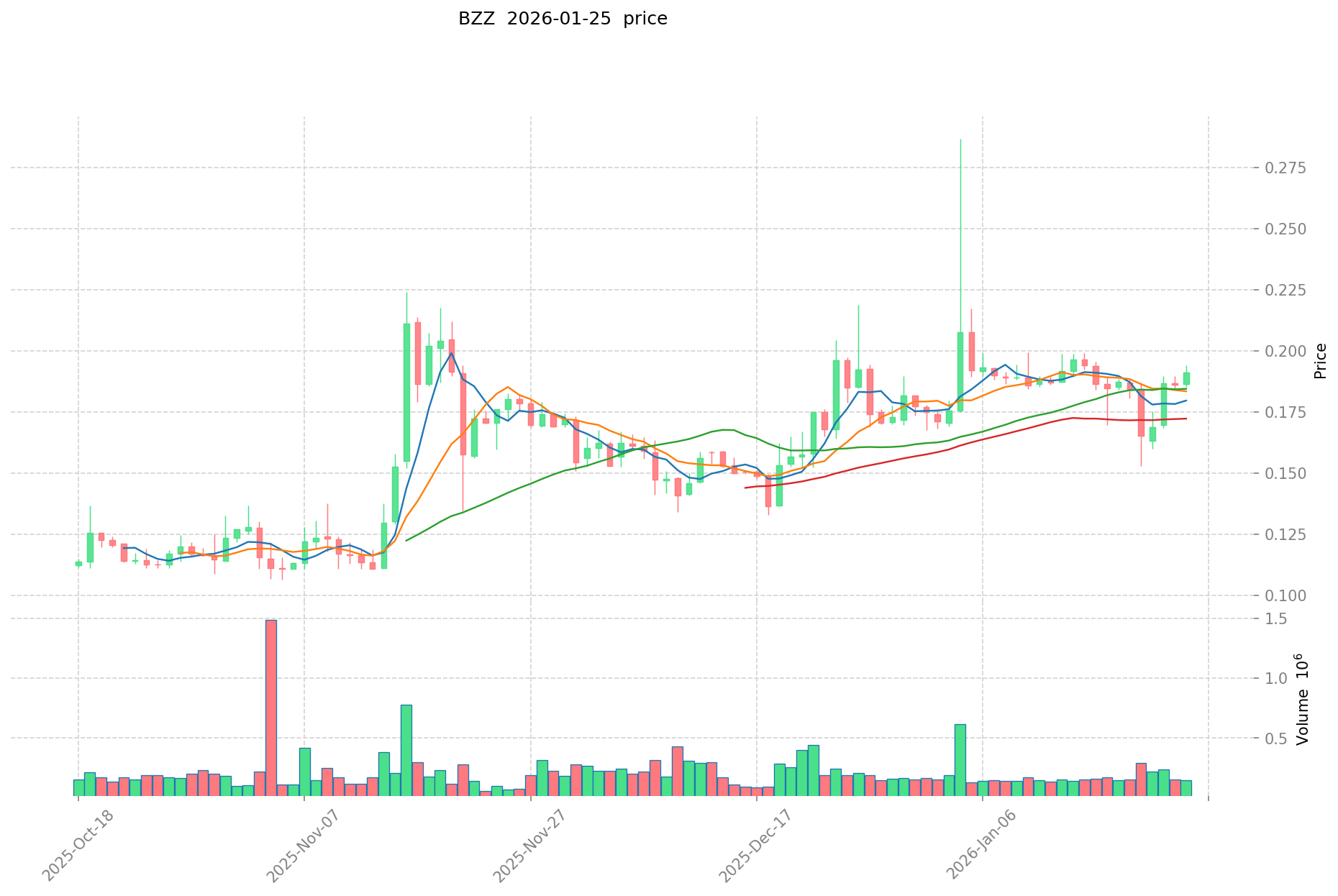
Swarm (BZZ) reached a notable price level of $21.11 on 22 June 2021, during a period of heightened market activity in the decentralized storage sector. The token experienced its lowest price point of $0.110009 on 14 November 2025, reflecting broader market conditions and sector adjustments.
Recent price dynamics show varied performance across different timeframes:
- 1-hour change: -0.21% (price adjustment of -$0.0004)
- 24-hour change: -1.91% (price movement of -$0.0037)
- 7-day change: +2.32% (price increase of $0.0043)
- 30-day change: -1.55% (price decrease of -$0.0030)
- 1-year change: -44.87% (price decline of -$0.1546)
As of the last update, BZZ is trading at $0.1899, with a 24-hour high of $0.1941 and a low of $0.1893. These fluctuations reflect ongoing market dynamics, adoption patterns, and the evolving landscape of decentralized storage solutions.
Click to view current BZZ market price
On-chain Metrics
- 24-hour trading volume: $26,566.55 (indicating current market liquidity)
- Market capitalization: $11,992,078.25 (representing 0.00038% market dominance)
- Token holders: 24,475 addresses (reflecting user distribution)
- Trading availability: Listed on 6 exchanges
Swarm Ecosystem Applications and Strategic Partners
Core Use Cases
Swarm's ecosystem supports multiple application scenarios:
- Decentralized Storage: As a distributed storage platform, Swarm provides on-chain data storage solutions for Ethereum, enabling developers to store and retrieve data in a decentralized manner.
- Content Distribution: Swarm serves as a content distribution service protocol, offering bandwidth resources that enhance the efficiency of data transmission across the Web3.0 infrastructure.
- Web3.0 Infrastructure: Together with smart contracts and Whisper (for encrypted data interaction), Swarm forms one of the three fundamental pillars of Ethereum's Web3.0 ecosystem.
Strategic Collaborations
Swarm operates as a native service layer for Ethereum, providing essential storage and bandwidth capabilities that strengthen the technical foundation of decentralized applications. The protocol's integration with Ethereum's ecosystem demonstrates its commitment to supporting blockchain infrastructure development.
Controversies and Challenges
Swarm faces several challenges in its development:
- Market Competition: The project operates in a competitive landscape with other decentralized storage solutions vying for market share.
- Price Volatility: BZZ has experienced fluctuations, with recent data showing a 1.91% decrease over 24 hours and a 44.87% decline over one year.
- Adoption Barriers: As with many Web3.0 technologies, achieving widespread adoption requires overcoming technical complexity and user education challenges.
These issues continue to drive discussions within the community and motivate ongoing innovation efforts.
Swarm maintains an active community presence with approximately 24,475 token holders. The project's social channels facilitate discussions around decentralized storage technology and Web3.0 development.
Conversations on social platforms reflect diverse perspectives:
- Supporters highlight Swarm's role as a critical infrastructure component for Ethereum's Web3.0 vision, emphasizing its decentralized storage capabilities and integration with smart contracts.
- Critics express concerns about market performance and competition from alternative storage solutions.
Community discussions often center on the project's technical developments and its position within the broader decentralized storage landscape.
Trending Topics
Community members actively discuss Swarm's potential to revolutionize data storage and content distribution in the Web3.0 era, while also addressing questions about market adoption and technological scalability.
Additional Resources for Swarm
- Official Website: Visit Swarm's official website to learn about features, use cases, and latest developments.
- White Paper: The Swarm White Paper provides detailed information about the protocol's technical architecture, objectives, and vision for decentralized storage.
- Social Media Presence: Follow Swarm on X (formerly Twitter) for updates on technical upgrades, community events, and ecosystem news.
- Development Resources: Explore Swarm's GitHub repository to access documentation and contribute to the codebase.
How to Participate in Swarm?
- Acquisition: BZZ tokens are available for trading on Gate.com and other exchanges, with current trading volume of approximately $26,566.55 over 24 hours.
- Storage Solutions: Consider using compatible wallet solutions that support ERC-20 tokens for secure storage of BZZ.
- Community Involvement: Engage with the Swarm community through official channels on Reddit and other social platforms to stay informed about project developments.
- Technical Contribution: Developers can explore Swarm's documentation and GitHub resources to build applications leveraging decentralized storage capabilities.
Summary
Swarm represents a significant infrastructure component for Ethereum's Web3.0 ecosystem, offering decentralized storage and content distribution services. The protocol addresses critical needs in blockchain data management by providing developers with tools for storing and accessing information without centralized intermediaries.
With BZZ serving as the functional token for accessing these services, Swarm continues to develop its position within the decentralized storage sector. The project maintains an active community of approximately 24,475 holders and operates with full token circulation.
While facing challenges including market competition and price volatility, Swarm's technical foundation and integration with Ethereum's ecosystem position it as a noteworthy project in the Web3.0 infrastructure landscape. Whether you are new to decentralized storage or an experienced blockchain developer, Swarm's approach to distributed data management merits attention and exploration.
FAQ
What is BZZ? What is its purpose?
BZZ is the native token of Swarm, a decentralized storage and communication protocol. It powers data storage, retrieval, and bandwidth services on the Swarm network, enabling users to upload and access files in a peer-to-peer manner without central servers.
How to buy and obtain BZZ tokens?
You can purchase BZZ tokens through major cryptocurrency platforms and DEX protocols. Simply create an account, complete verification, deposit funds, and trade for BZZ. You can also earn BZZ by running Swarm nodes and participating in the network's storage and bandwidth services.
What is the difference between BZZ and other storage tokens like Filecoin and Arweave?
BZZ powers Swarm's decentralized storage with faster data retrieval and lower costs. Unlike Filecoin's long-term archival focus and Arweave's permanent storage, Swarm emphasizes bandwidth efficiency and real-time data access, making it ideal for dynamic content delivery and dApp infrastructure.
What is the token economic model of Swarm project's BZZ?
BZZ operates on a utility model combining storage incentives, bandwidth rewards, and staking mechanisms. Token holders stake BZZ to operate nodes, earning fees from storage and retrieval services. Supply is capped at 62.5 million, with distribution through mining, rewards, and protocol mechanisms ensuring sustainable ecosystem growth.
What are the requirements and returns for BZZ mining or node operation?
BZZ node operation requires staking tokens and running bee client software. Operators earn rewards through storage services, bandwidth provision, and retrieval fees. Minimum stake varies by network conditions. Returns depend on node uptime, storage capacity, and network activity participation.
What risks should I pay attention to when investing in BZZ?
BZZ token volatility can be significant due to market sentiment shifts. Network adoption rates, regulatory changes, and storage demand fluctuations directly impact token value. Technical risks include smart contract vulnerabilities and infrastructure updates. Diversification and risk management are essential for long-term positioning.
* The information is not intended to be and does not constitute financial advice or any other recommendation of any sort offered or endorsed by Gate.