This comprehensive guide explores Swarm (BZZ), Ethereum's native decentralized storage platform launched in 2021 as a core pillar of Web3.0 infrastructure. BZZ serves as the functional token enabling distributed storage, bandwidth services, and fair node operator incentives across a censorship-resistant network. The article details Swarm's technical architecture, current market metrics showing 63.1M circulating tokens at $0.1799 as of January 2026, and its role alongside smart contracts in Ethereum's ecosystem. Readers will discover how to purchase BZZ on Gate, participate as storage providers, understand the competitive landscape against IPFS and Filecoin, and evaluate long-term opportunities in decentralized storage infrastructure. Whether new to Web3 storage or experienced crypto participants, this guide provides essential insights into Swarm's technology, economics, and ecosystem applications.
Swarm's Positioning and Significance
In 2021, the Ethereum Foundation launched Swarm (BZZ), aiming to address decentralized storage and bandwidth limitations in the Web3.0 ecosystem.
As a native service layer of Ethereum Web3.0, Swarm plays a critical role in distributed storage and content distribution.
As of 2026, Swarm has established itself as a key infrastructure component within the Ethereum ecosystem, with an active development community and ongoing technical evolution.
This article will provide an in-depth analysis of its technical architecture, market performance, and future potential.
Origin and Development History
Genesis Background
Swarm was created by the Ethereum Foundation in 2021, aiming to solve the challenges of decentralized data storage and bandwidth provision for blockchain networks.
It emerged during the expansion of Web3.0 infrastructure, with the goal of providing reliable, censorship-resistant storage and content distribution through decentralized architecture.
The launch of Swarm brought new possibilities for Ethereum-based applications and Web3.0 developers.
Key Milestones
- 2021: Mainnet launch with the introduction of BZZ token, establishing the foundation for decentralized storage services.
- 2021: Token distribution event that attracted significant community participation and initial network node deployment.
- Ongoing: Continuous protocol improvements focusing on storage efficiency, bandwidth optimization, and network stability.
- Recent years: Ecosystem expansion with integration of various decentralized applications utilizing Swarm's storage layer.
With support from the Ethereum ecosystem and the Swarm Foundation, the project continues to refine its technology, security, and real-world applications.
How Swarm Works?
No Central Control
Swarm operates on a decentralized network of computers (nodes) distributed globally, eliminating reliance on centralized servers or institutions.
These nodes collaborate to store and distribute data, ensuring system transparency and resistance to censorship, granting users greater autonomy and enhancing network resilience.
Blockchain Foundation
Swarm functions as a distributed storage platform integrated with the Ethereum blockchain, serving as one of the three pillars of Ethereum Web3.0 alongside smart contracts and Whisper.
The platform maintains data integrity through cryptographic hashing and distributed verification mechanisms.
Anyone can participate in the network as a storage provider or data consumer, establishing trust without intermediaries.
The protocol employs incentive mechanisms to ensure data availability and network reliability.
Ensuring Fairness
Swarm utilizes an incentive-based system where node operators provide storage and bandwidth resources in exchange for BZZ tokens.
Participants maintain network security and data availability through storage provision and bandwidth sharing, receiving BZZ rewards for their contributions.
The protocol incorporates mechanisms for fair resource allocation and quality-of-service guarantees.
Secure Transactions
Swarm employs cryptographic techniques to protect data integrity and user privacy:
- Private keys are used to control access to stored content and manage node operations
- Public addresses enable content addressing and verification of data authenticity
This architecture ensures data remains secure and accessible only to authorized parties, maintaining privacy levels appropriate to user requirements.
The platform supports features such as erasure coding and distributed redundancy to enhance data durability and availability.
Circulation Overview
As of January 26, 2026, Swarm's circulating supply is 63,149,437.84 BZZ tokens, with a total supply of 63,149,437.84 tokens. The circulating supply represents 100% of the total supply, indicating a fully circulating token model. BZZ serves as the functional token within the Swarm ecosystem, used as fuel for accessing decentralized storage and bandwidth services on the Swarm network.
Price Volatility
Swarm (BZZ) reached its all-time high price of $21.11 on June 22, 2021, during a period of heightened interest in Web3 infrastructure and decentralized storage solutions. The token's lowest recorded price was $0.110009, occurring on November 14, 2025, reflecting broader market corrections and decreased sentiment in the cryptocurrency sector.
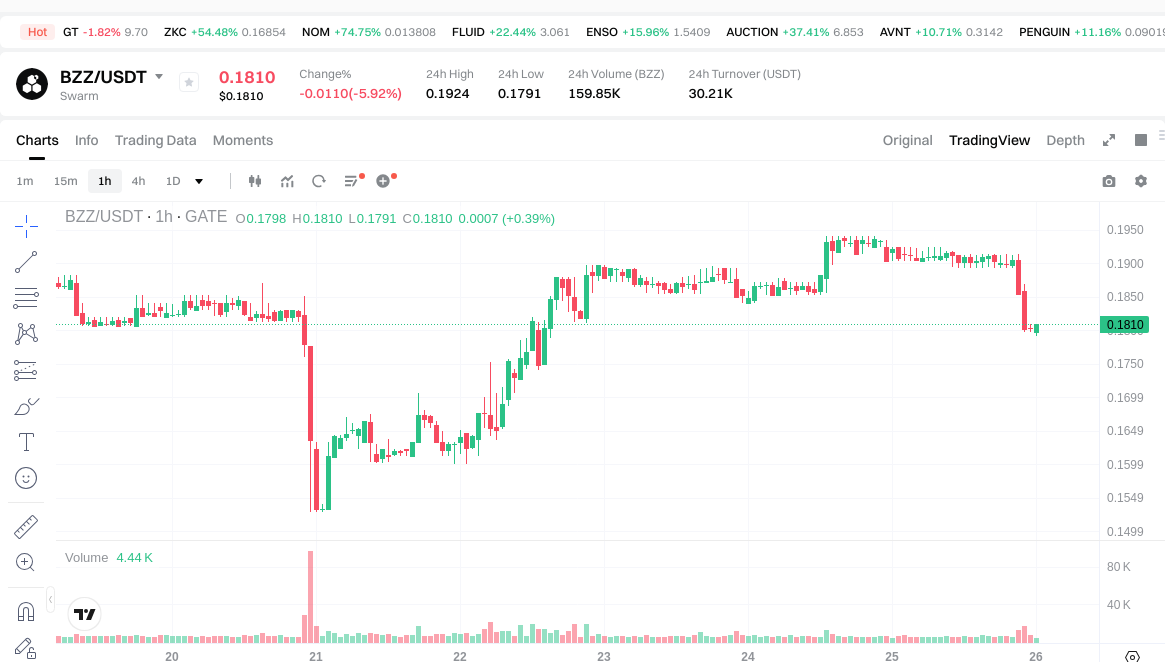
As of January 26, 2026, BZZ is trading at $0.1799, showing recent price movements with a 24-hour range between $0.1791 and $0.1924. Short-term price changes indicate a -0.16% movement over 1 hour, -5.95% over 24 hours, and -3.8% over 7 days. Longer-term trends show a -7.93% change over 30 days and -47.75% over the past year, demonstrating the volatility characteristic of cryptocurrency markets and reflecting shifts in market sentiment and adoption patterns.
Click to view current BZZ market price
On-Chain Metrics
- Market Capitalization: $11,360,583.87, representing approximately 0.00036% market dominance
- 24-Hour Trading Volume: $30,186.11, indicating current market activity levels
- Holder Count: 24,475 addresses holding BZZ tokens, reflecting community distribution
- Fully Diluted Valuation: $11,360,583.87, matching the current market capitalization due to full circulation
Swarm Ecosystem Applications and Partners
Core Use Cases
Swarm's ecosystem supports distributed storage and content delivery applications:
- Decentralized Storage: Swarm provides a distributed storage platform that serves as Ethereum's native service layer, enabling on-chain data storage and bandwidth provision.
- Web3.0 Infrastructure: Together with smart contracts and Whisper (encrypted data interaction), Swarm forms one of the three pillars of Ethereum Web3.0, facilitating decentralized content distribution services.
Strategic Cooperation
As a core component of the Ethereum ecosystem, Swarm contributes to Web3.0 infrastructure development through its role in data storage and bandwidth provision. This positioning provides a foundation for potential ecosystem expansion.
Challenges and Considerations
Swarm faces various considerations in its development:
- Technical Evolution: As a distributed storage platform, ongoing optimization of storage efficiency and bandwidth allocation remains a focus area.
- Market Competition: The decentralized storage sector includes multiple protocol alternatives, creating a competitive landscape.
- Adoption Progress: Building network effects and attracting users to utilize decentralized storage services requires continued effort.
These factors contribute to ongoing discussions within the community and drive continuous development efforts.
Swarm maintains an active community presence with holders numbering 24,475 as of the latest data. The project operates across multiple platforms including Twitter, Reddit, and GitHub, fostering developer and user participation in the distributed storage ecosystem.
On X platform, community discussions center around:
- Technology advocates highlight Swarm's role in decentralized storage and Ethereum Web3.0 infrastructure, viewing it as a component of the broader decentralized technology movement.
- Market observers monitor metrics such as token utility within the Swarm network and adoption rates for decentralized storage solutions.
Community sentiment reflects interest in the development of decentralized storage technologies and their integration within Web3.0 applications.
Discussion Topics
X users engage with topics related to Swarm's distributed storage capabilities, integration with Ethereum ecosystem, and the evolution of decentralized content delivery networks, reflecting both opportunities and challenges in advancing decentralized infrastructure adoption.
- Official Website: Visit Swarm Official Site for features, use cases, and latest developments.
- Whitepaper: Swarm Whitepaper details its technical architecture, objectives, and vision for distributed storage and content delivery.
- X Platform: Swarm maintains an active presence on X via @ethswarm, sharing updates on technical developments, community activities, and ecosystem news.
- Development Resources: Access Swarm GitHub for technical documentation and contribution opportunities.
Future Roadmap Considerations
Swarm continues to develop its distributed storage platform with focus on:
- Technical Enhancement: Ongoing improvements to storage efficiency and bandwidth optimization
- Ecosystem Growth: Expanding use cases for decentralized storage within Web3.0 applications
- Long-term Vision: Establishing robust infrastructure for Ethereum's data storage and content distribution needs
How to Participate in Swarm?
- Purchase Options: BZZ is available on Gate.com and other supporting exchanges
- Storage Solutions: Use compatible Ethereum wallets such as MetaMask for secure token management
- Community Involvement: Engage with the community through official channels on Twitter, Reddit, and GitHub
- Ecosystem Building: Visit Swarm GitHub to explore development documentation and contribute to the project
Summary
Swarm represents a distributed storage solution designed to support Ethereum's Web3.0 infrastructure, offering decentralized data storage and content distribution capabilities. As one of the three pillars of Ethereum Web3.0 alongside smart contracts and Whisper, it plays a role in the broader decentralized technology landscape.
Its active community, development resources, and focus on distributed storage position it within the evolving Web3.0 ecosystem. While facing considerations such as market competition and adoption challenges, Swarm's integration with Ethereum infrastructure and commitment to decentralized storage solutions contribute to its presence in the distributed technology space.
Whether you are new to decentralized storage or an experienced participant in the crypto ecosystem, Swarm offers opportunities for engagement and exploration.
FAQ
What is BZZ? What is the role of BZZ token in the Swarm project?
BZZ is the native token of Swarm, a decentralized storage and communication platform. BZZ tokens are used for paying storage fees, bandwidth costs, and incentivizing node operators to maintain the network. They also enable governance participation and staking for network security.
How to acquire and purchase BZZ tokens? On which exchanges can I trade?
BZZ tokens can be purchased through major cryptocurrency exchanges by trading against stablecoins or other digital assets. Users can deposit funds, place buy orders, and store BZZ in personal wallets. Trading volume for BZZ has grown significantly, making it increasingly accessible across multiple platforms.
What is the use of BZZ tokens? How to use BZZ in the Swarm network?
BZZ is Swarm's native utility token used for paying storage and bandwidth fees. Users stake BZZ to become nodes, earning rewards for providing storage and serving data. BZZ incentivizes network participation and ensures fair compensation for data hosting services.
What is the difference between Swarm/BZZ and other distributed storage projects like IPFS and Filecoin?
Swarm uses incentive-based economics with BZZ tokens for bandwidth and storage. Unlike IPFS's peer-to-peer model, Swarm guarantees data availability through smart contracts. Filecoin focuses on market-driven storage pricing, while Swarm emphasizes censorship-resistant, self-sovereign data with integrated payment mechanisms.
What is the economic model of BZZ token and what is the total supply?
BZZ is Swarm's native token with a maximum supply of 125 million tokens. The economic model uses a bonding curve mechanism for stake and incentives, combining inflation rewards for node operators with deflationary mechanisms through service fees, creating a sustainable ecosystem for decentralized storage and bandwidth.
What are the risks of investing in BZZ? What is the outlook?
BZZ carries market volatility and regulatory risks. However, as Swarm's native token powering decentralized storage infrastructure, BZZ has strong fundamentals. With increasing demand for Web3 storage solutions, BZZ demonstrates promising long-term growth potential in the decentralized internet ecosystem.
* The information is not intended to be and does not constitute financial advice or any other recommendation of any sort offered or endorsed by Gate.