Chainbase (C) is a foundational Hyperdata Network addressing fragmented onchain data challenges in the DataFi era. This comprehensive guide explores how Chainbase transforms raw blockchain signals into structured, AI-ready datasets through decentralized infrastructure and advanced verification protocols. Since its 2025 launch, it has served over 20,000 developers and facilitated 500+ billion data calls across 8,000+ integrations. The article covers its technical architecture, market performance (160M circulating tokens, $12M market cap), ecosystem partnerships, and real-world applications. It examines current challenges including market volatility and adoption barriers, while outlining future roadmap goals. Whether you're a developer, investor, or crypto enthusiast, this guide provides essential insights into purchasing C tokens on Gate, community participation, and Chainbase's pivotal role in decentralized data infrastructure.
Chainbase's Positioning and Significance
In 2025, Chainbase launched Chainbase (C) to address the fragmentation of onchain data and the lack of structured, AI-ready infrastructure for decentralized applications.
As a foundational Hyperdata Network for the DataFi era, Chainbase plays a critical role in data infrastructure, AI integration, and decentralized data economies.
As of 2026, Chainbase has established itself as a significant data infrastructure provider in the blockchain space, serving over 20,000 developers and facilitating 500 billion+ data calls across 8,000+ project integrations.
This article explores its technical architecture, market performance, and future potential.
Origin and Development History
Birth Background
Chainbase was created by its founding team in 2025 to solve the challenge of transforming fragmented onchain signals into structured, verifiable, and AI-ready data.
It emerged during the growing intersection of blockchain technology and artificial intelligence, aiming to enable permissionless coordination between agents, applications, and humans through accessible data infrastructure.
The launch of Chainbase opened new possibilities for developers, AI systems, and decentralized applications seeking reliable onchain data.
Key Milestones
- 2025: Mainnet launch on Base blockchain, implementing ERC-20 token standard and data infrastructure capabilities.
- 2025: Secured backing from prominent funds including Matrix Partners, Hash Global, Folius Ventures, JSquare, DFG, Mask Network, Bonfire Union Ventures, XVC, ZhenFund, M77, and BODL Ventures.
- 2025: Ecosystem expansion with developer community surpassing 20,000 members and data calls exceeding 500 billion.
- 2025: Integration milestone reached with over 8,000 projects utilizing Chainbase infrastructure.
With support from leading venture capital firms and an active developer community, Chainbase continues to enhance its data infrastructure, security features, and real-world applications.
How Chainbase Works?
Decentralized Infrastructure
Chainbase operates on a decentralized network architecture that processes onchain data without centralized control.
The distributed infrastructure collaborates to validate and structure blockchain data, ensuring transparency and system resilience while granting developers greater autonomy in accessing verifiable information.
Data Processing Core
Chainbase's infrastructure transforms raw blockchain signals into structured, queryable datasets.
The platform processes data from multiple blockchain sources, organizing information through systematic indexing and verification protocols.
Developers can access this structured data through standardized interfaces, enabling efficient integration without intermediary gatekeepers.
The architecture supports AI-ready data formats, facilitating machine learning applications and autonomous agent interactions.
Network Coordination
Chainbase utilizes decentralized coordination mechanisms to maintain data accuracy and system integrity.
Network participants contribute to data validation and infrastructure maintenance, supporting the platform's operational security.
The system's design emphasizes composability and monetization opportunities within the data economy framework.
Secure Data Access
Chainbase implements verification protocols to ensure data authenticity and reliability:
- Cryptographic verification validates data sources and transformations
- Standardized interfaces enable secure programmatic access
This framework ensures data integrity while maintaining transparent access patterns for developers and applications.
The platform supports permissionless integration, allowing developers to build data-driven applications without centralized approval processes.
Circulation Overview
As of January 25, 2026, Chainbase (C) has a circulating supply of 160,000,000 tokens, with a total supply of 1,000,000,000 tokens and a maximum supply capped at 1,000,000,000 tokens.
New tokens enter the market through a structured distribution model, influencing supply-demand dynamics.
The current circulating supply represents approximately 16% of the total supply, indicating a controlled release mechanism.
Price Volatility
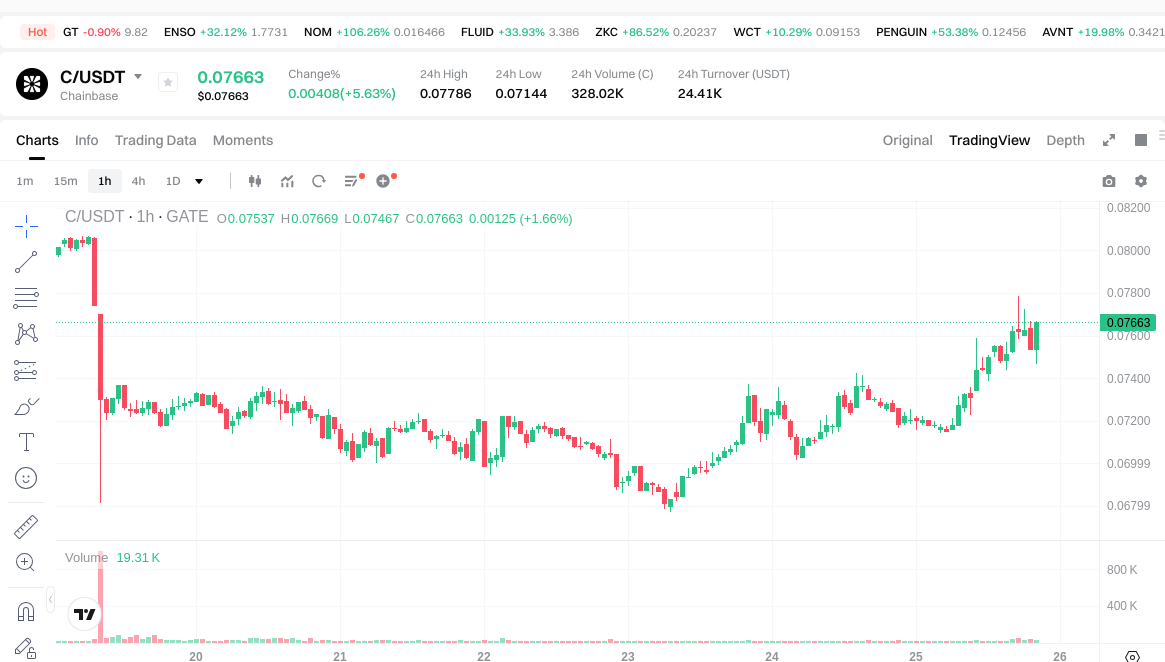
Chainbase (C) reached a notable price level of $0.5396 on July 18, 2025, driven by factors such as increased market interest and project developments.
Its lowest recorded price was $0.0661, occurring on October 10, 2025, reflecting market corrections and broader crypto market trends.
These fluctuations demonstrate the interplay between market sentiment, adoption trends, and external factors affecting the cryptocurrency ecosystem.
Click to view the current C market price
On-Chain Metrics
- Holder Count: 70,411 addresses (reflecting user participation and distribution)
- 24-Hour Trading Volume: $24,273.37 (indicating current market activity)
- Market Capitalization: $12,070,399.99 (representing the circulating token value)
- Fully Diluted Valuation: $75,440,000 (projecting potential value at maximum supply)
Chainbase Ecosystem Applications and Partners
Core Use Cases
Chainbase's ecosystem supports multiple applications:
- Data Infrastructure: Provides structured and verifiable onchain data services, enabling AI-ready data transformation and permissionless coordination.
- Developer Tools: With over 8,000 project integrations, Chainbase empowers developers to build decentralized applications by offering composable and monetizable data solutions.
Strategic Partnerships
Chainbase has established collaborations with prominent venture capital firms and blockchain entities, including Matrix Partners, Hash Global, Folius Ventures, JSquare, DFG, Mask Network, Bonfire Union Ventures, XVC, ZhenFund, M77, and BODL Ventures.
These partnerships provide a solid foundation for Chainbase's ecosystem expansion and enhance its technical capabilities.
Controversies and Challenges
Chainbase faces the following challenges:
- Market Volatility: Price fluctuations remain a concern for investors and users.
- Competitive Pressure: The evolving blockchain data infrastructure landscape presents ongoing competition.
- Adoption Barriers: Achieving widespread developer and enterprise adoption requires continuous innovation.
These issues have sparked discussions within the community and market, driving Chainbase's continued innovation.
Chainbase's community demonstrates strong engagement, with a vibrant network of over 20,000 developers and 70,411 token holders.
On X platform, related posts and hashtags (such as #Chainbase) frequently gain attention.
Factors such as new feature releases and ecosystem milestones fuel community enthusiasm.
Sentiment on X shows diverse perspectives:
- Supporters praise Chainbase's AI-ready data infrastructure and decentralized data economy model, viewing it as a foundational layer for the DataFi era.
- Critics focus on market volatility and adoption challenges.
Recent trends indicate growing interest in data infrastructure solutions within the Web3 space.
Hot Topics
X users actively discuss Chainbase's data verification mechanisms, AI integration capabilities, and developer ecosystem growth,
showcasing both its transformative potential and the obstacles toward mainstream adoption.
- Official Website: Visit Chainbase Official Website for features, use cases, and latest developments.
- White Paper: Chainbase Litepaper details its technical architecture, objectives, and vision.
- X Updates: On X platform, Chainbase maintains an active presence through @ChainbaseHQ,
with posts covering technical upgrades, community events, and partnership announcements.
Chainbase Future Roadmap
- Ongoing Development: Continuous enhancement of the Hyperdata Network infrastructure to improve data processing capabilities
- Ecosystem Goals: Expand developer community and increase project integrations across multiple blockchain networks
- Long-term Vision: Establish Chainbase as the foundational data layer for AI-driven decentralized applications
How to Participate in Chainbase?
- Purchase Options: Buy C tokens on Gate.com and other supported exchanges
- Storage Solutions: Securely store tokens using compatible wallets
- Community Engagement: Join the Discord community at Chainbase Discord to participate in discussions
- Ecosystem Building: Visit Chainbase Documentation to develop applications or contribute to the ecosystem
Summary
Chainbase is redefining blockchain data infrastructure through its innovative approach, offering structured, verifiable, and AI-ready data solutions.
Its active community of over 20,000 developers, comprehensive resources, and market presence position it uniquely within the cryptocurrency sector.
Despite facing market volatility and adoption challenges, Chainbase's innovative vision and clear development direction establish it as an important player in the future of decentralized data economy.
Whether you are a newcomer or an experienced participant, Chainbase merits attention and engagement.
FAQ
What is Crypto C? What are its main features?
Crypto C is a decentralized digital asset designed for efficient transactions and smart contract functionality. Its main features include fast transaction speeds, low fees, strong security protocols, and scalability. It leverages blockchain technology to enable transparent, peer-to-peer value transfer across global networks.
What is the difference between Crypto C and other cryptocurrencies like Bitcoin and Ethereum?
Crypto C features enhanced scalability, lower transaction fees, and faster processing speeds compared to Bitcoin and Ethereum. It offers improved smart contract functionality and greater energy efficiency, designed for next-generation blockchain applications.
How to buy and store Crypto C?
Purchase Crypto C through major cryptocurrency platforms using fiat or other digital assets. Store securely in hardware wallets for maximum safety, or use reputable custodial wallets. Always enable two-factor authentication and backup your private keys.
What are the security and risks of Crypto C?
Crypto C employs advanced encryption and blockchain technology for security. Main risks include market volatility, regulatory uncertainty, and smart contract vulnerabilities. Users should practice proper key management and use reputable wallets to minimize exposure.
What are the application scenarios and use value of Crypto C?
Crypto C enables decentralized finance, smart contract execution, and cross-border payments. It provides programmable value transfer, supports DeFi protocols, NFT transactions, and serves as a governance token for decentralized autonomous organizations, offering enhanced transparency and reduced intermediary costs.
* The information is not intended to be and does not constitute financial advice or any other recommendation of any sort offered or endorsed by Gate.