This comprehensive guide explores CLORE, a decentralized GPU computing marketplace launched in 2022 to address inefficient resource allocation and high computational costs. Built on Ethereum blockchain, CLORE connects GPU owners with users seeking affordable high-performance computing through peer-to-peer rental mechanisms. The article examines its technical architecture, market performance with current pricing at $0.002873, tokenomics showing 632.2M circulating supply, and ecosystem applications spanning AI training, rendering, and mining. It analyzes community sentiment on X, discusses challenges including regulatory risks and competition, and outlines participation methods including purchasing on Gate.com. With 1,532 active holders and expanding adoption, CLORE represents an innovative approach to democratizing computational resource access through blockchain technology.
Clore.ai's Positioning and Significance
In 2022, the Clore.ai team launched Clore.ai (CLORE), aiming to address inefficiencies in GPU resource allocation and high costs of accessing computational power for AI training, rendering, and mining.
As a decentralized marketplace for GPU computing power, Clore.ai plays a key role in AI infrastructure, cloud computing, and decentralized resource sharing.
As of 2026, Clore.ai has evolved into a community-driven platform serving users seeking affordable high-performance computing, with over 1,532 holders and an active ecosystem.
This article will provide an in-depth analysis of its technical architecture, market performance, and future potential.
Origins and Development Timeline
Birth Background
Clore.ai was created by its founding team in 2022, aiming to solve the inaccessibility and high cost of GPU computing resources for AI developers, content creators, and miners.
It emerged during the rapid expansion of AI applications and blockchain technology, with the goal of democratizing access to advanced computational resources through a decentralized sharing economy.
The launch of Clore.ai brought new possibilities for individuals and enterprises requiring scalable GPU power.
Key Milestones
- 2022: Platform launch, enabling peer-to-peer GPU rental with integrated mining incentives.
- 2024: Introduction of managed data center services, enhancing reliability for enterprise-grade workloads.
- 2024-2026: Ecosystem expansion with growing adoption in AI training, rendering workflows, and cryptocurrency mining operations.
Supported by its community and data center partners, Clore.ai continues to refine its platform's usability, security, and real-world applications.
How Clore.ai Works
Decentralized GPU Marketplace
Clore.ai operates as a decentralized marketplace connecting GPU owners with users who need computational power, eliminating reliance on centralized cloud providers.
This peer-to-peer model allows GPU owners to monetize idle hardware while users access affordable resources, creating a more efficient allocation of computing capacity.
Blockchain Foundation
Clore.ai's token (CLORE) runs on the Ethereum blockchain, leveraging smart contracts to facilitate secure transactions between GPU providers and renters.
The blockchain serves as a transparent, immutable ledger recording all rental agreements and payments.
Users can verify transactions independently, ensuring trust without intermediaries.
Incentive Mechanism
Clore.ai employs a community-driven reward system where GPU providers earn CLORE tokens for offering their computing power.
Users can participate in Clore Mining, earning tokens while contributing to network operations.
This dual incentive structure encourages broader participation and enhances platform liquidity.
Secure Transactions
Clore.ai utilizes Ethereum's cryptographic infrastructure to protect transactions:
- Private keys (secure credentials) authorize rental agreements and payments
- Public keys (identifiable addresses) enable transparent verification of transactions
This mechanism ensures secure fund transfers while maintaining pseudonymous user interactions.
The platform's managed data center option provides additional security layers for enterprise clients requiring high-reliability services.
Circulation Overview
As of 01 February 2026, CLORE has a circulating supply of 632,222,341.30 tokens, with a total supply of 635,715,821.30 tokens. The maximum supply is capped at 1,300,000,000 tokens, representing a fixed supply model. The current circulation ratio stands at approximately 48.63% of the total supply. New tokens enter the market through mining mechanisms, specifically Clore Mining, which provides additional incentives while influencing the supply and demand dynamics of the ecosystem.
Price Volatility
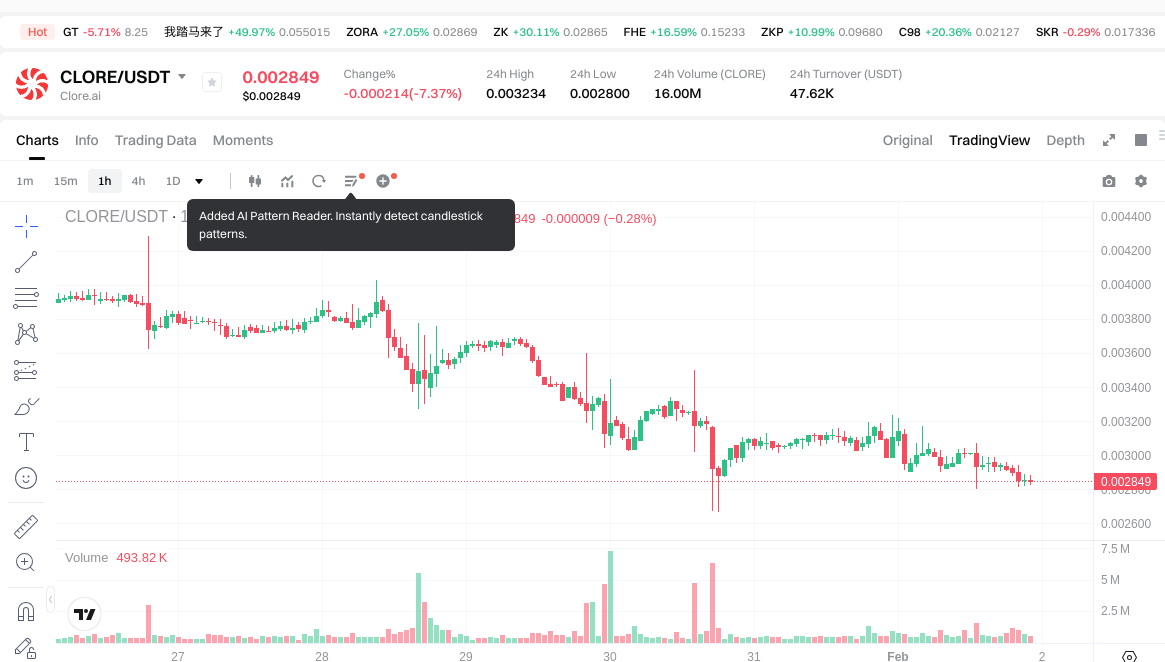
CLORE reached its historical peak price of $0.45 on 17 March 2024, driven by increased interest in GPU computing power sharing and AI-related market enthusiasm during that period. The token's lowest recorded price was $0.002667, occurring on 30 January 2026, reflecting broader market corrections and decreased trading activity. These fluctuations demonstrate the impact of market sentiment, adoption trends, and external factors on CLORE's valuation. As of the latest data, CLORE is trading at $0.002873, showing a 24-hour decline of 7.29% and a 7-day decrease of 27.35%.
Click to view the current CLORE market price
On-Chain Metrics
- Market Capitalization: Approximately $1.82 million with a fully diluted valuation matching this figure
- 24-Hour Trading Volume: $47,665.37, indicating current market activity levels
- Holder Count: 1,532 addresses, reflecting the community size and token distribution
- Exchange Listings: Available on 6 exchanges, providing accessibility for trading and liquidity
Clore.ai Ecosystem Applications and Partners
Core Use Cases
Clore.ai's ecosystem supports multiple applications:
- AI Training and Rendering: The platform enables users to rent out their GPUs for artificial intelligence training tasks and rendering workloads, providing affordable access to high-performance computing resources.
- Mining Operations: Clore Mining offers an additional incentive mechanism, allowing GPU owners to monetize their idle computing power while supporting network participants.
Strategic Partnerships
Clore.ai operates through a community-driven approach with managed data center services that enhance reliability for high-performance computing needs.
These partnerships provide a solid foundation for Clore.ai's ecosystem expansion.
Controversies and Challenges
Clore.ai faces the following challenges:
- Technical Issues: Maintaining optimal performance and reliability across distributed GPU resources
- Regulatory Risks: Evolving regulations around cryptocurrency and decentralized computing markets
- Competitive Pressure: Competition from other GPU marketplace platforms and cloud computing providers
These issues have sparked discussions within the community and market, while also driving Clore.ai's continuous innovation.
Clore.ai's community demonstrates active participation, with the token maintaining a presence across multiple exchanges.
On X platform, related posts and hashtags (such as #CLORE) appear in discussions about GPU computing and AI infrastructure.
Developments such as platform upgrades and marketplace expansions have generated community interest.
Sentiment on X shows varied perspectives:
- Supporters praise Clore.ai's accessibility to GPU computing resources and community-driven approach, viewing it as an innovative solution for computational power sharing.
- Critics focus on market volatility and adoption challenges in the competitive GPU marketplace sector.
Recent trends indicate mixed sentiment reflecting broader market conditions.
Popular Topics
X users discuss Clore.ai's marketplace dynamics, GPU rental economics, and platform development, showcasing both its potential for democratizing computing access and the challenges of building sustainable decentralized infrastructure.
- Official Website: Visit Clore.ai Official Website for features, use cases, and latest updates.
- White Paper: Clore.ai White Paper details its technical architecture, goals, and vision.
- X Updates: On X platform, Clore.ai maintains an active presence using @clore_ai,
with posts covering platform updates, community activities, and marketplace developments.
Clore.ai Future Roadmap
- Ongoing Development: Enhancing platform reliability and user experience, improving GPU marketplace efficiency
- Ecosystem Goals: Expanding the network of GPU providers and increasing accessibility to computational resources
- Long-term Vision: Becoming a leading marketplace for decentralized GPU computing power
How to Participate in Clore.ai?
- Purchase Channels: Purchase CLORE on exchanges including Gate.com
- Storage Solutions: Securely store using compatible wallets that support ERC-20 tokens
- Participate in Ecosystem: Explore GPU rental opportunities through the Clore.ai marketplace
- Build Ecosystem: Visit official documentation to learn about platform integration and development opportunities
Summary
Clore.ai redefines GPU computing access through blockchain technology, offering transparency, affordability, and decentralized resource sharing.
Its community-driven approach, innovative marketplace model, and focus on accessibility distinguish it in the cryptocurrency and computing sectors.
Despite facing market volatility and competitive challenges, Clore.ai's commitment to democratizing computing resources and clear development direction position it as a noteworthy project in decentralized technology.
Whether you are new to crypto or an experienced participant, Clore.ai represents an interesting intersection of blockchain and computational infrastructure.
FAQ
What is CLORE cryptocurrency and what is its main purpose?
CLORE is the native cryptocurrency of CLORE.AI platform, serving as the foundation for ecosystem operations. Its main purpose is to provide stability, enable member rewards, and support decentralized computing infrastructure and services within the CLORE.AI network.
How can I buy and store CLORE tokens?
Purchase CLORE tokens on exchanges supporting Ethereum, then transfer them to an ERC-20 compatible wallet. Use wallets that support Ethereum for secure token storage and management.
What are the risks and security considerations when investing in CLORE?
CLORE investment risks include market volatility, smart contract vulnerabilities, liquidity constraints, and regulatory uncertainty in crypto markets. Users should conduct thorough due diligence and understand tokenomics before investing.
How does CLORE compare to other similar cryptocurrency projects?
CLORE stands out through its decentralized GPU computing network, offering lower costs and higher efficiency than traditional cloud providers. It delivers superior performance with transparent, community-driven governance, making it a competitive alternative in the distributed computing space.
CLORE has a circulating supply of 95,005,394 tokens, representing 7.31% of the maximum supply of 1,300,000,000 tokens, with a total supply of 1,000,000,000 tokens.
* The information is not intended to be and does not constitute financial advice or any other recommendation of any sort offered or endorsed by Gate.