COTI is a comprehensive Layer-2 blockchain payment solution launched in 2017, designed to address limitations of centralized finance and decentralized finance through innovative DAG-based architecture. This guide explores COTI's technical foundation, featuring parallel transaction processing for enhanced scalability, speed, and reduced costs while maintaining security and confidentiality. With a circulating supply of 2.61 billion tokens and nearly 29,000 active holders, COTI has established market presence across multiple platforms including Gate. The article examines market performance, ecosystem applications spanning DeFi and enterprise solutions, community engagement, and future development roadmap. Whether for newcomers or experienced participants, COTI represents a noteworthy innovation in decentralized payment infrastructure and blockchain technology.
COTI's Positioning and Significance
In 2017, COTI's founding team launched COTI (COTI), aiming to address the challenges faced by both centralized finance (including fees, latency, global compatibility, and risk) and decentralized finance (including adoption barriers, network congestion, and complexity).
As a comprehensive ecosystem built around the "financial blockchain", COTI plays a key role in optimizing digital payment experiences and financial infrastructure.
As of 2026, COTI has established itself within the blockchain payments sector, with a circulating supply of approximately 2.61 billion tokens and an active holder base of nearly 29,000 users.
This article will provide an in-depth analysis of its technical architecture, market performance, and future potential.
Origin and Development Journey
Background of Creation
COTI was created by its founding team in 2017, aiming to solve the limitations of traditional payment systems and the complexity challenges of decentralized finance.
It emerged during the global expansion of blockchain technology, with the goal of providing scalable, fast, and cost-efficient financial solutions to transform the existing landscape.
COTI's launch brought new possibilities for businesses and users seeking optimized payment infrastructure.
Key Milestones
- 2017: Project inception, introducing the DAG-based protocol designed for financial applications.
- 2019: Mainnet launch on November 7, establishing the foundation for network operations.
- 2021: On September 29, COTI reached a notable price level of $0.668634, reflecting growing market interest.
- Recent years: Ecosystem expansion with integration across multiple blockchain platforms, evidenced by deployment on Ethereum (contract address: 0xDDB3422497E61e13543BeA06989C0789117555c5).
With support from its community and development team, COTI continues to refine its technical capabilities, security features, and real-world applications.
How COTI Works
Decentralized Architecture
COTI operates on a distributed network of nodes across the globe, removing reliance on traditional banking intermediaries or centralized authorities.
These nodes collaborate to validate transactions, ensuring system transparency and resistance to attacks, thereby granting users greater autonomy and enhancing network resilience.
DAG-Based Foundation
COTI utilizes a Directed Acyclic Graph (DAG)-based protocol as its core infrastructure, which differs from traditional blockchain structures.
This architecture is designed to provide scalability, speed, confidentiality, compatibility, and low transaction costs.
The DAG structure enables parallel transaction processing, supporting higher throughput while maintaining security.
This innovative approach addresses both the limitations of centralized systems and the performance challenges of conventional blockchains.
Consensus and Security Model
COTI employs a specialized consensus mechanism within its DAG architecture to validate transactions and prevent fraudulent activities.
Network participants maintain system integrity through node operation and transaction validation, contributing to the network's overall security framework.
The protocol's design emphasizes efficiency and scalability while preserving transaction integrity.
Secure Transactions
COTI uses cryptographic techniques to protect transactions:
- Private keys (similar to secret passwords) are used to authorize transactions
- Public keys (similar to account numbers) are used to verify ownership
This mechanism ensures fund security while maintaining transaction privacy.
The system's architecture supports both the transparency required for trust and the confidentiality needed for commercial applications.
Circulation Overview
As of January 19, 2026, Coti has a circulating supply of 2,605,184,962.34 tokens, with a total supply of 2,605,199,699.74 tokens. The maximum supply is capped at 4,910,000,000 tokens, establishing a fixed supply model that may influence long-term scarcity dynamics. The current circulation ratio stands at approximately 53.06% of the maximum supply.
Price Volatility
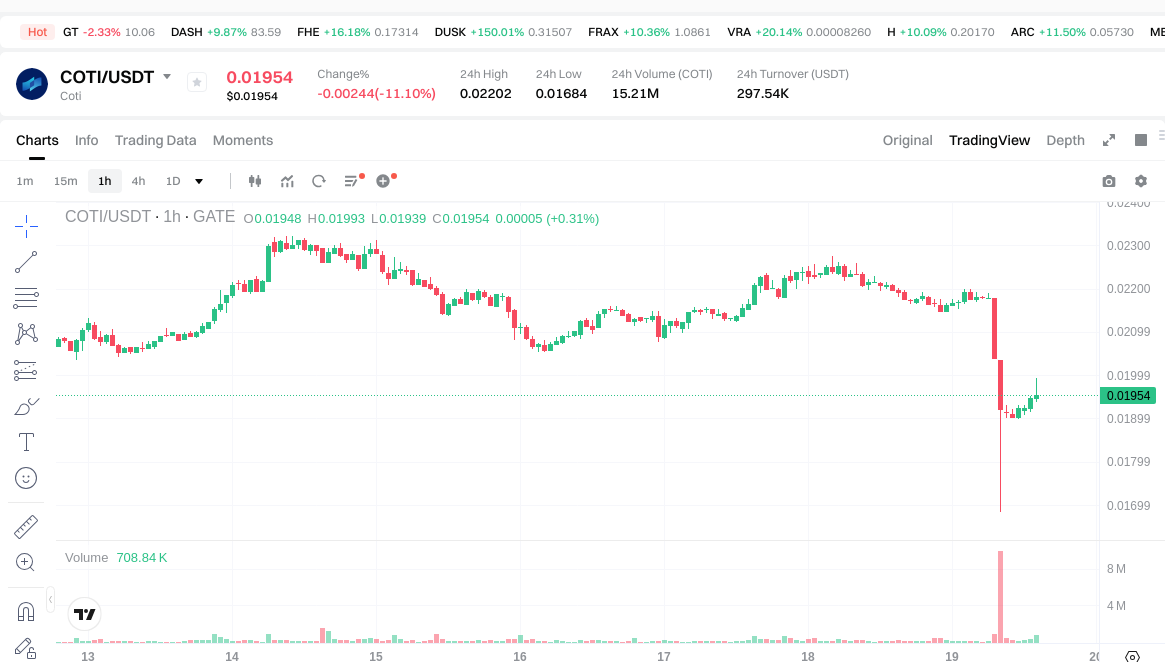
Coti reached its highest price of $0.668634 on September 29, 2021. Its lowest recorded price was $0.00556342 on November 7, 2019. As of the latest update, Coti is trading at $0.01974, representing significant volatility over its trading history. Recent price movements show a -9.33% change over the past 24 hours, with the 24-hour trading range between $0.01684 and $0.02202.
Click to view the current COTI market price
On-Chain Metrics
- Market Capitalization: $51,426,351.16 (as of January 19, 2026)
- 24-Hour Trading Volume: $289,715.14
- Holder Count: 28,977 addresses
- Market Dominance: 0.0015%
- Market Cap to FDV Ratio: 53.06%
COTI Ecosystem Applications and Partners
Core Use Cases
COTI's ecosystem supports multiple applications:
- Decentralized Finance (DeFi): COTI enables payment solutions and stablecoins, providing fast, low-cost transactions optimized for financial applications.
- Enterprise Solutions: COTI's DAG-based infrastructure facilitates scalable payment processing for businesses seeking blockchain integration.
Strategic Partnerships
COTI has established collaborations to enhance its technical capabilities and market reach.
These partnerships provide a solid foundation for COTI's ecosystem expansion.
Controversies and Challenges
COTI faces the following challenges:
- Technical Issues: Maintaining scalability while ensuring transaction speed and security
- Regulatory Risks: Navigating evolving cryptocurrency regulations across different jurisdictions
- Competition Pressure: Competing with established blockchain platforms and emerging payment solutions
These issues have sparked discussions within the community and market, driving COTI's continuous innovation.
COTI's community demonstrates consistent activity, with approximately 28,977 holders as of January 2026.
On X platform, related posts and hashtags (such as #COTI) generate regular engagement.
Technical developments and price movements energize community discussions.
Sentiment on X shows varied perspectives:
- Supporters praise COTI's DAG-based architecture, low fees, and fast transaction speeds, viewing it as an innovative solution for financial blockchain applications.
- Critics focus on price volatility and market competition.
Recent trends indicate cautious sentiment amid broader market conditions.
Hot Topics
X users actively discuss COTI's technological advantages, market positioning, and ecosystem development,
showcasing both its transformative potential and the challenges in achieving mainstream adoption.
- Official Website: Visit COTI's official website for features, use cases, and latest updates.
- White Paper: COTI's White Paper details its technical architecture, objectives, and vision.
- X Updates: On X platform, COTI maintains an active presence through @COTInetwork,
with posts covering technical upgrades, community events, and ecosystem developments.
COTI Future Roadmap
- Ongoing Development: Continued enhancement of DAG-based protocol and infrastructure, improving scalability and transaction efficiency
- Ecosystem Goals: Expanding financial blockchain applications and partnerships
- Long-term Vision: Establishing itself as a leading solution for decentralized finance and payment processing
How to Participate in COTI?
- Purchase Options: Buy COTI on Gate.com and other supported exchanges
- Storage Solutions: Use compatible wallets such as MetaMask or hardware wallets for secure storage
- Community Engagement: Follow official channels and participate in ecosystem activities
- Developer Participation: Visit COTI's GitHub repository to contribute or build applications
Summary
COTI redefines digital currency through blockchain technology, offering scalability, speed, confidentiality, compatibility, and low costs.
Its active community, comprehensive resources, and market presence establish its position in the cryptocurrency sector.
Despite facing regulatory uncertainties and competitive pressures, COTI's innovative approach and clear development path position it as a noteworthy project in decentralized technology.
Whether you are a newcomer or experienced participant, COTI merits attention and engagement.
FAQ
What is COTI and what problem does it solve in the cryptocurrency space?
COTI is a cryptocurrency designed to improve payment processing by eliminating barriers between consumers and merchants, solving inefficiencies in traditional payment systems and enabling faster, cheaper transactions.
How does COTI's technology work and what makes it different from other blockchain projects?
COTI uses Directed Acyclic Graph (DAG) technology enabling parallel transaction processing for high scalability and speed. Unlike traditional blockchains, it features a unique Trustchain protocol, lower fees, and supports digital payments, stablecoins, and enterprise applications.
What are the main use cases and applications of COTI?
COTI enables confidential transactions for DeFi applications with enhanced privacy and security. It supports privacy-preserving machine learning on sensitive data, secure regulated environments, and helps developers build secure decentralized applications while maintaining compliance standards.
How can I buy and store COTI tokens?
You can buy COTI tokens through decentralized exchanges or on-chain trading platforms. Store them securely in a Web3 wallet that supports ERC-20 tokens for complete control and security.
What is the tokenomics of COTI and what is the total supply?
COTI has a total supply of 2 billion tokens. The tokenomics feature both inflationary and deflationary mechanisms through transaction fees, staking rewards, and token burning to maintain economic balance.
What are the risks and security considerations when investing in COTI?
COTI investments carry risks including potential security breaches, code defects, regulatory changes, and blockchain vulnerabilities like hacking and forking. Evaluate these factors carefully before investing.
* The information is not intended to be and does not constitute financial advice or any other recommendation of any sort offered or endorsed by Gate.