This comprehensive guide explores Directed Acyclic Graph (DAG) technology and its revolutionary application in Constellation, a Layer-0 blockchain protocol addressing scalability limitations in traditional systems. Discover how Constellation's hypergraph network architecture, two-tier consensus mechanism, and horizontal scalability enable secure enterprise data management and Web3 infrastructure with over 70 connected enterprises. Learn about the technical framework, market performance metrics, ecosystem applications including Alkimi and Geojam, and community dynamics surrounding DAG cryptocurrency. Perfect for enterprises seeking decentralized solutions, developers building on blockchain infrastructure, and investors evaluating next-generation cryptocurrency projects. The article provides detailed insights into Constellation's positioning as innovative infrastructure, transaction security mechanisms, and clear participation pathways through Gate exchange and ecosystem engagement opportunities.
Constellation's Positioning and Significance
In 2018, Constellation Labs launched Constellation (DAG), aiming to address scalability limitations and data validation challenges in traditional blockchain systems.
As a Layer-0 protocol with horizontal scalability and fault-tolerant distributed architecture, Constellation plays a key role in enterprise data infrastructure and Web3 applications.
As of 2026, Constellation has established itself as an innovative blockchain infrastructure provider, with over 70 connected enterprises through its accelerator program and an active developer community.
This article will provide an in-depth analysis of its technical architecture, market performance, and future potential.
Origin and Development History
Birth Background
Constellation was created by Constellation Labs in 2018, aiming to address scalability bottlenecks and inefficient data validation in traditional blockchain architectures.
It emerged during the blockchain technology expansion period, with the goal of providing horizontally scalable distributed systems with mobile nodes as full participants to transform the landscape.
Constellation's launch brought new possibilities for enterprises seeking secure, scalable data validation and Web3 infrastructure.
Important Milestones
- 2018: Project launched, introducing the concept of mobile clients as full nodes with Extended TrustChain consensus model.
- Ongoing: Mainnet supported by 120 mainnet nodes earning DAG cryptocurrency through network state maintenance.
- Development Phase: Connected over 70 companies through accelerator program, including alkimi and geojam.
- Technical Evolution: Implemented two-tier consensus (L0 and L1) enabling enhanced speed and scalability.
Under the support of Constellation Labs and its community, Constellation continues to optimize its technology, security, and real-world applications.
How Constellation Works?
Decentralized Control
Constellation operates on a globally distributed network of computing nodes, independent of banks or government control.
These nodes collaborate to validate transactions, ensuring system transparency and attack resistance, granting users greater autonomy and enhancing network resilience.
Blockchain Core
Constellation's architecture utilizes a hypergraph network as a Layer-0 protocol with a public, immutable digital ledger recording all transactions.
The network employs an asynchronous Extended TrustChain structure, where transactions are organized through cryptographic validation forming a secure framework.
Anyone can view records, establishing trust without intermediaries.
The two-tier consensus mechanism (L0 and L1) further enhances performance and scalability.
Ensuring Fairness
Constellation employs asynchronous Extended TrustChain with Proof of Meme consensus model to validate transactions and prevent fraudulent activities.
Mainnet node operators maintain network security through running nodes and maintaining network state, earning DAG rewards.
Its innovation includes horizontal scalability with mobile clients as full nodes and composable microservices as smart contracts using JVM.
Secure Transactions
Constellation uses public-private key cryptography to protect transactions:
- Private keys (similar to secret passwords) are used to sign transactions
- Public keys (similar to account numbers) are used to verify ownership
This mechanism ensures fund security while transactions maintain pseudonymous privacy.
The system represents secure consensus through modern serverless architecture with fault-tolerant capabilities.
Circulation Overview
As of January 20, 2026, Constellation's circulating supply stands at 3,800,398,479.99 DAG tokens, with a total supply of 3,800,418,268.76 DAG. The token operates under an inflationary model with an unlimited maximum supply. The circulating supply represents approximately 95.01% of the total supply, indicating a high level of token distribution in the market. The gradual release of tokens into circulation affects the supply-demand dynamics of the ecosystem.
Price Volatility
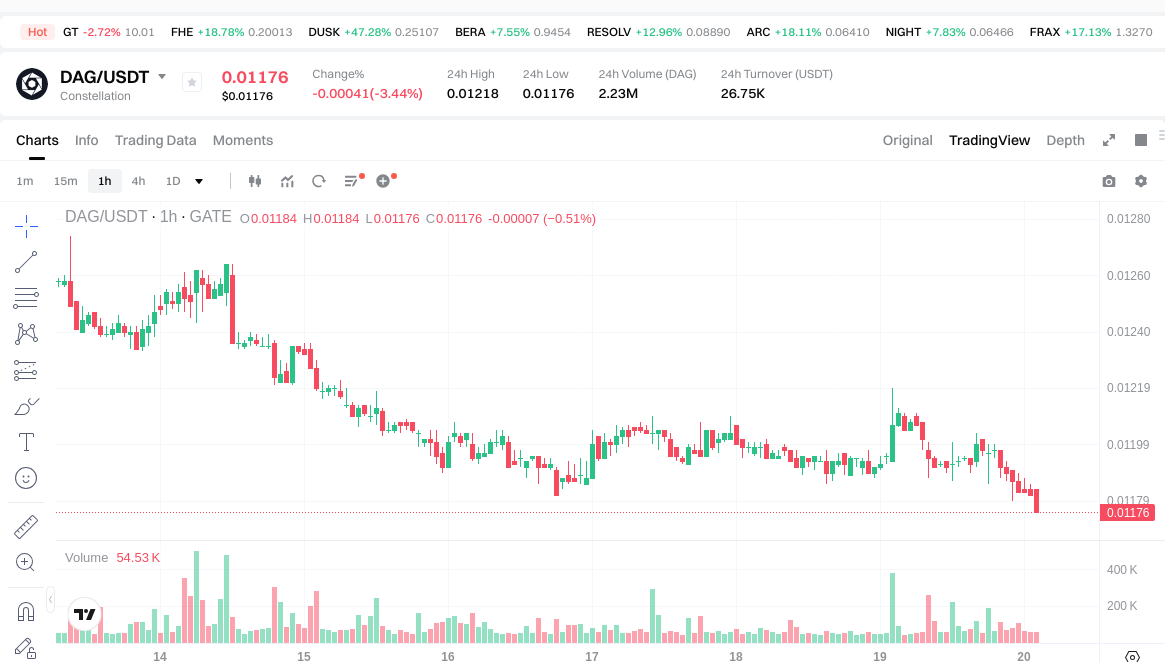
Constellation reached its all-time high of $0.451761 on August 26, 2021, during a period of broader cryptocurrency market expansion and increased interest in enterprise-grade blockchain solutions. The token's all-time low of $0.00110189 occurred on March 9, 2019, reflecting early-stage market conditions and limited adoption. As of the latest data, DAG is trading at $0.01181, showing a 24-hour decline of 2.15% and a one-year decrease of 83.14%. These price movements reflect shifting market sentiment, adoption trends, and evolving competitive dynamics in the blockchain infrastructure space.
Click to view the current DAG market price
On-Chain Metrics
- 24-Hour Trading Volume: $29,166.31 (indicating current market activity levels)
- Market Capitalization: $44,882,706.05 (reflecting the token's overall market valuation)
- Token Holders: 3,211 addresses (demonstrating the distribution of token ownership across the network)
- Market Dominance: 0.0013% (showing Constellation's position within the broader cryptocurrency market)
- Fully Diluted Valuation: $44,882,939.75 (representing the total market value if all tokens were in circulation)
Constellation Ecosystem Applications and Partners
Core Use Cases
Constellation's ecosystem supports multiple applications:
- Enterprise Data Management: Constellation network connects over 70 companies through its accelerator program, providing decentralized data infrastructure solutions.
- Web3 Infrastructure: Representative projects including Alkimi and Geojam, driving innovation in stakeholder economy and data entrepreneurship.
Strategic Partnerships
Constellation has established collaborations with companies like Dor and Traffic, enhancing its technology capabilities through recently launched currency analysis devices.
These partnerships provide a solid foundation for Constellation's ecosystem expansion.
Controversies and Challenges
Constellation faces the following challenges:
- Technical Complexity: Implementing asynchronous Extended Trust Chain and distributed operating systems across mobile clients as full nodes
- Market Competition: Competition from other blockchain infrastructure providers in the Web3 space
These issues have sparked discussions within the community and market, while also driving Constellation's continuous innovation.
Constellation's community shows vitality with 3,211 token holders and an active presence across multiple platforms.
On X platform, related posts and hashtags (such as #DAG and #Constellation) generate engagement.
New application launches and mainnet developments have ignited community enthusiasm.
Sentiment on X presents diverse perspectives:
- Supporters praise Constellation's hypergraph network architecture, two-tier consensus mechanism (L0 and L1), and scalability features, considering it as "next-generation blockchain infrastructure".
- Critics focus on price volatility and market performance challenges.
Recent trends show mixed sentiment with focus on technical capabilities.
Hot Topics
X users actively discuss Constellation's mainnet node operations, Web3 infrastructure development, and enterprise adoption,
showcasing both its transformative potential and the path toward mainstream adoption.
- Official Website: Visit Constellation Official Website for features, use cases, and latest updates.
- White Paper: Constellation White Paper details its technical architecture, goals, and vision.
- X Updates: On X platform, Constellation maintains an active presence through @conste11ation,
with posts covering technical upgrades, community activities, and partnership announcements.
Constellation Future Roadmap
- Ongoing Development: Continuous enhancement of hypergraph network and zero-layer protocol, improving speed and scalability performance
- Ecosystem Goals: Supporting enterprise-level applications and expanding Web3 infrastructure capabilities
- Long-term Vision: Becoming leading blockchain infrastructure for the stakeholder economy
How to Participate in Constellation?
- Purchase Channels: Buy DAG on Gate.com and other supporting exchanges
- Storage Solutions: Securely store using compatible wallets supporting DAG tokens
- Participate in Ecosystem: Engage with mainnet node operations and contribute to network maintenance
- Build on Platform: Visit developer resources to build applications on the Constellation network
Summary
Constellation redefines blockchain infrastructure through its innovative technology, providing scalability, security, and enterprise-grade solutions.
Its active community of over 3,200 holders, comprehensive resources, and unique hypergraph architecture distinguish it in the cryptocurrency space.
Despite facing market volatility and competitive pressures, Constellation's innovative spirit and clear development direction position it importantly in the future of decentralized technology.
Whether you are a newcomer or experienced participant, Constellation deserves attention and engagement.
FAQ
What is DAG (Directed Acyclic Graph) technology in cryptocurrency?
DAG is a data structure where each transaction builds upon previous ones without blocks. It enables faster transaction speeds, eliminates mining requirements, reduces fees significantly, and handles higher transaction volumes than traditional blockchain networks.
What is the difference between DAG technology and traditional blockchain?
DAG uses a directed acyclic graph structure instead of linear chains, enabling faster transaction processing and higher throughput. Unlike blockchain's sequential validation, DAG allows parallel transaction confirmation. However, DAG may have different security models and faces greater complexity in implementation compared to traditional blockchain architecture.
Which cryptocurrency projects use DAG technology?
Popular DAG-based cryptocurrencies include IOTA(MIOTA), which focuses on IoT applications, Nano, combining DAG with blockchain for fast zero-fee transactions, and BlockDAG for scalable solutions.
What are the advantages and disadvantages of DAG technology compared to blockchain?
DAG offers higher throughput and better scalability than blockchain. However, it faces greater decentralization challenges and potential security vulnerabilities in its consensus mechanisms.
How does DAG implement transaction confirmation and prevent double spending in cryptocurrency?
DAG confirms transactions by linking them together, with nodes verifying the entire path back to genesis. Double spending is prevented through path tracing and cumulative weight algorithms, ensuring funds cannot be spent twice across different branches.
* The information is not intended to be and does not constitute financial advice or any other recommendation of any sort offered or endorsed by Gate.