DAI is a decentralized stablecoin launched by MakerDAO in 2017, currently standing as the largest decentralized stablecoin on Ethereum with over $4.26 billion in market capitalization and 134,646 holders. Unlike centralized alternatives like USDT and USDC, DAI maintains its $1 USD peg through over-collateralized smart contracts and community governance, eliminating reliance on traditional intermediaries. The stablecoin operates on Ethereum's blockchain using advanced mechanisms including algorithmic stability and automated liquidation to ensure security and fairness. DAI serves critical functions across the DeFi ecosystem, powering lending protocols, decentralized exchanges, and payment solutions through platforms like Aave and Compound. This comprehensive guide explores DAI's technical architecture, market performance, ecosystem applications, and participation methods through Gate and other platforms, providing readers with essential insights into this cornerstone DeFi infrastructure asset.
Dai's Positioning and Significance
In 2017, MakerDAO launched Dai (DAI), aiming to address volatility and centralization issues in the cryptocurrency market.
As the largest decentralized stablecoin on Ethereum, Dai plays a critical role in decentralized finance (DeFi).
As of 2026, Dai has become a top-tier stablecoin with over $4.26 billion in market capitalization, with 134,646 holders and an active developer community.
This article will deeply analyze its technical architecture, market performance, and future potential.
Origin and Development History
Birth Background
Dai was created by MakerDAO in 2017, aiming to solve the volatility problem inherent in cryptocurrencies and the need for a decentralized stable value.
It was born during the rapid expansion of blockchain technology and growing demand for DeFi infrastructure, with the goal of providing economic freedom and opportunities through a low-volatility, mortgage-backed cryptocurrency pegged to the US dollar.
The launch of Dai brought new possibilities for DeFi protocols and users seeking stable value without centralized control.
Important Milestones
- 2017: Dai was officially launched, establishing the first decentralized stablecoin backed by cryptocurrency collateral.
- 2019: Multi-Collateral Dai (MCD) upgrade introduced support for multiple collateral types beyond ETH.
- 2020: Market capitalization growth as DeFi adoption accelerated, with Dai becoming integral to numerous protocols.
- 2021: Ecosystem expansion with hundreds of DeFi applications integrating Dai as a core asset.
With the support of MakerDAO community governance and the Maker Foundation, Dai continues to optimize its stability mechanisms, security, and real-world applications.
How Does Dai Work?
No Central Control
Dai operates on a decentralized network of smart contracts on the Ethereum blockchain, free from control by banks or governments.
These smart contracts and community governance validate operations, ensuring system transparency and attack resistance, granting users greater autonomy and enhancing network resilience.
Blockchain Foundation
Dai's infrastructure is built on Ethereum's public, immutable digital ledger that records every transaction.
Transactions are grouped into blocks and linked through cryptographic hashes to form a secure chain.
Anyone can view the records, establishing trust without intermediaries.
The system utilizes smart contracts deployed on Ethereum to manage collateralization and stability mechanisms.
Ensuring Fairness
Dai relies on Ethereum's Proof of Stake (PoS) consensus mechanism to validate transactions and prevent fraud such as double-spending.
Ethereum validators maintain network security through staking ETH and running validator nodes, earning rewards for their participation.
Dai's innovation includes over-collateralization and algorithmic stability mechanisms that maintain its peg to the US dollar.
Secure Transactions
Dai uses public-private key cryptography to protect transactions:
- Private keys (like secret passwords) are used to sign transactions
- Public keys (like account numbers) are used to verify ownership
This mechanism ensures fund security while transactions maintain pseudonymous privacy.
Additional security features include decentralized governance through MKR token holders and automated liquidation mechanisms to protect the system's solvency.
Circulation Overview
As of January 13, 2026, Dai's circulating supply stands at 4,258,749,418.30 tokens, with a total supply of 4,258,749,418.30 tokens. The circulating supply represents 100% of the total supply, indicating that all issued tokens are currently in circulation. Dai operates under a dynamic supply model managed by MakerDAO, where new tokens are minted through the creation of collateralized debt positions (CDPs) and burned when debt is repaid. This mechanism allows the supply to expand or contract based on market demand and user activity, directly influencing the supply-demand dynamics of the stablecoin.
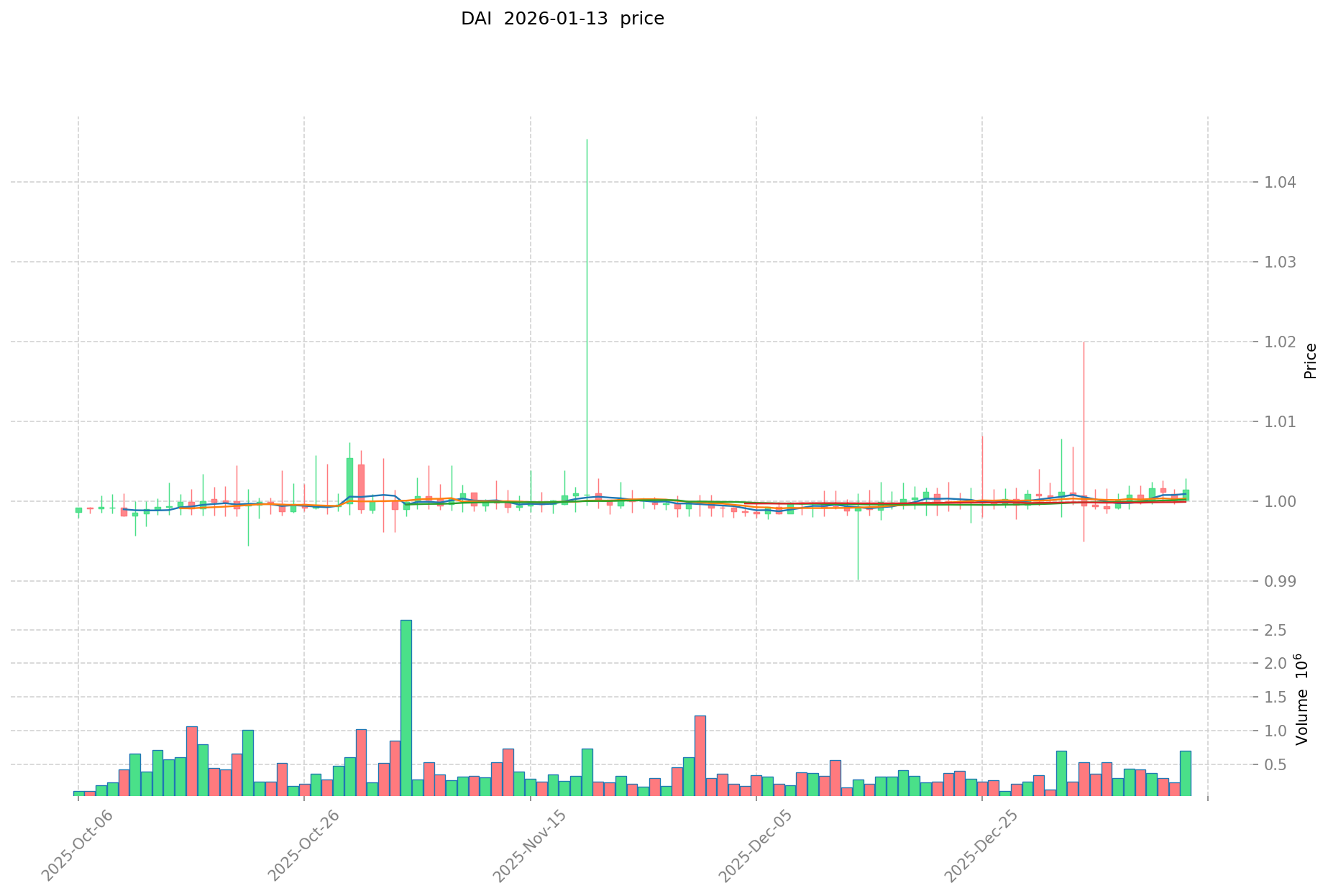
Price Volatility
Dai reached its historical high price of $1.22 on March 13, 2020, during a period of significant market volatility in the broader cryptocurrency ecosystem. This peak reflected heightened demand for stablecoins as investors sought safe-haven assets amid market uncertainty.
The lowest recorded price for Dai was $0.88196, occurring on March 11, 2023. This deviation from its $1.00 peg was influenced by market stress factors and temporary imbalances in the protocol's collateral mechanisms.
These price fluctuations, while relatively modest compared to volatile cryptocurrencies, reflect market sentiment shifts, adoption trends, and the effectiveness of MakerDAO's stability mechanisms in maintaining the peg.
Click to view current DAI market price
On-Chain Metrics
- Holder Count: As of the latest data, Dai has 134,646 unique holders, demonstrating widespread adoption and usage across the Ethereum ecosystem and other supported networks including Polygon.
- Trading Activity: The 24-hour trading volume stands at approximately $497,028.36, reflecting ongoing market activity and liquidity.
- Market Capitalization: Dai maintains a market capitalization of approximately $4.26 billion, securing its position as one of the leading decentralized stablecoins in the cryptocurrency market.
Dai Ecosystem Applications and Partners
Core Use Cases
Dai's ecosystem supports multiple applications:
- DeFi: Projects like Aave and Compound utilize Dai, providing decentralized lending and borrowing services.
- Payment Solutions: Dai serves as a stable medium of exchange, enabling low-volatility transactions across various platforms.
Strategic Partnerships
Dai has established collaborations with projects in the DeFi space, enhancing its technical capabilities and market presence.
These partnerships provide a solid foundation for Dai's ecosystem expansion.
Controversies and Challenges
Dai faces the following challenges:
- Technical Issues: Maintaining the peg stability during extreme market conditions
- Regulatory Risks: Evolving regulatory frameworks for stablecoins globally
- Competition Pressure: The emergence of other stablecoins and central bank digital currencies (CBDCs)
These issues have sparked discussions within the community and market, while also driving Dai's continuous innovation.
Dai's community remains active, with over 134,000 holders participating in the ecosystem.
On X platform, related posts and hashtags (such as #Dai and #MakerDAO) frequently gain traction.
New protocol updates and DeFi integrations continue to energize community participation.
Sentiment on X shows diverse perspectives:
- Supporters praise Dai's decentralization, transparency, and stability, recognizing it as "a cornerstone of DeFi infrastructure".
- Critics focus on collateralization risks and governance complexities.
Recent trends indicate steady confidence in Dai's role within decentralized finance.
Popular Topics
X users actively discuss Dai's collateral management, governance decisions, and adoption in DeFi protocols,
showcasing both its transformative potential and the challenges in achieving broader mainstream adoption.
- Official Website: Visit Dai Official Website for features, use cases, and latest updates.
- X Updates: On X platform, MakerDAO actively shares updates using @MakerDAO,
with posts covering protocol upgrades, community initiatives, and partnership announcements.
Dai Future Roadmap
- Ongoing Development: Continuous improvements to collateral types and risk management mechanisms
- Ecosystem Goals: Expanding Dai adoption across DeFi protocols and real-world payment applications
- Long-term Vision: Becoming a globally recognized decentralized stablecoin standard
How to Participate in Dai?
- Purchase Channels: Buy Dai on Gate.com and other major exchanges
- Storage Solutions: Securely store Dai using wallets like MetaMask or hardware wallets
- Participate in Governance: Engage in MakerDAO governance through voting on protocol proposals
- Build in the Ecosystem: Access MakerDAO documentation to develop DApps or contribute to the protocol
Summary
Dai redefines stablecoin functionality through blockchain technology, offering decentralization, transparency, and price stability.
Its active community, extensive resources, and solid market performance distinguish it within the cryptocurrency space.
Despite facing regulatory uncertainties and technical challenges, Dai's innovative approach and clear development path position it as a significant player in the future of decentralized finance.
Whether you're a newcomer or experienced participant, Dai merits attention and engagement.
FAQ
What is DAI? How does it maintain its 1 USD value as a stablecoin?
DAI is a decentralized stablecoin pegged to 1 USD through over-collateralized smart contracts in MakerDAO. Multiple cryptocurrencies like ETH and USDC serve as collateral, with community governance ensuring stability. DAI maintains its peg through algorithmic mechanisms and transparent on-chain processes.
What is the difference between DAI and other stablecoins like USDT and USDC?
DAI is decentralized and backed by crypto collateral through smart contracts, while USDT and USDC are centralized stablecoins pegged 1:1 to the US dollar. USDC offers transparent audits of dollar reserves, whereas DAI operates independently without relying on a single issuer.
How to obtain DAI? Which exchanges can I buy it from?
You can acquire DAI through decentralized exchanges like Uniswap and Kyber Network, or centralized platforms. Use credit cards, debit cards, or bank transfers to purchase DAI directly. Many major exchanges support DAI trading with competitive pricing and fast settlement.
What are the risks of DAI? What happens when collateral becomes insufficient?
DAI's main risks include unpredictable events affecting collateral assets. When collateral becomes insufficient, MKR automatically increases supply and repurchases funds from the market to maintain DAI stability.
What are the application scenarios of DAI in DeFi?
DAI serves as a stable collateral in lending protocols, enables decentralized trading, facilitates liquidity mining, supports smart contracts, and provides stable value storage across DeFi platforms.
What is MakerDAO? What is its relationship with DAI?
MakerDAO is a decentralized lending protocol on Ethereum blockchain. Users deposit approved crypto assets as collateral to generate DAI, a stablecoin pegged to the US dollar. DAI's stability is maintained through over-collateralization and smart contract mechanisms.
* The information is not intended to be and does not constitute financial advice or any other recommendation of any sort offered or endorsed by Gate.