This comprehensive guide explores deBridge (DBR), a decentralized cross-chain liquidity infrastructure launched in 2021 to solve DeFi's liquidity fragmentation challenges. The article examines DBR's positioning as "DeFi's internet of liquidity" and its evolution to 89,192 holders by 2026. It details the technical architecture including decentralized node networks, blockchain-based transaction validation, and cryptographic security mechanisms that eliminate traditional liquidity pool bottlenecks. The guide covers market performance metrics showing DBR trading at $0.01785 with a $32.13 million market cap, alongside on-chain statistics and price volatility trends since its October 2024 Gate.com launch at $0.03. Strategic sections analyze ecosystem applications, cross-chain DeFi use cases, community engagement on social platforms, and investment participation options. The article addresses technical complexity challenges while highlighting DBR's innovative approach to enabling seamless asset transfers with deep l
deBridge's Positioning and Significance
In 2021, the deBridge team launched deBridge (DBR), aiming to address liquidity fragmentation and inefficient cross-chain asset transfers in the DeFi ecosystem.
As DeFi's internet of liquidity, deBridge plays a critical role in decentralized finance and cross-chain interoperability.
As of 2026, deBridge has established itself as a key infrastructure provider for cross-chain liquidity, with 89,192 holders and an active developer community.
This article will provide an in-depth analysis of its technical architecture, market performance, and future potential.
Origins and Development History
Birth Background
deBridge was created by its development team in 2021, aiming to solve liquidity pool bottlenecks and risks in cross-chain DeFi interactions.
It emerged during the rapid expansion of multi-chain ecosystems, with the goal of enabling real-time movement of assets and information across the DeFi landscape through deep liquidity, tight spreads, and guaranteed rates.
The launch of deBridge brought new possibilities for DeFi users and protocols requiring seamless cross-chain interactions.
Important Milestones
- October 2024: DBR token launched on Gate.com at a price of $0.03, expanding community participation and liquidity.
- December 2024: Token reached a notable price level of $0.05764, demonstrating strong market interest.
- 2026: The platform continues to support cross-chain interactions across the DeFi ecosystem, with holders growing to 89,192.
With community and ecosystem development support, deBridge continues to optimize its technology, security, and real-world applications.
How deBridge Works
No Central Control
deBridge operates on a decentralized network of nodes distributed globally, free from control by banks or governments.
These nodes collaborate to validate cross-chain transactions, ensuring system transparency and attack resistance, granting users greater autonomy and improving network resilience.
Blockchain Core
deBridge's infrastructure leverages blockchain technology as a public, immutable digital ledger for recording cross-chain operations.
Transactions are grouped and processed through cryptographic mechanisms to form a secure chain.
Anyone can verify records without intermediaries, establishing trustless interactions.
The protocol's design eliminates traditional liquidity pool bottlenecks, enabling more efficient cross-chain asset movement.
Ensuring Fairness
deBridge employs a decentralized validation mechanism to verify transactions and prevent fraudulent activities such as double-spending.
Network validators maintain network security through operating nodes and validating cross-chain messages, receiving DBR rewards for their contributions.
Its innovation includes enabling cross-chain interactions without liquidity pool limitations, supporting deep liquidity and guaranteed rates.
Secure Transactions
deBridge uses cryptographic technology to protect cross-chain transactions:
- Private keys (like secret passwords) are used to sign transactions
- Public keys (like account numbers) are used to verify ownership
This mechanism ensures fund security while maintaining transaction pseudonymity.
The protocol implements additional security features to protect cross-chain message passing and asset transfers.
Circulation Overview
As of January 21, 2026, deBridge (DBR) has a circulating supply of 1.8 billion tokens, with a total supply of 10 billion tokens. The maximum supply is capped at 10 billion tokens, establishing a fixed supply model.
The current circulating supply represents 18% of the total supply, indicating a controlled token release strategy that may influence supply and demand dynamics over time.
Price Volatility
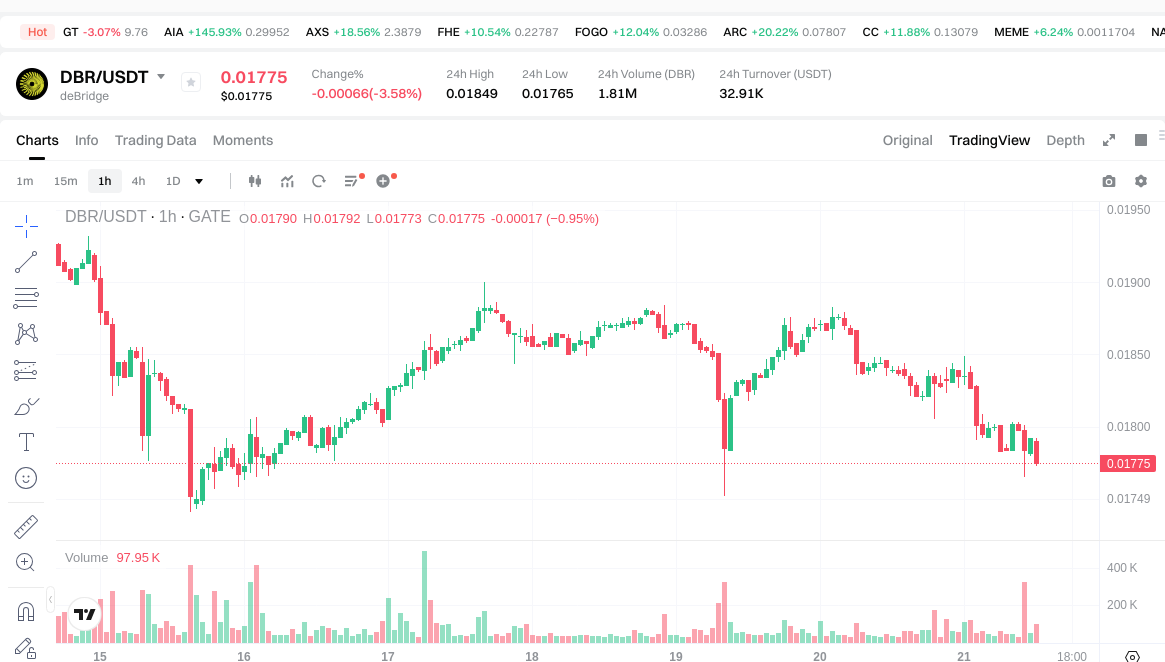
DBR reached its peak price of $0.05764 on December 22, 2024, reflecting positive market sentiment during that period. The token experienced its lowest price of $0.005 on October 17, 2024, shortly after its market debut.
As of the latest update, DBR is trading at $0.01785, showing price fluctuations influenced by market conditions and adoption trends. The 24-hour trading range spans from $0.01765 to $0.01849, with recent price movements showing a decline of 3.04% over the past 24 hours and 7.85% over the past 7 days.
Click to view the current DBR market price
On-Chain Metrics
- Market Capitalization: $32.13 million (reflecting current circulating supply valuation)
- Fully Diluted Market Cap: $178.5 million (based on maximum supply)
- 24-Hour Trading Volume: $32,100.76 (indicating current market activity)
- Holder Count: 89,192 addresses (demonstrating community distribution)
- Market Dominance: 0.0056% (representing DBR's share in the overall crypto market)
deBridge (DBR) Ecosystem Applications and Partners
Core Use Cases
deBridge's ecosystem supports multiple applications:
- Cross-Chain DeFi: deBridge enables seamless asset and information transfer across different blockchain networks, providing decentralized liquidity solutions without traditional liquidity pool bottlenecks.
- Interoperability Infrastructure: The protocol facilitates cross-chain interactions with deep liquidity, tight spreads, and guaranteed rates, supporting various DeFi protocols in achieving multi-chain operations.
Strategic Partnerships
deBridge continues to expand its ecosystem through strategic collaborations, enhancing its technical capabilities and market presence.
These partnerships provide a solid foundation for deBridge's ecosystem expansion.
Challenges and Considerations
deBridge faces several challenges:
- Technical Complexity: Cross-chain interoperability remains a complex technical challenge requiring continuous innovation
- Market Competition: The cross-chain bridge sector faces intense competition from various blockchain interoperability solutions
- Security Considerations: As with all cross-chain protocols, maintaining robust security measures is an ongoing priority
These challenges drive deBridge's continuous innovation and improvement.
deBridge's community demonstrates notable activity, with 89,192 token holders as of January 21, 2026.
The protocol's focus on cross-chain liquidity solutions has attracted developers and DeFi enthusiasts.
On X platform, the community discusses various aspects of deBridge:
- Supporters praise deBridge's innovative approach to cross-chain liquidity and its ability to eliminate liquidity pool risks, viewing it as "DeFi's internet of liquidity".
- Observers monitor price movements and ecosystem development progress.
Recent trends show active community engagement around cross-chain DeFi developments.
Popular Topics
X users actively discuss deBridge's cross-chain technology, liquidity solutions, and DeFi integration capabilities,
demonstrating both its innovation potential and the challenges of cross-chain infrastructure development.
- Official Website: Visit deBridge Official Website for features, use cases, and latest developments.
- Documentation: deBridge Documentation provides detailed technical architecture, objectives, and vision.
- X Platform: deBridge maintains an active presence on X via @deBridgeFinance,
sharing updates on technical developments, community initiatives, and ecosystem partnerships.
deBridge (DBR) Future Roadmap
- Ecosystem Goals: Expand cross-chain liquidity solutions and enhance interoperability across multiple blockchain networks
- Long-term Vision: Establish itself as the infrastructure layer for seamless cross-chain DeFi interactions
How to Participate in deBridge (DBR)?
- Purchase Options: DBR tokens are available on Gate.com and other cryptocurrency exchanges
- Storage Solutions: DBR tokens can be stored in compatible Solana wallets
- Ecosystem Participation: Visit deBridge Documentation to explore integration opportunities or contribute to the ecosystem
- Track Contract: Monitor the token at Solana Explorer
Summary
deBridge (DBR) redefines cross-chain liquidity through blockchain technology, providing seamless asset transfer, deep liquidity, and efficient cross-chain interactions.
Its innovative approach to eliminating liquidity pool bottlenecks and active community make it stand out in the cross-chain infrastructure sector.
Despite facing technical complexity and market competition, deBridge's innovative spirit and clear focus on cross-chain interoperability position it importantly in the future of decentralized finance.
Whether you're a newcomer or experienced participant, deBridge deserves attention as a key infrastructure provider in the multi-chain DeFi landscape.
FAQ
What is DBR and how does it work in the cryptocurrency ecosystem?
DBR is a decentralized finance token designed to facilitate debt repayment mechanisms within blockchain networks. It operates through smart contracts, enabling users to manage obligations transparently while earning yields through protocol participation and collateral staking.
What are the main use cases and features of DBR token?
DBR token serves as the core utility for the Dodo protocol ecosystem, enabling governance participation, transaction fee discounts, and liquidity incentives. It facilitates decentralized trading, provides staking rewards, and supports protocol development through community governance mechanisms.
How can I buy, store, and trade DBR cryptocurrency?
You can purchase DBR on major crypto platforms using fiat or other digital assets. Store DBR securely in hardware wallets or trusted custodial solutions. Trade DBR on decentralized exchanges or over-the-counter markets for liquidity and flexibility.
What are the risks and security considerations when investing in DBR?
DBR investments carry market volatility risks and smart contract risks. Secure your private keys, use reputable wallets, enable two-factor authentication, and only invest capital you can afford to lose. Always conduct thorough research before investing.
How does DBR compare to other similar cryptocurrencies or tokens?
DBR distinguishes itself through unique tokenomics, deflationary mechanisms, and strong community governance. It offers superior transaction efficiency and lower fees compared to traditional tokens, with innovative staking rewards that provide competitive returns in the DeFi ecosystem.
DBR features a fixed total supply of 250 million tokens. The tokenomics include allocation for community rewards, staking incentives, and development fund. Token distribution occurs over multiple phases to ensure stable market conditions and long-term ecosystem growth.
* The information is not intended to be and does not constitute financial advice or any other recommendation of any sort offered or endorsed by Gate.