DeepBook (DEEP) is a next-generation decentralized central limit order book (CLOB) built on the Sui blockchain, addressing inefficiencies in traditional AMM liquidity provision. Launched in October 2024, it has evolved into foundational liquidity infrastructure for Sui DeFi with over 46,500 holders. This comprehensive guide explores DeepBook's technical architecture leveraging Sui's parallel execution for sub-second latency, its market performance with 2.5 billion circulating tokens, and real-world applications in high-performance decentralized trading. The article examines ecosystem partnerships, community engagement, and growth strategies while addressing adoption challenges and competitive dynamics. Whether you're a trader seeking deep liquidity, a liquidity provider optimizing returns, or a developer building DeFi applications, this guide provides essential insights into participating in DeepBook's ecosystem and understanding its strategic position within Sui's financial infrastructure on Gate exchange.
DeepBook's Positioning and Significance
In 2024, the DeepBook team launched DeepBook (DEEP), aiming to address inefficiencies in decentralized exchange liquidity provision and limited control for liquidity providers in traditional AMM models.
As a next-generation decentralized central limit order book (CLOB) built on Sui, DeepBook plays a key role in DeFi trading and liquidity provision.
As of 2026, DeepBook has become a foundational liquidity infrastructure within the Sui DeFi ecosystem, with over 46,500 holders and an active developer community.
This article will provide an in-depth analysis of its technical architecture, market performance, and future potential.
Origin and Development Journey
Background of Creation
DeepBook was created by the DeepBook team in 2024, aiming to solve inefficiencies in on-chain trading execution and the limitations of automated market maker models for sophisticated liquidity provision.
It emerged in the context of growing demand for high-performance DeFi infrastructure, with the goal of delivering deep and tight liquidity through advanced order book architecture.
The launch of DeepBook brought new possibilities for decentralized trading and institutional-grade liquidity provision.
Key Milestones
- October 2024: Mainnet launch with initial price of $0.005, introducing CLOB architecture on Sui blockchain.
- October 2024: Achieved all-time low price of $0.005263 on October 14.
- January 2025: Reached all-time high of $0.34572 on January 18, marking significant market recognition.
- 2025-2026: Ecosystem expansion with integration across Sui DeFi protocols, establishing position as premier wholesale liquidity venue.
With support from the Sui Foundation and the broader Sui ecosystem, DeepBook continues to optimize its technology, security, and real-world applications.
How DeepBook Works?
No Central Control
DeepBook operates on the decentralized Sui blockchain network distributed globally across nodes, independent of banks or government control.
These nodes collaborate to validate transactions, ensuring system transparency and attack resistance, granting users greater autonomy and enhancing network resilience.
Blockchain Core
DeepBook's blockchain is a public, immutable digital ledger recording every transaction.
Transactions are grouped into blocks and linked through cryptographic hashes to form a secure chain.
Anyone can view the records, establishing trust without intermediaries.
Leveraging Sui's parallel execution architecture further enhances performance and sub-second latency.
Ensuring Fairness
DeepBook operates on Sui's consensus mechanism to validate transactions and prevent fraudulent activities such as double-spending.
Validators maintain network security through running nodes and processing transactions on the Sui network, earning rewards.
Its innovations include leveraging Sui's high throughput and low transaction fees for superior on-chain trading performance.
Secure Transactions
DeepBook utilizes public-private key cryptography to protect transactions:
- Private keys (similar to secret passwords) are used to sign transactions
- Public keys (similar to account numbers) are used to verify ownership
This mechanism ensures fund security while transactions maintain transparency on the public blockchain.
The order book architecture provides enhanced control over price orders compared to traditional AMM models, offering sophisticated liquidity providers better execution capabilities.
Circulation Overview
As of January 17, 2026, DeepBook (DEEP) has a circulating supply of 2.5 billion tokens, with a total supply of 10 billion DEEP tokens. The maximum supply is capped at 10 billion tokens, representing a fixed supply model.
The current circulation ratio stands at 25%, indicating that three-quarters of the total supply has yet to enter circulation. This controlled release mechanism may influence the token's supply-demand dynamics over time.
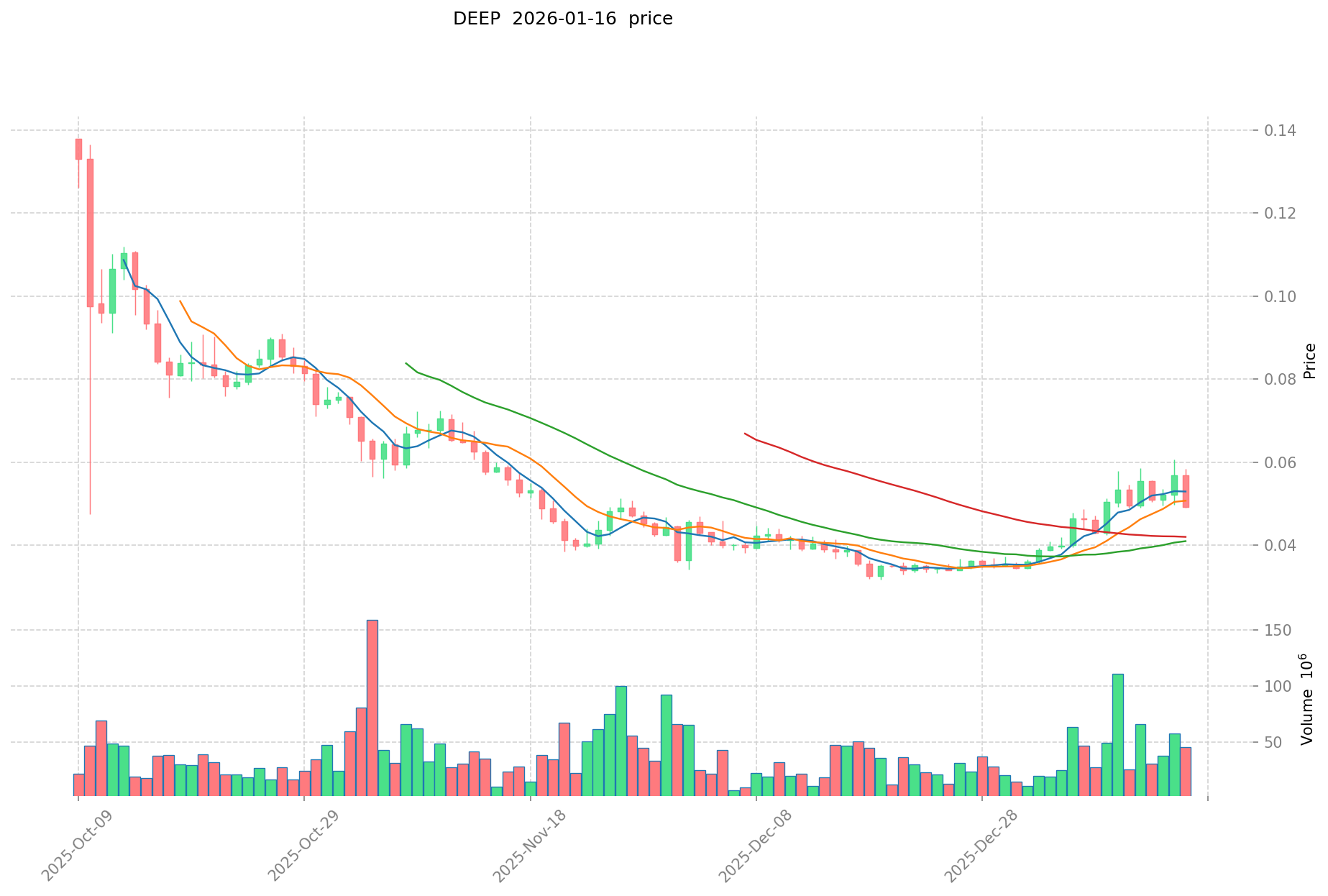
Price Fluctuation
DeepBook (DEEP) reached a notable price level of $0.34572 on January 18, 2025, driven by market momentum following its recent launch and initial trading activity.
The token's lowest recorded price was $0.005263, occurring on October 14, 2024, shortly after its public debut on October 13, 2024, reflecting typical early-stage price discovery volatility.
These price movements illustrate the market's response to the project's development, liquidity provision capabilities, and broader sentiment within the Sui ecosystem.
Click to view the current DEEP market price
On-Chain Metrics
- Holder Count: Approximately 46,558 addresses hold DEEP tokens, demonstrating growing community participation
- Trading Volume (24H): $2.45 million, indicating active market engagement
- Blockchain Infrastructure: Built on the Sui network, leveraging parallel execution capabilities and sub-second transaction finality
DeepBook Ecosystem Applications and Partners
Core Use Cases
DeepBook's ecosystem supports multiple applications:
- DeFi: As a decentralized central limit order book (CLOB), DeepBook provides high-performance on-chain trading with deep liquidity for sophisticated traders and liquidity providers.
- Liquidity Infrastructure: DeepBook serves as the foundational wholesale liquidity venue for Sui DeFi, enabling efficient price execution for various financial services across the ecosystem.
Strategic Partnerships
DeepBook is positioned as the premier liquidity infrastructure within the Sui ecosystem, powering broad financial services and DeFi applications.
These integrations provide a solid foundation for DeepBook's ecosystem expansion.
Challenges and Controversies
DeepBook faces the following challenges:
- Technical Considerations: Ensuring consistent liquidity depth and maintaining competitive spreads in a developing ecosystem
- Market Competition: Competing with established AMM models and other order book protocols in the DeFi space
- Adoption Dynamics: Building sufficient trading volume and liquidity provider participation to achieve network effects
These challenges drive ongoing innovation and community engagement within the DeepBook ecosystem.
DeepBook's community demonstrates growing activity, with 46,558 holders as of January 2026.
On X platform, discussions around DeepBook and related hashtags generate consistent engagement.
The protocol's integration with Sui DeFi has generated interest among traders and liquidity providers.
Sentiment on X shows diverse perspectives:
- Supporters praise DeepBook's order book architecture, precise price control, and suitability for sophisticated liquidity strategies, viewing it as infrastructure for advanced DeFi trading.
- Critics focus on early-stage adoption challenges and competition from established protocols.
Recent trends reflect interest in the protocol's technical capabilities and position within Sui DeFi.
Popular Topics
X users discuss DeepBook's order book model advantages, liquidity provision strategies, and integration potential,
showcasing both its innovation and the opportunities for ecosystem growth.
- Official Website: Visit DeepBook Official Site for features, use cases, and latest updates.
- Whitepaper: The DeepBook Whitepaper details its technical architecture, objectives, and vision.
- X Updates: DeepBook maintains an active presence on X via @DeepBookonSui,
with posts covering protocol updates, liquidity metrics, and ecosystem integrations.
DeepBook Future Roadmap
- Ongoing Development: Enhance order matching efficiency and liquidity aggregation, improving trading performance and user experience
- Ecosystem Goals: Expand integration with Sui DeFi protocols and support sophisticated trading strategies
- Long-term Vision: Establish position as the primary liquidity layer for Sui's financial ecosystem
How to Participate in DeepBook?
- Purchase Options: Acquire DEEP tokens on Gate.com and other supported exchanges
- Storage Solutions: Use Sui-compatible wallets for secure token storage
- Liquidity Provision: Participate as a liquidity provider through the DeepBook protocol interface
- Ecosystem Building: Visit the official documentation to explore integration opportunities and protocol features
Summary
DeepBook redefines decentralized trading through its central limit order book architecture, offering precise price control, deep liquidity, and efficient execution on the Sui blockchain.
Its strategic position within Sui DeFi, technical innovation, and growing adoption demonstrate its potential in the ecosystem.
Despite facing adoption and competition challenges, DeepBook's sophisticated trading model and integration capabilities position it as important infrastructure in decentralized finance.
Whether you're a trader, liquidity provider, or protocol developer, DeepBook represents an interesting development in on-chain trading technology.
FAQ
What is crypto DEEP and what does it do?
Crypto DEEP is a decentralized exchange with a fully on-chain order book, delivering high-throughput and low latency trading. It provides a CEX-like trading experience with enhanced security and transparency on blockchain.
How can I buy or acquire DEEP tokens?
You can acquire DEEP tokens through various platforms by selecting DEEP, choosing your preferred payment method, and receiving tokens directly in your wallet. Check available exchanges and payment options for your region.
What is the total supply and tokenomics of DEEP?
DEEP has a total supply of 996.39 million tokens with 996.39 million in circulating supply. The fully diluted valuation stands at $71.04K, reflecting its current market positioning in the crypto ecosystem.
What are the main use cases and applications of DEEP?
DEEP enables decentralized AI model training, data monetization, and privacy-preserving machine learning. It supports smart contracts for autonomous decision-making, serves as infrastructure for Web3 applications, and facilitates trustless collaboration between data providers and AI developers across distributed networks.
Is DEEP a legitimate project and what are the associated risks?
DEEP is a blockchain platform integrating AI with Web3 technology. Legitimacy can be verified through official channels. Risks include market volatility and regulatory changes in the crypto sector.
How does DEEP differ from other similar cryptocurrency projects?
DEEP focuses on decentralized physical infrastructure networks (DePIN) and edge computing solutions. It stands out through its blockchain-integrated approach to scalable, community-driven infrastructure, unique tokenomics incentivizing participation, and real-world utility in decentralized cloud services.
* The information is not intended to be and does not constitute financial advice or any other recommendation of any sort offered or endorsed by Gate.