DEXE is a decentralized portfolio management platform launched in 2020 to revolutionize DeFi trading through trustless strategy replication and autonomous asset management. Built on Ethereum as an ERC-20 token, DEXE eliminates custody risks by connecting traders with investors without requiring private key sharing. The platform features innovative tokenomics with a deflationary buyback mechanism, DAO governance participation, and insurance staking capabilities. With 3,025 token holders and listings on 22 exchanges including Gate, DEXE addresses critical DeFi challenges through transparent, secure transactions powered by smart contracts. This comprehensive guide explores DEXE's technical architecture, market performance, ecosystem applications, and how participants can engage with decentralized finance's most promising portfolio management solution.
DeXe's Position and Significance
In 2020, the DeXe Network team launched DeXe (DEXE), aiming to address the lack of decentralized interconnection between users and successful traders within the DeFi framework, as well as security risks in portfolio management.
As a decentralized and autonomous cryptocurrency portfolio platform, DeXe plays a key role in DeFi trading and asset management.
As of 2026, DeXe has established itself as a notable asset in the DeFi ecosystem, with a circulating supply of approximately 46.67 million tokens and an active community of holders. The platform continues to evolve with its governance-driven approach.
This article will provide an in-depth analysis of its technical architecture, market performance, and future potential.
Origin and Development History
Background
DeXe was created by the DeXe Network team in 2020, aiming to solve the absence of secure, decentralized connections between cryptocurrency traders and investors, as well as risks associated with sharing private keys and APIs with third parties.
It emerged during the rapid expansion of decentralized finance, with the goal of providing a trustless environment for portfolio management and automated rebalancing to transform the landscape.
The launch of DeXe brought new possibilities for DeFi participants seeking transparent and autonomous trading solutions.
Key Milestones
- 2020: Platform launch, implementing autonomous smart contracts for portfolio management and automatic rebalancing.
- 2021: Market recognition with price appreciation, expanding the user base and holder community.
- Ongoing: Ecosystem development with continuous improvements to governance mechanisms and platform functionality.
- Present: The platform maintains over 3,000 token holders and listings on 22 exchanges.
With support from its community and governance participants, DeXe continues to refine its technical infrastructure, security features, and real-world applications.
How DeXe Works?
Decentralized Control
DeXe operates on a decentralized network powered by smart contracts, eliminating reliance on centralized intermediaries or traditional financial institutions.
These smart contracts autonomously execute portfolio management functions, ensuring transparency and reducing counterparty risk, thereby granting users greater control and enhancing system resilience.
Blockchain Foundation
DeXe is built as an ERC-20 token on the Ethereum blockchain, leveraging a public, immutable digital ledger that records all transactions.
Transactions are grouped into blocks and cryptographically linked to form a secure chain.
Anyone can verify records without requiring intermediaries, establishing trustless interactions.
The platform utilizes Ethereum's established infrastructure for security and interoperability.
Governance and Consensus
DeXe employs a governance model where DEXE token holders can vote on network decisions and must hold DEXE to participate in the DAO.
The platform operates within Ethereum's Proof of Stake consensus mechanism, which validates transactions and prevents fraudulent activities.
Participants maintain network integrity through token holding and voting, with innovative features including automated buyback mechanisms where 30% of trader commissions are used to purchase tokens from the market—one-third burned, one-third sent to the vault, and one-third distributed to DEXE holders.
Secure Transactions
DeXe utilizes public-private key cryptography to protect transactions:
- Private keys (similar to secret passwords) are used to authorize transactions
- Public keys (similar to account numbers) are used to verify ownership
This mechanism ensures fund security while maintaining transaction pseudonymity on the blockchain.
Additionally, the platform offers an insurance mechanism where users can stake up to 10% of their capital value in DEXE tokens to hedge against potential losses, providing an extra layer of protection.
Circulation Overview
As of January 16, 2026, DeXe's circulating supply stands at 46,673,279.55 tokens, with a total supply of 96,504,599.34 tokens. The token operates under a deflationary model through its buyback and burn mechanism.
New tokens enter the market through the platform's reward distribution system, where 30% of trading commissions are used to automatically buy back DEXE tokens from the market. Of these buybacks, one-third are burned, one-third are sent to the treasury vault, and one-third are distributed to DEXE holders, creating a balanced supply dynamic that affects market demand.
Price Fluctuations
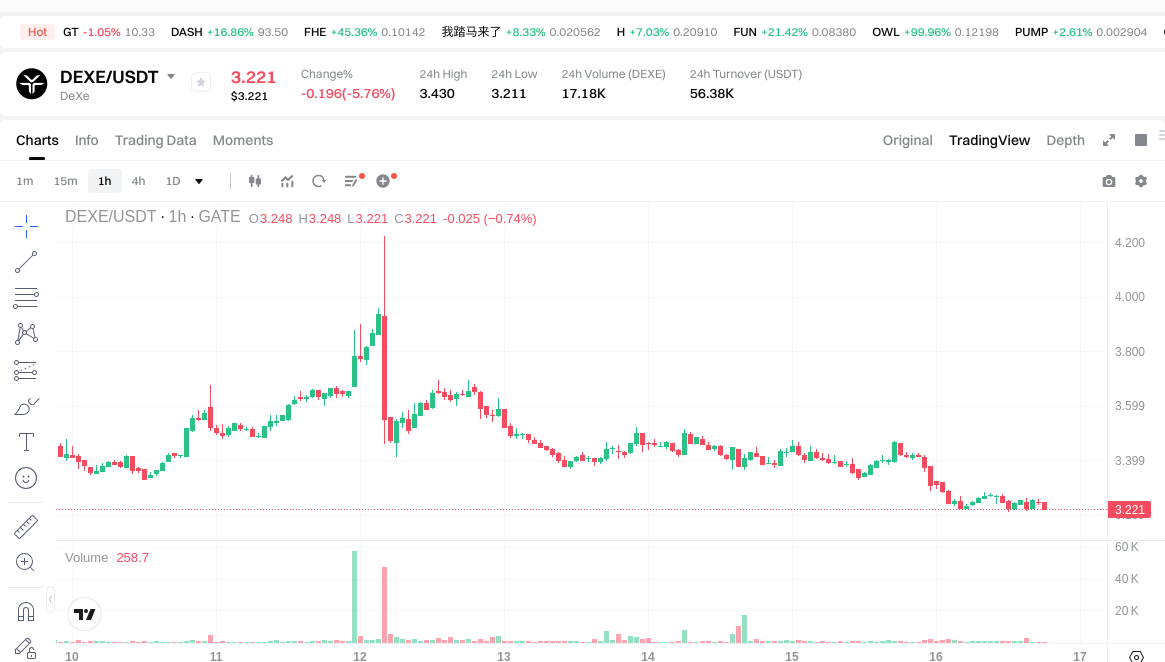
DeXe reached a notable price point of $32.38 on March 8, 2021, driven by the broader DeFi market expansion and increased interest in decentralized trading platforms.
The token's lowest recorded price was $0.671563 on November 7, 2020, reflecting the early-stage market conditions and limited adoption during the project's initial phase.
These price movements demonstrate the impact of market sentiment, DeFi sector trends, and the platform's development progress on token valuation.
Click to view the current DEXE market price
On-Chain Metrics
- Token Holders: 3,025 addresses (indicating community participation levels)
- Circulating Supply Ratio: 47.17% of total supply (reflecting token distribution status)
- 24-Hour Trading Volume: $56,452.35 (demonstrating market liquidity and trading activity)
DeXe Ecosystem Applications and Partners
Core Use Cases
DeXe's ecosystem supports multiple applications:
- DeFi: DeXe.network provides decentralized portfolio management, enabling users to follow successful traders' strategies without transferring private keys or API access to third parties.
- Governance: DEXE token holders participate in DAO governance, voting on network decisions and protocol upgrades.
- Trading Infrastructure: The platform offers automatic rebalancing tools and virtual currency allocation mechanisms for optimized portfolio management.
Strategic Partnerships
DeXe operates within the broader Ethereum ecosystem, leveraging ERC-20 standard compatibility to integrate with various DeFi protocols and decentralized applications.
These connections provide a foundation for DeXe's ecosystem expansion.
Controversies and Challenges
DeXe faces the following challenges:
- Technical considerations: As an ERC-20 token, scalability depends on Ethereum network performance and gas fee fluctuations
- Market competition: Competition from other decentralized portfolio management platforms and social trading solutions
- Adoption barriers: Educating users about decentralized trading strategies andDAO participation mechanisms
These issues have sparked discussions within the community and driven continuous innovation at DeXe.
DeXe's community demonstrates growing interest, with approximately 3,025 token holders as of January 2026.
On X platform, discussions around #DEXE focus on portfolio management strategies and governance proposals.
Announcements of token buyback mechanisms and insurance features have generated community enthusiasm.
Sentiment on X shows varied perspectives:
- Supporters praise DeXe's innovative approach to decentralized portfolio management and the token's deflationary buyback mechanism, recognizing it as a solution for safe strategy replication without custody risks.
- Critics focus on price volatility and the complexity of understanding the platform's commission structure.
Recent trends reflect discussions about the token's utility in DAO governance and insurance staking.
Trending Topics
X users actively discuss DeXe's tokenomics model, particularly the automated buyback system where one-third of collected fees are burned, one-third sent to the vault, and one-third distributed to DEXE holders,
showcasing both its innovative economic design and the learning curve for new participants.
- Official Website: Visit DeXe official website for features, use cases, and latest updates.
- X Updates: On X platform, DeXe maintains active presence through @DexeNetwork,
posting content about platform upgrades, trading strategy insights, governance proposals, and community initiatives.
DeXe Future Roadmap
Based on available information, DeXe continues to develop its decentralized portfolio management infrastructure and governance mechanisms.
The platform's ongoing focus includes enhancing user experience in strategy replication and expanding DAO participation features.
How to Participate in DeXe?
- Purchase Channels: Buy DEXE on Gate.com and other cryptocurrency exchanges
- Storage Solutions: Store securely using Ethereum-compatible wallets such as MetaMask or hardware wallets
- Participate in Governance: Engage in DAO decisions by holding DEXE tokens and participating in voting processes
- Explore the Platform: Visit the official website to understand trading strategies and portfolio management tools
Summary
DeXe redefines decentralized portfolio management through blockchain technology, offering transparency, security, and commission-based rewards for successful traders.
Its active community, unique tokenomics model, and focus on eliminating custody risks distinguish it in the cryptocurrency landscape.
Despite facing market competition and adoption challenges, DeXe's innovative approach to social trading and clear value proposition position it as a noteworthy project in decentralized finance.
Whether you are a beginner or experienced trader, DeXe presents an interesting approach to portfolio management worth exploring.
FAQ
What is DEXE and what does it do?
DEXE is a universal governance layer for blockchain ecosystems governed by the DEXE token. It solves DAO governance challenges through expertise-driven voting, AI integration, and incentive mechanisms that encourage participation and decentralization across various use cases including meme coins, AI automation, RWA, and DeSci.
How do I buy and store DEXE tokens?
Purchase DEXE tokens using a centralized exchange with debit/credit card or bank transfer. After buying, transfer them to a secure wallet for storage. For maximum security, consider using a hardware wallet to hold your tokens offline.
What is the use case and tokenomics of DEXE?
DEXE powers decentralized trading and liquidity provision. Its tokenomics feature deflationary mechanisms with token burns, reward systems for liquidity providers and traders, and designed supply reduction to enhance long-term value.
Is DEXE safe and what are the risks associated with it?
DEXE carries significant risks including high volatility, token unlock pressure, and price instability. The token experienced substantial price decline in June 2025. Investors should be aware of these factors before participation.
What is the difference between DEXE and other DeFi protocols?
DEXE specializes in decentralized exchange and peer-to-peer trading without intermediaries, while other DeFi protocols offer broader services like lending, borrowing, and yield farming. DEXE prioritizes liquidity efficiency and direct market access.
* The information is not intended to be and does not constitute financial advice or any other recommendation of any sort offered or endorsed by Gate.