This comprehensive guide explores DigiByte (DGB), an established UTXO-based blockchain launched in 2014 by Jared Tate to address scalability and transaction speed limitations. DGB distinguishes itself through innovative multi-algorithm mining support (SHA256, Scrypt, Skein, Qubit, Odocrypt), enhancing network security and decentralization. The article examines DigiByte's technical architecture, including its Proof-of-Work consensus mechanism, SegWit implementation, and cryptographic security features. It covers market performance metrics, ecosystem applications, and community engagement trends. Suitable for blockchain enthusiasts, investors, and developers seeking in-depth insights, this guide provides essential information about DGB's position in the cryptocurrency market, real-world use cases for decentralized payments, and its continuous development trajectory on Gate exchange and beyond.
DigiByte's Positioning and Significance
In 2014, creator Jared Tate launched DigiByte (DGB), aiming to address scalability limitations and transaction speed bottlenecks in early blockchain networks.
As one of the longest-running UTXO-based blockchains with multi-algorithm mining support, DigiByte plays a key role in decentralized payments and secure digital asset transfers.
As of 2026, DigiByte has evolved into an established blockchain infrastructure project, with an active community and continuous development efforts.
This article will provide an in-depth analysis of its technical architecture, market performance, and future potential.
Origin and Development History
Birth Background
DigiByte was created by Jared Tate in 2014, aiming to solve scalability and speed limitations in Bitcoin's blockchain design.
It emerged during the early blockchain expansion era, with the goal of providing faster, more secure, and decentralized payment solutions to improve upon existing systems.
DigiByte's launch brought new possibilities to individuals and businesses seeking efficient blockchain-based transactions.
Key Milestones
- 2014: Mainnet launch on January 10, achieving 15-second block times and multi-algorithm mining support.
- 2017: SegWit activation enabled improved transaction capacity and laid groundwork for smart contract compatibility.
- 2019: DigiAssets protocol introduction allowed tokenization and digital asset issuance on the DigiByte blockchain.
- 2024: Continued ecosystem development with enhanced security protocols and ongoing community-driven improvements.
With community and foundation support, DigiByte continues to optimize its technology, security, and real-world applications.
How DigiByte Works
No Central Control
DigiByte operates on a decentralized network of computers (nodes) distributed globally, free from bank or government control.
These nodes collaborate to verify transactions, ensuring the system remains transparent and attack-resistant, granting users greater autonomy and improving network resilience.
Blockchain Core
DigiByte's blockchain is a public, immutable digital ledger that records every transaction.
Transactions are grouped into blocks and linked through cryptographic hashes to form a secure chain.
Anyone can view the records, establishing trust without intermediaries.
DigiByte employs five parallel mining algorithms (SHA256, Scrypt, Skein, Qubit, and Odocrypt) to enhance security and decentralization.
Ensuring Fairness
DigiByte uses Proof of Work (PoW) to validate transactions and prevent fraud such as double-spending.
Miners secure the network through computational work across five different algorithms, receiving DGB rewards for their efforts.
Its innovation includes multi-algorithm support that distributes mining power and reduces centralization risks.
Secure Transactions
DigiByte uses public-private key cryptography to protect transactions:
- Private keys (like secret passwords) are used to sign transactions
- Public keys (like account numbers) are used to verify ownership
This mechanism ensures fund security while maintaining pseudonymous transaction privacy.
DigiByte also supports SegWit technology for improved transaction efficiency and reduced fees.
Circulation Overview
As of January 17, 2026, DigiByte's circulating supply is 18,091,493,740.85 DGB, with a total supply of 18,103,245,612.94 DGB. The maximum supply is capped at 16,892,905,168 DGB, representing a fixed supply model designed to prevent unlimited inflation. New coins enter the market through Proof-of-Work (PoW) mining using multiple algorithms, which influences its supply-demand dynamics by rewarding miners for securing the network.
Price Fluctuation
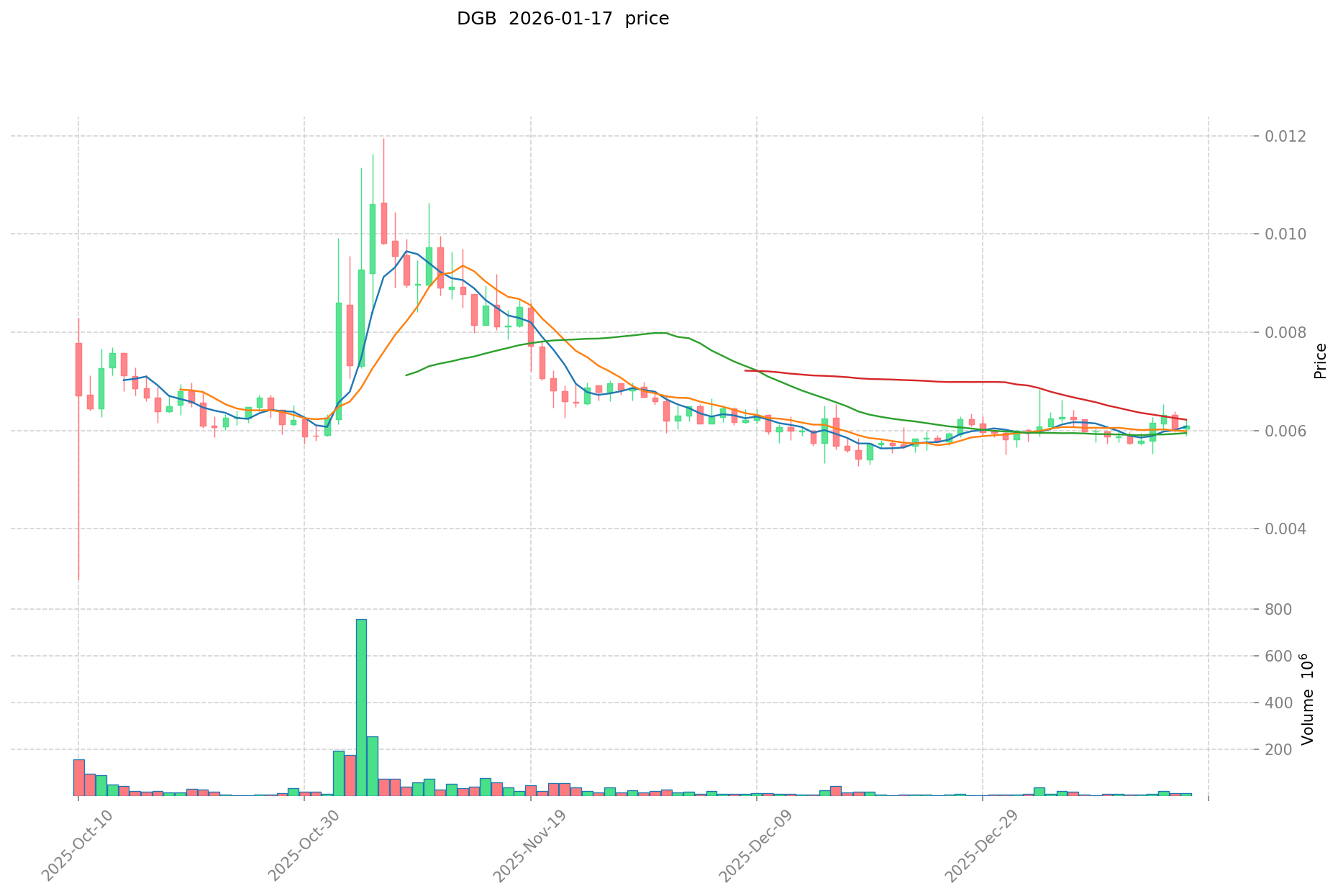
DigiByte reached its historical high price of $0.022754 on April 1, 2024, driven by broader market momentum and increased attention to established blockchain projects with strong technical foundations. Its lowest price was $0.002962, occurring on October 10, 2025, during a period of market-wide correction and reduced trading activity. These fluctuations reflect shifting market sentiment, adoption trends, and external factors affecting the cryptocurrency sector.
Click to view the current DGB market price
On-Chain Metrics
- Market Capitalization: $109,598,269 (demonstrating its position in the cryptocurrency market)
- 24-Hour Trading Volume: $98,040.84 (indicating current market activity levels)
- Circulating Supply Ratio: 107.10% of the maximum supply (reflecting the unique supply dynamics of the project)
DigiByte Ecosystem Applications and Partners
Core Use Cases
DigiByte's ecosystem supports multiple applications:
- Decentralized Payments: DigiByte provides fast and secure peer-to-peer transactions, enabling efficient digital payments across its network.
- Blockchain Security: With its multi-algorithm mining approach, DigiByte enhances network security and decentralization.
Strategic Cooperation
DigiByte continues to develop its ecosystem through community-driven initiatives and open-source development.
These efforts provide a solid foundation for DigiByte's ecosystem expansion.
Controversies and Challenges
DigiByte faces the following challenges:
- Technical Challenges: As a UTXO-based blockchain, balancing scalability with decentralization remains an ongoing consideration
- Regulatory Risks: Like many cryptocurrencies, DigiByte operates in an evolving regulatory environment across different jurisdictions
- Competition Pressure: The emergence of other blockchain platforms with smart contract capabilities presents competitive dynamics in the market
These issues have sparked discussions within the community and market, while also driving DigiByte's continuous innovation.
DigiByte's community demonstrates active participation, with over 18 billion DGB in circulation across its network.
On X platform, related posts and hashtags (such as #DigiByte) frequently generate engagement, with community members actively discussing the project.
Factors such as technical developments and network upgrades have contributed to community enthusiasm.
Sentiment on X shows varied perspectives:
- Supporters praise DigiByte's decentralized nature, multi-algorithm security, and fast transaction speeds, considering it a reliable blockchain solution.
- Critics focus on market volatility and awareness challenges in an increasingly competitive landscape.
Recent trends reflect mixed sentiment influenced by broader market conditions.
Popular Topics
X users actively discuss DigiByte's decentralization philosophy, security features, and long-term sustainability,
showcasing both its innovative potential and the challenges of achieving mainstream adoption.
- Official Website: Visit DigiByte Official Website to learn about features, use cases, and latest developments.
- X Updates: On X platform, DigiByte maintains an active presence through @DigiByteCoin,
with posts covering technical upgrades, community events, and development updates, generating engagement from the community.
DigiByte Future Roadmap
- Ongoing Development: Continue enhancing network capabilities with SegWit and smart contract support, improving performance and functionality
- Ecosystem Goals: Expand adoption through community-driven development and increased utility
- Long-term Vision: Establish DigiByte as a secure and decentralized blockchain infrastructure for digital transactions
How to Participate in DigiByte?
- Purchase Options: Buy DGB on Gate.com and other supported exchanges
- Storage Solutions: Store DGB securely using compatible wallets that support the DigiByte network
- Community Participation: Join community discussions through official forums and social media channels
- Ecosystem Building: Visit DigiByte GitHub to contribute to development or explore technical documentation
Summary
DigiByte redefines digital currency through blockchain technology, offering decentralization, security, and fast transaction speeds.
Its active community, open-source resources, and consistent development make it a notable presence in the cryptocurrency space.
While facing regulatory uncertainties and competitive pressures, DigiByte's commitment to decentralization and its clear development approach position it as a relevant player in the future of decentralized technology.
Whether you are a newcomer or an experienced participant, DigiByte presents opportunities worth exploring and engaging with.
FAQ
What is DGB (Digibyte)? What are its main features?
Digibyte (DGB) is an open-source blockchain launched in 2014, focusing on security, speed, and scalability. It employs a unique multi-algorithm approach to enhance network diversity and resilience. DGB aims to provide decentralized solutions with improved transaction efficiency and robust cryptographic security.
What is the difference between DGB and other cryptocurrencies like Bitcoin and Litecoin?
DGB is designed for fast payments and microtransactions with quicker block times than Bitcoin. While Bitcoin focuses on store of value and Litecoin on faster transactions, DGB emphasizes speed and accessibility for everyday payments across its blockchain network.
How to buy and store DGB? What are the secure wallet options?
Purchase DGB through decentralized exchanges or peer-to-peer platforms. For secure storage, use hardware wallets like Ledger or Trezor, or mobile wallets such as Bitget Wallet. Always backup your private keys safely offline.
What is the market outlook and development potential of DGB?
DGB has strong market prospects driven by growing digital asset demand and institutional adoption. Its innovative technology and robust partnerships position it for significant growth in the cryptocurrency market.
What hardware and steps are needed to mine DGB (Digibyte)?
DGB mining requires GPU or ASIC miners supporting Skein algorithm. Joining mining pools increases success rates. Choose hardware based on power efficiency and hash rate performance for optimal returns.
What are the advantages of DGB's transaction fees and transaction speed compared to other cryptocurrencies?
DGB offers low transaction fees and fast transaction speeds. It utilizes five mining algorithms, ensuring enhanced security and network stability compared to many other cryptocurrencies.
* The information is not intended to be and does not constitute financial advice or any other recommendation of any sort offered or endorsed by Gate.