Datagram Network (DGRAM) is a decentralized data infrastructure protocol addressing inefficient routing, unreliable uptime tracking, and on-chain verification challenges in DePIN networks. Launched by the Datagram team in 2025, DGRAM operates through blockchain-based mechanisms ensuring transparent, permissionless participation without central control. With over 3,800 token holders and strategic partnerships across AI and energy sectors, the protocol enables real-world activity verification and scalable data coordination. Currently trading on Gate with 2.83 billion circulating tokens, DGRAM faces market volatility but demonstrates strong technical foundations. This comprehensive guide explores its architecture, market performance, ecosystem applications, and investment considerations for participants evaluating decentralized infrastructure opportunities.
Datagram Network's Positioning and Significance
In 2025, the Datagram team launched Datagram Network (DGRAM), aiming to address challenges in decentralized physical infrastructure networks, including inefficient data routing, unreliable uptime tracking, and difficulty verifying real-world activities on-chain.
As a decentralized data infrastructure protocol designed to support next-generation DePIN networks, Datagram Network plays a crucial role in decentralized infrastructure, IoT connectivity, and on-chain data verification.
As of 2026, Datagram Network has positioned itself within the emerging DePIN ecosystem, with over 3,800 token holders and backing from partners in AI, energy, and decentralized systems.
This article will provide an in-depth analysis of its technical architecture, market performance, and future potential.
Origin and Development History
Birth Background
Datagram Network was created by the Datagram team in 2025, aiming to solve fragmentation in decentralized physical infrastructure networks, inefficient data routing, and challenges in verifying real-world device activity on blockchain.
It emerged during the rapid expansion of DePIN projects and IoT integration with blockchain technology, with the goal of providing a unified substrate for tracking device uptime, routing data flows, and enabling on-chain verification of physical world activities.
Datagram Network's launch brought new possibilities for DePIN projects, IoT networks, and decentralized data infrastructure developers.
Major Milestones
- November 2025: Token deployment on BSC, establishing infrastructure for decentralized data coordination.
- 2025-2026: Ecosystem development with backing from partners in artificial intelligence, energy systems, and decentralized infrastructure.
With support from its development team and industry partners, Datagram Network continues to optimize its technical capabilities, security features, and real-world applications.
How Datagram Network Operates
No Central Control
Datagram Network operates on a decentralized infrastructure protocol that coordinates data across distributed networks without central authority control.
The protocol enables permissionless participation, allowing devices and data sources to connect directly, ensuring system transparency and resistance to single points of failure while granting participants greater autonomy and enhancing network resilience.
Blockchain Foundation
Datagram Network utilizes blockchain technology as a public, immutable ledger for recording uptime, data routing events, and verification of real-world activities.
Data is organized and verified through cryptographic mechanisms, creating a secure and transparent record.
Anyone can verify recorded information, establishing trust without intermediaries.
The protocol's architecture supports scalability designed for hundreds of millions of devices and data sources globally.
Ensuring Fairness
Datagram Network employs verification mechanisms for on-chain validation to ensure accurate tracking of device uptime and real-world activities, preventing fraudulent reporting.
Network participants maintain system integrity through operating nodes, providing data, and participating in verification processes, contributing to the protocol's security and reliability.
Its innovation includes unified substrate architecture that standardizes data coordination across diverse DePIN networks.
Secure Transactions
Datagram Network implements cryptographic security measures to protect data integrity and transaction authenticity:
- Private keys secure participant credentials and signing authority
- Public verification enables transparent validation of recorded activities
This mechanism ensures data security while maintaining verifiable transparency of on-chain records.
The protocol is designed to support various DePIN use cases including IoT networks, energy systems, and AI infrastructure coordination.
Circulation Overview
As of 06 February 2026, Datagram Network's circulating supply is 2,827,658,968.645195 DGRAM tokens, with a total supply of 10,000,000,000 DGRAM and a maximum supply capped at 10,000,000,000 DGRAM, indicating a fixed supply model.
The current circulating supply represents approximately 28.28% of the total supply. The token distribution influences the market's supply-demand dynamics.
Price Fluctuations
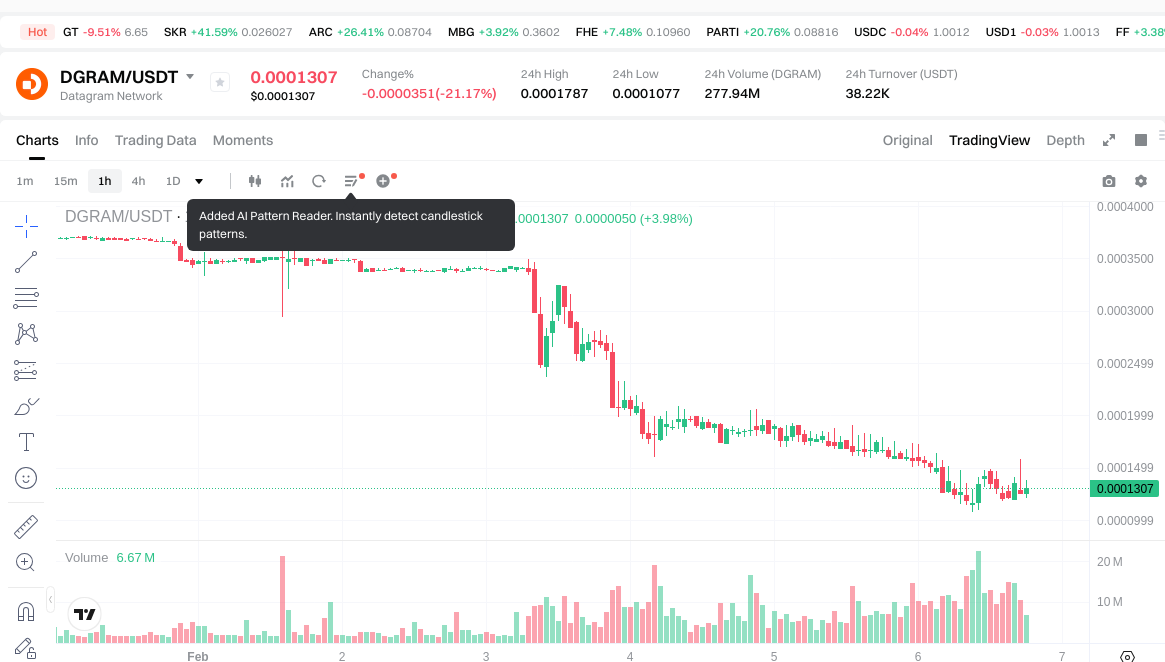
Datagram Network (DGRAM) reached a notable price level of $0.02 on 19 November 2025, driven by factors related to early market enthusiasm and initial trading activity following its launch.
The token's lowest recorded price was $0.0001077, occurring on 06 February 2026, influenced by broader market corrections and declining trading volumes.
These fluctuations reflect market sentiment, adoption trends, and external factors affecting decentralized infrastructure protocols.
Click to view the current DGRAM market price
On-Chain Metrics
- 24-Hour Trading Volume: $38,260.47 (reflecting current market activity levels)
- Active Addresses: 3,819 holders (indicating user participation in the network)
- Market Capitalization: $360,526.52 with a fully diluted valuation of $1,275,000
Datagram Network (DGRAM) Ecosystem Applications and Partners
Core Use Cases
Datagram Network's ecosystem supports multiple applications across decentralized infrastructure:
- DePIN (Decentralized Physical Infrastructure Networks): Datagram provides a unified substrate for tracking uptime, routing data, and verifying real-world activity on-chain, enabling various DePIN projects to build on its infrastructure.
- Data Verification: The protocol facilitates on-chain verification of real-world activities, supporting applications that require transparent and immutable data tracking.
Strategic Partnerships
Datagram Network has established collaborations with partners in AI, energy, and decentralized systems sectors, enhancing its technical capabilities and market reach.
These partnerships provide a solid foundation for DGRAM's ecosystem expansion and demonstrate the protocol's commitment to supporting diverse decentralized infrastructure applications.
Challenges and Controversies
Datagram Network faces several challenges:
- Market Volatility: Recent price trends show considerable fluctuations, with a 65.57% decline over 7 days and a 78.08% decrease over 30 days.
- Circulating Supply: With only 4.0% of total supply in circulation, the token faces potential supply-side pressures as more tokens enter the market.
- Competitive Landscape: The DePIN sector is experiencing growth with multiple competing protocols vying for market share.
These challenges have sparked discussions within the community and continue to drive DGRAM's innovation efforts.
Datagram Network's community shows active participation, with 3,819 token holders as of February 2026.
On X platform, discussions around DGRAM and decentralized infrastructure frequently generate interest within the crypto community.
The protocol's integration with the BEP-20 standard on BSC has facilitated community growth and accessibility.
Sentiment on X presents varied perspectives:
- Supporters praise DGRAM's focus on decentralized infrastructure and its potential to scale to hundreds of millions of devices and data sources worldwide, viewing it as foundational for next-generation DePIN networks.
- Observers monitor price movements and the project's ability to deliver on its technical roadmap amid competitive market conditions.
Recent trends reflect cautious optimism as the project develops its infrastructure capabilities.
Trending Topics
X users actively discuss DGRAM's role in the emerging DePIN sector, its technical infrastructure for real-world activity verification, and the project's scalability potential,
showcasing both its transformative possibilities and the challenges it faces in achieving mainstream adoption.
- Official Website: Visit Datagram Network official website to explore features, use cases, and latest developments.
- Documentation: Datagram Network documentation provides detailed information about its technical architecture, objectives, and vision.
- X Platform: Datagram Network maintains an active presence on X via @dgramnetwork,
sharing updates on technical developments, community activities, and ecosystem news.
- Blockchain Explorer: Track DGRAM transactions and smart contract activity on BSCScan.
How to Participate in Datagram Network (DGRAM)?
- Purchase Options: DGRAM is available for trading on Gate.com and other cryptocurrency exchanges.
- Storage Solutions: Use BEP-20 compatible wallets to securely store DGRAM tokens.
- Community Engagement: Join the Datagram Network Discord to connect with the community and stay informed about project developments.
- Ecosystem Building: Visit the developer documentation to explore opportunities for building on the Datagram infrastructure.
Summary
Datagram Network (DGRAM) is redefining decentralized infrastructure through blockchain technology, offering a unified substrate for tracking uptime, routing data, and verifying real-world activity on-chain.
Its focus on supporting DePIN networks, partnerships across AI and energy sectors, and scalable architecture position it as a noteworthy project in the decentralized infrastructure space.
Despite facing market volatility and competitive pressures, Datagram Network's technical foundation and clear focus on solving real-world infrastructure challenges demonstrate its potential in the evolving landscape of decentralized technology.
Whether you're new to crypto or an experienced participant, DGRAM represents an interesting project in the DePIN sector worth monitoring.
FAQ
What is Crypto DGRAM and how does it work?
Crypto DGRAM is a blockchain token powering the Datagram Network for decentralized data transmission. Users can trade and transfer DGRAM tokens on cryptocurrency platforms, enabling peer-to-peer data exchange with smart contract automation.
What are the main use cases and features of DGRAM?
DGRAM tokens serve network service fees, node rewards, and governance participation. The platform enables decentralized infrastructure networks with fast, low-cost data transmission for efficient distributed systems.
How is DGRAM different from other cryptocurrency projects?
DGRAM differentiates itself through its focus on high-speed data transmission capabilities. Unlike other cryptocurrency projects emphasizing different aspects, DGRAM prioritizes efficient data services and infrastructure, positioning itself as a specialized solution for fast, reliable data communication within the blockchain ecosystem.
Is DGRAM safe to invest in and what are the potential risks?
DGRAM offers promising potential in AI connectivity infrastructure. Main risks include market volatility, liquidity fluctuations, and regulatory changes. Strong fundamentals and growing adoption support long-term value. Conduct thorough research before investing.
How can I buy and store DGRAM tokens?
Purchase DGRAM through spot trading on supported platforms, then transfer to a secure digital wallet. Use hardware wallets for maximum security or keep funds in platform wallets for convenient trading access.
* The information is not intended to be and does not constitute financial advice or any other recommendation of any sort offered or endorsed by Gate.