DIA is a decentralized oracle platform launched in 2020 that provides verified, transparent financial data for blockchain applications and DeFi protocols. This comprehensive guide explores how DIA addresses the critical challenge of reliable data access in decentralized ecosystems through its community-governed architecture and token-based incentive system. The article examines DIA's technical infrastructure, market performance with 119.7 million circulating tokens, strategic ecosystem applications, and integration across multiple blockchain networks. Readers will understand DIA's competitive advantages in data validation, current trading metrics on Gate exchange, and participation mechanisms through token governance and staking. Whether you are exploring oracle solutions or seeking trustless data infrastructure for blockchain projects, this guide covers everything from DIA's origins and operational mechanisms to community sentiment and future roadmap.
DIA's Position and Significance
In 2020, the DIA Association launched DIA (DIA), aiming to address challenges in accessing reliable and transparent financial data within decentralized ecosystems.
As an open-source oracle platform providing verified market data, DIA plays a crucial role in DeFi protocols, dApps, and blockchain ecosystems that require accurate price feeds and market information.
As of 2026, DIA has established itself as a key infrastructure provider in the oracle space, serving numerous protocols with its decentralized data validation mechanism and active community governance.
This article will provide an in-depth analysis of its technical architecture, market performance, and future potential.
Origin and Development History
Birth Background
DIA was created by the DIA Association in August 2020, aiming to solve the lack of transparent, verified, and community-governed financial data in decentralized finance.
It emerged during the rapid expansion of DeFi protocols, with the goal of providing accurate, crowd-sourced oracle data through crypto-economic incentives to change the reliance on centralized data providers.
The launch of DIA brought new possibilities for DeFi protocols, developers, and data consumers seeking trustless information sources.
Important Milestones
- 2020: Platform launch, establishing decentralized data collection and validation mechanisms.
- The project has maintained continuous development with ongoing protocol enhancements and ecosystem expansion.
- DIA has been integrated by various DeFi protocols, supporting data infrastructure across multiple blockchain networks.
- The governance token model enables community participation in platform decisions and data validation processes.
With support from the DIA community and governance token holders, DIA continues to optimize its technology, security, and real-world applications.
How DIA Works?
No Central Control
DIA operates on a decentralized network of data providers and validators distributed globally, eliminating dependence on single centralized entities.
These participants collaborate to collect and verify market data, ensuring system transparency and resistance to manipulation, granting users greater autonomy and enhancing network resilience.
Blockchain Core
DIA's architecture leverages blockchain technology to create transparent, immutable records of data collection and validation processes.
Data submissions are verified through community consensus mechanisms, with validated information made publicly accessible.
Anyone can view and utilize the data feeds, establishing trust without intermediaries.
The platform's multi-source data aggregation methodology enhances accuracy and reliability.
Ensuring Fairness
DIA employs a token-based incentive system combined with community governance to validate data submissions and prevent manipulation.
Data providers and validators participate through staking DIA tokens and submitting verifiable data sources, maintaining network integrity and earning rewards.
Its innovation includes crowd-sourced data validation and dispute resolution mechanisms.
Secure Transactions
DIA utilizes cryptographic verification methods to ensure data integrity:
- Data signatures verify the authenticity of submitted information
- Smart contract validation ensures accuracy before data publication
This mechanism ensures data reliability while maintaining transparency in the validation process.
The governance framework enables token holders to participate in protocol decisions and dispute mediation.
Circulating Supply Overview
As of January 21, 2026, DIA's circulating supply stands at 119,676,104 tokens, with a total supply of 168,817,248 tokens and a maximum supply capped at 200,000,000 tokens. The circulating supply represents approximately 59.84% of the total supply, indicating a controlled release mechanism.
The DIA platform has allocated 25 million tokens (12.5% of the total supply) for governance purposes, including reward distribution to incentivize token holding, funding platform services, and supporting open-source development to stimulate innovation. This structured distribution model affects the token's supply-demand dynamics by balancing circulating supply with reserved allocations for ecosystem growth.
Price Fluctuations
DIA reached its all-time high of $5.73 on May 5, 2021, driven by favorable market conditions during a broader cryptocurrency bull market. The token's lowest recorded price was $0.208951 on September 2, 2023, reflecting challenging market conditions and broader industry headwinds.
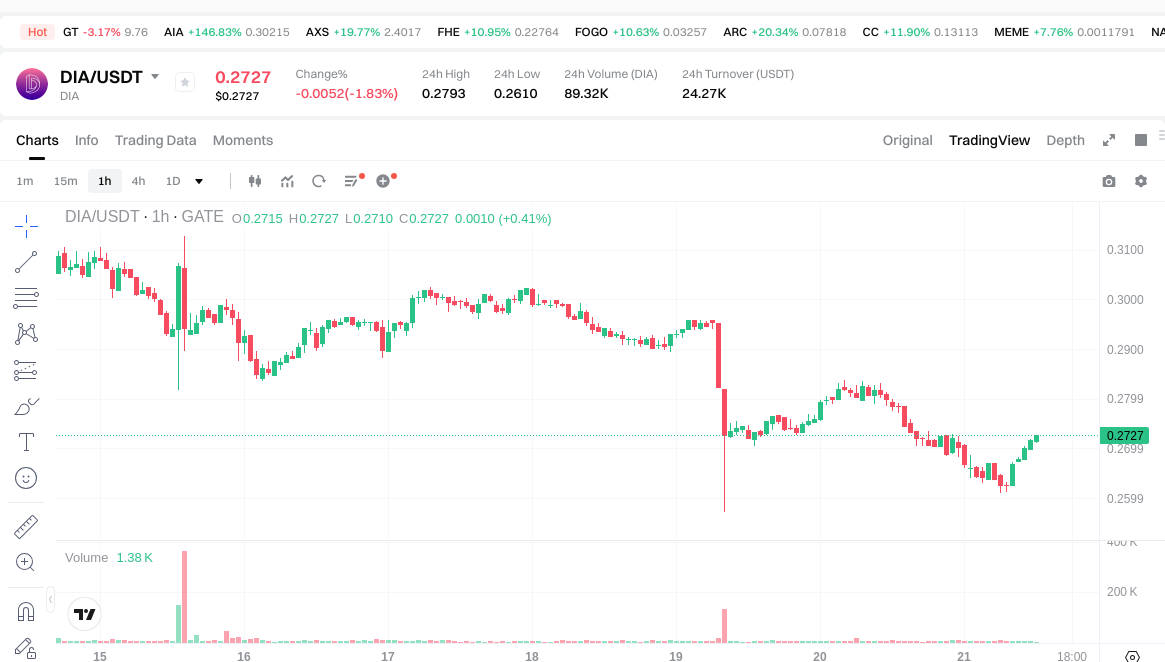
As of the latest data, DIA is trading at $0.2719, showing varied performance across different timeframes: a 0.22% increase over 1 hour, a 2.78% decrease over 24 hours, an 11.67% decline over 7 days, a 1.38% gain over 30 days, and a significant 54.83% decrease over the past year. These fluctuations reflect market sentiment shifts, adoption trends, and external factors affecting the decentralized oracle sector.
Click to view current DIA market price
On-Chain Metrics
- Token Holders: 24,717 addresses (reflecting user participation and token distribution across the community)
- 24-Hour Trading Volume: $25,376.40 (indicating current market activity levels)
- Market Capitalization: $32,539,932.68 (representing DIA's current market valuation based on circulating supply)
- Fully Diluted Valuation: $45,901,409.73 (projecting potential market cap if all tokens were in circulation)
- Market Dominance: 0.0014% (showing DIA's relative position within the broader cryptocurrency market)
DIA Ecosystem Applications and Strategic Partners
Core Use Cases
DIA's ecosystem supports multiple applications:
- Data Infrastructure: DIA provides decentralized oracle services, offering transparent and verifiable financial data for blockchain applications.
- DeFi Integration: Projects utilize DIA's price feeds to enable accurate asset valuation and risk management in decentralized finance protocols.
Strategic Partnerships
DIA has established collaborations with projects in the blockchain space, enhancing its technical capabilities and market presence.
These partnerships provide a solid foundation for DIA's ecosystem expansion.
Controversies and Challenges
DIA faces the following challenges:
- Technical Challenges: Ensuring data accuracy and oracle reliability in rapidly evolving blockchain environments
- Regulatory Risks: Navigating compliance requirements for financial data provision across different jurisdictions
- Competition Pressure: Competing with established oracle providers in the blockchain data infrastructure space
These issues have sparked discussions within the community and market, while driving DIA's continuous innovation.
DIA's community shows active participation, with the token held by 24,717 addresses.
On X platform, related posts and hashtags (such as #DIA) generate engagement within the crypto data community.
Developments in oracle technology and data verification have energized community interest.
Sentiment on X presents varying perspectives:
- Supporters praise DIA's decentralized approach to financial data and transparent verification mechanisms, considering it essential infrastructure for DeFi.
- Critics focus on market volatility and competition from alternative oracle solutions.
Recent trends reflect interest in decentralized data infrastructure solutions.
Trending Topics
X users discuss DIA's governance model, data verification processes, and integration with DeFi protocols,
showcasing both its transformative potential and the challenges in scaling oracle services.
- Official Website: Visit DIA Official Website for features, use cases, and latest updates.
- X Updates: On X platform, DIA maintains an active presence through its official account, sharing updates on technical developments, data partnerships, and community initiatives.
DIA Future Roadmap
- Ecosystem Goals: Expanding oracle coverage across multiple blockchain networks and data categories
- Long-term Vision: Becoming a leading provider of transparent and verifiable financial data infrastructure for the blockchain ecosystem
How to Participate in DIA?
- Purchase Options: Buy DIA on Gate.com and other supported exchanges
- Storage Solutions: Securely store DIA tokens using compatible wallets such as MetaMask or hardware wallets
- Governance Participation: Engage in community governance through DIA token voting mechanisms
- Ecosystem Building: Explore DIA's documentation to integrate oracle services or contribute to data verification
Summary
DIA redefines financial data infrastructure through blockchain technology, providing transparent, verifiable, and decentralized oracle services.
Its engaged community, open-source approach, and focus on data accuracy position it as a notable player in the blockchain data infrastructure space.
Despite facing regulatory considerations and market competition, DIA's commitment to innovation and clear development direction establish its relevance in the future of decentralized technology.
Whether you are new to crypto or an experienced participant, DIA represents an interesting project in the oracle and data verification sector.
FAQ
DIA is a decentralized oracle platform providing real-time, verified data for blockchain applications. It solves the oracle problem by enabling trustless access to off-chain data like prices, market data, and information feeds without relying on centralized intermediaries.
How does DIA's oracle network work and what are its main features?
DIA operates a decentralized oracle network that sources real-time crypto data from multiple sources. Key features include transparent data sourcing, customizable data feeds, high-frequency updates, and smart contract integration for accurate on-chain pricing and market data delivery.
What is the DIA token used for and how can I buy or stake it?
DIA token powers the decentralized oracle network, enabling data validation and governance. Users can purchase DIA through crypto platforms, then stake tokens to earn rewards while securing the network and participating in protocol decisions.
How is DIA different from other oracle solutions like Chainlink or Band Protocol?
DIA offers decentralized, crowdsourced data collection with transparency and community governance. Unlike Chainlink and Band Protocol, DIA emphasizes open-source infrastructure, lower costs, and customizable data feeds across multiple blockchains with greater flexibility.
What are the risks and security considerations when using DIA?
DIA mitigates risks through decentralized oracle architecture, multiple data sources, and smart contract audits. Users should verify contract addresses, manage private keys securely, and stay informed about protocol updates to ensure safe participation in the DIA ecosystem.
Which blockchain networks does DIA currently support?
DIA supports multiple blockchain networks including Ethereum, Polygon, Arbitrum, Optimism, Base, Solana, and other major EVM-compatible chains, enabling cross-chain data oracle functionality.
* The information is not intended to be and does not constitute financial advice or any other recommendation of any sort offered or endorsed by Gate.