Dynex (DNX) is a next-generation neuromorphic computing platform launched in 2022 that leverages blockchain technology to address inefficiencies in traditional computing for complex AI workloads and optimization problems. Built on a decentralized Proof of Useful Work (PoUW) consensus mechanism, Dynex enables distributed supercomputing capabilities compatible with PyTorch, TensorFlow, and Qiskit frameworks. The platform operates through a global network of nodes, ensuring transparency and security via cryptographic protocols while eliminating centralized dependencies. As of January 2026, DNX trades at $0.04463 with a market cap of $4.74M and circulating supply of 106.26M tokens. Dynex's ecosystem spans finance, medicine, construction, and military sectors through its innovative computing power marketplace where miners earn rewards. Despite facing adoption challenges and market competition, Dynex's technical architecture, active community support, and clear roadmap position it as a compelling solution in the de
Dynex's Positioning and Significance
In 2022, the Dynex team launched Dynex (DNX), aiming to address the inefficiency of traditional computing in handling complex optimization problems and AI workloads.
As a next-generation neuromorphic computing platform built on flexible blockchain protocol, Dynex plays a crucial role in AI computation, scientific research, and decentralized supercomputing.
As of 2026, Dynex has established itself as an innovative neuromorphic computing solution within the blockchain space, supporting applications across finance, medicine, construction, military, and other sectors.
This article will provide an in-depth analysis of its technical architecture, market performance, and future potential.
Origin and Development Timeline
Background of Creation
Dynex was created by the Dynex development team in 2022, aiming to solve the limitations of traditional computing systems in handling complex AI and optimization tasks.
It emerged during the rapid evolution of blockchain technology and growing demand for decentralized AI infrastructure, with the goal of providing efficient, decentralized neuromorphic supercomputing capabilities to transform the computational landscape.
The launch of Dynex brought new possibilities to AI researchers, developers, and industries requiring high-performance computing.
Key Milestones
- 2022: Mainnet launch with Proof of Useful Work (PoUW) mechanism, enabling decentralized neuromorphic computing network.
- Ongoing development: Integration with PyTorch, Google TensorFlow, and IBM Qiskit frameworks, establishing compatibility with mainstream AI development tools.
- Platform expansion: Launch of computing power marketplace, allowing miners to earn income through computational tasks and AI professionals to contribute to the ecosystem.
- Ecosystem growth: Adoption across finance, medicine, construction, military, and various other sectors, demonstrating practical utility.
With support from the community and development team, Dynex continues to optimize its technology, security, and real-world applications.
How Dynex Works
Decentralized Control
Dynex operates on a decentralized network of computers (nodes) distributed globally, eliminating dependence on centralized entities.
These nodes collaborate to validate computational tasks, ensuring system transparency and attack resistance, granting users greater autonomy and enhancing network resilience.
Blockchain Foundation
Dynex's blockchain serves as a public, immutable digital ledger recording computational activities and transactions.
Transactions are grouped into blocks and linked through cryptographic hashing to form a secure chain.
Anyone can verify records, establishing trust without intermediaries.
The neuromorphic computing approach enables direct AI implementation from the code level, surpassing traditional computing efficiency.
Ensuring Fairness
Dynex employs Proof of Useful Work (PoUW) to validate transactions and computational contributions, preventing malicious activities.
Miners maintain network security through providing computational resources for neuromorphic computing tasks and receive DNX rewards.
Its innovation includes combining blockchain security with practical computational utility, creating a decentralized supercomputing network.
Secure Transactions
Dynex uses public-private key cryptography to protect transactions:
- Private keys (similar to secret passwords) are used to sign transactions
- Public keys (similar to account numbers) are used to verify ownership
This mechanism ensures fund security while maintaining pseudonymous transaction privacy.
The platform's integration with established AI frameworks provides additional security and usability for computational tasks.
Circulation Overview
As of January 29, 2026, Dynex's circulating supply is 106,259,529.67 DNX, with a total supply of 106,276,327.22 DNX and a maximum supply cap of 110,000,000 DNX. The circulating supply represents approximately 96.6% of the total supply, indicating a relatively mature distribution phase. The fixed maximum supply model helps establish predictable scarcity dynamics in the long term.
Price Fluctuation
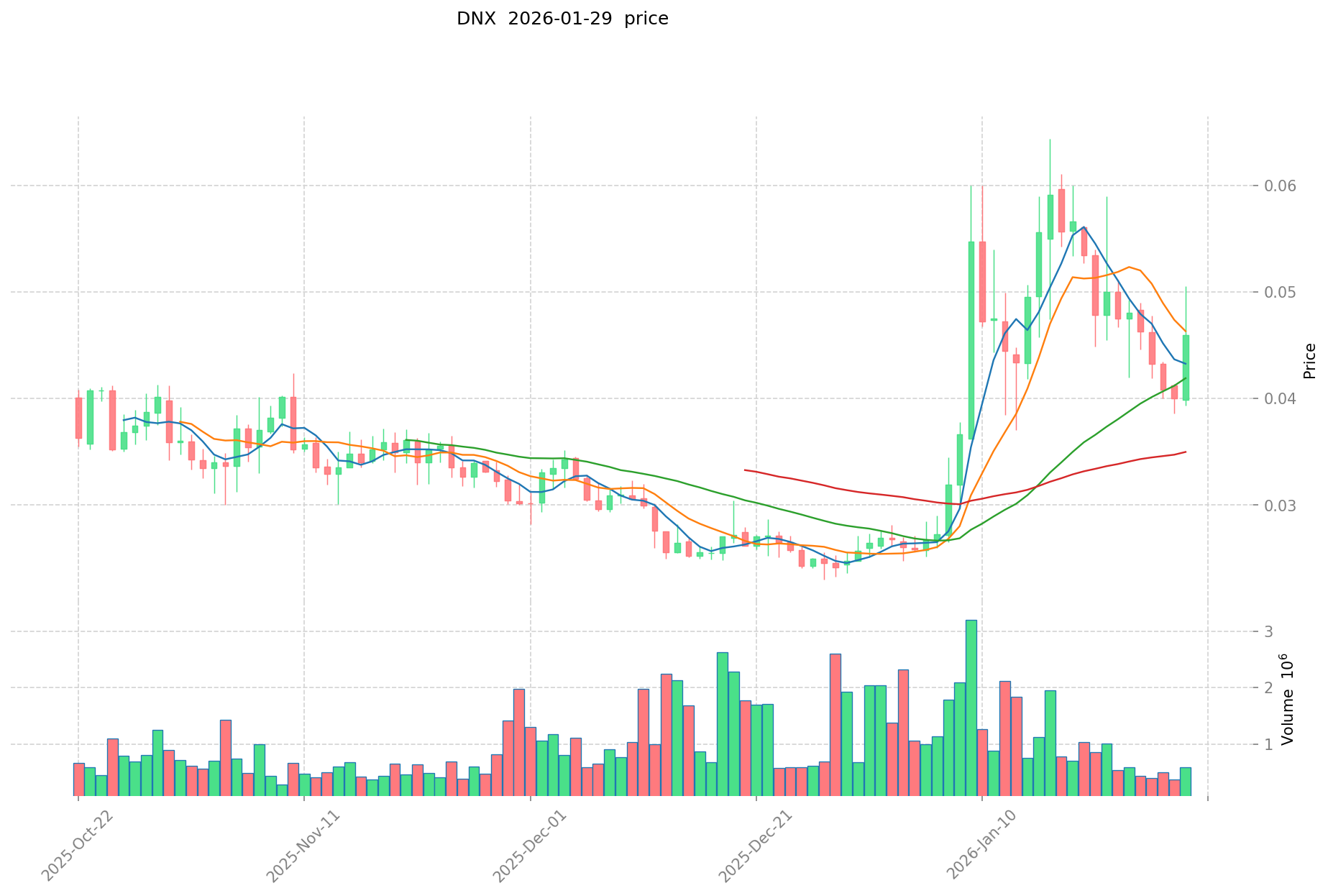
Dynex reached its all-time high of $1.23 on March 9, 2024, driven by increased interest in neuromorphic computing solutions and broader market momentum during that period. Its all-time low of $0.002 occurred on January 4, 2024, reflecting market corrections and early-stage price discovery. As of January 29, 2026, DNX trades at $0.04463, showing a 9.33% increase over the past 24 hours, though experiencing a 68.21% decline over the past year. These fluctuations reflect market sentiment shifts, adoption trends in the AI computing sector, and broader cryptocurrency market dynamics.
Click to view the current DNX market price
On-Chain Metrics
- 24-Hour Trading Volume: $27,953.54 (indicating moderate trading activity)
- Market Capitalization: $4,742,362.81 (reflecting current network valuation)
- Market Cap to FDV Ratio: 96.6% (demonstrating limited token unlock pressure)
Dynex Ecosystem Applications and Partners
Core Use Cases
Dynex's ecosystem supports multiple application scenarios:
- Neuromorphic Computing: Dynex platform provides distributed supercomputing capabilities for complex computational tasks.
- AI Integration: Compatible with PyTorch, Google TensorFlow and IBM Qiskit frameworks, enabling direct AI implementation from the code level.
- Computing Power Market: The platform has launched a marketplace where miners can earn income through computational tasks, and AI professionals can contribute to the ecosystem.
Strategic Collaborations
Dynex operates across various sectors including finance, medicine, construction, and military applications, leveraging its neuromorphic computing technology.
These applications provide a solid foundation for Dynex's ecosystem expansion.
Controversies and Challenges
Dynex faces the following challenges:
- Technical Development: Continuous optimization of the PoUW consensus mechanism and network efficiency
- Market Competition: Competition from other blockchain computing platforms in the decentralized computing space
- Adoption Barriers: Building awareness and integration in traditional computing sectors
These issues have sparked discussions within the community and market, while driving Dynex's continuous innovation.
Dynex's community maintains active participation, with the platform establishing a decentralized neuromorphic supercomputing network.
On X platform, related posts and hashtags (such as #Dynex and #DNX) generate engagement within the crypto computing community.
Developments such as computing power market launches and framework compatibility announcements have energized community enthusiasm.
Sentiment on X shows varied perspectives:
- Supporters praise Dynex's neuromorphic computing capabilities and compatibility with major AI frameworks, viewing it as "next-generation computing infrastructure".
- Critics focus on market volatility and the challenges of mainstream adoption in traditional computing sectors.
Recent trends indicate growing interest in decentralized computing solutions.
Hot Topics
X users actively discuss Dynex's innovative approach to neuromorphic computing, AI integration capabilities, and the potential of its computing power marketplace,
showcasing both its transformative potential and the challenges in achieving widespread adoption.
- Official Website: Visit Dynex Official Website for features, use cases and latest developments.
- X Updates: On X platform, Dynex maintains active presence through @dynexcoin,
with posts covering technical upgrades, community activities, and platform developments.
- Block Explorer: Dynex Block Explorer provides transparent on-chain data.
- GitHub Repository: Dynex GitHub offers technical documentation and development resources.
Dynex Future Roadmap
- Ecosystem Development: Expand the computing power marketplace and enhance miner reward mechanisms
- Technical Enhancement: Improve compatibility with additional AI frameworks and optimize network performance
- Long-term Vision: Establish itself as a leading decentralized neuromorphic computing platform
How to Participate in Dynex?
- Purchase Options: DNX is available on Gate.com and other supported exchanges
- Storage Solutions: Use compatible cryptocurrency wallets for secure storage
- Mining Participation: Join the PoUW mining network to contribute computing power
- Ecosystem Building: Explore the computing power marketplace to offer or utilize AI computational services
Summary
Dynex leverages blockchain technology to redefine neuromorphic computing, offering decentralized supercomputing capabilities, AI framework compatibility, and an innovative computing power marketplace.
Its active community, technical resources and growing ecosystem position it uniquely in the decentralized computing sector.
Despite facing adoption challenges and market competition, Dynex's innovative approach and clear development direction establish its relevance in the future of decentralized computing technology.
Whether you are new to crypto or an experienced participant, Dynex presents an interesting project worth following and engaging with.
FAQ
What is Crypto DNX and what is its main purpose?
Crypto DNX is a utility token for the Dynex Cloud Platform, enabling users to pay for computational services. Its primary purpose is to incentivize and manage network resources while facilitating decentralized computing transactions.
How does DNX technology work and what are its key features?
DNX is a decentralized quantum computing platform utilizing blockchain to solve complex computational problems. Key features include distributed computing networks, token-based incentive mechanisms rewarding participants, and quantum-resistant algorithms enabling secure decentralized problem-solving.
Where can you buy and trade DNX tokens?
You can buy and trade DNX tokens on decentralized exchanges like Uniswap. The token contract address on Ethereum is 0x9928a8600d14ac22c0be1e8d58909834d7ceaf13. Simply connect your wallet and swap for DNX directly.
What is the total supply and tokenomics of DNX?
DNX has a total supply of 106,244,920.93 tokens, with circulating supply of 106,244,920 and maximum supply cap of 110,000,000. The tokenomics are designed to ensure sustainable long-term growth and ecosystem development.
Who are the team members and founders behind DNX?
DNX was founded by Mats Pettersson and Anders Carlberg. Mats Pettersson served as former CEO, while Anders Carlberg is also a key founder driving the project's development and vision.
Is DNX safe to invest in? What are the potential risks?
DNX carries inherent risks as an emerging blockchain project, including regulatory uncertainty, market volatility, and technology risk. Investors should conduct thorough due diligence and only invest capital they can afford to lose.
How does DNX compare to other similar cryptocurrency projects?
DNX specializes in decentralized identity solutions with stronger focus on privacy and authentication. Unlike DeFi-focused competitors, DNX offers superior cross-chain compatibility and lower transaction costs, making it ideal for identity verification applications across multiple blockchains.
What is the roadmap and future development plan for DNX?
DNX's 10-year roadmap focuses on developing a Silicon Quantum Chip and securing $50M investment. Future plans emphasize technological innovation and financial growth to advance quantum computing capabilities.
* The information is not intended to be and does not constitute financial advice or any other recommendation of any sort offered or endorsed by Gate.