This comprehensive guide explores Dynex (DNX), a next-generation decentralized neuromorphic supercomputing platform launched in 2022 to address AI computational demands. The article covers Dynex's revolutionary architecture built on flexible blockchain and Proof of Useful Work mining, enabling real-world problem-solving while maintaining network security. Readers will discover how Dynex integrates with PyTorch, TensorFlow, and Qiskit frameworks, its market performance metrics, and active ecosystem spanning finance, medicine, and construction sectors. The guide details participation methods on Gate and other exchanges, mining opportunities, and community engagement strategies. Whether evaluating investment potential or exploring decentralized computing infrastructure, this resource provides essential insights into Dynex's technical innovations, current valuation, and future roadmap in the evolving AI-blockchain convergence landscape.
Dynex's Position and Significance
In 2022, the Dynex team launched Dynex (DNX), aiming to address limitations in traditional computing efficiency and the growing demand for advanced AI computational capabilities.
As the next-generation neuromorphic computing platform built on a revolutionary flexible blockchain protocol, Dynex plays a critical role in decentralized AI computing, machine learning, and complex problem-solving across industries.
As of 2026, Dynex has established itself as an innovative computational infrastructure provider in the blockchain and AI convergence space, with compatibility across PyTorch, Google TensorFlow, and IBM Qiskit frameworks and an active ecosystem of miners and AI professionals.
This article will provide an in-depth analysis of its technical architecture, market performance, and future potential.
Origin and Development History
Birth Background
Dynex was created by its development team in 2022, aiming to solve the inefficiency of traditional computing systems in handling complex AI and machine learning tasks.
It emerged during the rapid expansion of blockchain technology and the increasing computational demands of artificial intelligence, with the goal of establishing a decentralized neuromorphic supercomputing network through innovative PoUW (Proof of Useful Work) mining mechanisms.
The launch of Dynex brought new possibilities to AI researchers, financial institutions, medical organizations, and various industries requiring advanced computational power.
Key Milestones
- 2022: Mainnet launch, establishing the foundation for decentralized neuromorphic computing infrastructure.
- Ongoing Development: Introduction of the computing power marketplace, enabling miners to earn income through computational tasks while AI professionals contribute to and benefit from the ecosystem.
- Market Expansion: Integration with major AI frameworks including PyTorch, Google TensorFlow, and IBM Qiskit, expanding accessibility for AI developers.
- Current Status: As of January 2026, DNX maintains a circulating supply of approximately 106.26 million tokens with a market capitalization reflecting its position in the decentralized computing sector.
With support from its community and development team, Dynex continues to optimize its technology, security features, and real-world applications across finance, medicine, construction, military, and other sectors.
How Dynex Works
Decentralized Architecture
Dynex operates on a decentralized network of computing nodes distributed globally, eliminating reliance on centralized cloud providers or traditional computing infrastructure.
These nodes collaborate to process neuromorphic computing tasks, ensuring system transparency and resilience while granting users greater autonomy over computational resources and reducing vulnerability to single points of failure.
Blockchain Foundation
Dynex's blockchain serves as a transparent, immutable digital ledger recording all computational tasks and transactions.
Computational jobs are organized and validated through blockchain technology, with cryptographic mechanisms ensuring data integrity and task verification.
Anyone can participate in the network, establishing trust without intermediaries.
The platform's flexible blockchain protocol enables efficient handling of complex AI workloads while maintaining security and decentralization.
Consensus and Validation
Dynex employs Proof of Useful Work (PoUW) to validate computational tasks and maintain network integrity.
Miners contribute actual computational power to solve real-world AI and machine learning problems rather than performing arbitrary calculations, earning DNX rewards for their contributions.
This innovative approach differs from traditional mining by ensuring that computational resources serve practical purposes while maintaining network security, making the system both economically efficient and environmentally conscious compared to conventional proof-of-work systems.
Secure Operations
Dynex utilizes cryptographic techniques to protect computational tasks and transactions:
- Private keys secure access to mining rewards and computational task submissions
- Public keys enable transparent verification of computational contributions and task completion
This mechanism ensures that computational resources are properly attributed and rewards are securely distributed to participants.
The platform's architecture maintains transparency in task allocation while protecting proprietary computational models and data privacy for enterprise users.
Circulation Overview
As of January 29, 2026, Dynex's circulating supply is 106,259,529.67 DNX tokens, with a total supply of 106,274,765.11 DNX. The maximum supply is capped at 110,000,000 DNX, indicating a fixed supply model with approximately 96.6% of the maximum supply already in circulation.
The token distribution demonstrates a high circulating ratio of 96.6%, suggesting that the majority of tokens have entered market circulation. The relatively small gap between circulating supply and maximum supply indicates limited potential for significant supply-side inflation in the future.
Price Fluctuation
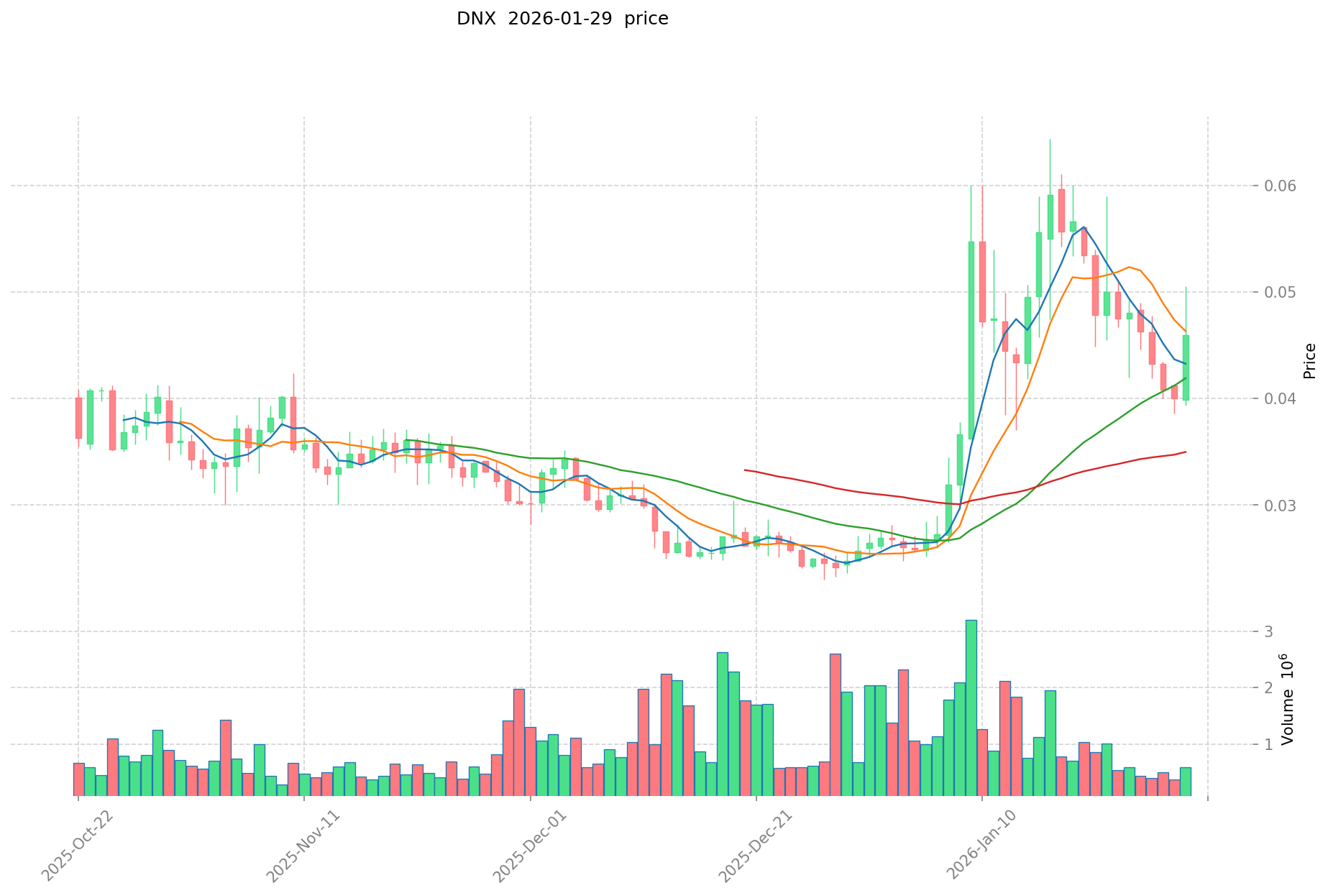
Dynex reached a notable price level of $1.23 on March 9, 2024, during a period of market expansion. The token experienced its lowest price point of $0.002 on January 4, 2024, reflecting market volatility and evolving adoption patterns.
As of January 29, 2026, DNX is trading at $0.04543, showing a 24-hour price increase of 7.96%. The token has demonstrated significant volatility, with a 30-day increase of 78.86%, while experiencing a one-year decline of 67.64%. These fluctuations reflect market sentiment shifts, adoption trends, and broader cryptocurrency market dynamics.
The 24-hour price range spans from $0.03934 to $0.05057, indicating active trading activity and ongoing price discovery.
Click to view the current DNX market price
On-chain Metrics
- 24-hour Trading Volume: $24,967.83 (demonstrating current market liquidity)
- Market Capitalization: $4,827,370.43 (ranking #1547 in the cryptocurrency market)
- Market Dominance: 0.00015% (representing a niche position in the overall crypto market)
- Fully Diluted Valuation: $4,828,062.58 (with a market cap to FDV ratio of 96.6%, indicating minimal dilution risk)
Dynex Ecosystem Applications and Partners
Core Use Cases
Dynex's ecosystem supports multiple applications:
- Neuromorphic Computing: The platform provides decentralized supercomputing capabilities for complex computational tasks.
- AI Integration: Compatible with PyTorch, Google TensorFlow, and IBM Qiskit frameworks, enabling direct AI implementation from the code level.
- Computing Power Market: Miners can earn income through tasks, while AI professionals can contribute to the ecosystem and generate revenue via the task marketplace.
Strategic Collaborations
Dynex operates across finance, medicine, construction, military, and various other sectors, establishing its presence in multiple industries.
These partnerships provide a solid foundation for Dynex's ecosystem expansion.
Controversies and Challenges
Dynex faces the following challenges:
- Technical Issues: Maintaining computational efficiency and network stability as the platform scales
- Competition Pressure: Other blockchain platforms and traditional computing solutions competing in the neuromorphic computing space
These issues have sparked discussions within the community and market, while also driving Dynex's continuous innovation.
Fan Enthusiasm
Dynex's community demonstrates activity with a 24-hour trading volume of $24,967.83.
On X platform, related posts and hashtags (such as #Dynex) generate engagement, with the community actively discussing platform developments.
Factors such as technological advancements and computing power market growth have ignited community enthusiasm.
Sentiment on X shows polarization:
- Supporters praise Dynex's neuromorphic computing capabilities and decentralized infrastructure, considering it as "the future of AI computation".
- Critics focus on price volatility and adoption challenges.
Recent trends show sentiment influenced by market conditions and platform developments.
Hot Topics
X users actively discuss Dynex's computational efficiency, PoUW mining mechanism, and AI integration capabilities,
showcasing both its transformative potential and the obstacles toward mainstream adoption.
- Official Website: Visit Dynex Official Website for features, use cases, and latest updates.
- X Updates: On X platform, Dynex maintains active engagement through @dynexcoin,
with posts covering technical upgrades, community activities, and platform developments, generating engagement from the community.
Dynex Future Roadmap
- Ecosystem Goals: Expanding the computing power marketplace and enhancing miner participation
- Long-term Vision: Becoming a leading neuromorphic supercomputing network for AI and complex computational tasks
How to Participate in Dynex?
- Purchase Channels: Buy DNX on Gate.com and other supported exchanges
- Storage Solutions: Use compatible wallets to securely store your DNX tokens
- Participate in Mining: Join the PoUW mining network to contribute computing power and earn rewards
- Build the Ecosystem: Visit the official GitHub repository at https://github.com/dynexcoin to develop applications or contribute code
Summary
Dynex redefines computing through neuromorphic technology, providing decentralized supercomputing, AI integration, and efficient task processing.
Its active community, comprehensive resources, and innovative approach position it uniquely in the cryptocurrency field.
Despite facing adoption challenges and market competition, Dynex's innovative spirit and clear development path secure it an important position in the future of decentralized computing technology.
Whether you are a newcomer or an experienced participant, Dynex deserves attention and engagement.
FAQ
What is DNX and what problem does it solve in the crypto market?
DNX is Dynex, a decentralized quantum computing platform using blockchain to solve complex computational problems. It addresses inefficiencies in traditional quantum computing by leveraging distributed networks and incentivizing problem-solving.
How can I buy and store DNX tokens?
Create an account on a crypto platform, purchase USDT or other stablecoins, swap them for DNX tokens, and transfer them to a secure wallet for storage and security.
What is the tokenomics and total supply of DNX?
DNX has a total supply of 1,000,000,000 tokens. The tokenomics are designed to support the Dynex network ecosystem with token distribution across development, community, and operations.
Is DNX safe to invest in? What are the main risks?
DNX involves market volatility and technological risks as an emerging blockchain asset. Key risks include price fluctuations and adoption uncertainty. Evaluate your risk tolerance before investing.
How does DNX differ from other similar cryptocurrency projects?
DNX specializes in enterprise identity verification solutions, distinguishing itself from competitors. While projects like RUNE focus on cross-chain interoperability and decentralized applications, DNX targets institutional adoption through advanced identity authentication protocols. This enterprise-centric approach and specialized use case position DNX uniquely within the blockchain ecosystem.
What is the development roadmap and future prospects of DNX?
DNX is transitioning from quantum emulation to silicon-based hardware. Near-term plans include chip launches, while long-term prospects focus on advanced quantum computing solutions and expanding enterprise adoption in healthcare, finance, and optimization sectors.
* The information is not intended to be and does not constitute financial advice or any other recommendation of any sort offered or endorsed by Gate.