Dynex (DNX) is a next-generation decentralized neuromorphic computing platform launched in 2022 to address inefficiencies in traditional computing and rising AI computational demands. This comprehensive guide explores how Dynex bridges blockchain technology with neuromorphic supercomputing through its innovative Proof of Useful Work mining mechanism. The article examines Dynex's technical architecture, including its distributed network, blockchain foundation, and compatibility with PyTorch, Google TensorFlow, and IBM Qiskit frameworks. It analyzes current market metrics—circulating supply of 106.26M DNX tokens and $4.44M market capitalization—alongside price fluctuations reflecting emerging technology volatility. The guide details ecosystem applications across AI, finance, and computing power marketplaces, explores community engagement on social platforms, and outlines the platform's development roadmap. Whether you're exploring decentralized computing infrastructure or AI-driven blockchain solutions, Dynex o
Dynex's Positioning and Significance
In 2022, the Dynex team launched Dynex (DNX), aiming to address inefficiencies in traditional computing and the growing demand for AI-driven computational power.
As a next-generation neuromorphic computing platform built on a flexible blockchain protocol, Dynex plays a key role in AI, machine learning, and decentralized computing.
As of 2026, Dynex has established itself as a specialized platform bridging blockchain technology with neuromorphic supercomputing, with compatibility across PyTorch, Google TensorFlow, and IBM Qiskit frameworks, and an active ecosystem of miners and AI professionals.
This article will analyze its technical architecture, market performance, and future potential.
Origin and Development History
Background
Dynex was created by its development team in 2022, aiming to solve the limitations of traditional computing architectures in handling complex AI and optimization problems.
It emerged during the rapid expansion of AI technology and blockchain innovation, with the goal of providing decentralized neuromorphic computing power that surpasses conventional efficiency through direct AI implementation at the code level.
Dynex's launch brought new possibilities to industries including finance, medicine, construction, and military applications.
Key Milestones
- 2022: Platform launch with Proof of Useful Work (PoUW) mining mechanism, establishing a decentralized neuromorphic supercomputing network.
- Development Phase: Introduction of computing power marketplace enabling miners to earn income through computational tasks while AI professionals contribute to the ecosystem.
- Ecosystem Growth: Integration with major AI frameworks including PyTorch, Google TensorFlow, and IBM Qiskit, expanding application scenarios across multiple sectors.
- Market Recognition: Listed on Gate.com and other platforms, gaining visibility within the crypto community.
With support from its community and development team, Dynex continues to refine its technology, security features, and real-world applications.
How Dynex Works
Decentralized Architecture
Dynex operates on a distributed network of computing nodes worldwide, eliminating dependence on centralized computing infrastructure.
These nodes collaboratively validate transactions and perform neuromorphic computations, ensuring system transparency and resilience while granting users greater autonomy over computational resources.
Blockchain Foundation
Dynex's blockchain serves as a public, immutable digital ledger recording computational tasks and transactions.
Transactions are grouped into blocks and cryptographically linked to form a secure chain.
Anyone can verify records without intermediaries, establishing trust through transparency.
The flexible blockchain protocol enables the integration of neuromorphic computing capabilities directly into the network architecture.
Maintaining Network Integrity
Dynex employs Proof of Useful Work (PoUW) to validate transactions and computational tasks, preventing fraudulent activities.
Miners maintain network security through performing useful neuromorphic computations rather than arbitrary hashing, earning DNX rewards for their contributions.
This innovative approach transforms computational work into valuable AI processing rather than wasted energy.
Secure Operations
Dynex uses public-private key cryptography to protect transactions:
- Private keys (similar to secret passwords) are used to sign transactions
- Public keys (similar to account numbers) are used to verify ownership
This mechanism ensures fund security while transactions maintain pseudonymous privacy.
The platform's architecture provides additional security through its decentralized neuromorphic computing network structure.
Circulation Overview
As of January 29, 2026, Dynex's circulating supply stands at 106,259,529.67 DNX tokens, with a total supply of 106,277,960.40 DNX. The maximum supply is capped at 110,000,000 DNX, representing a fixed supply model that creates scarcity dynamics in the market.
The current circulation ratio reaches approximately 96.60% of the total supply, indicating that the majority of tokens have already entered the market. New tokens enter circulation through the platform's Proof of Useful Work (PoUW) mining mechanism, where miners contribute computational power to the neuromorphic supercomputing network and receive DNX rewards. This distribution model aligns network security with real computational utility, distinguishing it from traditional proof-of-work systems.
Price Fluctuations
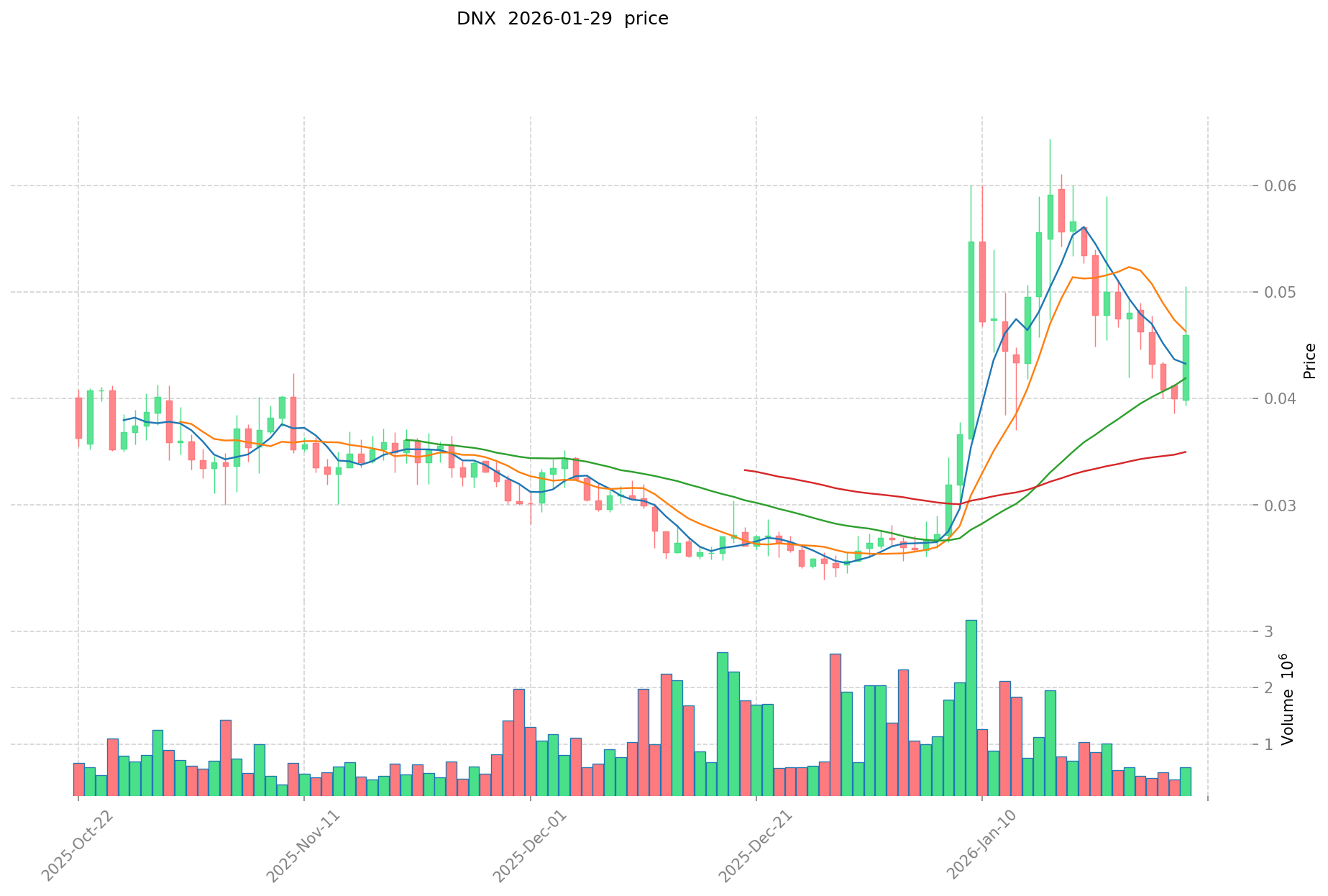
Dynex reached its historical peak price of $1.23 on March 9, 2024, driven by increased market interest in AI-focused blockchain projects and the platform's expanding neuromorphic computing capabilities. The token demonstrated significant growth during this period as the platform gained traction in computational markets.
The token's lowest price point was recorded at $0.002 on January 4, 2024, reflecting broader cryptocurrency market corrections and early-stage project valuation adjustments. This substantial price range illustrates the token's volatility and its sensitivity to market sentiment shifts, technological developments, and adoption trends in the decentralized computing sector.
Recent price movements show mixed performance across different timeframes. The token experienced a 3.95% increase over the past 24 hours, reaching $0.04181, while demonstrating a notable 65.25% gain over the past 30 days. However, the token faced a 13.98% decline over the past week and a 70.01% decrease over the past year, indicating ongoing market adjustments and volatility characteristic of emerging technology projects.
Click to view the current DNX market price
On-Chain Metrics
- 24-Hour Trading Volume: The platform recorded a trading volume of $27,617.56 over the past 24 hours, reflecting active market participation and liquidity dynamics.
- Market Capitalization: Dynex maintains a circulating market cap of approximately $4.44 million, with a fully diluted valuation closely aligned at $4.44 million due to its high circulation ratio.
- Market Dominance: The token holds a 0.00014% share of the total cryptocurrency market, positioning it as a specialized project within the broader digital asset ecosystem.
Dynex Ecosystem Applications and Partners
Core Use Cases
Dynex's ecosystem supports multiple applications across various sectors:
- Neuromorphic Computing: Dynex provides a decentralized supercomputing network that enables advanced computational tasks, offering quantum-inspired computing capabilities for complex problem-solving.
- AI and Machine Learning: The platform is compatible with PyTorch, Google TensorFlow, and IBM Qiskit frameworks, facilitating direct AI implementation and supporting professionals in developing advanced neural network solutions.
- Computing Power Market: Dynex has established a marketplace where miners can earn income through computational tasks, and AI professionals can contribute to the ecosystem while generating revenue.
Strategic Cooperation
Dynex's compatibility with major frameworks such as PyTorch, Google TensorFlow, and IBM Qiskit demonstrates its technical integration capabilities.
These partnerships provide a solid foundation for Dynex's ecosystem expansion across finance, medicine, construction, military, and other sectors.
Challenges and Discussions
Dynex faces several considerations:
- Market Volatility: The token has experienced notable price fluctuations, with current trading significantly below previous levels
- Adoption Curve: As a specialized neuromorphic computing platform, broader market understanding and adoption remain ongoing processes
- Competition: The decentralized computing space continues to evolve with various technological approaches
These factors have generated discussions within the community and market, while also driving Dynex's continued innovation.
Dynex's community demonstrates activity through its decentralized neuromorphic supercomputing network, with a circulating supply of approximately 106.26 million DNX tokens.
On X platform, discussions related to Dynex and computational topics maintain regular engagement within the crypto and AI communities.
Interest peaks around platform developments and computing power marketplace updates.
Sentiment on X presents varied perspectives:
- Supporters highlight Dynex's neuromorphic computing capabilities, framework compatibility, and innovative PoUW mining approach, viewing it as a significant advancement in decentralized AI computation.
- Observers note market performance patterns and the specialized nature of the platform's use cases.
Recent trends reflect interest in the intersection of blockchain technology and advanced computing applications.
Discussion Topics
X users engage with Dynex regarding decentralized computing infrastructure, AI framework integration, and the computational power marketplace,
showcasing both the platform's technical innovation and its position within the evolving landscape of blockchain-based computing solutions.
- Official Website: Visit Dynex Official Website for features, use cases, and latest developments.
- X Updates: On X platform, Dynex maintains an active presence at @dynexcoin,
posting content covering technical developments, computing network updates, and ecosystem announcements, generating engagement from the community.
- Block Explorer: View network activity and transaction data at Dynex Block Explorer.
- GitHub Repository: Access technical documentation and development resources at Dynex GitHub.
Dynex Future Roadmap
- Ongoing Development: Continue enhancing neuromorphic computing capabilities and network efficiency
- Ecosystem Goals: Expand the computing power marketplace and increase integration with AI development frameworks
- Long-term Vision: Establish itself as a leading decentralized neuromorphic supercomputing platform supporting advanced computational research and applications
How to Participate in Dynex?
- Purchase Options: Acquire DNX on Gate.com and other supporting exchanges
- Storage Solutions: Use compatible cryptocurrency wallets for secure storage
- Network Participation: Contribute computational power through PoUW mining to support the neuromorphic computing network
- Ecosystem Building: Explore development opportunities through Dynex's computing power marketplace and framework integrations
Summary
Dynex leverages blockchain technology to create a decentralized neuromorphic computing platform, providing advanced computational capabilities, AI framework compatibility, and a computing power marketplace.
Its specialized approach, technical integrations, and market presence position it within the emerging field of blockchain-based advanced computing.
Despite facing market dynamics and adoption considerations, Dynex's innovative approach and clear technical focus give it a distinct position in decentralized computing technology.
Whether you are exploring AI applications or interested in computational infrastructure, Dynex offers a specialized platform worth examining.
FAQ
What is DNX and what problem does it solve in the crypto space?
DNX is a decentralized quantum computing platform that leverages blockchain technology to solve complex computational problems. It addresses the limitations of traditional computing by providing efficient solutions for advanced tasks through distributed quantum computing networks.
How does DNX cryptocurrency work and what is its underlying technology?
DNX operates on the Dynex blockchain using quantum computing and GPU resources from decentralized miners. The network validates transactions through quantum node operators, efficiently solving computational problems while maintaining blockchain security and integrity.
What is the total supply and tokenomics of DNX?
DNX has a maximum supply of 110,000,000 tokens. The total supply is 106,244,920.93 DNX, with a circulating supply of 106,244,920 DNX. The tokenomics reflect a carefully structured allocation designed for long-term ecosystem sustainability.
Where can I buy and trade DNX tokens?
You can buy and trade DNX tokens on Uniswap, which is a decentralized exchange on the Ethereum network. Visit Uniswap to swap and trade DNX directly from your wallet.
How is DNX different from other similar cryptocurrency projects?
DNX differentiates itself through its focus on practical real-world problem-solving via decentralized technology. Unlike speculative projects, DNX prioritizes genuine utility and measurable impact, emphasizing sustainable value creation over short-term gains.
What are the security features and potential risks of DNX?
DNX implements encryption and multi-factor authentication for enhanced security. Primary risks include data breaches and phishing attacks. Users should employ proactive security measures like strong passwords and regular monitoring to mitigate threats effectively.
What is the roadmap and future development plan for DNX?
DNX is transitioning from quantum emulation to silicon-based hardware. Near-term plans include chip launches, while long-term goals focus on advancing hardware technology and expanding quantum computing capabilities.
* The information is not intended to be and does not constitute financial advice or any other recommendation of any sort offered or endorsed by Gate.