DODO is an innovative decentralized trading protocol launched in 2020 that addresses capital inefficiency and high slippage through its proprietary Proactive Market Maker (PMM) algorithm. This comprehensive guide explores DODO's technical architecture, market positioning, and ecosystem applications within the DeFi landscape. Covering its origin story, operational mechanisms, market performance with a $17.21 million market cap, and strategic partnerships, the article equips traders and liquidity providers with essential insights. Discover how DODO's PMM algorithm optimizes on-chain liquidity, supports cost-free asset issuance, and differentiates itself from traditional DEX platforms. Learn about trading opportunities on Gate, participation strategies, and DODO's roadmap for advancing decentralized finance infrastructure.
DODO's Positioning and Significance
In 2020, the DODO team launched DODO (DODO), aiming to address inefficiencies in decentralized liquidity provision and high slippage in on-chain trading.
As a next-generation on-chain liquidity infrastructure based on the Proactive Market Maker (PMM) algorithm, DODO plays a key role in DeFi and decentralized exchange sectors.
As of 2026, DODO has established itself within the decentralized trading ecosystem, with a market capitalization of approximately $17.21 million and an active presence across multiple blockchain networks.
This article will provide an in-depth analysis of its technical architecture, market performance, and future potential.
Origin and Development History
Birth Background
DODO was created by its founding team in 2020, aiming to solve the capital inefficiency and high slippage issues prevalent in traditional automated market maker (AMM) models.
It emerged during the rapid expansion of DeFi protocols, with the objective of providing efficient on-chain liquidity and supporting zero-cost issuance of new assets to revolutionize decentralized trading.
DODO's launch brought new possibilities for DeFi traders, liquidity providers, and emerging token projects.
Key Milestones
- 2020: Mainnet launch, implementing the Proactive Market Maker algorithm to optimize capital efficiency.
- 2021: Price reached an all-time high of $8.38 on February 20, reflecting strong market interest during the DeFi boom.
- Ongoing: Platform evolution with deployment across Ethereum and Binance Smart Chain, enabling cross-chain liquidity and broader ecosystem integration.
- 2026: The platform continues to serve the DeFi community with a pure on-chain trading model and fund pool mechanism.
With support from its community and development team, DODO continues to refine its technology, security features, and real-world applications.
How DODO Works
II. No Central Control
DODO operates on a decentralized network of nodes distributed globally, independent of banks or government oversight.
These nodes collaborate to validate transactions, ensuring system transparency and attack resistance, granting users greater autonomy and enhancing network resilience.
III. Blockchain Foundation
DODO's blockchain serves as a public, immutable digital ledger recording every transaction.
Transactions are grouped into blocks and linked through cryptographic hashing to form a secure chain.
Anyone can view the records, establishing trust without intermediaries.
The platform's Proactive Market Maker algorithm optimizes liquidity depth and reduces slippage compared to traditional constant product formulas.
IV. Ensuring Fairness
DODO leverages the underlying consensus mechanisms of Ethereum (Proof of Stake) and Binance Smart Chain to validate transactions and prevent double-spending fraud.
Validators on these networks maintain security through staking and block validation, earning rewards in their respective native tokens.
DODO's innovation lies in its PMM algorithm, which provides better price stability and capital efficiency for liquidity providers.
V. Secure Transactions
DODO utilizes public-private key cryptography to protect transactions:
- Private keys (like secret passwords) are used to sign transactions
- Public keys (like account numbers) are used to verify ownership
This mechanism ensures fund security while maintaining pseudonymous transaction privacy.
Users interact with smart contracts deployed on Ethereum and BSC, benefiting from the security features of these established blockchain platforms.
Circulation Overview
As of January 24, 2026, DODO's circulating supply is 1,000,000,000 tokens, with a total supply of 1,000,000,000 tokens, indicating a fully circulated supply with a fixed cap model.
New tokens enter the market through the initial token distribution mechanism, influencing its supply-demand dynamics.
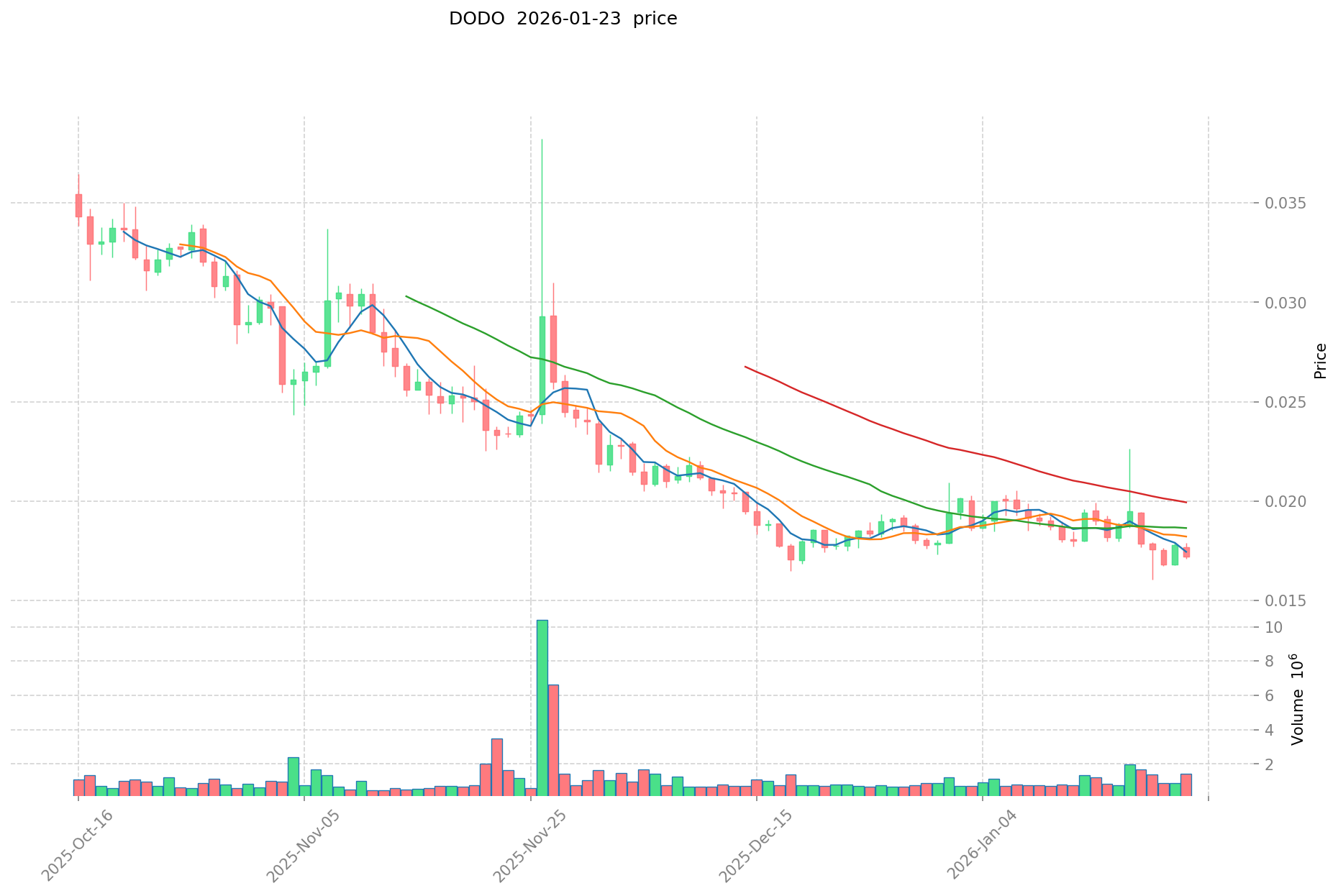
Price Volatility
DODO reached its historical high price of $8.38 on February 20, 2021, driven by favorable market conditions during the DeFi boom.
Its lowest price was $0.01663396, occurring on December 19, 2025, reflecting broader market corrections and reduced trading activity.
These fluctuations reflect market sentiment, adoption trends, and external factors.
Click to view current DODO market price
On-Chain Metrics
- Holder Count: 15,756 addresses (reflecting user participation)
- Market Capitalization: $17,210,000 (indicating current market valuation)
- 24-Hour Trading Volume: $13,940.80 (showing network activity level)
DODO Ecosystem Applications and Partners
Core Use Cases
DODO's ecosystem supports multiple applications:
- DeFi: As a decentralized trading platform, DODO provides on-chain liquidity infrastructure based on active market maker (PMM) algorithms, enabling efficient asset swaps and liquidity provision.
- Asset Issuance: DODO supports cost-free issuance of new assets, lowering barriers for projects to launch tokens and access liquidity.
Strategic Partnerships
DODO has established partnerships to enhance its technical capabilities and market presence. These collaborations provide a solid foundation for DODO's ecosystem expansion.
Controversies and Challenges
DODO faces the following challenges:
- Technical Issues: As a DeFi protocol, maintaining optimal liquidity efficiency and preventing potential vulnerabilities requires continuous development.
- Regulatory Risks: The evolving regulatory landscape for decentralized exchanges and DeFi platforms poses compliance uncertainties.
- Competitive Pressure: The rise of other DEX platforms and AMM protocols creates a highly competitive environment in the decentralized trading space.
These issues have sparked discussions within the community and market, while also driving DODO's continuous innovation.
DODO's community remains active, with the platform supporting decentralized trading through its fund pool model and pure on-chain execution. The project has attracted holders across multiple blockchain networks.
Sentiment on X displays a range of perspectives:
- Supporters praise DODO's innovative PMM algorithm and liquidity provision model, viewing it as an efficient solution for decentralized trading.
- Critics focus on market volatility and competitive pressures from established DEX platforms.
Trending Topics
X users frequently discuss DODO's liquidity mechanisms, asset issuance features, and position within the broader DeFi landscape, highlighting both its technological innovations and the challenges of achieving wider adoption.
- Official Website: Visit DODO Official Website for features, use cases, and latest updates.
- X Updates: On X platform, DODO maintains an active presence through @BreederDodo, sharing updates on technical developments, community activities, and platform enhancements.
DODO Future Roadmap
- Ongoing Development: Continuous optimization of the PMM algorithm to enhance trading efficiency and liquidity provision.
- Ecosystem Goals: Expanding support for diverse asset types and strengthening integration with multiple blockchain networks.
- Long-term Vision: Establishing DODO as a leading on-chain liquidity infrastructure for decentralized trading.
How to Participate in DODO?
- Purchase Options: Acquire DODO on Gate.com and other supported exchanges.
- Storage Solutions: Store DODO securely using compatible wallets that support ETH and BSC networks.
- Platform Usage: Utilize DODO's decentralized exchange features for trading and liquidity provision.
- Ecosystem Building: Explore development opportunities by visiting DODO's official resources and documentation.
Summary
DODO redefines decentralized trading through its innovative PMM algorithm, providing efficient on-chain liquidity and cost-free asset issuance. Its active community, multi-chain deployment, and market presence distinguish it within the DeFi sector. Despite facing regulatory uncertainties and competitive pressures, DODO's technological innovation and clear development direction position it as a noteworthy player in decentralized finance infrastructure. Whether you are new to DeFi or an experienced participant, DODO offers compelling features worth exploring.
FAQ
What is DODO and how does it work?
DODO is a decentralized exchange powered by the Proactive Market Maker(PMM)algorithm. It enables efficient trading with lower slippage by dynamically adjusting liquidity based on market prices. Users can trade tokens, provide liquidity, and earn fees on the DODO platform.
What are the differences between DODO and other DEXs like Uniswap and Curve?
DODO uses PMM (Proactive Market Maker) algorithm enabling capital efficiency and lower slippage. Unlike Uniswap's AMM and Curve's stableswap, DODO offers customizable liquidity pools, better pricing, and unique trading mechanics for various asset types.
How to trade and provide liquidity on DODO?
Connect your wallet to DODO, deposit tokens into liquidity pools to earn fees, or swap tokens directly. DODO offers efficient trading with low slippage through its PMM algorithm, allowing users to trade and provide liquidity seamlessly.
What is the use of DODO token?
DODO token serves as the governance token for the DODO protocol, enabling holders to participate in platform governance decisions. It's used for liquidity mining rewards, fee discounts, and accessing premium features within the DODO ecosystem.
Is trading on DODO safe? What risks should I pay attention to?
DODO uses smart contracts audited by leading security firms. Trading involves standard crypto risks like price volatility and smart contract vulnerabilities. Always verify contracts and manage position sizes carefully for optimal security.
What is DODO's PMM (Proactive Market Maker) mechanism and what advantages does it have compared to traditional AMM?
DODO's PMM uses intelligent pricing curves and real-time market data to optimize liquidity efficiency. Unlike traditional AMM, PMM reduces slippage, improves capital utilization, and provides better pricing through dynamic adjustment based on market conditions and order flow.
* The information is not intended to be and does not constitute financial advice or any other recommendation of any sort offered or endorsed by Gate.